The world's first self-balancing personal exoskeleton that does not require crutches has been approved by the FDA for marketing.
Recently, French robotics company Wandercraft announced that its personal self-balancing exoskeleton Eve™ has received FDA 510(k) clearance in the United States, and is suitable for eligible wheelchair users with spinal cord injury at any segment.
This is the world's first dynamically self-balancing medical exoskeleton approved by the FDA for personal home use, which does not require users to hold crutches or walkers to maintain physical balance during the walking phase.
In addition, Wandercraft plans to officially launch commercialization in the United States on September 17, 2026. The battlefield of exoskeletons is moving from next to the parallel bars in rehabilitation centers to the living rooms and kitchens of ordinary people.
Why Haven't Exoskeletons Truly Entered Homes for a Long Time
Exoskeleton robots are a type of wearable intelligent mechanical equipment that restores or enhances the human body's motor capacity through the coordination of motors, sensors and control systems. The concept of powered exoskeletons has been around for more than half a century, but for a long time, it has never really entered households.
Early exoskeletons were positioned as rehabilitation training devices. Products such as Ekso GT and HAL are mainly used in hospitals, where therapists guide patients to practice standing and walking, maintain muscle strength and improve physical functions. Their usage scenarios are limited to institutions, and they are not designed for personal daily use.
Later, products represented by ReWalk Personal and Ekso Indego Personal obtained FDA clearance for personal use. However, the technical framework has not changed fundamentally: patients still need to use forearm crutches or walkers to maintain dynamic physical balance. With both hands occupied by assistive devices, it is difficult to complete daily actions such as picking up objects, opening doors, and operating mobile phones. In addition, the wearing process is cumbersome and consumes a lot of upper limb strength, so many users gradually reduce their actual usage frequency after purchasing the equipment.
Crutches and walkers have become an insurmountable ceiling for traditional personal exoskeletons. Although such devices can help users stand and walk, they restrain their hands, making the act of "standing up" not thorough enough.
The reason why this problem is critical is that it directly determines whether personal exoskeletons can change from "training equipment" to "life tools".
The health damage caused by long-term wheelchair use is clear, and standing and weight-bearing walking are effective means to counter these problems. But if every standing and walking action relies on crutches and consumes a lot of upper limb strength, it is difficult for patients to integrate the equipment into their daily home life.
The core breakthrough of Eve is that it solves the balance problem.
Self-balancing Technology Breaks Scenario Boundaries
Eve adopts the dynamic self-balancing route.
The logic of traditional exoskeletons is that the exoskeleton provides lower limb support, and the balance is maintained by the user himself with crutches. The self-balancing exoskeleton is more like a biped robot: it maintains stability on its own, and the person only needs to tell it where to go.
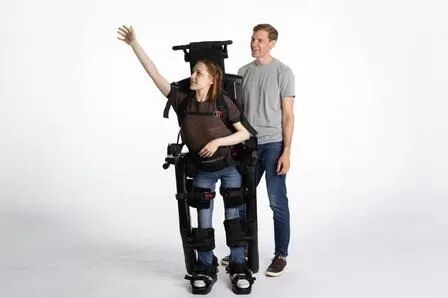
Wandercraft Eve Self-Balancing Personal Exoskeleton
Eve is built with 12 motor degrees of freedom to drive key joints such as hips, knees and ankles, and collects real-time data including trunk inclination, plantar pressure and joint torque. Based on these data, the control algorithm adjusts the joint movements at a frequency of hundreds of times per second, so that the human-machine system always maintains balance.
For users, they only need to slightly shift their body's center of gravity or send commands via the handle to trigger actions such as stepping, stopping and turning of the exoskeleton.
Under this design, the exoskeleton takes on the function of "driving", and the human brain only needs to be responsible for "navigation". The burden of balancing is removed from the user and transferred to the machine.
This technology is not a new concept in the laboratory.
The underlying technology of Eve is derived from Wandercraft's flagship rehabilitation exoskeleton Atalante series. This series has obtained FDA clearance in the United States, and is one of the earliest approved self-balancing rehabilitation exoskeletons in the world. It has been put into use in more than 150 rehabilitation and scientific research institutions around the world, and has accumulated large-scale clinical gait data.
Eve is an extension of the Atalante series for personal usage scenarios — it is lighter in weight, the battery adopts a modular design, and the wearing process is simplified. The goal is to allow users to complete most of the putting on and taking off operations while sitting in a wheelchair, without the need for a therapist to operate the equipment on site.
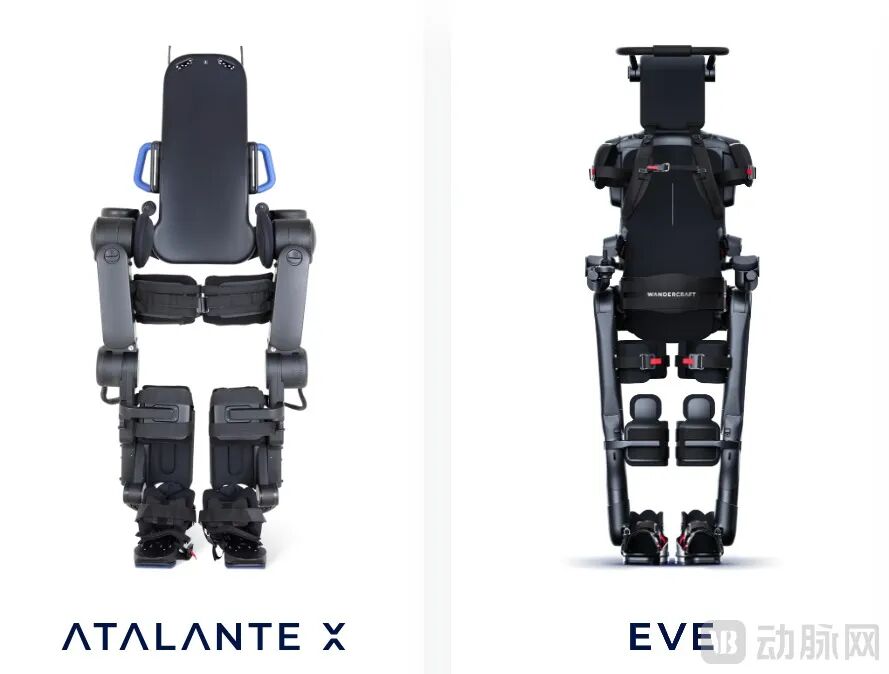
Schematic Diagram of AtalanteX and Eve Products
According to the clinical data released by Wandercraft, no device-related serious adverse events occurred during Eve's clinical trials in the United States. The stability of the self-balancing system and the emergency braking mechanism have met the home safety standards. Subjects who completed the training can independently complete daily actions such as walking indoors, passing through narrow passages, and picking up and placing items in the clinical trial environment.
Payment is the Threshold, but the Track Has Been Opened
Eve's approval is more than just the launch of a new product.
For enterprises that are developing self-balancing technology, this is a verified review path; for traditional manufacturers that are still following the crutch assistive device route, this is a clear reference for product direction. The track of exoskeletons moving from rehabilitation institutions to households has been officially proven feasible.
However, technical feasibility is only the first step. Whether the personal exoskeleton market can be opened ultimately depends on a more realistic question: who will pay for it.
The support on the demand side is clearly in place.
According to 2024 statistics from the World Health Organization (WHO), there are more than 15 million spinal cord injury patients worldwide. In the United States, according to 2025 data from the National Spinal Cord Injury Statistical Center (NSCISC), there are about 308,000 patients with traumatic spinal cord injury, with about 18,400 new cases each year. Most of these patients are of working age when injured, and have a strong willingness to return to normal life and society.
The existence of demand does not mean that the market can expand rapidly. The price of personal exoskeletons is generally between tens of thousands and more than 100,000 US dollars, which is a heavy burden for the vast majority of families. Even if Medicare, the U.S. federal health insurance program, has set up a special reimbursement code for personal exoskeletons, patients still need to pay part of the cost out of pocket.
The bigger obstacle lies in the commercial insurance sector: the coverage standards of U.S. commercial insurance for exoskeletons are highly fragmented, and no unified policy has been formed. The high out-of-pocket threshold directly inhibits the expansion speed of the end market.
From Wandercraft's perspective, to leverage a larger market, two realistic hurdles need to be overcome:
The first is to use real-world data to prove that Eve can reduce complications and lower long-term care costs, so as to promote its inclusion in the insurance reimbursement catalog. The second is to continuously optimize the cost side, and reduce the initial payment pressure on users through large-scale production, supply chain management, as well as models such as leasing and installment payment.
In addition, the home implementation of personal exoskeletons involves many more complex issues than technology: how to build a user training system, how to cover the after-sales support network, how to guide the adaptation of the home environment, how to carry out safety monitoring during long-term use... All of these need to be gradually polished in the commercialization process.
However, from Atalante to Eve, Wandercraft has completed a key leap on the self-balancing exoskeleton route: applying the self-balancing technology that was originally limited to use in rehabilitation institutions to the home scenarios of patients.
The next thing that will really test it is no longer the technology itself, but whether it can broaden this path with its commercial capabilities.
This article is from the WeChat official account "vcbeat" (ID: vcbeat), written by Chen Maoyu, published with authorization from 36Kr.