Surpassing AI, the healthcare sector has become the largest holding of hedge funds.
In the US stock market in August 2026, the healthcare sector witnessed a rare market rally where large-cap and small-cap stocks rose in tandem.
During intraday trading, Eli Lilly saw its market cap break through $1.2 trillion, hitting an all-time high among pharmaceutical companies. Amgen refreshed its record stock price, while Merck & Co. and Moderna surged sharply driven by positive clinical news for tumor vaccines. AbbVie and Johnson & Johnson both hit 52-week highs, staging an independent uptrend amid the overall market's pullback.
Meanwhile, the XBI Index, which tracks small-cap biotech stocks in the US market, kept climbing and approached its all-time high set in early 2021.
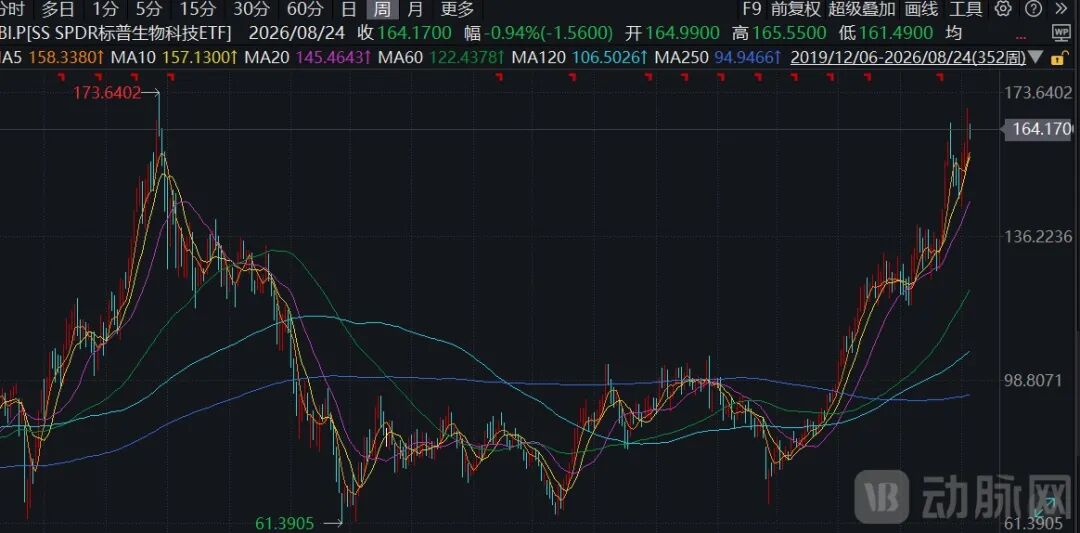
The S&P Biotechnology Index (XBI) is approaching its all-time high (Source: Wind)
Behind the booming market, the shift in institutional capital allocation is clearly reflected in position data. Goldman Sachs released its hedge fund position report Hedge Fund Trend Monitor: Down but not out on August 20, covering a total of 991 hedge funds with a total gross equity exposure of $5.4 trillion.
Based on this statistical data as of the early third quarter of 2026, a major shift in US institutional positions has emerged: at the end of June 2026, the healthcare sector accounted for 18.7% of the total net exposure of hedge funds, surpassing the information technology sector and becoming the largest position sector for hedge funds.
A pharma investor analyzed to VCbeat that the rising trading crowding level in the AI sector has prompted hedge funds to actively reduce their risk exposure in the information technology sector and seek undervalued assets across the market. The healthcare sector features both growth and defensive properties, making it a key direction for institutional position adjustment.
01 Healthcare sector surpasses information technology to become the largest hedge fund position
It is worth noting that just three months ago, at the beginning of the second quarter of 2026 (March 31), institutional choices were completely different.
The same series of reports released by Goldman Sachs on May 22 showed that hedge funds were still "all in AI" at that time. The information technology sector was the largest sector in their portfolios, accounting for 25.3% of total net exposure. The long weight of semiconductors hit an all-time high, and a large amount of institutional capital poured into the AI hardware industry chain.
Even then, however, healthcare was already the sector with the highest overweight level relative to the Russell 3000 Index, with an overweight of 504 basis points, and institutions had been quietly deploying in the healthcare track.
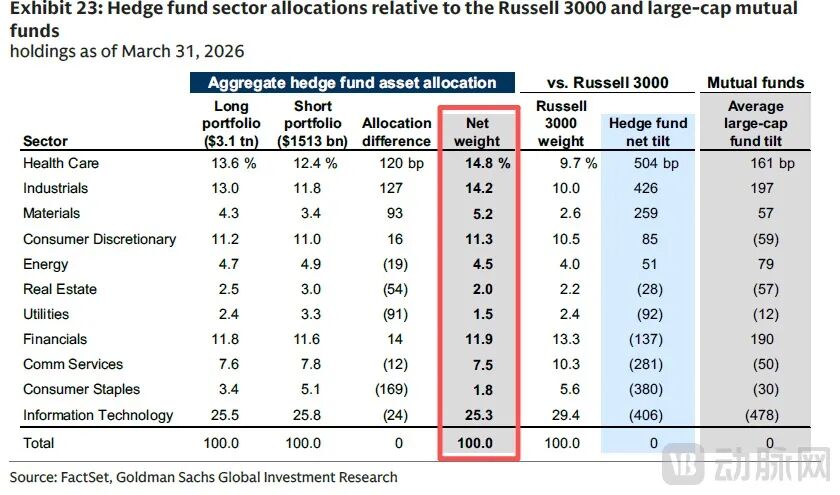
Institutions deployed in the healthcare sector at the end of Q1 2026 (Source: Goldman Sachs Hedge Fund Position Report: All In on AI)
By the end of June, institutional positions had undergone a substantial shift. As of June 30, 2026, the healthcare sector accounted for 18.7% of the total net exposure of hedge funds, exceeding the information technology sector and becoming the largest net exposure sector for hedge funds, with a net overweight of 962 basis points relative to the Russell 3000 Index, while the information technology sector was underweight by 1752 basis points.
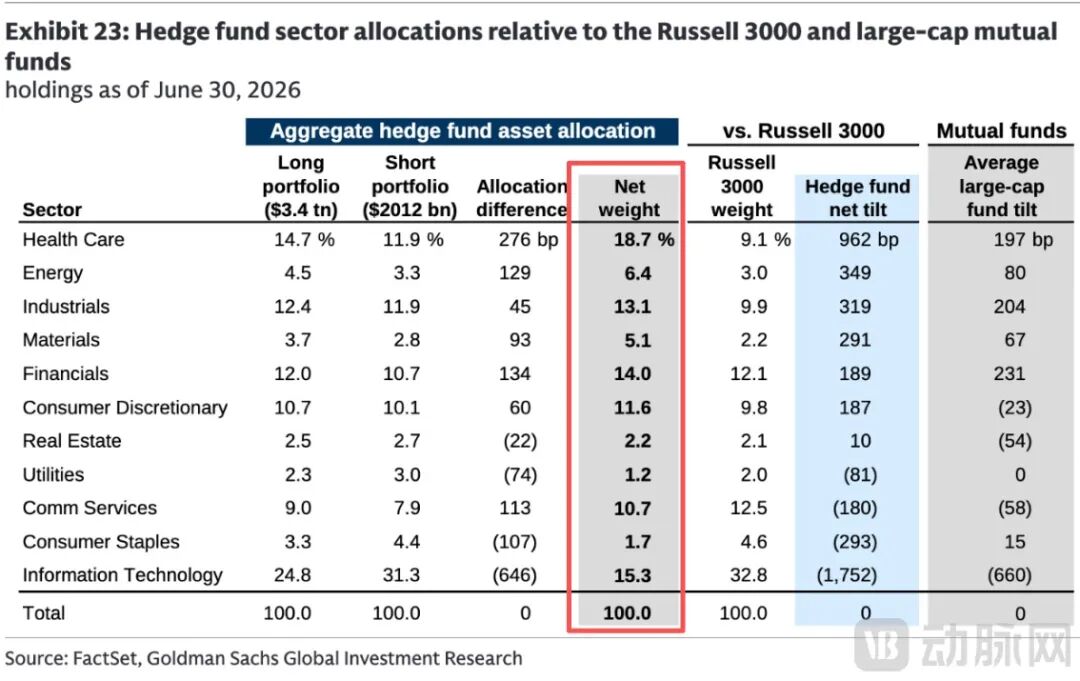
Healthcare sector became the largest net position at the end of Q2 2026 (Source: Goldman Sachs Hedge Fund Position Report: Down but not out)
It should be noted that there are differences in the fund samples counted in the two Goldman Sachs reports: the statistical sample at the end of the second quarter is 991 hedge funds, while the sample size of the report at the beginning of the first quarter is 1059. Although the samples do not completely overlap, the two sets of data can still effectively reflect the overall allocation trend of US institutional investors.
In addition, the allocation intensity of hedge funds to the healthcare sector has also risen from the historical central level at the beginning of the first quarter to close to the 10-year high of allocation.
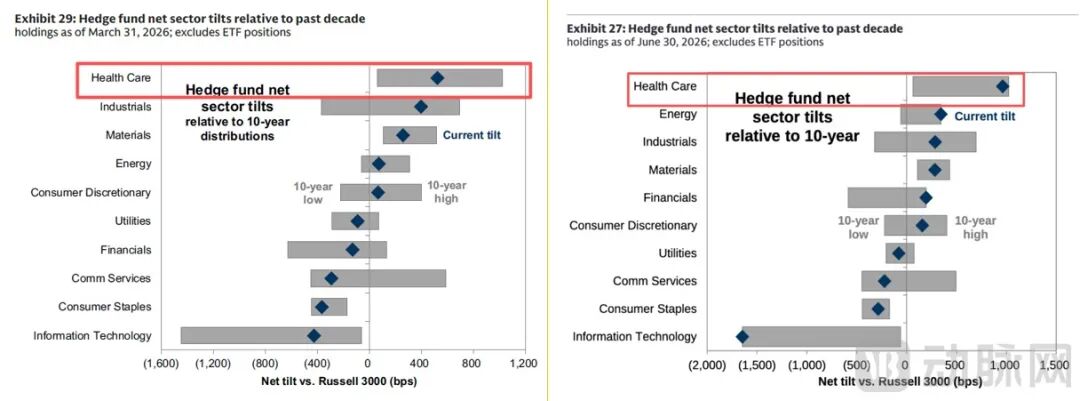
Hedge fund positions in the healthcare sector further rose to a 10-year high on June 30, 2026 (Source: Goldman Sachs Hedge Fund Position Report, sorted by VCbeat)
It should be pointed out that the report uses the Russell 3000 as the benchmark, which covers nearly 98% of the market value of local US stocks, including both large-cap leading companies and small and medium-cap targets, and highly matches the actual stock selection pool of US hedge funds, making the comparative calculation of sector allocation more convincing.
Entering the second quarter, the market is witnessing a significant track rotation: the trading crowding level of AI, which was wildly sought after before, has pulled back, a large number of hedge funds have transferred capital to healthcare, and the healthcare sector has ushered in a capital allocation boom rarely seen in the past decade.
This round of US pharma market rally presents a rare simultaneous rise of large-cap and small-cap stocks, the market value of leading pharmaceutical giants continues to break through the ceiling, and the small-cap biotech index XBI keeps surging.
02 Large enterprises deliver solid performance, giants hit new market value highs one after another
Large pharmaceutical companies are the cornerstone of this round of rally. The commercialization of heavyweight products brings tangible performance, supporting the continuous upward breakthrough of market value.
Eli Lilly became the first pharmaceutical company in the world with a market value exceeding $1.2 trillion. The performance cornerstone of Eli Lilly comes from the GLP-1 metabolic pipeline matrix. The two tirzepatide formulations, the hypoglycemic drug Mounjaro and the weight-loss drug Zepbound, continue to exceed expectations in sales, firmly occupying the main share of the global GLP-1 market. The new generation of oral small-molecule GLP-1 drug Foundayo was successfully approved for marketing, completing the product echelon of injection + oral, further expanding the market space for obesity and diabetes.
In addition to the metabolic track, the Alzheimer's disease treatment drug Kisunla (donanemab) has completed commercialization, and the neuroscience pipeline continues to iterate; multiple pipelines for oncology and autoimmune diseases are advancing simultaneously.
At the same time, Eli Lilly has abundant cash flow brought by weight-loss drugs, and continues to implement large-scale BD M&A strategies, supplementing cutting-edge pipelines such as cell therapy, circular RNA, and neurodegenerative diseases by acquiring Biotech companies, continuously broadening the medium and long-term growth ceiling. The resonance of multiple product and pipeline logics pushes the market value to a record high, and Eli Lilly has also entered the VIP popular long list of hedge funds.
As a long-established global biopharmaceutical company, Amgen relies on diversified pipelines for autoimmunity, rare diseases, and cardiovascular to achieve continuous sales growth, superimposed with precise M&A expansion strategies, its market value has refreshed the all-time high since its listing, staging an independent uptrend outperforming the broader market.
Amgen has gradually got rid of its dependence on a single heavyweight drug, and currently has a product matrix of more than a dozen products with annual sales of one billion US dollars: the cholesterol-lowering drug Repatha and the osteoporosis treatment drug Evenity maintain steady growth; in the fields of autoimmunity and rare diseases, new drugs such as UPLIZNA and TEZSPIRE have achieved rapid sales growth, covering multiple unmet clinical needs such as IgG4-related diseases and asthma. Multiple marketed drugs generated by the bispecific antibody platform in the oncology pipeline continue to contribute new increments.
Facing the competitive pressure of biosimilars for some old drugs, Amgen relies on the new drug echelon to continuously hedge the risk of patent expiration, and continuously strengthens its pipeline through license-in and acquisition. This performance stability attracts a large amount of institutional capital pursuing certainty for allocation.
AbbVie's stock price hit a 52-week high, only a step away from its own all-time high; Johnson & Johnson refreshed its all-time stock price record. The former has completed the transition after Humira's patent cliff, and relies on the two major autoimmune products Skyrizi and Rinvoq to generate continuous cash flow; the latter has steady performance and is favored by capital pursuing certainty.
The core logic of large enterprises' rally is performance certainty, and heavyweight drugs continue to contribute cash flow, providing institutions with choices that feature both high growth and defensive properties.
However, not all stocks in the sector are rising. As a first-tier large healthcare sector, institutions have focused on increasing their positions in innovative drugs, biotechnology, and life science tools, but the Managed Care sub-industry has not received incremental capital support. Only UnitedHealth UNH, which has a highly diversified business, remains on the VIP position list of hedge funds, buffered by its Optum healthcare service business.
In terms of specific targets, the "Falling stars" list in the Goldman Sachs report shows that healthcare targets such as Corcept Therapeutics, Globus Medical, Veeva Systems, and DaVita suffered large-scale position reduction by hedge funds in the second quarter, and the number of funds holding these individual stocks recorded a double-digit decline. These four stocks belong to the fields of innovative drugs, medical devices, life science SaaS, and healthcare services respectively.
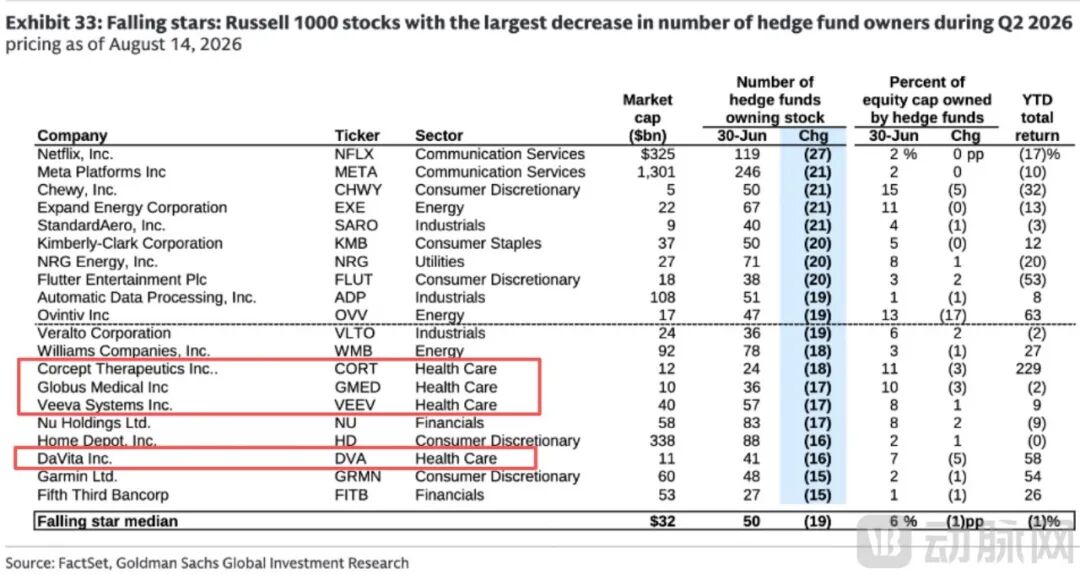
Four healthcare stocks suffered large-scale position reduction by hedge funds in the second quarter (Goldman Sachs Hedge Fund Position Report)
It can be seen that institutional optimism about the healthcare sector is highly structural, rather than indiscriminately buying all healthcare stocks.
03 Small-cap Biotech valuation recovery, M&A expectations ignite sector risk appetite
If the rally of large pharmaceutical companies is driven by performance, the rise of small-cap biotech represented by the XBI Index comes more from valuation recovery and industrial M&A logic.
There are two practical driving factors behind it:
First, large pharmaceutical companies have sufficient cash flow, and the pressure of pipeline iteration continues to exist. Acquiring start-up Biotech to supplement innovative pipelines has become the industry norm, and M&A premiums have raised the valuation center of the entire small-cap biotech sector. In industry observations, VCbeat has repeatedly mentioned that large pharmaceutical companies have limited internal early R&D output efficiency, and external acquisitions have become the most important source of innovative pipeline supply.
Second, as Biotech's valuation recovers and rises, the price expectations of both buyers and sellers for assets gradually converge, and the closing efficiency of M&A projects has been significantly improved. At the same time, PE capital and MNC, the two major buyers, are in fierce competition, and the continuous increase of PE institutions has further boosted the M&A market sentiment of the biotechnology industry.
At the same time, market risks cannot be ignored. The constituent stocks of the XBI Index are mainly small and medium-sized biotech enterprises, and their corporate value is highly tied to the progress of clinical trials. Once the core key clinical trials fail, the stock price will often plummet sharply. In addition, if large pharmaceutical companies reduce M&A investment, the most important logic that supports the valuation of small-cap Biotech will also be weakened accordingly.
04 Industrial drive + capital resonance fuel the boom of the healthcare sector
This round of rally in the US healthcare sector is the result of the combined effect of three factors: industrial fundamentals, valuation recovery, and track crowding level, rather than being driven by a single factor.
On the industrial side, the continuous commercialization of new heavyweight drugs and the strong M&A demand of multinational pharmaceutical companies form the underlying support for the rally; the valuation recovery logic is also an important driving force. After a long period of previous pullback, the valuations of many pharma targets have fallen to historical lows, and the valuation recovery space for small-cap Biotech has opened up. Combined with the rebalancing of institutional positions after the AI track became crowded, multiple forces have jointly boosted the popularity of the healthcare sector.
However, institutional overweight does not mean that the sector will continue to rise unilaterally. Whether healthcare can truly take over from AI and become the medium and long-term main line of the US stock market still needs further observation of the commercialization effect of new drugs and the sustainability of pharmaceutical M&A activities.
This article is from the WeChat official account "VCbeat" (ID: vcbeat), author: Wang Lutai, published with authorization from 36Kr.