Profits decreased by 3.2 billion yuan in half a year, where did the evaporated profits of the "involution king" go?
On June 9, in Pingshan, Shenzhen, the 2025 annual general meeting of BYD was held with the Enlightenment Hall fully packed. The meeting was attended by nearly 1,000 people, the largest number in history. When responding to shareholders' most concerned issues including share price, sales volume, production capacity and global expansion, Wang Chuanfu, Chairman and President of BYD Group, made a firm statement, "The worst moment has passed."
On the evening of August 28, BYD released its 2026 semi-annual financial report, whose performance was "a mixed bag". Data shows that in the first half of the year, BYD's revenue reached 344.815 billion yuan, down 7.13% year on year; the net profit attributable to shareholders was 123.25 billion yuan, down 20.54% year on year. In the same period, the company's net profit margin stood at 3.58%, hitting a new low in nearly four years.
However, the financial report also showed positive signs. By quarterly breakdown, BYD's performance improved significantly in the second quarter, with revenue of 1945.90 billion yuan in the quarter, down 3.15% year on year; the net profit attributable to shareholders reached 82.41 billion yuan, up 29.66% year on year, almost doubling from the previous quarter. Auto sales also resumed growth, with year-on-year increases of 0.26%, 5.46% and 21.76% in May, June and July respectively. Sales in August exceeded 440,000 units, up about 32.2% year on year.
Of particular note is that overseas markets are becoming a new growth fulcrum for BYD's automotive business. In the first half of the year, BYD's overseas business revenue reached 1812.68 billion yuan, up 33.92% year on year, accounting for 52.57% of the company's total revenue. In the same period of 2025, the overseas business only accounted for 36.46%. Nomura called this semi-annual report a milestone for the company in its flash comment: BYD is evolving from a leading electric vehicle player in the Chinese market to a truly global automaker.
Previously, Wang Chuanfu publicly stated that the overseas market features a more benign competitive environment with significantly higher gross profit margin than the domestic market, and the "high-level offensive" strategy has delivered remarkable results.

Wang Chuanfu, Chairman and President of BYD Group Source: The interviewee
However, the pressure in overseas markets cannot be ignored. For automakers, completing the transformation from "selling products overseas" to "taking root locally" is a universal challenge. For BYD, known as the "industry's top competitor", although the worst moment has passed, the best moment is far from coming.
Dual decline in revenue and net profit
Judging from financial data, BYD's performance pressure mainly comes from its automotive business.
In the first half of the year, BYD's total sales volume reached 1.809 million units, down 15.7% year on year. It explained in the financial report that the sales decline was mainly affected by multiple factors including the phasing out of purchase tax incentives and intensifying industry price wars. According to data from the China Association of Automobile Manufacturers, the overall production and sales of automobiles in China fell by 4% in the first half of the year.
Reflected in the financial report, in the first half of the year, BYD's revenue from automobiles, automotive-related products and other products reached 2753.41 billion yuan, down 8.98% year on year, with its revenue share dropping from 81.48% to 79.85%; revenue from electronics and other product businesses reached 694.05 billion yuan, up 0.96% year on year, with its revenue share rising to 20.13%.
In addition, exchange losses caused by exchange rate fluctuations also amplified BYD's profit decline. In the first half of the year, the exchange loss recorded in BYD's financial expenses reached as high as 47.03 billion yuan. In the same period of 2025, BYD recorded an exchange gain of 31.60 billion yuan, the impact of exchange gain and loss fluctuation reached 78.63 billion yuan.
It is worth noting that BYD's R&D investment rhythm has also changed this year. Different from other independent brands, in the past few years, BYD is used to expensing high R&D investment to reduce current profits. In 2025, BYD's R&D investment reached 634 billion yuan, with the R&D expensing rate at 91.4% and R&D capitalization rate at 8.6%. In the same period, the R&D capitalization rates of SAIC Motor, Great Wall Motors, BAIC BluePark and other automakers were 16.59%, 43.41% and 90.87% respectively. The choice to include the vast majority of R&D investment in current profit and loss in exchange for long-term competitiveness at the cost of short-term profit is also one of the reasons for its "revenue growth without profit growth".
However, in the first half of this year, BYD's R&D investment was about 288.61 billion yuan, down 6.54% year on year. Among them, the R&D expenses included in current profit and loss were 233.07 billion yuan, down about 63 billion yuan year on year, with a decline of 21.25%. In 2025, BYD's average quarterly R&D expenses were about 145 billion yuan. In contrast, the company's R&D intensity this year has decreased significantly.
BYD explained in the financial report that "facing the global clean energy transformation and intelligent wave, the company continues to increase investment in scientific and technological innovation and always adheres to high-intensity R&D investment", but it did not explain the specific reasons for the decline in R&D investment.
Although the overall performance was under pressure in the first half of the year, compared with its peers, BYD was not in a too difficult situation. Data shows that in the first half of the year, Great Wall Motors' net profit attributable to shareholders was 24.65 billion yuan, down 61.1% year on year, Changan Automobile's net profit attributable to shareholders was 8.17 billion yuan, plummeting 64.3% year on year, GAC Group suffered a loss of 44.7 billion yuan, and SAIC Motor's net profit attributable to shareholders was 51.52 billion yuan, down 14.4% year on year. The four companies made a total profit of 39.6 billion yuan, only one third of BYD's net profit.
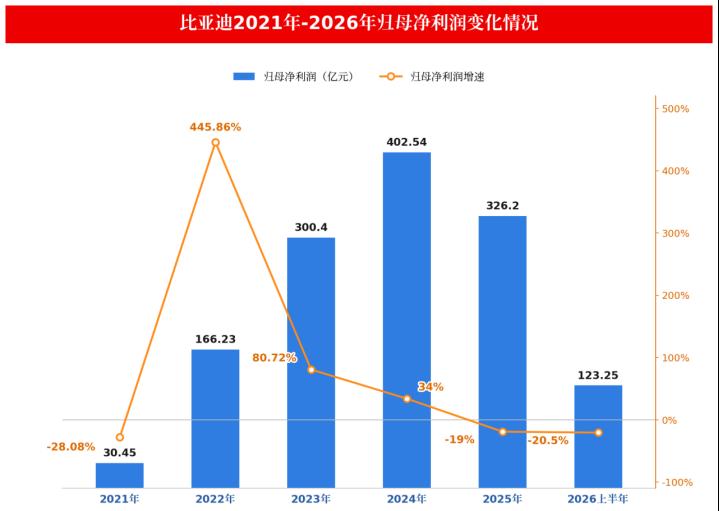
Chart by Ren Yafei
In addition, by quarterly breakdown, BYD's performance is continuously improving.
In the first quarter of this year, BYD's revenue fell 11.82% year on year, and its net profit attributable to shareholders fell 55.38% year on year. By the second quarter, the year-on-year decline in BYD's revenue narrowed to 3.15%, the net profit attributable to shareholders increased 29.66% year on year, and the non-net profit deducted increased 51.54% year on year. Before that, BYD's net profit attributable to shareholders had declined year on year for four consecutive quarters.
Driven by factors such as the advancement of high-end strategy and the increase in export sales, BYD's gross profit margin also improved in the first half of the year, rising 0.84 percentage points year on year to 18.85%, of which the gross profit margin of automotive and related product businesses was 22.33%, up from the same period last year. Data shows that the three high-end brands Denza, Fangchengbao and Yangwang recorded cumulative sales of about 228,000 units in the first half of the year, up 61% year on year, accounting for 12.8% of the group's total sales. A year ago, this proportion was only 6.6%.
In addition, BYD's asset-liability ratio has also begun to fall. The financial report shows that as of the end of June 2026, BYD's asset-liability ratio was about 70.96%, basically the same as that at the end of 2025. At the same time, the total amount of three interest-free liabilities of BYD including notes payable, accounts payable and other payables was about 3356.91 billion yuan, and its proportion in the company's total liabilities dropped from 52.57% at the end of 2025 to 50.26%.
Overseas market becomes new growth point
While the domestic business continues to face pressure, the overseas market has become BYD's new growth engine.
In 2025, BYD's overseas sales exceeded the 1 million unit mark for the first time, reaching 1.05 million units, up 145% year on year. In the same period, BYD's overseas revenue reached 3107.4 billion yuan, up 40.1% year on year, and its proportion in the company's total revenue increased from 28.6% in 2024 to 38.7%.
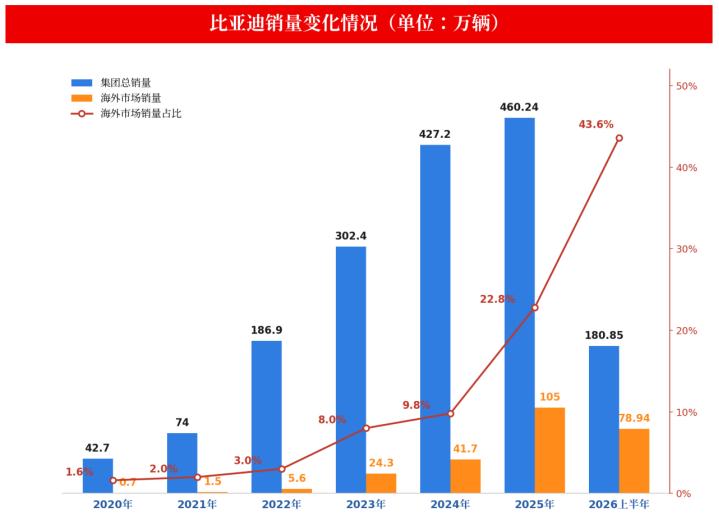
Chart by Ren Yafei
In the first half of this year, BYD exported 792,000 vehicles, up 67.8% year on year. Reflected in the financial report, BYD's domestic business recorded revenue of 1635.47 billion yuan, down 30.68% year on year; its revenue share was 47.43%, down about 16 percentage points year on year. While the overall revenue of overseas business increased 33.92% year on year to 1812.68 billion yuan, accounting for 52.57% of total revenue. In March this year, BYD even raised its annual overseas sales target from 1.3 million units to 1.5 million units. If the target is achieved, it means a 43% year-on-year increase for the whole year.
Goldman Sachs predicted in its research report that the overseas market will become BYD's growth engine in the next ten years, and overseas sales will reach 1.5 million to 3.5 million units from 2026 to 2035. Morgan Stanley is more aggressive, predicting that BYD's overseas sales in 2026 will reach 1.6 million to 1.8 million units, up 68% to 89% year on year.
In the past few years, BYD has successively announced plans to build factories in Hungary, Turkey, Uzbekistan, Brazil, Thailand, Cambodia, Malaysia and other countries. Up to now, BYD's complete vehicle factories in Thailand, Uzbekistan and Brazil have been completed and put into operation.
However, there are also hidden worries in the overseas market.
The first unavoidable risk is the exchange rate. In the first half of the year, overseas revenue accounted for more than half of BYD's total revenue, but the enterprise cannot fully hedge all foreign currency risks. The appreciation of RMB in the first half of 2026 caused an exchange loss of 47.03 billion yuan, which directly eroded profits.
This is not a challenge faced by BYD alone, but an unavoidable proposition for any global automaker. For example, in the first half of the year, Geely Auto recorded revenue of 1736 billion yuan, up 14.67% year on year, but its net profit attributable to shareholders fell slightly by 1.79% year on year to 90.91 billion yuan; Chery Automobile recorded revenue of 1433 billion yuan, up slightly by 1.19% year on year, and its net profit attributable to shareholders fell 11.73% year on year to 85.67 billion yuan. The profit decline of the two automakers is also closely related to factors such as overseas business expansion and exchange rate fluctuations.
In 2026, the ranking competition among Geely, BYD and Chery in overseas markets will become more intense. According to statistics from the China Passenger Car Association, Chery, BYD and Geely ranked top three in export sales in the first half of the year. Among them, Chery Automobile ranked first with 931,500 units, up 70.9% year on year; BYD's export sales reached 769,300 units, up 73.6% year on year; Geely Auto ranked third with sales of 472,500 units. This means that BYD not only has to resist the catch-up of Geely Auto in the domestic market, but also has to cope with the blocking of Chery Automobile in overseas markets.
According to public data, in the first half of 2026, Geely Auto's terminal retail sales in China's domestic narrow passenger vehicle market reached 1.021 million units, becoming the domestic sales champion of Chinese passenger vehicles in the first half of the year.
In addition, the frequent shifts in European industrial policies have also added uncertainty to BYD's overseas layout. In December 2025, the European Commission issued the Industrial Accelerator Act, attempting to add new barriers to protect local industries. The act requires that if electric vehicles produced by Chinese enterprises locally want to obtain the "Made in EU" certification, they must meet the localization ratio requirements: except for batteries, 70% of vehicle parts must be produced in the EU, and 3 key parts including battery cells must also come from European enterprises. In addition, the act also requires that local factory construction must be in the form of joint ventures, with Chinese parties only holding minority shares.
The UK is currently one of the largest single national markets for BYD in Europe in terms of sales. According to statistics from the Society of Motor Manufacturers and Traders (SMMT), BYD only sold 8,788 vehicles in the UK in 2024, and its sales climbed to 51,400 units in 2025. In the first half of 2026, its sales reached 37,800 units, up 94.92% year on year, and its market share increased from 1.86% in the same period last year to 3.32%.
However, the persistently high electricity price in the UK has restricted the popularization of electric vehicles to a certain extent. To break through this bottleneck, BYD is trying to deploy a "super fast charging" network in the UK.
In March this year, BYD officially launched the second-generation Blade Battery and super fast charging technology. It is understood that this combination can support the battery power to rise from 10% to 97% within 9 minutes of charging, and the energy replenishment efficiency is comparable to refueling of fuel vehicles. Wang Chuanfu described this energy storage system as "a reservoir when storing electricity, and a power amplifier when discharging". According to the plan, BYD will build 20,000 super fast charging stations across China by the end of 2026. For overseas markets, it plans to build 3,000 super fast charging stations in Europe by the end of March 2027, of which at least 300 will be located in the UK. As of August 28, BYD has put 10,000 super fast charging stations into operation, covering 332 cities.