Why do home furnishing enterprises need to "return to county-level markets"?
Against the backdrop of slowing growth, cutthroat competition and soaring traffic costs in first-tier markets, where is the second growth curve for the home furnishing and home improvement industry amid the highly uncertain operating environment?
Beyond the first-tier markets with subdued consumer expectations, county-level markets have demonstrated stronger consumption resilience, with their expenditure growth rate significantly outpacing that of first-tier cities. The price-to-income ratio for housing in third- and fourth-tier cities has dropped from 9.5 in 2020 to 7.4 in the first half of 2025. As the home purchase threshold falls systematically, home ownership has gradually become a "precondition" that unlocks home improvement consumption in county-level markets. For home furnishing enterprises, exploring the county-level market by "moving down the tiers" has shifted from an optional initiative to a mandatory strategic priority.
Market Foundation: Understanding the Unique "Local Context" of County-Level Home Furnishing Consumption
The scale of the county-level market forms the most solid foundation of the entire home furnishing and home improvement sector. There are more than 1,800 counties across China, with a total permanent resident population of around 450 million in urban districts and towns, accounting for nearly one third of the country's total urban population. Their aggregate economic output has grown from 30 trillion yuan in 2020 to 54 trillion yuan in 2024, making up nearly 40% of China's total GDP. Consumption growth in rural areas has consistently outperformed that of urban areas, and county-level regions are widely regarded as a key growth pole driving domestic demand. McKinsey also predicts that by 2030, the sinking markets will contribute over 66% of China's total incremental personal consumption. However, scale is only the base, and what can actually be translated into home furnishing business revenue are tangible demands including housing renewal, partial renovation, whole-house customization and soft furnishing upgrades, which require tiered implementation of strategies based on different county-level categories.
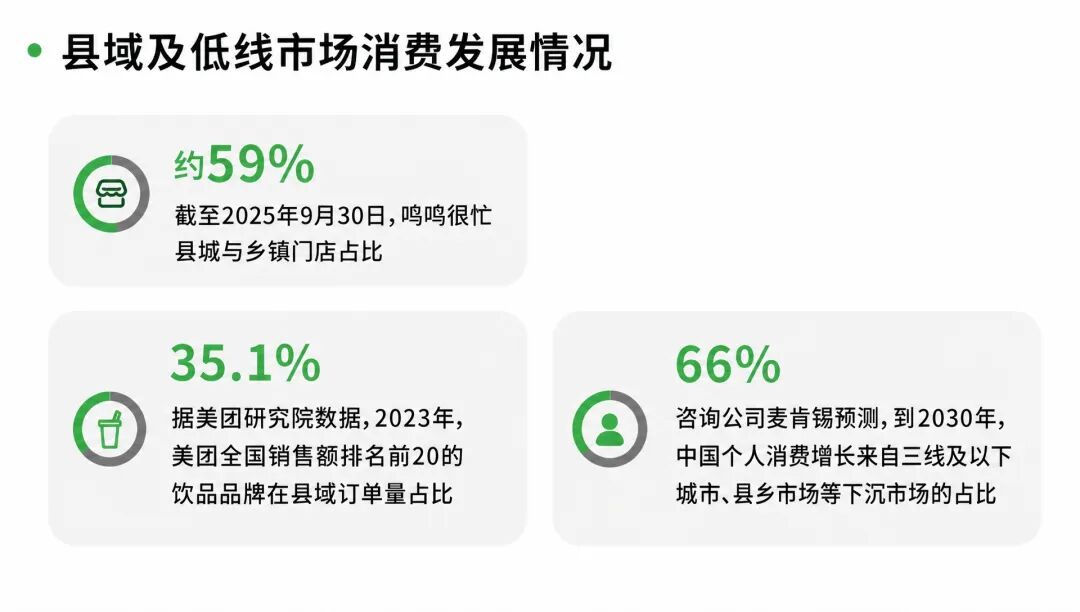
"2025 Black Ant Capital Consumer Trend Research Report"
The trends of county-level consumption are highly referential for the development of the home furnishing and home improvement industry. "New Home Furnishing Paradigm" summarizes the following key points from the report:
First, county-level consumption is shifting from prioritizing "external prestige" to focusing on "internal substance". The declining demand for the "middle-class identity" label means that home furnishing brands must stay grounded, win recognition from rational consumers with genuine product strength, experiential value and long-term services, and build a new and sustainable premium logic.
Second, the significance of the "shared companionship" demand has risen markedly. Especially for families with children, the value of home space as a carrier of family emotion has been highlighted to an unprecedented degree.
Third is the folded consumption trend, where demands for quality upgrading and extreme cost-effectiveness coexist. Consumers will pursue "9.9-yuan eyeshadow" and "15,000-yuan gold bracelet" at the same time, and this kind of consumption decision that "maintains appropriate external prestige while cutting unnecessary costs internally" has brought important enlightenment to home furnishing and home improvement consumption.
For example, categories of the "gold bracelet" type including sofas, mattresses, range hood and stove sets, smart TVs, whole-house custom cabinets, and categories of the "eyeshadow" type including storage furniture, basic lighting, small home appliances, soft furnishings and cleaning tools, are essentially divided by their social attributes, use frequency, replacement cost, brand sensitivity, and decision drivers (prestige, emotion, quality).
Fourth is the resilience and pressure of county-level life. Housing with high home ownership rate and low loan ratio, overall "tight balance" of income, and the community-based lifestyle characterized by "low rate of living alone and high rate of living with family" form the stable foundation of county-level home furnishing consumption, but this also means that new ideas and new models penetrate at a relatively slow pace.
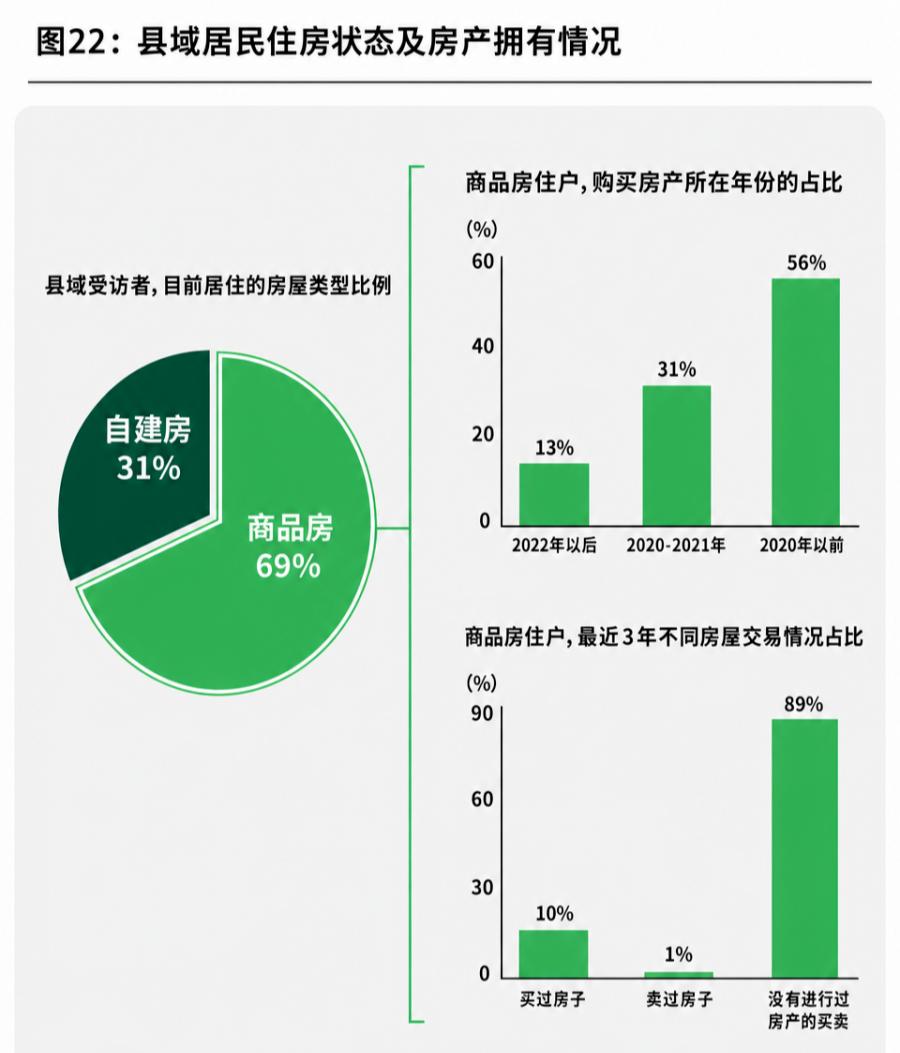
"2025 Black Ant Capital Consumer Trend Research Report"
Opportunity Insight: The County-Level Growth Map of the Home Furnishing Industry
Based on the consumption characteristics of the county-level market, "New Home Furnishing Paradigm" has drawn a county-level growth map. At present, there are four major opportunities for the home furnishing industry in the county-level market:
First, the expansion of experience-oriented consumption brings opportunities for home furnishing "experience spaces". The report points out that there is differentiation in optional consumption in the county-level market: function-oriented optional consumption is declining, while experience-oriented optional consumption is expanding. Consumers in county-level markets will cut down external consumption such as clothing, but are willing to pay for "self-pleasing experiences" such as beauty treatments, yoga, pet-related services and short-distance travel. This consumption shift of "reducing external spending while expanding internal experience investment" exactly provides the psychological foundation for home furnishing stores to upgrade from traditional sales malls to experience spaces.
Implemented in the home furnishing industry, home furnishing stores (especially full-house renovation stores, custom furnishing stores and high-end single-product stores) may try to upgrade into "experience spaces" that integrate design consultation, lifestyle display and light social functions, rather than being mere product selling venues, which may deliver stronger appeal to consumers.
Second, changes in channel preferences drive the coexistence of content-driven consumption and near-field cost-effective consumption. The changes in consumers' information access channels and purchase channels mean that home furnishing brands cannot just "wait for customers to come" at offline stores, but need to actively enter consumers' content scenarios and daily life circles. The report cites a statistic that the national online retail sales of rural areas reached 2.56 trillion yuan in 2024 (2020-2024 CAGR=9.2%), accounting for 17% of the total, and its growth rate in recent years is higher than the national average (2020-2024 CAGR=6.7%).
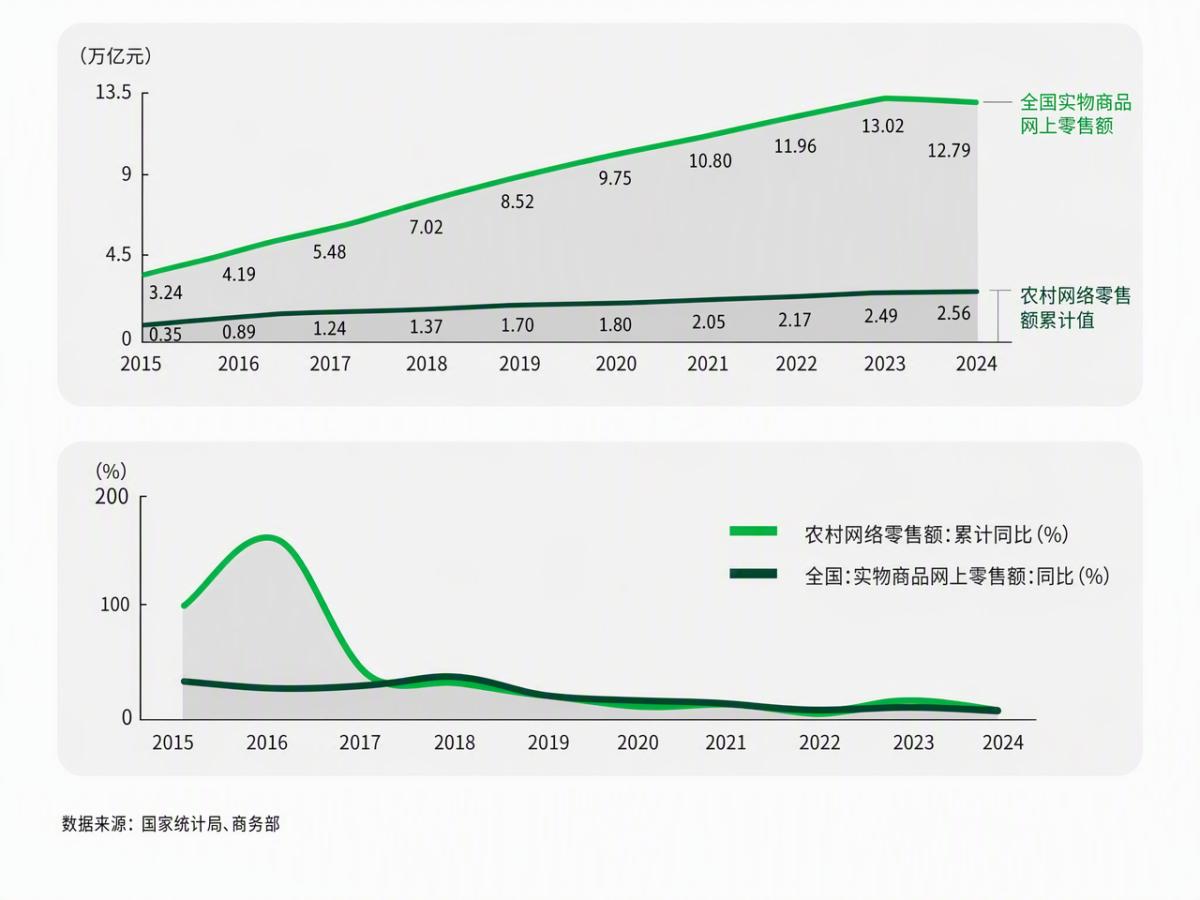
Comparison between China's national online retail sales of physical goods and rural online retail sales from 2015 to 2024
Meanwhile, the usage rate of social e-commerce platforms such as Douyin and Xiaohongshu among county-level consumers is on the rise. The report mentions that the share of surveyed residents who use content e-commerce channels has increased from 54.4% in 2022 to 62.4% in 2025, for product discovery and knowledge acquisition. This means that home furnishing enterprises can realize value transmission and "cognition co-construction" with the consumer side by strengthening scenario-based product display, popularization of home renovation knowledge and sharing of design solutions on content platforms (short videos, live streaming).
The report also notes that county consumers' preference for the offline consumption mode of "near-field, convenient and cost-effective" is rising, and modern channels represented by "snack collection stores" and "discount stores" have achieved counter-trend growth. In the process of laying offline channels in county-level markets, the retail model featuring high cost-effectiveness, high turnover and clear price labels may be easier to penetrate than large and all-inclusive malls.
Third, the product strategy under "upgrading without price increase" and "folded consumption". County-level consumers demand better quality but are unwilling to pay for inflated brand premiums. This pragmatic and progressive mindset forces home furnishing enterprises to re-examine the design logic of their product portfolios. The report points out that county consumers' recognition of "middle-class identity" is generally weakening, and they are more pursuing "upgrading without price increase". In consumption choices, the premium brought by "status symbol" is declining, as consumers pursue better quality but refuse to pay for excessive brand premiums.
For home furnishing enterprises, the product line design may require a "folded" product matrix: providing best-selling basic models with strong design sense and solid quality to meet the demand for "upgrading without price increase", while matching a small number of iconic products with high design value and high emotional value to meet the high-value demand of the "gold bracelet" type.
At the same time, the report mentions that the core of the success of snack collection stores and tea chain stores is the high cost-effectiveness brought by large-scale operation. This also inspires us whether home furnishing enterprises can achieve price breakthroughs on some standardized categories (such as sofas, mattresses, custom cabinets) through supply chain integration, so as to truly implement the "upgrading without price increase" concept in products.
Fourth, stay alert to "diseconomies of scale" and avoid mismatches of some home furnishing categories in county-level markets. Chain brands often take it for granted that "the larger the scale, the more economical" when expanding to sinking markets, but this golden rule will fail in some categories when encountering the special cost structure of county-level markets, namely self-built housing with low rent and labor force with zero opportunity cost. According to the survey results of the report, in categories that highly rely on non-standardized processes, manpower and localized services (such as fresh food and breakfast), chain operation is less efficient than family-run stores. The warning for the home furnishing industry is that when enterprises carry out standardized chain expansion in counties, businesses that feature high customization, heavy on-site services, and heavy reliance on local technicians for installation and after-sales (such as complex partial renovation and old house renovation) may face challenges of excessive cost and difficult management. It is a better choice to adopt the franchise model or cooperate with local service providers.
Forward-Looking Insights: Laying Out Seeds for Future Growth
Looking back at the layout and growth of home furnishing enterprises in county-level markets from the perspective of opportunities, "New Home Furnishing Paradigm" has identified five unmet market demands:
First, the light experience demand of "affordable and immediate enjoyment". Can home furnishing brands attract customer flow by providing light-weight experiences such as design pop-ups, mini show room check-in activities, and home furnishing DIY workshops?
Second, county-level women pay more attention to "self-settling" and seek their own "private space" from their family roles. Behind this demand lies the relatively limited income structure of county-level women: they have a strong willingness to fight for personal space in the family budget, but their disposable income is limited, so they need "small and certain" quality upgrading solutions more.
The report shows that 64% of county-level women have a personal annual income below 35,000 yuan (less than 3,000 yuan per month), while in the high-income range with annual income above 60,000 yuan, the proportion of men is more than twice that of women. This means that county-level women's home furnishing consumption decisions are more inclined to "strive for a small personal space within the family budget". Therefore, what expandable opportunities are there for women-oriented products such as cozy corners, reading nooks, beauty storage spaces and smart home products?
Third, new supply creates new demand. Dessert shops and cold drink shops have activated the market through space and product innovation. Can home furnishing enterprises stimulate the unmet improvement demand in county-level markets through innovative design solutions, rental packages, storage services and other measures? For example, the home entertainment demand.
The report shows that county residents' home entertainment time is shifting from "passively scrolling through short videos" to "quality life pursuit". The core inspiration for home furnishing enterprises is to break away from the traditional "new house full renovation" mindset, adapt to the "experience upgrading" trend in consumption stratification, shift the layout focus from single hardware sales to "partial renewal of existing houses" (such as old house renovation and partial renovation packages) and "multi-functional scene creation" (such as e-sports rooms and parent-child interaction areas), and use more flexible and composite space solutions to meet the new demand of county residents for "both cost-effectiveness and emotional value" for their living environment.
Fourth, adapt products to channels. Combined with the characteristics of "folded consumption", home furnishing enterprises can capture part of the county-level market by designing differentiated product portfolios, deploying content e-commerce, and optimizing the efficiency and experience of offline stores.
Fifth, innovate channel models. Pursue efficiency in categories that feature "economies of scale" (standardized products), and explore localized cooperation in segments that feature "diseconomies of scale" (services, installation).
In addition, home furnishing enterprises and dealers can adhere to long-termism, pay attention to "concept pioneers" such as young people who return to their hometowns, and lay out emerging demands in advance.
The county-level market is not a "low-end version" of the first-tier market, but a complex market with unique operation logic, rational and shrewd consumers, and a balance between emotional value and cost-effectiveness. The key to success lies in respecting its underlying logic, rather than simply replicating the operation methods of first-tier cities.
Home furnishing brands need to shift from the condescending mindset of "sinking down" to the equal mindset of "digging in" to understand local lifestyles.