How do real estate enterprises reshape their capital flow after the "August 28 New Policy"?
"The "8.28 New Policy" marks that China's real estate development has officially entered a new era of development model, which is mainly characterized by "strict regulation" paired with "moderate easing", and prioritizes long-term institutional construction while taking into account flexible transition in the current phase. The "8.28 New Policy" will exert a huge impact on real estate enterprises' investment, sales, financing, profit and capital flow. After the implementation of the new policy, the operation of real estate enterprises has entered a new stage of "high capital accumulation and slow cash flow return", the occupation of self-owned funds for a single project has increased significantly and the cycle has been greatly extended, the capital at the group level may face maturity mismatch and the flexible overall allocation is restricted, so the cash flow management logic at both the project level and the group level needs to be reshaped.
The "8.28 New Policy": Restructure Industry Rules and Build a New Development Model
On August 28, 2026, five departments including the Ministry of Housing and Urban-Rural Development, the People's Bank of China, the National Administration of Financial Regulation, the Ministry of Natural Resources, and the China Securities Regulatory Commission successively issued documents to systematically reconstruct basic systems such as real estate development, sales and financing, forming a three-in-one institutional framework of existing home sales system, project company system and host bank system, marking that China's real estate sector has officially entered the era of new development model.
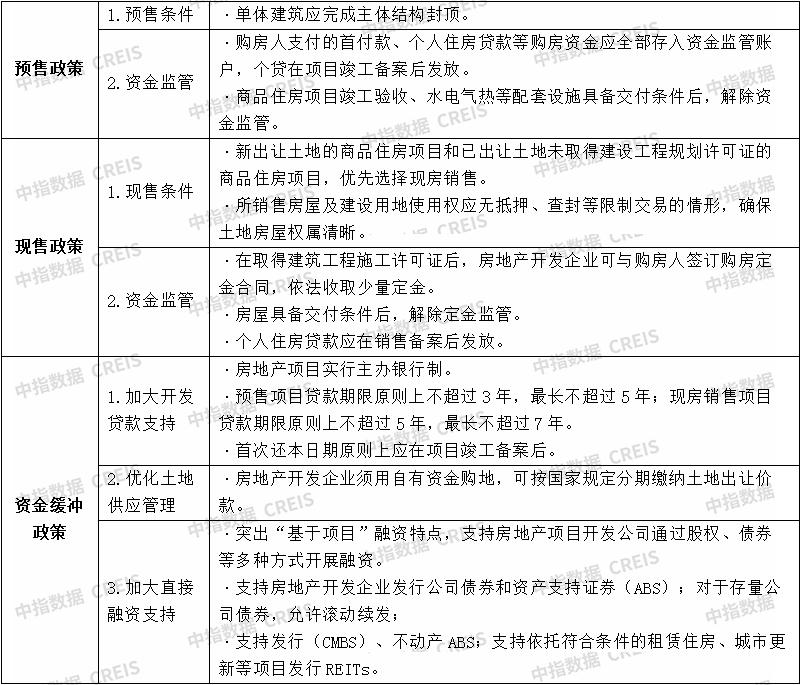
The impact of this "8.28 New Policy" on real estate enterprises mainly has the following characteristics: First, it is dominated by "strict regulation" with "easing" measures. In terms of "strict regulation", the sales process is more standardized, sales conditions and capital supervision are more stringent, the pre-sale threshold for commercial housing is uniformly raised to the capping of the main structure of a single building, the returned funds are transferred to a special account for exclusive use, and no withdrawal is allowed before delivery. New projects will give priority to existing home sales. In terms of "easing", the policy mainly supports the financing of real estate enterprises to ease the tension of their capital flow, such as extending the term of development loans, the first principal repayment date shall in principle be after the completion filing of the project, allowing the installment payment of land transfer fees, and supporting real estate enterprises to raise funds through bond issuance, ABS, REITs and other instruments. Second, it focuses on long-term institutional construction while taking into account the flexible transition in the current period. This round of intensive policies is mainly to reconstruct the basic systems of development, sales and financing, and build the institutional framework of the new development model with the existing home sales system, project company system and host bank system. In addition, it also takes into account the flexibility of the current transition period, such as promoting existing home sales in a vigorous and orderly manner, which means that existing home sales are not implemented with a one-size-fits-all approach, and "existing home sales" and "pre-sales" will coexist in the short term.
Table: Key Contents of the Impact of the "8.28 New Policy" on Real Estate Enterprises
Impacts on Real Estate Enterprises: Cash Flow Management Logic at Both Project Level and Group Level Needs to Be Reshaped
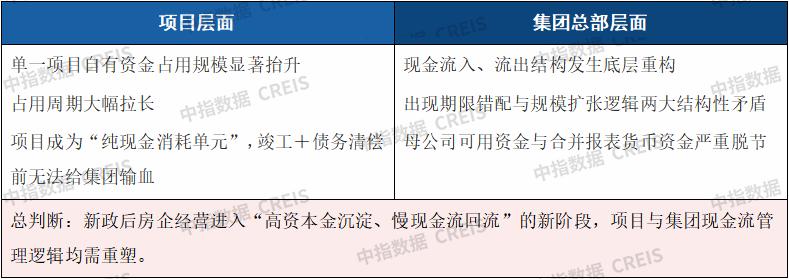
The "8.28 New Policy" will have a huge impact on the investment, sales, financing, profit and capital flow of real estate enterprises. Capital flow is the lifeline of enterprises, this paper will focus on analyzing the impact of the new policy on capital flow from the project level and the group level. The core of the new policy shifts from "group credit" to "project-based" financing supervision, the focus of financing shifts from the group's main credit to the project side, and the group credit subject is de-emphasized. Project funds are under closed-loop supervision, the returned funds are transferred to a special account for exclusive use, and no withdrawal is allowed before delivery. After the implementation of the new policy, the operation of real estate enterprises has entered a new stage of "high capital accumulation and slow cash flow return", the occupation of self-owned funds for a single project has increased significantly and the cycle has been greatly extended, the capital at the group level may face maturity mismatch and the flexible overall allocation is restricted, so the cash flow management logic at both the project level and the group level needs to be reshaped.
Figure: Impact of the New Policy on Capital Flow at Project Level and Group Level
1. Impact of the New Policy on Capital Flow at Project Level
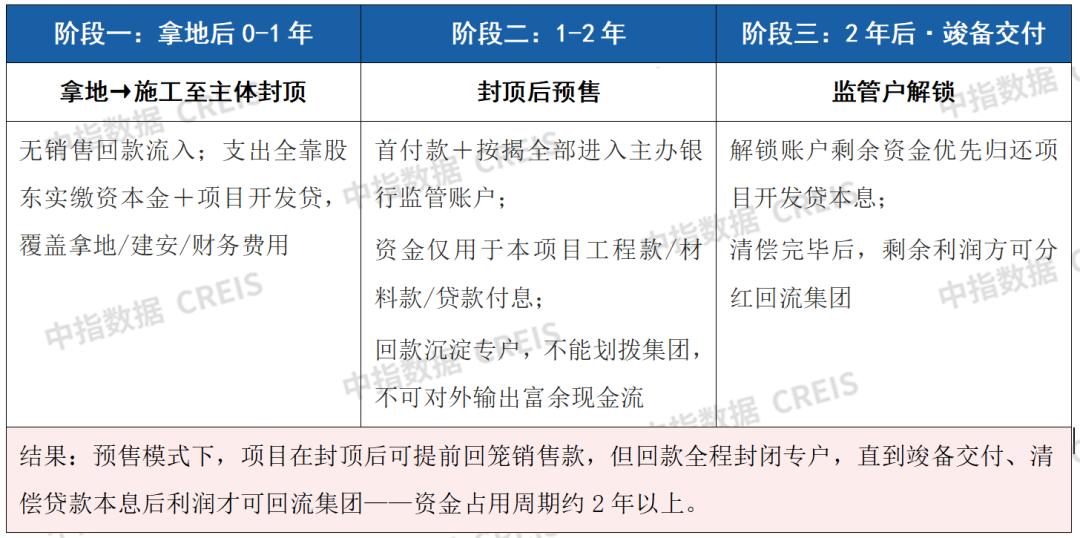
Under the pre-sale model, projects can recover sales proceeds 1-2 years in advance after the main structure is capped, but the whole process of fund return is closed in a special account, and the profit can only be returned to the group after the project is completed, delivered and the principal and interest of the loan are repaid — the capital occupation cycle is about 2 years or more.
Figure: Impact of the New Policy on Capital Flow of Pre-sale Projects
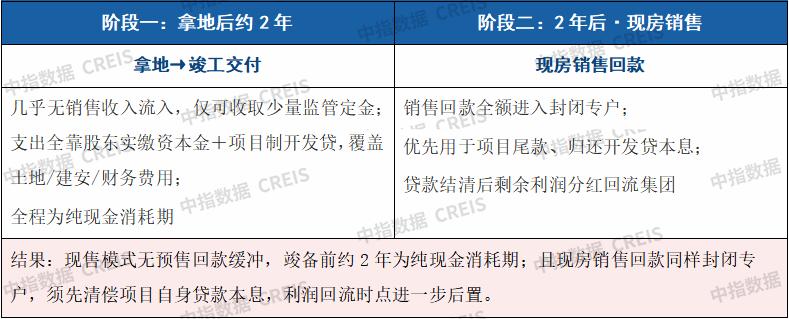
Under the existing home sales model, there is no buffer of pre-sale proceeds, and the nearly 2 years before project completion and filing is a pure cash consumption period; in addition, the returned proceeds from existing home sales are also closed in a special account, which must first repay the principal and interest of the project's own loans, and the time point for profit return is further delayed.
Figure: Impact of the New Policy on Capital Flow of Existing Home Sales Projects
2. Impact of the New Policy on Capital Flow at Group Level
Under the project-based financing of the "8.28 New Policy", the underlying structure of the cash flow of the group headquarters has been reconstructed, which is reflected in the synchronous changes in the two directions of cash inflow and cash outflow. The usable inflow of the group is compressed to the delayed node, the "gap period" of cash flow is extended, and the group needs to rely on existing capital to get through the empty window of project return. In addition, the overall flexible allocation of funds is restricted, and debt repayment and expansion are more dependent on the group's own existing cash and delayed dividends.
Figure: Impact of the New Policy on Cash Outflow at Group Level
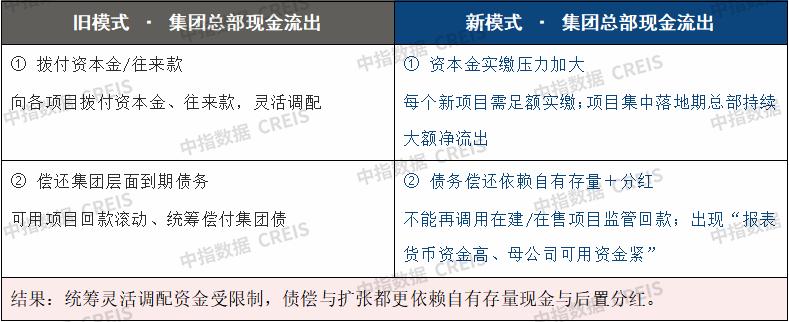
Under the influence of the new policy, the cash flow of the group headquarters will have the following changes: First, the contradiction of maturity mismatch: the interest-bearing liabilities of the group are usually rolled over upon maturity, but the dividend return of the project is lagging and distributed in batches. The old model relied on the rolling return of project funds to smooth debts, while the smoothing mechanism in the new model disappears, making the liquidity management of the headquarters more difficult. Second, the two sides of risk isolation: the risk isolation at the project level means that the unfinished construction of a single project will not directly drag down the group; but on the other hand, if the group falls into liquidity difficulties, it cannot call the funds of high-quality under-construction projects for self-rescue, and risks are isolated bidirectionally between the group and the projects. Third, the logic of scale expansion has changed: the old model used "a small amount of self-owned capital + rolling return funds + group credit line" to support multiple projects in parallel; the upper limit of the number of parallel projects in the new model is essentially determined by the scale of capital that the group can invest; the underlying capital logic of high turnover has been broken.
Conclusion: The "8.28 New Policy" has systematically reconstructed the basic systems of real estate development, sales and financing, further standardized sales and capital supervision, and provided greater support for the financing of real estate enterprises. It has a huge impact on the investment, sales, financing, profit and capital flow of real estate enterprises, and puts forward higher requirements for the operation capability of real estate enterprises. Real estate enterprises need to reshape the cash flow management logic at both the project level and the group level, so as to promote the focus of their operation to return to product quality and services. The implementation of the new policy marks that the real estate industry has officially entered the era of new development model, which will help protect the rights and interests of home buyers, reduce the leverage level of the industry, and promote the high-quality development of the real estate sector.
This article is from the WeChat Official Account "China Index Academy", author: China Index Academy, published with authorization from 36Kr.