At a critical moment, the top authorities issued a document calling for "salary increases". What kind of signal does this send?
An increasingly clear signal — during the 15th Five-Year Plan period, the country will raise salaries for all residents.
In July this year, the State Council approved the first national-level special plan for consumption, the 15th Five-Year Plan for Expanding Consumption. The document mentions content related to raising residents' income on multiple occasions:
"Improve the mechanisms for wage determination, reasonable growth, and payment security for workers, raise the minimum wage standard steadily".
"Increase the property income of urban and rural residents through multiple channels".
"Gradually raise the basic pension for urban and rural residents".
Many regions have taken actions in advance. Since the end of last year, the minimum wage standard has been generally raised across the country, with the increase rate exceeding 10% in multiple provinces. Among them, the minimum wage standard for the first tier (major cities) in Guangdong, Jiangsu and Zhejiang has reached more than 2500 yuan, and western provinces including Tibet, Xinjiang and Qinghai have also broken through 2000 yuan.
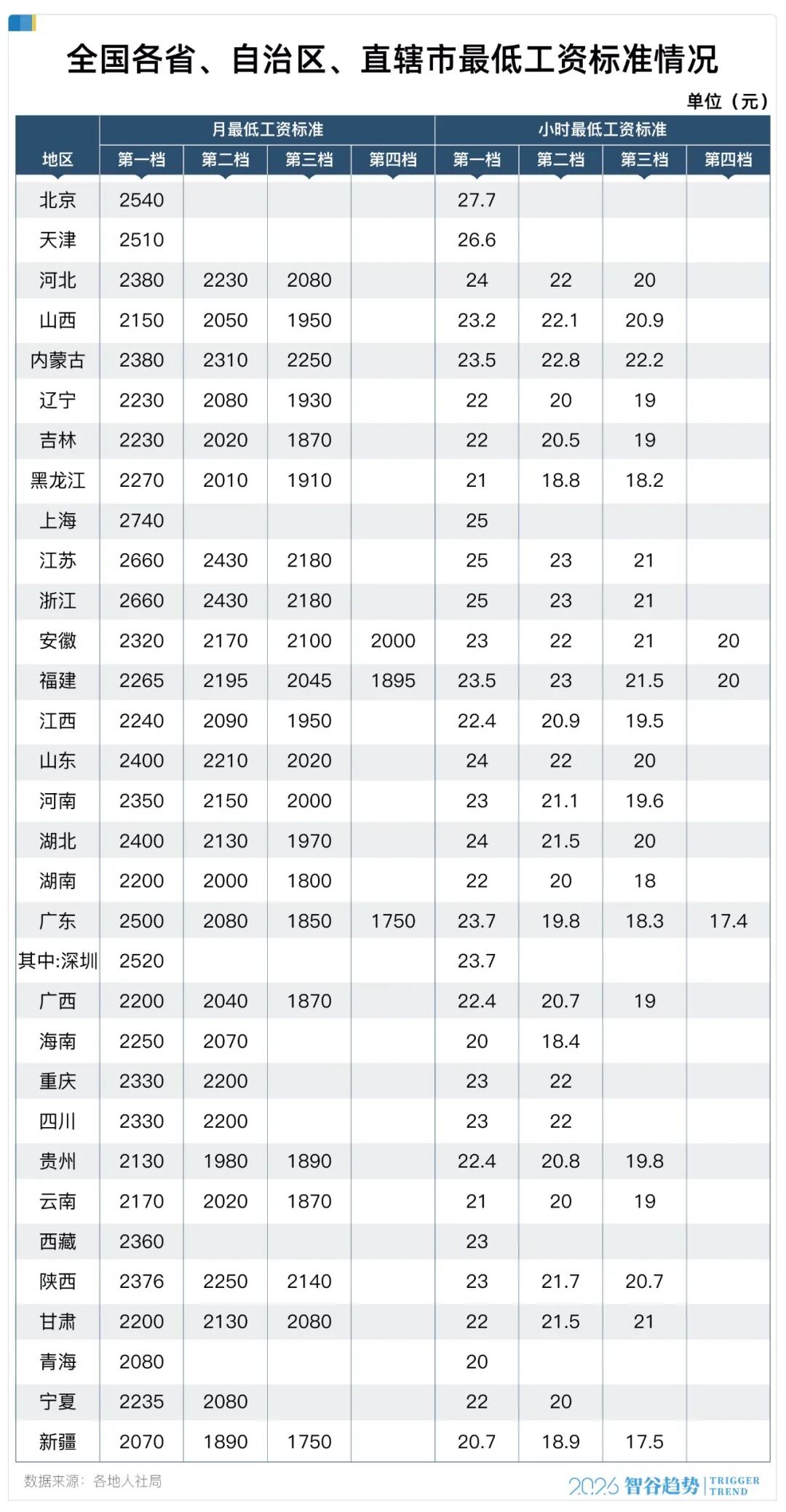
Large tech companies have also taken the lead in raising salaries. According to reports from multiple media outlets, JD announced that the total investment in 2025 year-end bonuses will increase by more than 70% year-on-year, with an average of 25 months' salary for procurement and sales positions; ByteDance announced that its 2025 bonus investment will increase by 35%; BYD and CATL have successively announced salary increases for frontline employees and R&D personnel.
Why has raising salaries become a top priority in the opening year of the 15th Five-Year Plan?
This is not only related to everyone's personal income, but also closely linked to the national development trajectory.
01
What is the main driving force for salary increases?
Judging from the content of the plan, the minimum wage standard is the clearest and most powerful measure.
In the past two years, the minimum wage in many regions has seen a notable sharp rise. Take Guangdong, a major economic province, as an example:
Since the end of 2021, Guangzhou has been implementing a minimum wage standard of 2300 yuan, and Shenzhen 2360 yuan. The adjustment did not come until March 2025 — the standard in Guangzhou rose to 2500 yuan, and that in Shenzhen to 2520 yuan.
In accordance with the Minimum Wage Regulations, the minimum wage shall be adjusted "at least once every two years". This round of adjustment in Guangdong is equivalent to making up for the "arrears" accumulated over more than the past three years in one go.
Many people think this has nothing to do with them, who still lives on the minimum wage these days?
But the actual beneficiaries are far more than those who earn the minimum wage. It should be noted that the amount of unemployment benefits, the deduction for sick leave, and the calculation of overtime pay are all referenced to the minimum wage. The social security payment base and economic compensation standards are also linked to it.
This is equivalent to raising a floor, so all steps above it need to be adjusted accordingly. The minimum wage is the "pricing anchor" of the whole social salary system.
To a large extent, this is equivalent to "raising salaries" for all people.
Another noteworthy point comes from this sentence in the plan: "Promote higher income for those who work more, those with higher skills, and those who make innovations."
This means that the premium for skills and innovation is gaining increasing attention. In April this year, UBTECH recruited the global chief scientist of embodied intelligence, with an annual salary starting from 15 million yuan and the maximum reaching 124 million yuan.
The salaries of skilled talents who do not need degrees from top universities are also rising. In the recent recruitment released by the Shenzhen-Shanwei BYD factory, salaries for some positions such as senior technicians and mold designers can reach 15000 to 20000 yuan, higher than the average monthly salary of many undergraduates from 985 universities.
The era when "a diploma equals high salary" has ended, and the salary increase dividend will first go to those who can solve practical problems and define the future.
02
However, raising salaries is still quite difficult in reality.
One reason is that a large number of small and medium-sized private enterprises have been under great pressure in the past two years.
In 2025, the average annual salary of urban non-private sector employees nationwide was 129,441 yuan, representing a real increase of 4.2%; the average salary of private sector employees was 71,590 yuan, with a real increase of 2.9%.
According to statistics from Time Weekly, among the 19 provinces that announced last year's average salary, the average salary of private sector employees in Yunnan increased by only 0.1% year-on-year, 0.2% in Hunan, 1.2% in Hainan, and 1.1% in Sichuan.
Considering the inflation factor, this means that the income of employees in many private enterprises barely increased last year, or even shrank relatively. Talking about "salary increase" now seems a little unrealistic.
Another unavoidable problem is the increasingly obvious "K-shaped divergence" phenomenon in the economy.
In the first half of the year, China's exports increased by 13.4%, rising for 11 consecutive quarters. The data of all industries related to hard technology are extremely strong: integrated circuit exports surged by 96.1%, new energy vehicles by 120%, and the added value of high-tech manufacturing increased by 13.3%.
In contrast, the performance of many traditional industries is relatively sluggish: the sales area of commercial housing decreased by 11.6%, retail sales of household appliances decreased by 7.4%, and retail sales of automobiles decreased by 12.6%.
Li Daokui from Tsinghua University recently pointed out that pinning hopes on the upper branch of the K-shape to drive the entire Chinese economy actually misleads the direction of solving problems. It is necessary to maintain a sense of urgency and "not only focus on the small part that is on the rise".
One of the important reasons is that a considerable part of China's employed population has income deeply tied to traditional industries, and the wave of the technological revolution has not yet reached them.
This is not a phenomenon unique to China. In India, AI is replacing ordinary white-collar jobs in batches. With about 1.5 million new engineering graduates every year, the unemployment rate of university graduates aged 15 to 25 has soared to 40%.
The more advanced technology becomes, the more anxious ordinary people get.
In the AI era, how to achieve a general rise in everyone's income may be a problem faced by the whole world.
03
Raising salaries is never a question of "whether to do it", but "how to do it".
The 15th Five-Year Plan has clear goals: by 2030, the total retail sales of consumer goods will reach about 60 trillion yuan, and the household consumption rate will increase significantly. The State Council also specially mentioned a sentence in its approval —
"Enhance the internal driving force and reliability of the domestic economic cycle"
What does "internal driving force" mean? It means driving growth relying on the domestic market. In the current context where the external environment is full of uncertainties, consumption is not only an important part of the "three troikas" driving economic growth, but also a key national priority to maintain economic certainty.
For consumption to thrive, it ultimately depends on two things: whether people have money, and whether they dare to spend it.
Salary is the only source of cash income for the vast majority of families. However, raising salaries alone is not enough. It is also necessary to improve people's income expectations. Measures to expand employment, raise pension standards, and improve supporting services such as childcare and medical care are all indispensable.
In the AI era, having property income that does not depend on "selling working time" is also quite critical. Some explorations in foreign countries are worth referring to:
South Korea previously proposed to share the profits of technology companies such as Samsung and SK Hynix with all citizens; the United States sets up an initial fund for each newborn for investment in stocks and other assets. The underlying logic is consistent — all citizens participate and share the dividends of technological development.
A better life of course mainly depends on personal struggle, but it is also inseparable from the development of the times.
Letting everyone enjoy the dividends of the era equally is the core meaning of "investing in people".
This article is from the WeChat official account "TrendInsight by Zhigu Trend", author: Zi Qi, published with authorization from 36Kr.