Revisiting the "sample economy" of the beauty industry five years later, this business has changed.
About five years ago, when "luxury brand samples" first appeared on China's beauty retail market on a large scale, the focus of industry discussions was still: why did people start paying for something that was originally given away for free?
At that time, the sample economy showed obvious characteristics of unregulated rapid growth. Counter gifts re-entered the market through daigou (overseas purchasing agents), individual C-stores, and beauty collection stores. Consumers could experience a thousand-yuan face cream for only dozens of yuan, while channels attracted young people with the concept of "luxury brands at a low threshold". For the first time, samples broke away from full-size products and became independently tradable goods.
Five years on, this business has taken on a whole new look.
In February this year, Li Jiaqi's live stream launched the "March 8 Sample Festival"; in May, the "618 Sample Festival" once again became the first round of preheating for the major promotion, with 157 brands bringing nearly 300 sample links to the special session. Even earlier, Tmall launched "Tmall U First", fully moving the "sample distribution - customer acquisition" logic online. During the full 2026 618 promotion cycle, more than 23 million trial packs were distributed through the warehouse entry model alone, involving over 10,000 merchants.
In physical channels, "beauty sample zones" are becoming increasingly common. Sephora, Watsons, KKV, HARMAY, and Yanyli have all set up sample zones categorized by product type and price; instant retail has created a previously untypical demand scenario — when you forget to bring skincare products on a business trip or need a quick makeup touch-up, a bottle of product of more than ten milliliters can be delivered to your hotel in half an hour.
At the same time, according to the keywords "sample / U First / trial pack" across the entire online market, the total size of the beauty sample market is about 2 billion yuan, but the total amount has declined year-on-year.
This seems contradictory, but in fact it reflects that the sample economy is undergoing structural changes: it has evolved from a simple "sample retail business" into multiple roles including brand customer acquisition, channel traffic attraction, new product testing, travel emergency use and daily consumption.
Looking back five years later, the truly noteworthy issue of the sample economy is that it is changing the way brands sell new products, channels acquire new users, and consumers buy beauty products.
Three major changes have taken place in the "sample economy" over the past 5 years
The most obvious change in beauty samples is that they have shifted from being accessories of full-size products to independent business operations.
Li Jiaqi's live stream has continuously held "Sample Festivals", which shows that the free gift that counter staff used to casually put into shopping bags now has an independent product portfolio, independent activity nodes, and an independent consumer group.
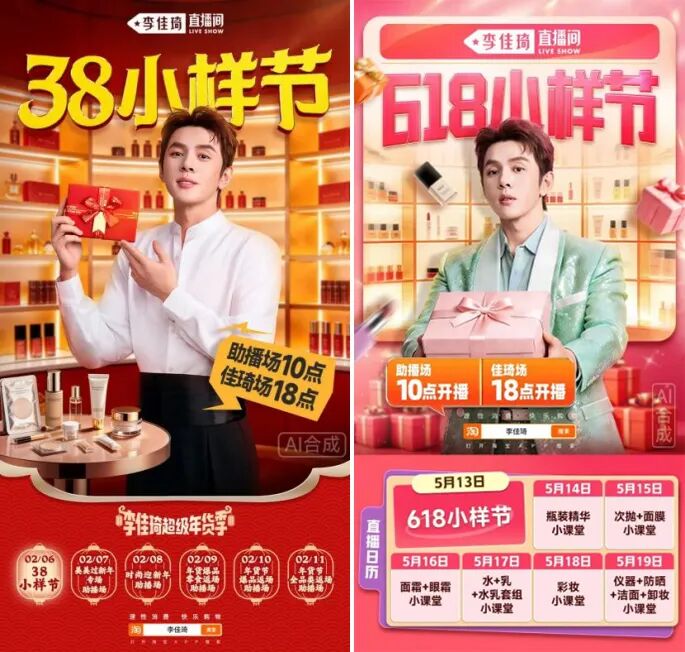
The "Sample Festival" on Li Jiaqi's live stream, source: Li Jiaqi WeChat official account
Offline channels have also developed different gameplay. Sephora launched a 199-yuan perfume sample set that combines multiple perfumes for sale, with additional benefits for full-size product repurchases; Watsons and Yanyli attract consumers to enter stores through multi-item discounts and free collection activities; KKV places medium and small samples in the "fresh experience portable goodies" zone; HARMAY continues the category logic of "centralized display of luxury brand medium and small samples".
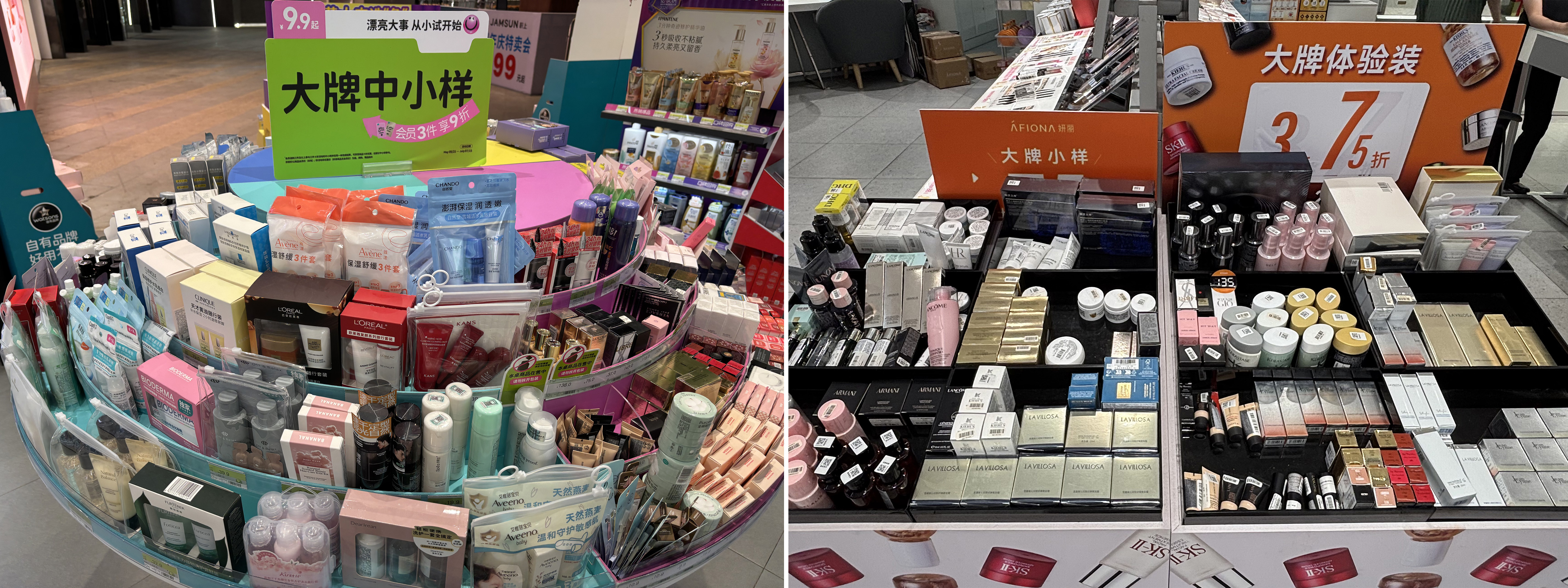
Sample zones in Watsons and Yanyli
Instant retail has pushed samples to new consumption scenarios. Data from the Chinese Academy of International Trade and Economic Cooperation under the Ministry of Commerce shows that the scale of the instant retail market reached 781 billion yuan in 2024, and is expected to exceed 1 trillion yuan in 2026. For demands such as temporary washing and care, travel emergency use, and makeup touch-ups on business trips, samples provide the value of instant replenishment and easy access.
Today, it is difficult to understand sample channels with a single logic. Live streams undertake promotion and new user acquisition, collection stores provide fresh experience and low-threshold consumption, instant retail solves portability and emergency needs, and Tmall U First is increasingly approaching a complete brand customer acquisition system.
Samples have gradually evolved from a type of commodity into an "operation tool" that can be deployed by different channels.
The second change has taken place on the brand side.
In the past, when new products were launched, brands usually first launched full-size products, and then used gifts to let consumers experience them. Now more and more brands have moved this process forward: they launch samples first, accumulate the first batch of users through low-cost trials, traffic investment and content marketing, and then fully promote full-size products.
OLAY launched the sample of its dark spot correcting black tube essence two weeks before the official launch of the full-size product; on the day Clinique released its new PDRN restructuring product, it simultaneously launched a 2-piece trial pack. Brands including La Mer, Helena Rubinstein, Lancôme, and Jo Malone London have also long operated medium and small sample zones in their official flagship stores.
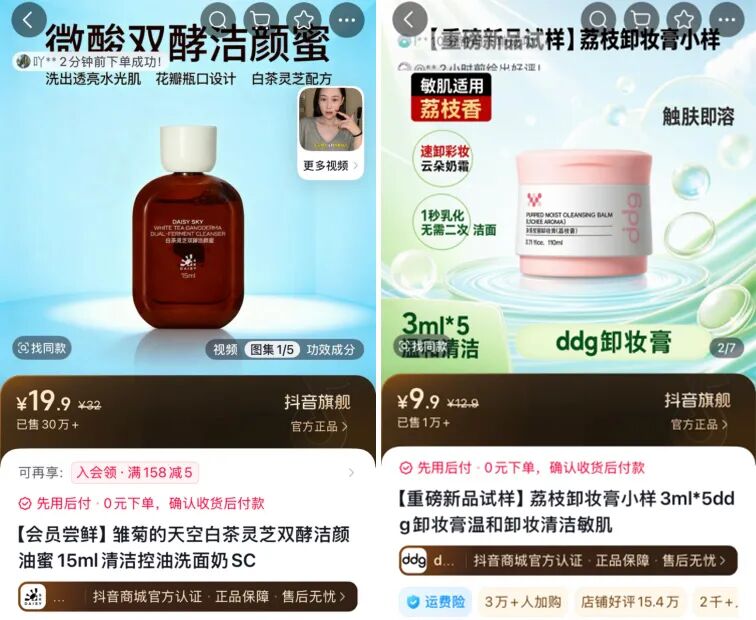
Sample facial cleanser from DAISY SKY (left) and new product trial cleansing balm from ddg (right), screenshot from Douyin Mall
Emerging brands are more dependent on this method. Brands such as ddg and DAISY SKY will test the market in advance through trial pack traffic investment, influencer videos and consumer feedback before the official full launch of new products. FBeauty Future Traces found that the trial pack of DAISY SKY's facial cleansing balm sold more than 300,000 units on Douyin, which not only brought hundreds of thousands of low-unit-price orders, but also accumulated product education content, marketing materials and potential consumer groups.
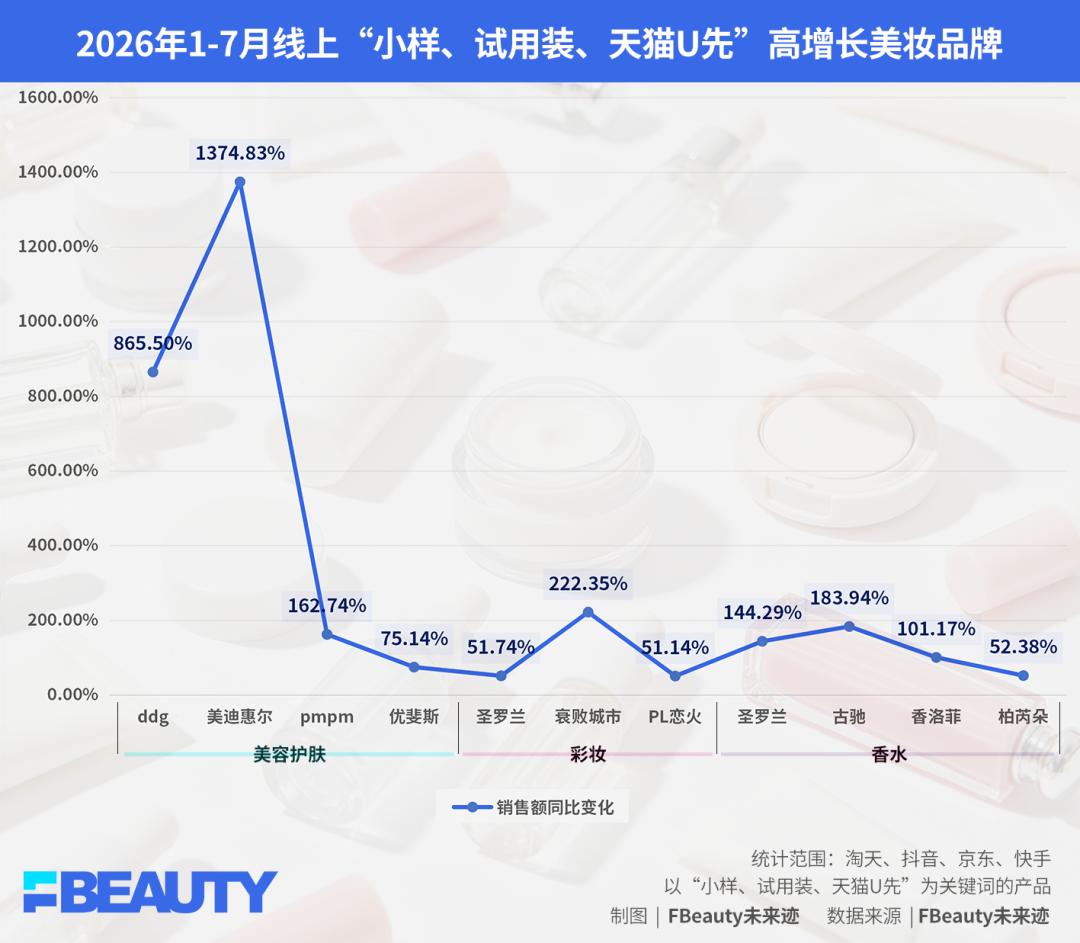
Perfume brands are also very suitable for this model. YSL, Gucci, Dior and other brands have greatly lowered the threshold for consumers to smell their perfumes for the first time through vial perfumes, mini perfumes and experience sets.
It is clear that samples are becoming a pre-launch testing tool in the new product launch chain.
The third change is somewhat counterintuitive. Data from FBeauty Future Traces shows that the size of the nationwide "sample / Tmall U First / trial pack" market is about 2 billion yuan, with a year-on-year decline in total volume, but the frequency of consumers' exposure to samples has not decreased simultaneously.
One of the reasons is that the "luxury brand sample" business that used to rely on Taobao C-stores, daigou and unauthorized supply sources is gradually declining, and the official brand sample distribution system and platform governance are taking over part of the demand.
Another change is that "buy full-size products during major promotions and get equal or even more samples as gifts" has become a common gameplay at promotion nodes. Brands use gifts to improve consumers' perceived discount without directly reducing the price of full-size products. These samples will later circulate for the second time on Xianyu, WeChat private domains and group-buying communities, so part of the demand bypasses traditional sample retail channels.
Therefore, the decline in the 2-billion-yuan market size is more appropriately interpreted as the migration of channels and statistical calibers. Samples have not disappeared, and they are increasingly embedded in full-size product promotions, brand customer acquisition and secondary circulation systems.
Five years ago, the core keyword of samples was "commoditization"; today, the core keyword of samples has become "tooling". They can be sold as well as given away; they undertake both sales and new user acquisition; they are not only the entry point for full-size products, but also have become an independent consumption category.
Are consumers starting to only buy samples instead of full-size products?
Channels and brands are increasingly favoring samples, but a noteworthy change has emerged on the consumer side.
A survey of 1000 Gen Z consumers born after 2000 conducted by FBeauty Future Traces shows that 88.58% of respondents have purchased or used beauty samples. 69.36% use samples because they "want to try new products", 63.94% use them for travel or business trips, 62.66% hope to reduce trial and error costs, and another 59.21% choose samples first because "luxury full-size products are too expensive".
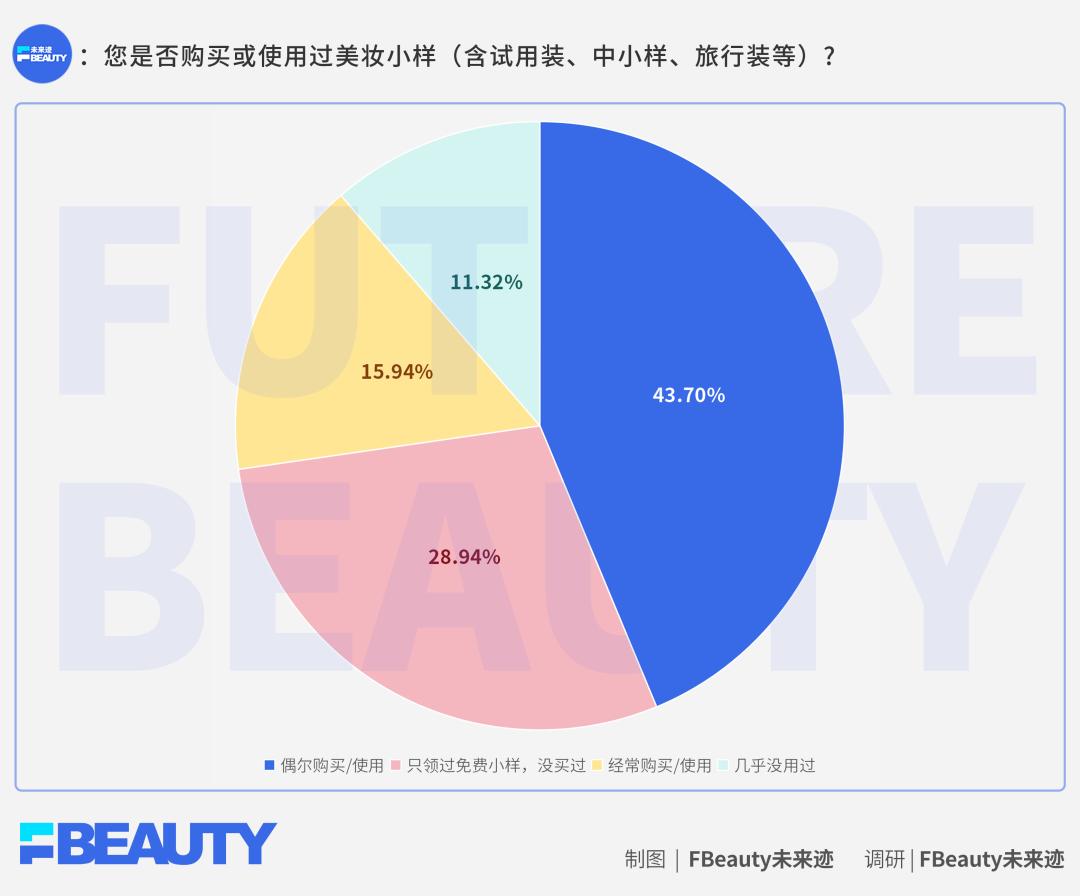
These figures show that the most basic value of samples still exists: reducing the risk of first-time consumption. Especially for consumers with sensitive skin or high-priced products, the cost of buying a wrong product that costs hundreds or even thousands of yuan is much higher than spending dozens of yuan to try it first. In the survey, 26.01% of consumers can accept that samples are more expensive per milliliter than full-size products, because they are paying for the opportunity to "spend less to avoid mistakes".
The problem arises after the experience.
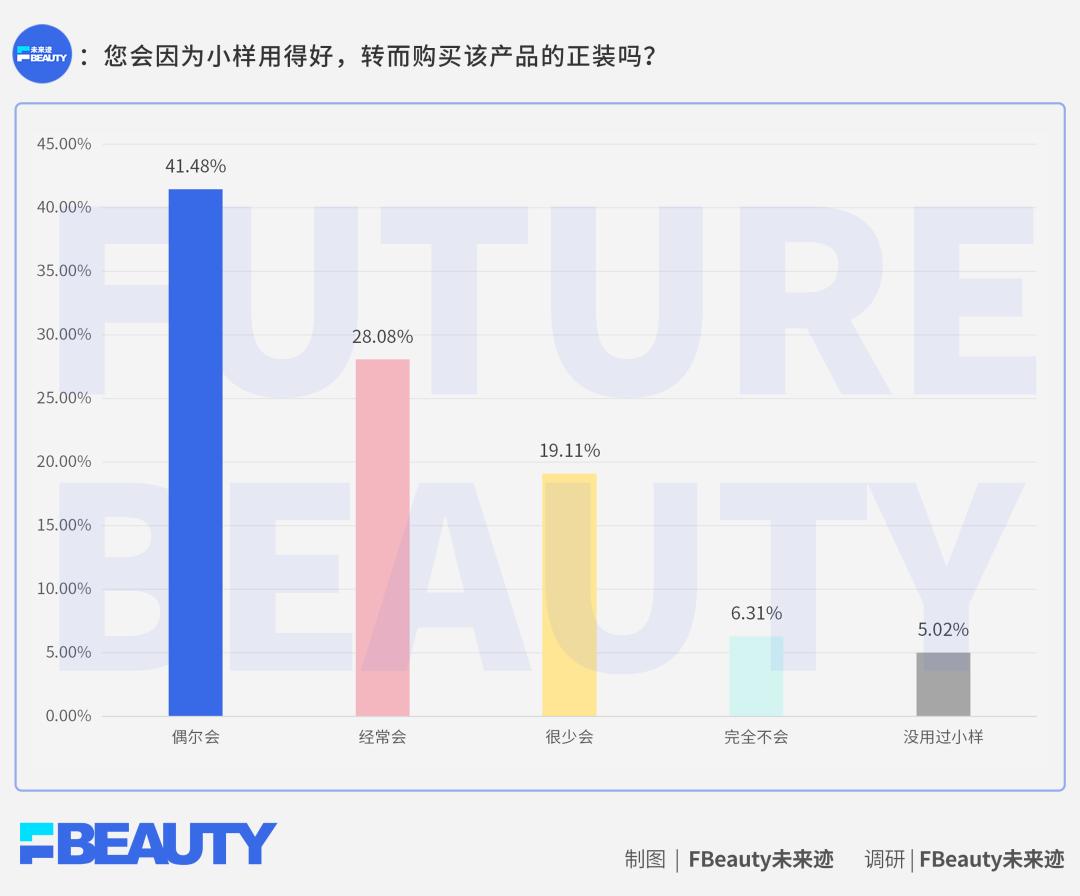
The survey shows that 28.08% of consumers often buy full-size products because they have a good experience with samples, and 41.48% do so occasionally. On the surface, samples still have good conversion capabilities, but once price conditions are added, the results change immediately.
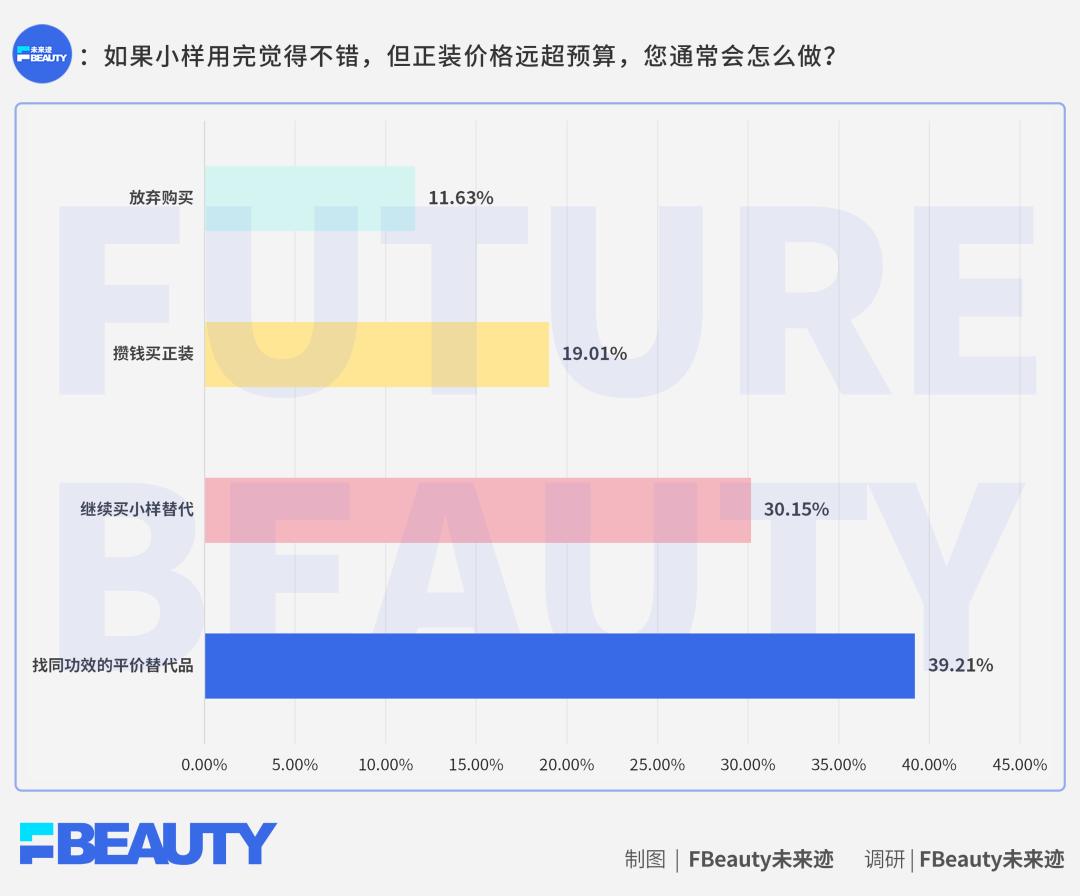
When "the sample works very well, but the full-size product is far beyond the budget", 40% of consumers will look for equivalent effective alternative products, 30% will continue to buy samples, and only less than 20% will choose to save money to buy full-size products. In addition, nearly 20% of consumers clearly stated that they belong to the "sample-only group" who "use samples whenever possible instead of full-size products".
This means that samples have produced a result that brands did not fully anticipate at the beginning: they were originally designed as the entry point for full-size products, but for some consumers, samples have become the "end point" of beauty consumption.
This phenomenon is particularly prominent in high-priced skincare products and perfumes.
Consumers can buy high-end essence that can be used for one or two weeks for dozens of yuan, and a few milliliters of perfume is enough to meet the demand for low-frequency use. If consumers own more than a dozen products at the same time, small-sized products even better match the actual consumption speed than full-size products.
Behind this is the change in the consumption logic of young consumers. In the past, buying full-size products emphasized "ownership", but today more and more consumers emphasize "experience" and "usage". They want to try more products at the same time, but do not want to bear the costs of stockpiling, product expiration and trial and error, and samples naturally adapt to this lightweight consumption pattern.
And brands giving away a large number of equal or even more samples during major promotions further amplifies this supply. Consumers can keep the samples for their own use, or get lower-priced split-set gifts through Xianyu and private domain group buying.
For brands, there is a subtle contradiction here. Samples can improve the efficiency of new product customer acquisition, but they may also weaken consumers' motivation to upgrade to full-size products. Especially for high-end brands, if third-party samples circulate in large quantities for a long time, consumers will form a new price anchor: why must I spend 1000 yuan to buy a full-size bottle?
Therefore, the metrics for brands to measure their sample business can no longer only focus on "how many samples have been distributed".
More importantly, they need to pay attention to the full-size product conversion rate after trial, repurchase rate, new customer acquisition cost, and whether samples are eroding the full-size product business.
Up to now, a clear change in the sample economy is that it has increasingly strong independent consumption value. This not only proves that the sample business has matured, but also leaves brands with a more tricky problem — when consumers are getting better at buying samples, what should full-size beauty products rely on to achieve value upgrading?
The next stop for samples: from "selling more" to "operating more precisely"
If the first stage of the sample economy solves the supply problem, the next stage will truly focus on solving efficiency and trust issues.
First of all, brands need to re-distinguish between "sample distribution" and "sample sales".
Both seem to deliver a few milliliters of product to consumers, but their business objectives are completely different.
Tmall U First and brand new product trial packs undertake the task of customer acquisition, and the final evaluation indicator is full-size product conversion; Sephora's perfume experience set is more like a decision-making aid tool; travel-sized products in instant retail are already complete commodities; the Sample Festival on live streams has both low-cost customer acquisition and transaction attributes.
Therefore, after different samples undertake different tasks, brands need to establish different specifications, prices and evaluation indicators for them.
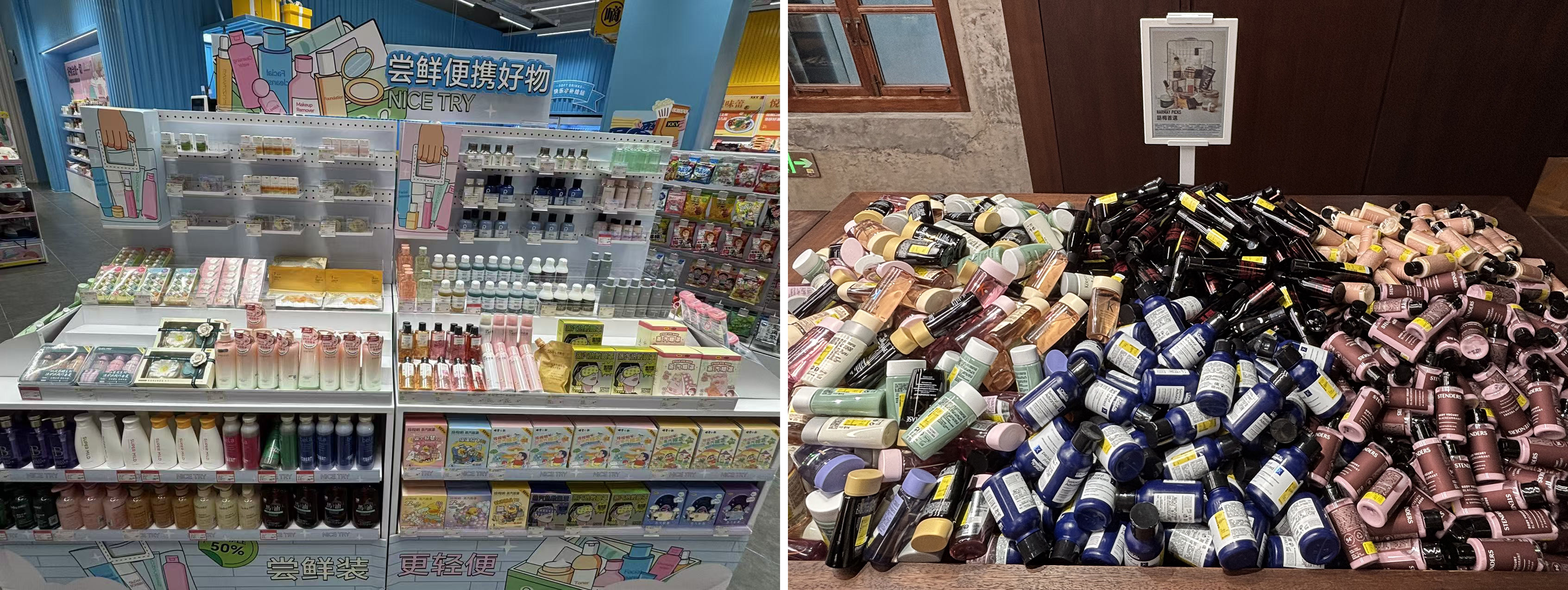
Sample zones in KKV and HARMAY
Second, samples will become increasingly official.
The survey from FBeauty Future Traces shows that 77.34% of respondents are worried that offline beauty collection stores mix counterfeit and genuine products,