Another prefecture-level city is emerging, striving to break into the "3-trillion-yuan industrial club".
Another city has clarified its timetable for breaking into the "3-trillion-yuan industrial output club".
According to local media reports, the outline of Dongguan's 15th Five-Year Plan has been officially released, which specifies that by 2030, the city will strive to raise its gross domestic product to over 1.7 trillion yuan, and the total industrial output of enterprises above designated size will exceed 3 trillion yuan.
What does the concept of "3-trillion-yuan industrial output" mean? As a key indicator measuring the manufacturing development level of top-tier cities, this volume surpasses that of roughly half of China's provincial-level administrative regions, and its high value is self-evident.
Looking through public reports, this is not the first time Dongguan has put forward the "3-trillion-yuan" target.
Back in early 2024, Foshan, its sister city, officially announced that it had become the second prefecture-level city nationwide and the first in Guangdong to hit the "3-trillion-yuan industrial output" mark. In the same period, the No.1 government document of Dongguan in 2024 clearly proposed that the total industrial output of enterprises above designated size would exceed 3 trillion yuan by the end of 2027.
Comparing the two target formulations, from striving to achieve the goal by the end of 2027 to the newly clarified deadline at the end of the 15th Five-Year Plan period, Dongguan has adjusted its "3-trillion-yuan industrial output" target from a short-term sprint to a more long-term and steadily achievable goal, yet the pressure remains non-negligible.
Nationwide, a large number of cities including Wuhan, Changzhou and Wuxi are vying to become the next "3-trillion-yuan industrial output" city. As a new round of competition for industrial capacity kicks off, can Dongguan break through in the fierce competition? How will it reshape the value of the "World Factory"?
Pressure
As two major manufacturing hubs in Guangdong Province, Dongguan and Foshan have long been in close competition, with industrial strength and economic scale being the core focus of their rivalry. Therefore, as early as when Foshan announced that it had achieved the "3-trillion-yuan industrial output" target, the public began to pay attention to Dongguan's timetable.
Now more than two years later, Dongguan has delivered a phased "answer sheet" for its catch-up: in 2025, the total industrial output of enterprises above designated size in Dongguan ranked second in Guangdong Province, only after Shenzhen; in the first half of this year, Dongguan's GDP surpassed Foshan with an advantage of 10.5 billion yuan, making it the historic new "third largest city in Guangdong".
At the same time, according to the latest official statement, the deadline for Dongguan's "3-trillion-yuan industrial output" target has been adjusted from the end of 2027 to 2030. A three-year extension is by no means a trivial matter for a major industrial city eager to cross the finish line. Where does the problem lie?
Image source: Dongguan Release
First, let's take a look at Dongguan's current industrial foundation.
Public data shows that in 2025, the total industrial output of enterprises above designated size in Dongguan exceeded 2.6 trillion yuan, with industry contributing more than 80% to GDP growth; the number of industrial enterprises above designated size exceeded 14,000, ranking among the top in China, which means that 1 out of every 15 industrial enterprises in Dongguan is an enterprise above designated size, with an extremely high density.
In the same period, Dongguan has cultivated more than 300 national-level "little giant" enterprises, over 3,300 provincial-level specialized, refined, differential and innovative enterprises, and more than 6,100 innovative small and medium-sized enterprises, with all totals ranking first among prefecture-level cities in Guangdong. In terms of industrial pattern, Dongguan has a trillion-yuan electronic information industrial cluster, as well as four 100-billion-yuan industrial clusters covering equipment manufacturing, new materials, food and beverage, and textile and apparel.
However, to cross the 3 trillion yuan threshold from the current output of over 2.6 trillion yuan, the incremental scale of more than 300 billion yuan is almost equivalent to recreating the industrial volume of a medium-sized city.
Judging from the growth trend of its total industrial output of enterprises above designated size in recent years, it is extremely difficult to hit the 3-trillion-yuan mark in 2027.
According to the data released in Dongguan Statistical Yearbook, the total industrial output of enterprises above designated size in Dongguan from 2022 to 2024 was 2,477.297 billion yuan, 2,460.955 billion yuan and 2,658.569 billion yuan respectively, with an average annual increment of about 69 billion yuan.
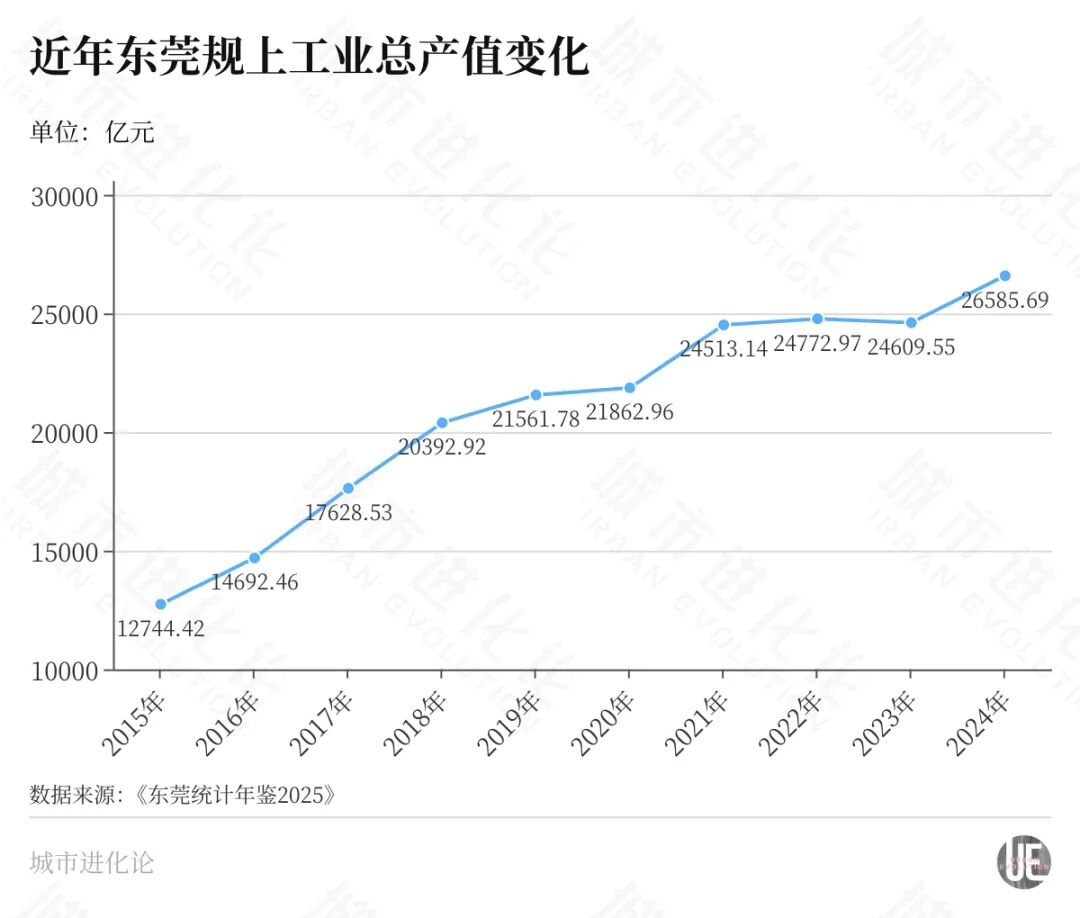
If the 3-trillion-yuan target is to be achieved in the following three years, it means that the average annual output increment from 2025 to 2027 needs to exceed 110 billion yuan, which is a big gap from the actual increment level.
However, in the view of Lin Jiang, professor of economics at Lingnan College, Sun Yat-sen University, this adjustment does not mean that Dongguan has lowered its industrial ambition, but shifted from short-term sprint to a more pragmatic and higher-quality industrial upgrading rhythm, "which actually reflects Dongguan's more prudent judgment on the current industrial environment, external market and its own structural problems."
Lin Jiang analyzed that as a typical export-oriented manufacturing city, Dongguan used to rely mainly on global orders, processing and manufacturing, and a complete supporting system to rapidly expand its scale. Entering the new stage, the improvement of Dongguan's industrial capacity is facing multiple pressures, including the heavy pressure from external demand and global supply chains, weak resilience of industrial structure, strategic emerging industries still in the climbing period, and tightening constraints of labor cost factors.
Layout Planning
Apart from the timetable, deeper transformation signals are worthy of attention.
Under pressure, what will support the 3-trillion-yuan target? The outline of Dongguan's 15th Five-Year Plan clarifies the specific path, focusing on 8 strategic emerging industries, 8 traditional industries and 4 future industries —
To expand the new generation of electronic information, high-end equipment manufacturing, new materials, semiconductors and integrated circuits, new energy, biomedicine and high-end medical devices, artificial intelligence, and low-altitude economy;
To optimize the industrial structure and product structure of sectors including textile, apparel and footwear, food and beverage, furniture, toys and stationery, papermaking and paper products, packaging and printing, chemical industry, and molds;
To proactively lay out next-generation mobile communications, cutting-edge new materials, embodied intelligence, and future life health.
Lin Jiang analyzed that the deployment of this industrial system is essentially an effort to solve two core problems: the first is to change the relatively single pillar of Dongguan's industry, and the second is to build a brand new industrial growth curve.
For example, it is specially mentioned that strategic emerging industries should form 1 trillion-yuan level, 1 500-billion-yuan level, and 3 100-billion-yuan level industrial clusters.
In Lin Jiang's view, behind this is the consideration of opening up incremental space through strategic emerging industries — the new generation of electronic information will still be the trillion-yuan "ballast stone" of Dongguan, but at the same time, it will no longer only rely on traditional electronic manufacturing, but hope to cultivate multiple high-growth industrial fulcrums. High-end equipment, new materials, semiconductors, new energy, AI servers and other sectors are expected to become new growth engines.
Image source: Dongguan+
Back in July this year, Dongguan issued the Implementation Plan for Promoting the High-quality Development of the AI Server Industry in Dongguan, clarifying that it will invest 100 billion yuan in the next five years to support the output value of the city's AI server related industries (complete machines, components and related supporting facilities) to exceed 500 billion yuan by 2030, cultivate 1 to 2 trillion-yuan level enterprises, 3 to 5 10-billion-yuan level enterprises and a number of specialized, refined, differential and innovative supporting enterprises, and build a globally competitive AI server industrial cluster.
Behind the search for new large-scale industrial tracks around AI computing hardware, this traditional manufacturing hub has a bigger vision — to transform from the "World Factory" to a "Global Intelligent Manufacturing Center".
In May this year, the Overall Plan for the Construction of Dongguan Global Intelligent Manufacturing Center (2026-2030) was officially released, which is regarded as the construction blueprint of Dongguan in the next five years. It clearly proposes to "reconstruct the development logic with AI" and make every effort to build an intelligent manufacturing center with global influence.
"The core of 'reconstructing the development logic with AI' is not only to develop the artificial intelligence industry, but to use AI to reconstruct the production mode, organization mode and value distribution mode of the manufacturing industry." In Lin Jiang's view, this is an important starting point for Dongguan to solve problems such as low profit, weak innovation, few brands and insufficient chain-leading enterprises in its manufacturing sector.
Local media commented that this transformation is not a simple repair and upgrade, but a systematic reconstruction — Dongguan is no longer satisfied with being a manufacturing terminal on the global industrial chain, and hopes to build an intelligent industrial system that can flexibly schedule and allocate global innovation and manufacturing resources.
From this perspective, the optimization and adjustment of the time limit and path for the "3-trillion-yuan industrial output" target also sends a signal that the local government has taken the initiative to shift from a scale-and-speed-oriented target to a quality-and-capacity-oriented target. In Lin Jiang's view, "the key is not only to reach 3 trillion yuan, but to see whether the '3 trillion yuan' is more from structural optimization, such as advanced manufacturing, high-tech manufacturing, intelligent manufacturing and high value-added links."
Opportunities
Nationwide, the competition is far more fierce than imagined.
In 2025, the total industrial output of enterprises above designated size in Shenzhen reached 5.44 trillion yuan, ranking first nationwide; followed by Suzhou with 4.9 trillion yuan, whose target of hitting 5 trillion yuan this year is almost certain; also in the Yangtze River Delta, Shanghai's total industrial output of enterprises above designated size reached 4.07 trillion yuan, and it is accelerating at full speed towards the goal of "surpassing 5 trillion yuan"...
The top tier is almost unshakable, but the "3-trillion-yuan industrial output" has become the pursuit target of many cities.
For example, Wuhan officially announced the launch of the advanced manufacturing doubling plan in May this year, which aims to raise its total industrial output to over 3 trillion yuan by 2030, with industrial added value reaching 800 billion yuan, accounting for about 27% of GDP, so as to support the city's GDP to move towards 3 trillion yuan with solid industrial strength.
Wuxi issued a document earlier this year clarifying that by 2030, the total industrial output of enterprises above designated size in the city will exceed 3.2 trillion yuan, and the number of enterprises above designated size will exceed 10,000; the output value of strategic emerging industries will strive to account for 50% of the total industrial output of enterprises above designated size, and the scale of future industries will exceed 300 billion yuan.
In February this year, Changzhou held a city-wide conference on promoting the construction of a modern industrial system, with the goal of raising the total industrial scale to 3 trillion yuan by 2030, and clarified the system support: upgrading the new energy industry, the trillion-yuan landmark industry; optimizing and strengthening the two 500-billion-yuan advantageous industries of intelligent equipment and new materials; cultivating and expanding the three 100-billion-yuan growing industries of electronic information, medicine and medical devices, and modern light textile; proactively laying out a number of future industries such as artificial intelligence, embodied intelligence, new energy storage, and synthetic biology to seize the commanding height of development.
In Lin Jiang's view, the above-mentioned cities are all accelerating their efforts in new energy, integrated circuits, artificial intelligence and other fields, and the competition for the next "3-trillion-yuan industrial output" city will be extremely fierce.
Image source: Xinhua News Agency
So where is Dongguan's opportunity?
Lin Jiang analyzed that Dongguan has a complete manufacturing ecosystem rarely seen among prefecture-level cities nationwide, which is its core industrial "moat" and the source of its competitiveness. At the same time, located in the manufacturing hinterland of the Guangdong-Hong Kong-Macao Greater Bay Area, Dongguan can not only undertake scientific and technological innovation, capital, headquarters economy and other resources from Shenzhen, but also link the industrial and market resources of Guangzhou, enjoying unique geographical advantages.
According to public reports, the relevant deployment of Dongguan's construction of a global intelligent manufacturing center clearly mentions that it will carry out in-depth cooperation with cities such as Shenzhen and Guangzhou in the artificial intelligence sector in areas including scenario co-construction, achievement transformation and paradigm sharing, to promote the "going global" of Dongguan's artificial intelligence technologies, products and solutions.
However, the shortcomings cannot be avoided.
Lin Jiang said frankly that compared with cities such as Wuxi and Changzhou, the leading traction of some emerging industries in Dongguan still needs to be enhanced. For example, Wuxi has profound accumulation in integrated circuits, Internet of Things, new energy and other industrial fields, while Changzhou has formed strong industrial labels in new energy passenger vehicles, power batteries, photovoltaics and other sectors. In contrast, although Dongguan has a complete range of industrial categories, its strategic emerging industries still need chain-leading enterprises with national influence and iconic industrial clusters.
He specially reminded that with the accelerated advancement of the intelligent and specialized industrial trend, the transformation and differentiation of traditional manufacturing enterprises in Dongguan may further intensify, which is the so-called "K-shaped growth". For example, in the fields of AI and intelligent manufacturing, some enterprises will enter higher value-added links through technological upgrading, while at the same time, part of the low-end industries and production capacity will be eliminated.
In Lin Jiang's words, if Dongguan wants to win the next round of industrial competition, the key is no longer simply to expand the output value, but to form industrial clusters with real national and even global competitiveness in new industrial tracks, which is also the key to determining whether it can seize the first opportunity in the future.
This article is from the WeChat official account "City Evolution Lab", written by Cheng Xiaoling, and published with authorization from 36Kr.