How can the sour soup industry underpin its 100-billion-yuan industrial base?
Against the nationalization wave of local flavors, sour soup has been one of the fastest-growing tracks in the past two years.
Sour soup hot pot is accelerating its expansion across the country. Leading chain brands including Haidilao and Ba Nu have successively added sour soup to their regular flavor matrix. The flavor that once carried strong southwestern regional labels has quickly gained widespread consumer recognition nationwide.
The popularity on the catering side has directly passed to the upstream industry. Data from Guizhou Provincial Administration for Market Regulation shows that the total output value of Guizhou sour soup industry reached about 8 billion yuan in 2025, which is close to the 10-billion-yuan target proposed earlier.
While catering demand is expanding, industrialized production capacity is being rapidly put into operation, and industry standardization is also continuously advancing. However, as mass production gradually becomes the basic capability of leading enterprises, the space for growth driven purely by production expansion begins to narrow, and problems such as product homogenization and single consumption scenarios have also emerged.
After reaching the 10-billion-yuan threshold, how the sour soup industry can continue to expand its scale through product innovation is becoming increasingly important.
Nanpopo has recently launched a series of new products including probiotic-fermented Guizhou sour soup and wild fruit & vegetable sour soup, providing a referable practical path for the entire sour soup category to break through the growth boundary.
01 The 10-Billion-Yuan Sour Soup Industry Is Still A "Niche Category"
The popularity in the catering sector easily makes people ignore that the overall scale of the sour soup industry is still relatively small.
When placed in the broader food industry, the 8-billion-yuan output value immediately appears far from large. As another local flavor, the total industrial chain revenue of Liuzhou snail noodles exceeded 80 billion yuan in 2025; the total industrial chain output value of Chongqing hot pot exceeded 340 billion yuan in 2024. This huge gap shows that Guizhou sour soup still has a long way to go before becoming a truly large national category.
Apart from the limited overall scale, there are also obvious structural differences within the sour soup industry.
Leading enterprises have taken the lead in entering the industrialization stage. Taking Nanpopo as an example, its first production line has formed an annual production capacity of more than 100,000 tons of sour soup series products, and it is now the largest sour soup brewing base in China; according to the certification of Frost & Sullivan, Nanpopo won the title of "No. 1 in China's sour soup production capacity" in 2025, and "No. 1 in China's sour soup sales" in 2026; it is reported that its products now stably supply more than 50,000 catering stores across the country.
It is worth noting that in 2025, Nanpopo also won two supplier honors issued by Haidilao, namely the "Service Benchmark Award" and "Annual Honorary Supplier".
However, leading enterprises entering the stage of large-scale production does not mean that the entire industry is mature.
Traditional sour soup has long been mainly made of basic raw materials such as tomatoes and chili peppers through natural fermentation, and the differences in basic products among different enterprises are limited. While leading enterprises have begun to improve product stability through factory-based production and fermentation control, there are still a large number of production entities of different sizes in regional markets.
It was not until March this year that the national standard formulation plan for "Quality Requirements for Fermented Sour Soup" was officially issued, which is still in the drafting stage. The Guizhou Provincial Administration for Market Regulation previously clearly stated that the long-term lack of a unified national standard has restricted the technological innovation, market expansion and brand upgrading of the sour soup industry.
This itself also indicates that there is still room for further integration of the sour soup industry in terms of product specifications, quality system and industrial concentration.
Under this structure, if enterprises still provide similar basic sour soup products, competition will easily return to price, channel and production capacity efficiency. For a category with a small overall scale, the situation where production capacity grows faster than product differentiation is not necessarily a good thing.
Another restriction comes from the consumption structure.
At least in the core red sour soup market, the catering sector still occupies a dominant position. Data disclosed at the 2025 China Sour Soup Industry Conference shows that the red sour soup market size reached about 980 million yuan in 2024, of which catering-specific products accounted for 58.3%. Sour soup has entered channels such as supermarkets, e-commerce platforms, convenient food and compound seasoning, but the most mature consumer recognition is still built on catering products such as hot pot, sour soup fish, noodles and rice noodles.
This is significantly different from daily basic seasonings such as soy sauce and vinegar. Consumers can use soy sauce every day, but few people regard sour soup as a high-frequency basic seasoning in the kitchen.
For most consumers, sour soup is still associated with several specific dishes. This consumption habit determines that the expansion of catering stores still has a strong driving effect on sour soup demand, while the demand base in household and retail sectors is not as mature.
Therefore, approaching the 10-billion-yuan mark is more like a milestone after the first round of industrial expansion of sour soup, rather than the end point of a mature large category. In addition to the growth brought by more restaurants selling sour soup, this local flavor category also needs to find new product value.
02 Beyond Production Capacity, Nanpopo Shifts Competition to R&D Field
In the past few years, the industrialization process of Guizhou sour soup has accelerated significantly. Leading enterprises have been able to solve the problems of stable production and large-scale supply through modern production lines, which is a crucial step for a local food industry that is still expanding. However, as more and more enterprises enter the stage of large-scale production, factories and production lines are no longer the only competitive barriers.
The truly irreplicable capabilities are beginning to shift to the R&D end.
Sun Baoguo, an academician of the Chinese Academy of Engineering, once pointed out that strain resources have become important strategic biological resources, and China's probiotic industry still needs continuous investment in the fields of domestic strain resource exploration, functional evidence-based research, fermentation process stability and achievement transformation, so as to finally translate scientific research strength into product competitiveness.
In the sour soup industry, this logic has been implemented in specific production and R&D links. A 2025 study published in China Brewing pointed out that both fermentation strains and raw material varieties are important factors affecting the quality of red sour soup.
In this context, Nanpopo's accumulation in the strain sector has gained more specific value.
Since 2014, Nanpopo has cooperated with scientific research teams to continuously collect samples of traditional fermented sour food for strain screening and research. Public information from Guizhou University shows that the fermented food strain preservation center jointly established by the two parties now preserves more than 500 high-quality strains, which have been used in the enhanced fermentation of sour soup and related technology development. It is reported that Nanpopo's current R&D has extended from strain resource exploration to evaluation and industrial application.
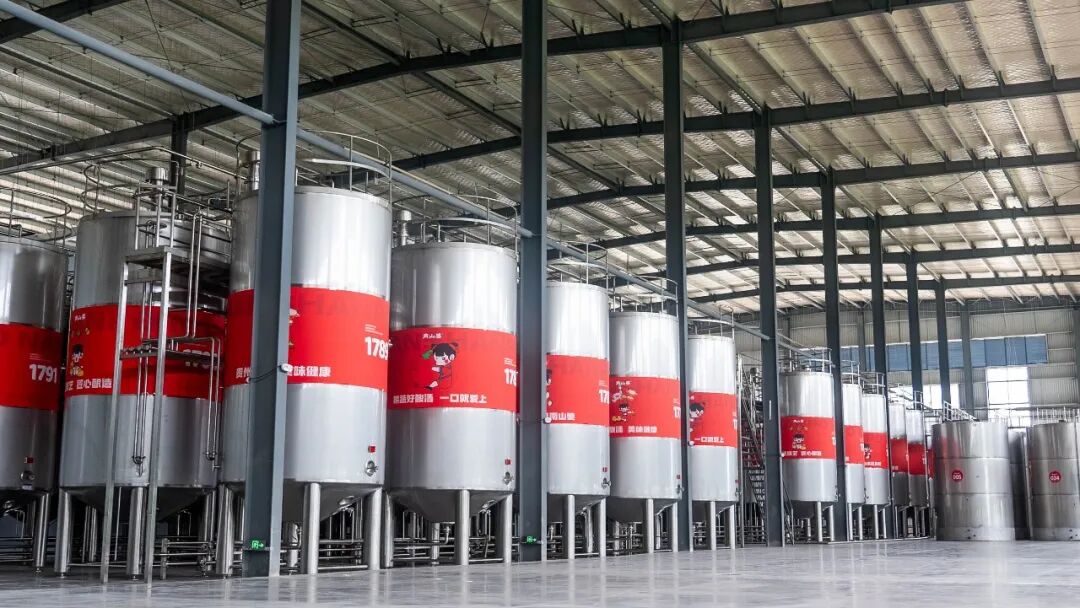
Image source: Nanpopo
For fermented food enterprises, the value of the strain library does not lie in the number of strains itself, but in that it provides a set of R&D resources that can be continuously screened and called.
Traditional sour soup relies on natural flora for fermentation, and it is difficult for enterprises to control which strains participate in the fermentation process and the final result. With screened and verified strains, the fermentation process can be transformed into active selection of strain combinations.
For enterprises like Nanpopo, this accumulation has two levels of commercial value: first, it improves the controllability of the fermentation process and reduces batch fluctuations caused by traditional natural fermentation; second, it provides more strain selection space for subsequent product development.
The commercial logic of this type of investment is different from that of expanding production capacity.
Production lines solve the problem of how many units of the same product can be produced, while strain resources determine how many different products the enterprise can develop around fermentation technology.
More importantly, strain screening and fermentation research usually require a longer R&D cycle. Nanpopo mentioned that from potential strain screening to subsequent safety evaluation and application verification, it often takes several years.
Equipment and production capacity can be increased quickly through capital investment, but strain resources, experimental data and long-term fermentation experience are difficult to replicate in a short time. For latecomers, this is the most difficult part to copy.
An industry insider told the Red Meal Supply Chain Guide that Nanpopo's more important value to Guizhou sour soup is that it has begun to transform the industry's past experience-dependent capabilities into continuously accumulable technical assets. Only when a local food completes this step, can its industrial growth evolve from a short-term market boom to long-term capability.
Simply put, from a broader perspective, this even determines whether Guizhou sour soup can form its own food industry system — this change may determine how far Guizhou sour soup can go more than simply expanding production capacity.
Regional culture can make a category popular, and catering can expand market demand, but what really determines whether it can grow into a mature industry in the long run is whether leading enterprises can build a set of long-term accumulable "R&D assets" for Guizhou sour soup.
It is worth noting that these accumulations have now gradually moved beyond the pure production links and entered the product end.
Traditional Guizhou red sour soup has long used tomatoes and chili peppers as basic raw materials. The new products launched by Nanpopo this time do not make minor adjustments around this traditional formula, but incorporate a variety of fruits and vegetables such as rosa roxburghii, sea buckthorn and wampee into the fermentation system, and try to match different probiotics with different raw materials.
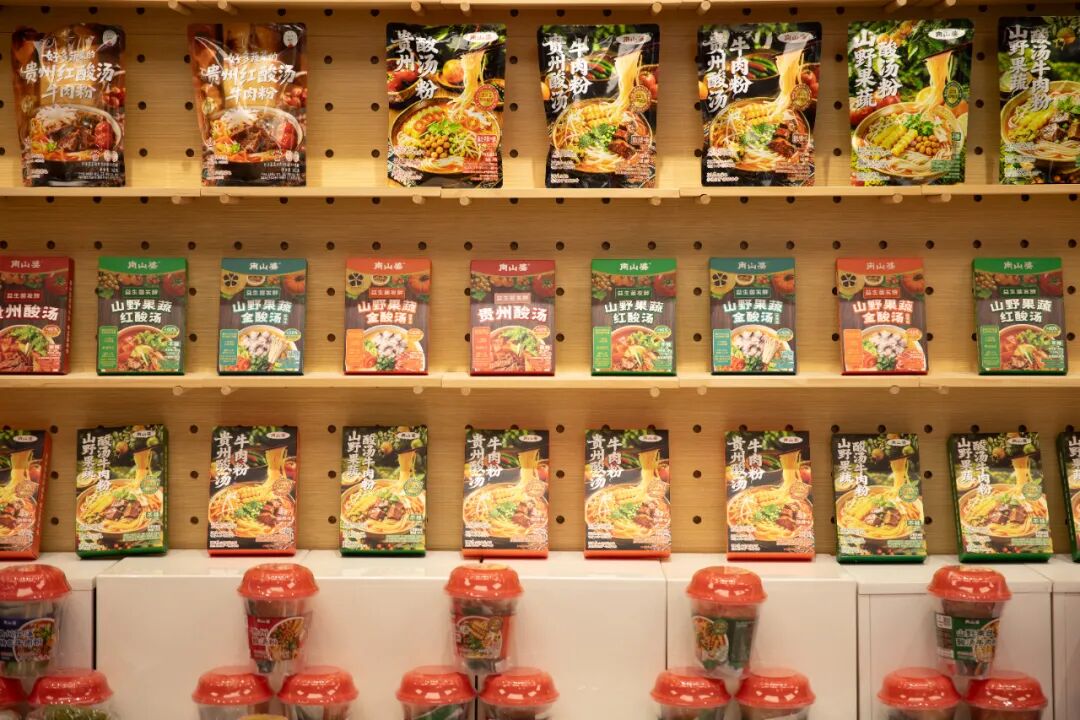
Image source: Nanpopo
In fact, the R&D of basic sour soup has long been focused on similar raw materials and flavor types, leaving limited space for upstream enterprises to create differentiation. However, when both strains and fruit & vegetable combinations become R&D objects, sour soup no longer has only one fixed formula, and enterprises can continue to develop new sour soup products around different raw materials and different product positioning.
Nanpopo has launched products including probiotic-fermented Guizhou sour soup/sour soup noodles and wild fruit & vegetable sour soup/sour soup noodles at the same time, which is essentially the extension of the same set of R&D capabilities to different products.
For a long time, probiotics have been regarded as an important development carrier for the healthy transformation of the food industry. But for Nanpopo, integrating strain research, product development and the healthy trend of food into the same product R&D system is more like a self-upgrade of product value. From a commercial perspective, when all enterprises can produce similar tomato red sour soup, competition will easily return to price, channel and production efficiency; only when R&D truly changes products, can technical investment have the opportunity to generate commercial value.
Now Nanpopo has been given a clearer position in the local industrial layout. The 2026 Anshun Municipal Government Work Report proposes to "support Nanpopo to grow and strengthen the sour soup industry, and accelerate the construction of a main production area of characteristic and advantageous sour soup food in Guizhou."
Shifting from focusing on production capacity to focusing on technology, and expanding from a single product to a complete product line, is the inevitable direction for the sour soup industry to break through the growth bottleneck. But whether technical investment and product expansion can be truly transformed into continuous market increments will eventually be tested in the broader consumer trends and industrial laws.
03 Where Does the New Growth of Sour Soup Come From After Breaking the 10-Billion-Yuan Mark?
As sour soup continues to expand, the commercialization capability beyond catering stores will become more and more important.
In the past few years, the catering sector has completed the most important round of consumer education for sour soup. But being popular in the terminal market is not the same as growing into a large category.
As a local specialty category, to truly break through the growth ceiling and become a popular food with universal appeal, it cannot only rely on the popularity of a single channel, but also need to find more sustainable sources of new growth.
Take snail noodles as an example. One of the important foundations for its much larger industrial scale than sour soup is that it is no longer just a local snack that must be consumed in restaurants. Pre-packaged products have separated it from Liuzhou local and in-store scenarios, enabling it to enter the vast household consumption scenarios.
If sour soup wants to continue to expand, it also needs to find more mature commercial carriers beyond catering base materials.
These attempts are already underway. According to official public information, the commercialization exploration of Guizhou sour soup has extended to products such as sour soup drinks and instant sour soup rice noodles, and related products have also entered large supermarkets such as Hema and Walmart.
Similar trends have also emerged on e-commerce platforms. According to the local flavor consumption data released by Pinduoduo earlier this year, Guizhou merchants have begun to develop small-packaged and single-serving sour soup products for consumers in other regions.
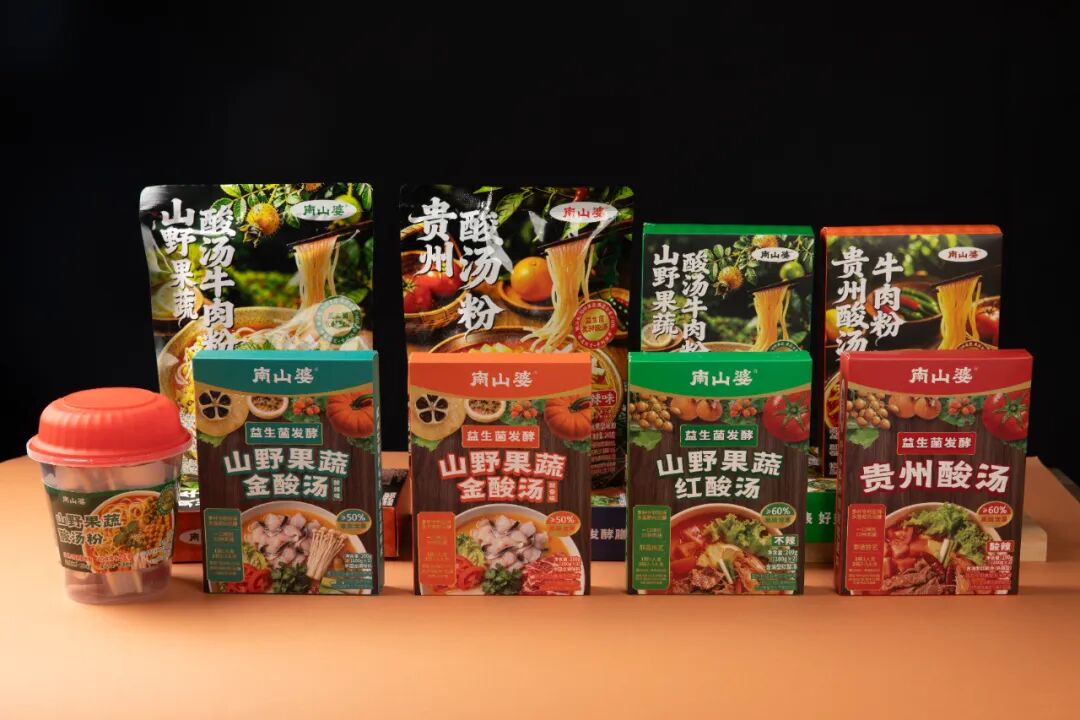
Image source: Nanpopo
In short, the catering sector is responsible for building consumer awareness, while retail products determine whether this awareness can be further transformed into higher-frequency and more stable repurchase rates.
At present, Nanpopo's market coverage is also continuing to expand outward. It is reported that its products have been exported to more than 30 countries and regions including the United States, Japan, Germany, France and Singapore.
In addition, sour soup has a special advantage: wild economy.
In the past two years, from Yunnan-Guizhou cuisine, Yunnan-Guizhou-Sichuan Bistro to wild hot pot, and then to camping, hiking and regional cultural tourism, the concept of "wild" has gradually expanded from a visual style to a composite consumption trend covering cultural tourism, catering and food sectors.
Consumers are getting tired of the standardized industrial taste, and prefer products with regional traceability, original ingredient attributes and natural cultural connotations. The premium ability and acceptance of such products are continuously improving.
Data from the Red Meal Industry Research Institute shows that in the first half of 2025, the order volume of "wild nature" themed restaurants on Douyin platform increased by 102% year on year, and the payment GMV of "forest, courtyard, green plant" themed restaurants increased by 86% year on year. Wild-themed catering is evolving from a niche style into an industry-wide growth track.
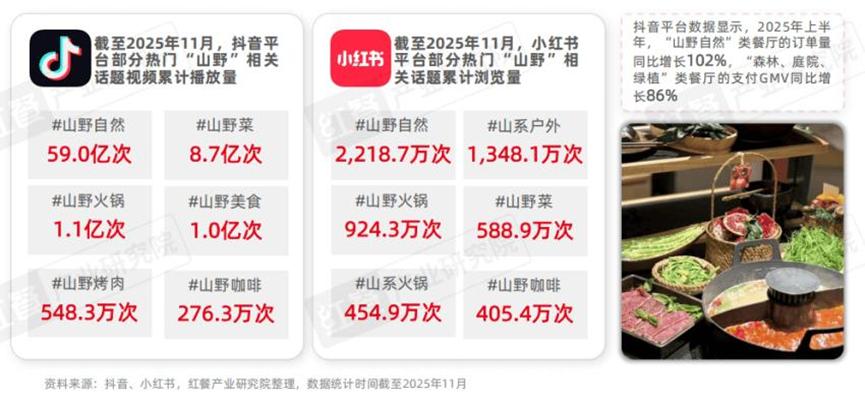
Image source: Red Meal Industry Research Institute
This is particularly important for Guizhou sour soup.
When local food goes national, it often faces a contradiction in the past: too strong regional characteristics will increase the understanding cost of non-local consumers; if regional characteristics are weakened too much, the product will easily lose its own uniqueness.
The rise of wild economy and local cuisine has changed this relationship to some extent