The biggest contribution of hybrid vehicles in recent years is to let everyone know how amazing pure electric vehicles are.
Unconsciously, have battery electric vehicles completely crushed hybrid vehicles?
Note that what we are talking about is that the combined sales of plug-in hybrids and range-extended EVs are no match for battery electric vehicles at all.
This is not a random talk from "Neck Bro". For the whole month of July (since the specific statistical data for August has not been released yet, we use the data of July), under the circumstance that the overall auto market is tepid and the retail volume of new energy vehicles declines year-on-year, battery electric vehicles bucked the trend and rose by 6%, while plug-in hybrids and range-extended EVs plummeted by 21% and 16% respectively.
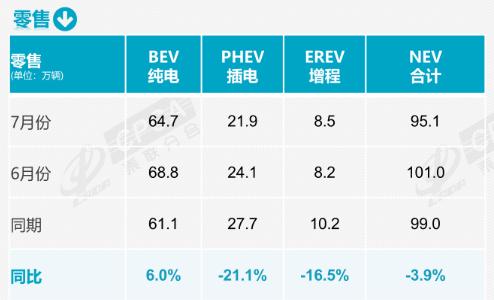
Moreover, not only in sales, battery electric vehicles have completely outperformed hybrids, in terms of price, battery electric vehicles are also very competitive.
Current battery electric vehicles are not propped up by those A0-class small micro commuter cars. Among the top 15 best-selling models by monthly sales, 5 models have a starting price of more than 200,000 RMB.
What is going on? In the minds of many people, hybrid vehicles are the optimal solution of the current version, and battery electric vehicles are just big toys that will not be considered before the maturity of solid-state battery technology. How come the data has suddenly reversed completely?

"Neck Bro" also did some research and found that the gradual decline of hybrid vehicles and the re-rise of battery electric vehicles did not just happen recently.
Back in 2020, Stephan Wöllenstein, then CEO of Volkswagen China, directly criticized that range-extended electric vehicles are "the worst solution" from the perspective of national and global emission reduction.
This remark immediately sparked a huge controversy. The range-extended camp led by Li Xiang immediately launched a public debate across the air.
At that time, Li Xiang directly stated that he would invite the media to conduct a 1-on-1 horizontal comparison of energy conservation and environmental protection between his own brand's vehicles and Volkswagen's models, and the official Weibo account of Li Auto even pulled Porsche into the discussion.
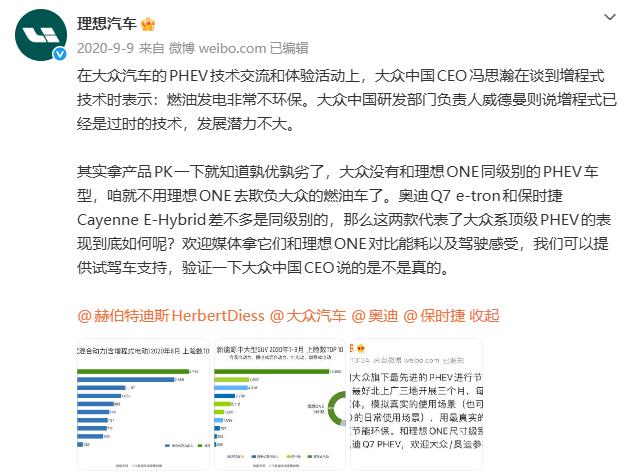
The final development of the incident was exactly as Li Xiang said. In the following 4 years, the sales of hybrid vehicles including range-extended EVs completely contradicted the remarks of the Volkswagen CEO.
From 2020 to 2023, the sales volume of domestic hybrid vehicle market increased by 10 times;
In the whole year of 2023, the annual sales of hybrid vehicles exceeded 2.8 million units, with a year-on-year surge of nearly 85%, and the growth rate was more than three times that of battery electric vehicles. The performance of range-extended models was even more exaggerated: their proportion in the wholesale data of new energy vehicles soared from 8% in 2023 to 12% in June 2024;
In the first 11 months of 2024, hybrid vehicle sales rose by another 85%, while battery electric vehicles only increased by 16% in the same period.
Li Auto, Seres and Leapmotor, which were the first to embrace the hybrid route, successively topped the new energy vehicle sales rankings and took the lead in turning losses into profits.
With these three leading enterprises as the bellwethers in the automotive industry, many car companies that were originally committed to producing battery electric vehicles have obediently launched their own hybrid models.
In those two years, there was even a popular saying in the automotive circle that no matter new forces or traditional old car enterprises, all of them had to embrace range-extended/hybrid technologies and put the fuel tank back into the car to survive.

Moreover, this was not just a meme at that time. In the minds of many people, hybrid vehicles did have irreplaceable advantages.
Because hybrid vehicles at that time had three killer features: range, price and policy support.
A few years ago, the number of charging piles was far less than now, and news about queuing for four hours to charge at service areas during holidays was everywhere. However, hybrid vehicles could rely on the fuel tank as a backup at any time, which gave many people the confidence to try new energy vehicles.
Users in northern China have more to say: in winter, the actual range of battery electric vehicles often drops by half, while the fuel tank of hybrid vehicles can at least ensure that you will not be stranded on the road. Spending less money but having an extra fuel tank as insurance is almost perfect.
On the other hand, battery electric vehicles at that time were really expensive.
A few years ago, the price of lithium carbonate was driven to an extremely high level. The battery became the most expensive component in new energy vehicles, while hybrid vehicles could be equipped with smaller batteries. After calculation, vehicles of the same class could be tens of thousands of RMB cheaper than battery electric vehicles. This is real money, so it is obvious how consumers would choose.
Not only that, except for a few cities, hybrid vehicles and battery electric vehicles enjoyed the same policy treatment: both could get green license plates and were exempt from purchase tax.
Therefore, hybrid vehicles have become a bridgehead for many fuel vehicle users to embrace new energy, and a magic weapon for countless young people to convince their parents. The phrase "it can also be refueled" is more effective than listing any parameters.
But by 2025, the general trend began to reverse.

Although the sales volume of hybrid models is still growing, the growth rate has visibly weakened. The most obvious case is the range-extended track, where the retail growth rate plummeted off a cliff. Only one year later, it plunged from 78.7% in the previous year to 6%, and the growth rate turned negative directly in the fourth quarter.
Plug-in hybrid models performed slightly better. Although the annual retail sales in 2025 reached a historical high of 3.697 million units, their share in the overall new energy vehicle wholesale market has shrunk from 32% to 29.5%, and the growth momentum of domestic terminal retail has hit the emergency brake.
Entering 2026, the last fig leaf is gone.
The retail sales of range-extended EVs plummeted by more than 30% year-on-year, hitting the largest monthly decline in the past five years. According to the latest data for July, no matter old models or newly launched range-extended vehicles, none of them have monthly sales exceeding 10,000 units.
In contrast, in the retail market of new car-making forces, the sales proportion of battery electric vehicles has exceeded 80%.
What makes the hybrid market even more uncomfortable is that the leading brand in the camp took the lead in defecting.
Li Auto, which once supported the heyday of range-extended vehicles, could deliver 40,856 units in a single month last May, almost all of which were range-extended hybrids. But by May this year, Li Auto delivered more than 30,000 units, two-thirds of which were battery electric vehicles, and the sales of range-extended models were only just over 10,000...
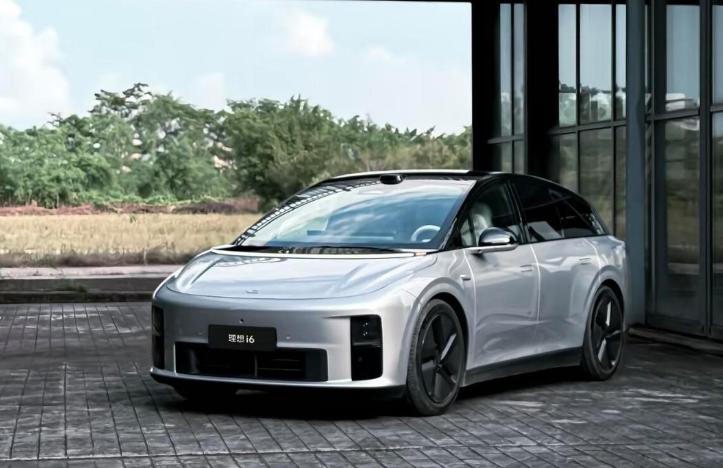
The main reason for this situation is that the three major advantages of hybrid vehicles in the past have disappeared completely.
The first is range anxiety. By the end of May this year, the number of automobile charging piles across the country has exceeded 22 million, and the coverage rate of charging piles on expressway service areas is more than 98%.
We don't even need to mention that home charging is more convenient than refueling. Even for public charging piles, it is very common that you can pass several charging stations just when you go out to buy a pack of cigarettes.
It should be noted that back in 2020, there were only about 1.6 million charging piles nationwide, and the number of piles has increased by more than ten times in 5 years.
At this time, electric car owners will ask: where are all the gas stations?
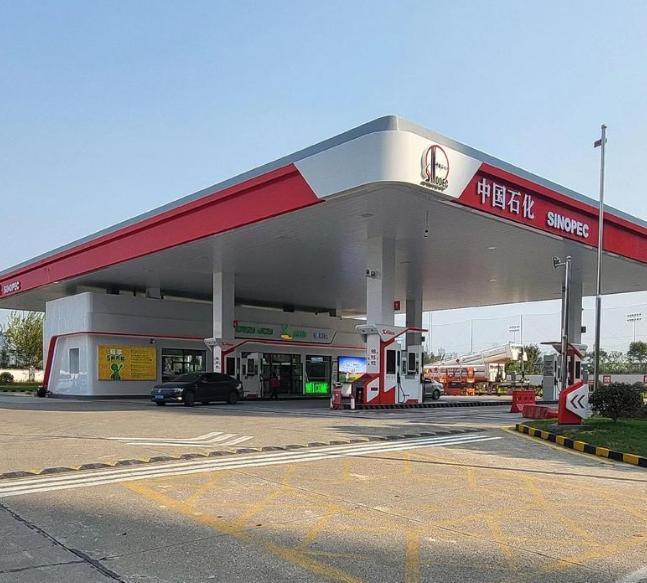
Having a large number of charging piles is not enough. The popularization speed of fast charging technology for new energy vehicles is also quite amazing. 800V high-voltage platforms and 5C ultra-fast charging have been applied to vehicles priced at 200,000 RMB or even lower.
When the charging time is roughly equal to the time spent refueling and going to the toilet, the act of "carrying an extra engine as a safety rope" has changed from a rigid demand to a redundant design.
Even if the charging speed cannot reach the maximum limit during peak electricity consumption periods, it is completely acceptable to drive three or four hundred kilometers, stop at the service area and charge for a while.
After range anxiety is eliminated, battery electric vehicles have gained huge advantages. What's more, I have to tell you that current electric vehicles may be cheaper than hybrid vehicles?
In terms of vehicle price, the price of lithium carbonate has been falling all the way, which makes the power battery sold at a very low price.
The reason why hybrid vehicles were cheaper in the past was that batteries were expensive. In 2022, the price of lithium carbonate was once driven to nearly 600,000 RMB per ton. At that time, reducing the battery capacity by 40 kWh could really save tens of thousands of RMB.
In the past, hybrid vehicles "saved a lot of money by using smaller batteries". But now, the small amount of money saved by reducing the number of batteries is completely offset by the cost of the range extender, which uses a lot of materials to meet emission standards and NVH requirements. Hybrid vehicles, which were originally designed as a cost reduction solution, have now become a cost killer. (Although the price of lithium carbonate has rebounded a lot this year, the price war is so fierce that vehicle prices cannot go up again.)

In addition to the car purchase cost, we also need to calculate the usage cost.
Hybrid vehicles have two sets of systems, so engine oil, oil filter and spark plugs are all necessary. Car owners around us told us that the maintenance cost of plug-in hybrids of the same class is much higher than that of battery electric vehicles.

In actual use, the cost of "supporting both fuel and electricity" for range-extended vehicles is that the fuel consumption under the power-depleted state is higher than that of fuel vehicles. Combined with the soaring oil price in the first half of this year, every step on the accelerator when you go out is burning money.
What is more heartbreaking is that the former hybrid vehicle fanatics have awakened first.
Li Auto once disclosed a set of data: more than 65% of the total mileage is driven by electricity, and the electricity usage time is close to 90%.
In other words, the fuel tank that people paid extra for as a safety measure is left unused and gathering dust 90% of the time, which is just a psychological placebo.
In daily commuting, the once indispensable fuel tank has become a vestigial organ in the new energy era, which is not used at ordinary times, but you still have to pay for repair if it "gets inflamed" (engine oil emulsification / carbon deposition). However, if you are forced to remove it, you will always feel a lack of sense of security.
Ma Lin, a senior executive of NIO, put it more directly: the sales volume of battery electric vehicles in May this year is 7 times that of range-extended vehicles. Thanks to range-extended vehicles, they have cultivated users' habit of using electricity.

Hybrid vehicles have small batteries, and the pure electric range is generally only 100 to 200 kilometers. If you want to use electricity every day to save money, you have to charge two or three times a week. Before buying a