An increasing number of young people are balding, but anti-hair loss brands such as Bawang are mired in losses and under enormous pressure.
"I have so little hair that each strand has its own name. Look, this one is Jennifer..."
"I left home young and returned old, my accent unchanged but my hairline long gone."
"Why do most programmers have balding crowns? Because when the CPU is under high load, it needs to maintain good heat dissipation."
You need to perk up that hairstyle!
At the data level, as early as 2019, the number of people suffering from hair loss in China exceeded 250 million, of whom about 163 million were men and 88 million were women respectively.
Moreover, the *2024 White Paper on China's Hair Loss Prevention and Treatment* points out that 60% of people show hair loss signs before the age of 24, and the hair loss probability for people aged 30 is as high as 83%.

How exaggerated are these figures?
Compared with their parents' generation, the average age at which young people today start losing hair is 20 years earlier. A simple calculation shows that on average, 1 out of every 6 passers-by in society is troubled by hair loss.
As the saying goes, demand drives market supply.
Against this backdrop, the "hair industry" centered on hair care, hair transplant medical aesthetics and other related concepts has risen rapidly. During this period, the market size of wigs is expected to hit 25-35 billion yuan ↓
From 2016 to 2018, the number of hair transplant institutions across the country surged to 3,000 with an average annual growth rate of 100%, and then increased to about 5,000 by the end of 2023.
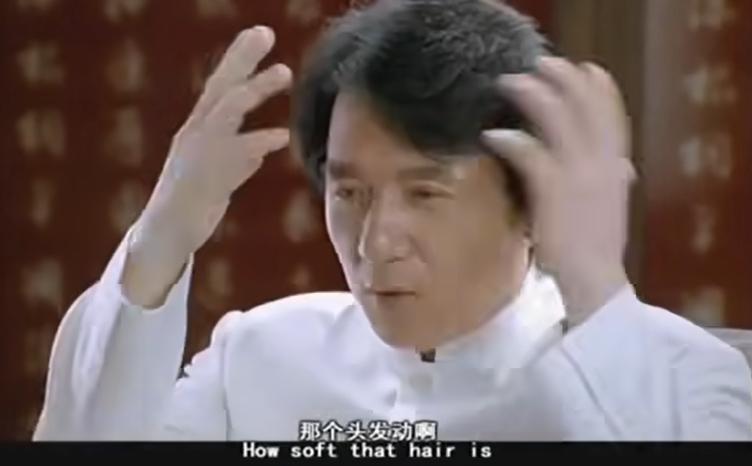
Classic hair care brand Bawang has also successfully entered the young consumer market with the help of Jackie Chan's iconic "Duang" moment, as well as cross-border collaborations with classic IPs such as *Jianwang 3*, *Yesterday's Once More*, and *Meteor, Butterfly and Sword*.
But...
The rapid growth of the market is like a rushing river. It not only brings coolness to the plants and trees on the banks, but also rolls up countless sediment under the riverbed.
Take the hair transplant market as an example. In the face of continuously growing consumer demand, the resources of hair transplant doctors in domestic public hospitals were inevitably limited in the past. At that time, a large number of beauty institutions emerged in the private sector to meet the corresponding consumer demand.
As information transparency continues to increase, consumers will gradually develop a preference for those "standardized operation" chain institutions based on their consumption experience and service quality.
Eventually, a new pattern between "customers and service providers" has taken shape in the market.

According to data from Huaan Securities, in 2020, private institutions took the leading position in the "hair transplant medical service providers" sector with a market share of 85.2%; chain hair transplant institutions firmly occupied the dominant position among private institutions with a 23.9% share.
Counting the chaos in the hair transplant industry
As for the industry chaos, a large number of private institutions and county-level beauty salons have been exposed to disputes such as "poor hair survival rate", "inducing loans", and "changing doctors before surgery".

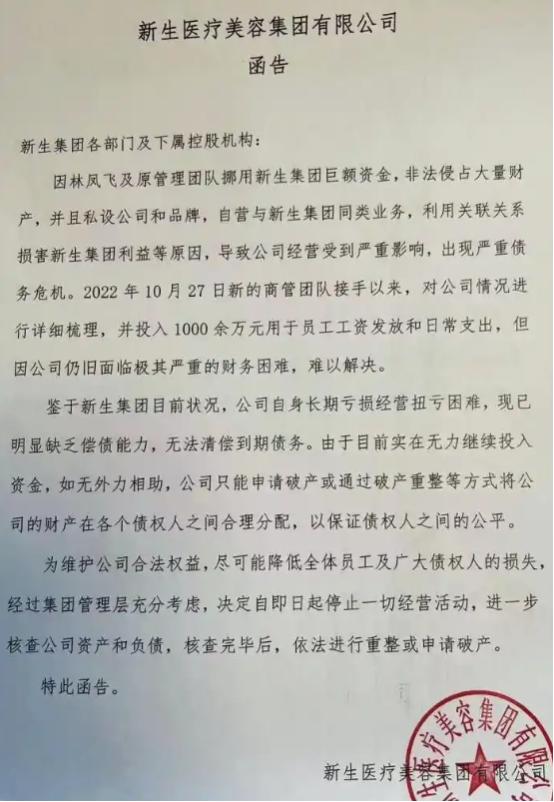
Earlier, Xinsheng Hair Transplant, which was named one of the "Four Major Hair Transplant Brands" alongside Yonghe, Dahua and Biliansheng for its 100-million-yuan annual revenue, also experienced a thunderstorm moment of shareholder disputes and large-scale wage arrears.
"The company has been operating at a loss for a long time and it is difficult to turn losses into profits, and now it is obviously unable to pay its debts."
According to media reports, on January 30, 2023, against the background of employees in many places asking for unpaid wages, Xinsheng Medical issued a relevant announcement, stating that it would enter the restructuring or bankruptcy process after verifying the company's assets and liabilities.
As a senior player in the industry, Xinsheng Group was founded in 2001. In 2011, Xinsheng built a full-link system of "hair transplant + hair care + hair maintenance" for the hair market, and then laid out hair transplant institutions in first-tier cities.

By the end of 2020, Xinsheng Hair Transplant had set up more than 60 chain hospitals in 50 cities across the country, with more than 4,000 employees and a revenue of about 750 million yuan.
Such a thriving enterprise embarked on the path of "shareholder split - rebranding and operating by region - debt crisis - thunderstorm" due to conflicts between shareholders.
In 2026, although the conflicts between shareholders and management have long been ignored, the helplessness of affected employees and consumers facing the drastic changes of the brand still gives a glimpse of the chaos in the hair transplant industry.
"It has harmed thousands of employees in dozens of our branch stores and defaulted on their salaries for several months."
In the report, consumer Mr. Yuan said that the "care package" he bought in installments before the institution went bankrupt still had more than 30,000 yuan of unused service quota.
Although the clinic is empty now, and no one replies to the WeChat messages of the doctors and nurses he added, he still has to repay the installment loan of more than 1,000 yuan every month.
The hair industry may face reshaping
Turning our attention from the hair transplant industry to the adjacent hair care industry, we will find that Bawang Group, which built its reputation on "anti-hair loss" products, did not have a smooth time in previous years.
From 2018 to 2021, Bawang Group recorded losses of 1.196 million yuan, 6.1 million yuan, 4.038 million yuan and 9.084 million yuan respectively.
From 2010 to 2015, Bawang Group recorded losses of 118 million yuan, 559 million yuan, 618 million yuan, 144 million yuan, 117 million yuan and 110 million yuan respectively.
The reasons behind this, apart from the aging of brand image and the loss of consumer mind caused by some public opinion incidents, also include:
The "single blockbuster product" strategy that Bawang pursued in the early days also made its revenue curve overly dependent on a few products. Against this background, in order to get rid of the above predicament, Bawang has built a brand matrix of "Bawang + Zhuifeng + Litao" to tap into diversified markets.
Collaborating with KOLs and co-branding with ACG and anime IPs has further enhanced its popularity and favorability among young consumers.
In terms of data alone, Bawang Group achieved a turnover of 273 million yuan in 2025, a year-on-year increase of 8%, showing a gradual recovery trend.

Whether it is the status of Bawang or the current situation of hair transplant institutions,
Regarding the future trend of the industry, Zhang Yu, CEO of Yonghe Medical, once said: "In the past ten years, China's hair industry has solved the 'hair loss anxiety' problem, with the core of making up for unmet needs; in the next ten years, the core demand we need to solve is 'beautification', which is the most essential difference between the two stages."
This change stemming from strategic direction and market prospects also means that the target customers of institutions and products will gradually expand from the traditional "people with balding crowns" to groups that have aesthetic needs for hairline, sideburns, even eyebrows, beards and other body hair.
To win their favor, in addition to younger operation methods, more standardized service procedures and more transparent terms and conditions, how to make consumers shift from "knowing your brand" to "trusting your brand" is the most critical part that requires the most effort.
After all, the chaos caused by various players in the industry still leaves a strong warning effect for consumers to avoid risks.
References:
National Business Daily: The number of people suffering from hair loss in China exceeds 250 million! The proportion of people losing hair before the age of 30 is as high as 84%, the hair loss age of young people is 20 years earlier, and the hair transplant market is booming
National Business Daily: Hair transplant companies are no longer only targeting "balding crowns"? Yonghe Medical bets on the female market, CEO Zhang Yu: The core demand of the industry shifts to "beautification"
The Beijing News: Net profit shrinks by more than 40%, revenue relies on a single brand, Bawang Group is far from being the "king"
Beijing Business Today: Financial Report Reading | Five consecutive years of losses, anti-hair loss brand Bawang struggles to get out of the trough
True Research Lab: The frugality of the middle class has hit the hair transplant industry hard
Lanjing News: Shareholder disputes, large-scale wage arrears, Xinsheng Hair Transplant is blown down by the "industry trend"
This article is from the WeChat official account "mawen011" (ID: hlw0823), the author is Internet Stories, and authorized by 36Kr for release.