Alibaba is copying Moore, while Tencent is copying itself.
On September 2, both Alibaba and Tencent took separate moves almost at the same time.
Alibaba upgraded its flagship model Qwen3.8-Max to the 0902 version. This model was released and open-sourced only in early August, with an upgrade interval of just one month.
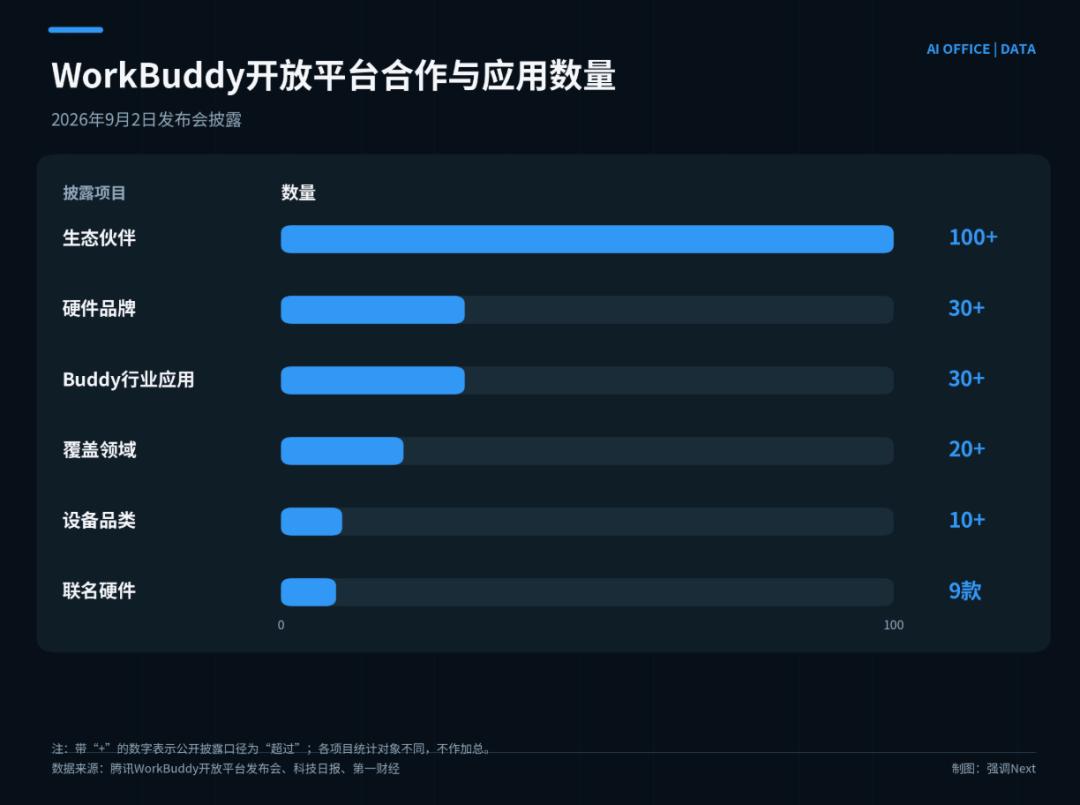
On the same day, Tencent launched the WorkBuddy open platform, opening the underlying capabilities of agents to hardware manufacturers, industry applications and developers. The first batch of partners exceeded 100, and 9 co-branded smart hardware products made their debut on the spot.
One sells models and the other develops office products. It seems that they are doing their own things, but in fact they are two ends of the same account: Alibaba is setting the price for "intelligence", while Tencent is setting the entry point for "work tasks".
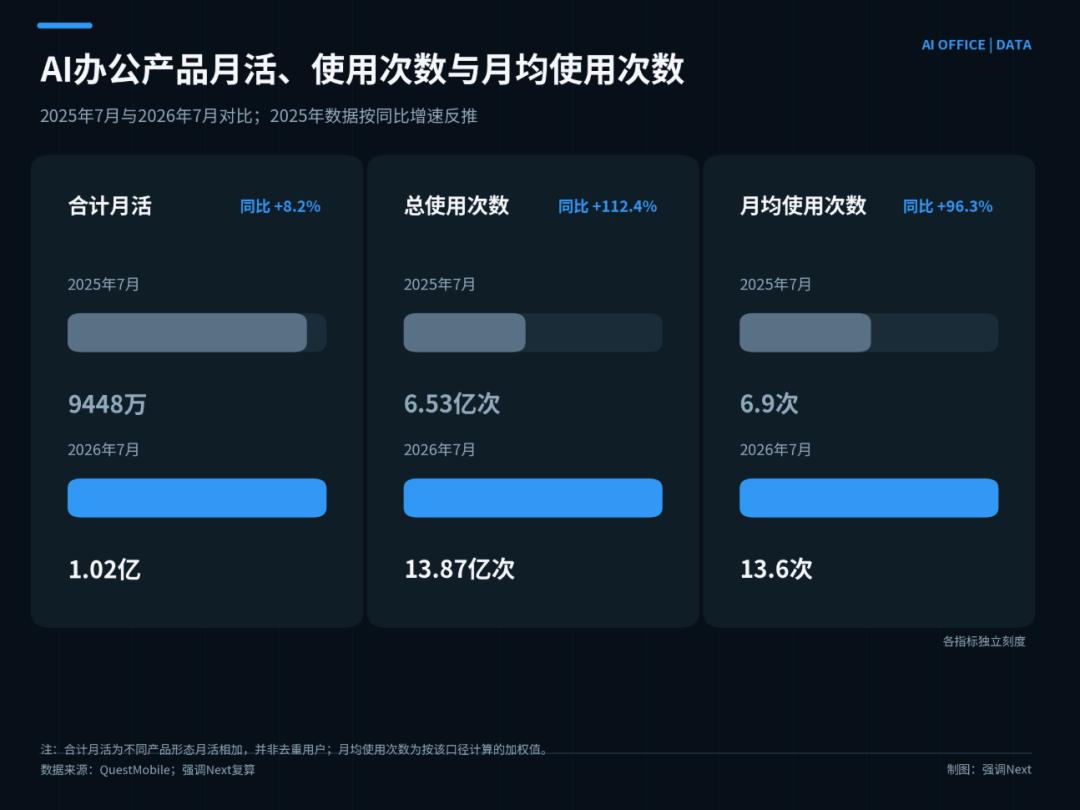
There is a larger background behind this. Data released by QuestMobile the previous day showed that in July 2026, the monthly active users of AI efficiency office reached 102 million, with a year-on-year increase of only 8.2%, but the total number of usage times surged by 112.4%. User growth is slow, while usage depth has doubled.
What Tencent, ByteDance and Alibaba are really competing for is the revenue brought by in-depth usage.
Alibaba has fixed the price of intelligence
Qwen3.8-Max was upgraded just one month after its release, and the iteration cycle of the flagship model has been compressed to "monthly update". This rhythm shows that model companies are using faster version updates to catch up with scenario demands, as scenarios cannot afford to wait for models.
This upgrade does not expand general capabilities either, and post-training is only focused on two scenarios: programming and professional office work (that is, AI collaborates to complete tasks in office scenarios). According to Alibaba's statement, the new version is more suitable for "complex real enterprise tasks, scientific research, and long-cycle tasks", all of which are scenarios that require deliverable results.
Third-party evaluations have given performance data: on the CodeArena list, which specifically assesses the ability of AI to independently deliver complete front-end applications, the score of Qwen3.8-Max has increased to 1691 points, ranking ahead of Claude Opus 5 and Kimi K3, taking the first place on this list. However, this is a special evaluation for the segmented capability of "front-end application delivery", which is not equivalent to a comprehensive ranking of the overall capabilities of the model.
The truly lethal part is the price at this performance level. Alibaba's quoted price averages $5 per million tokens, while on the same cost-performance list, the prices of the second and third highest-performing models are $20 and $12 respectively. The price of Qwen3.8-Max is only about a quarter of its competitors'.
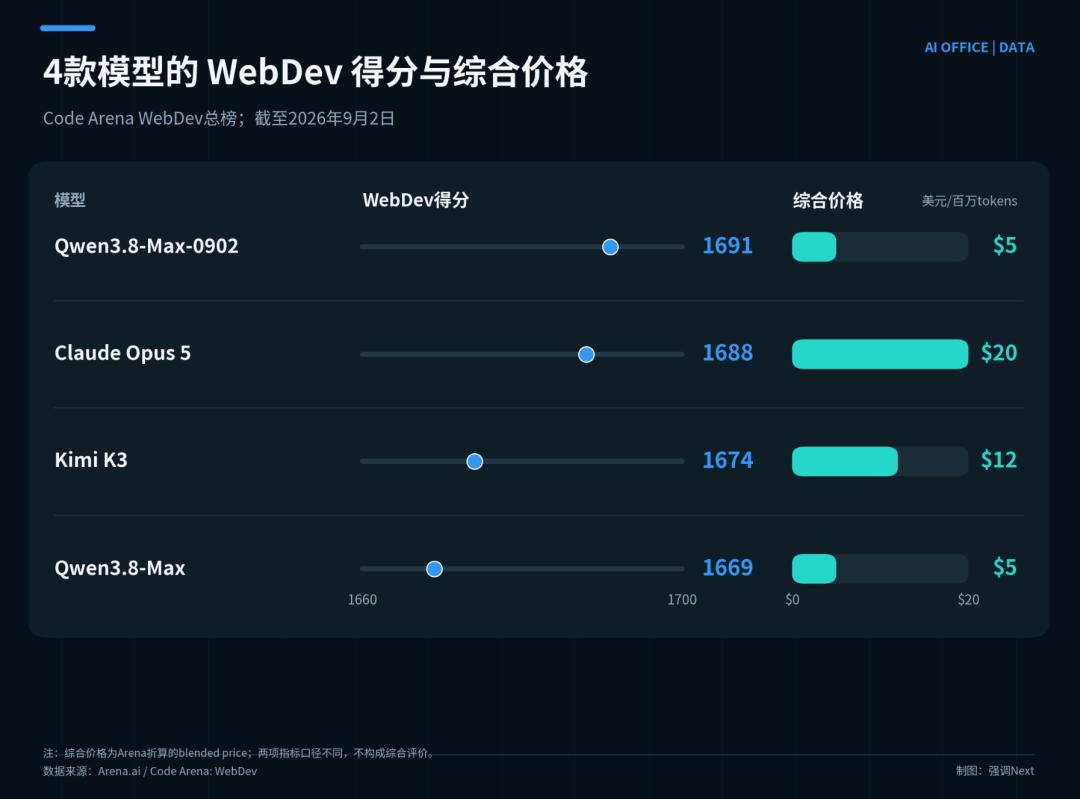
CodeArena refers to this phenomenon as the "Pareto frontier": when a cheap yet powerful model appears on the performance-price coordinate graph, the more expensive models will basically lose their reason to be purchased.
The reason why Alibaba dares to set such a price is that its profit and loss unit for selling models is not tokens, but cloud accounts. Low-priced tokens are customer acquisition costs, and revenue comes from elsewhere: consumption of inference computing power, and contracts for enterprise-level services (SLA, private deployment, compliance).
The open source path follows the same logic: the weights are released for free, but enterprises still need to purchase computing power to run the model. Competitors sell tokens to make money, while Alibaba sells tokens to acquire customers. In this account, intelligence is not a depreciating asset, but advertising expenditure for cloud services.
Tencent brings the operational logic of QQ and WeChat into the office
What Tencent recognized on the same day is another fact: single-point tools cannot beat connectivity.
WorkBuddy is positioned as "an operating system for the Agent era", which does not aim to be a stronger single-point tool, but a platform that carries all tools.
Zhang Jun from Tencent said on WeChat Moments that this is "the same thing" as the "openness" that Tencent launched in 2011.
The WorkBuddy open platform divides openness into three paths.
Hardware manufacturers access five types of touchpoints: "listen, see, record, chat, collaborate", covering more than 30 brands of smart glasses, recording devices, microphones, earphones, keyboards and mice, etc., with 9 co-branded hardware products debuting for the first time. The partners include Plaud, Rokid, Insta360, iFlytek, and Anker. Industry partners build "Buddy applications" based on the base platform, with more than 30 in the first batch, covering more than 20 fields such as finance, law, medical care, and education. Developers can obtain three types of interfaces: Skill, Expert and Connector.
There is a detail in the interface list: MCP and CLI are supported. MCP is an open protocol initiated by Anthropic, and Tencent is an access party. The standards at the protocol layer are in the hands of other parties, and Tencent does not compete for them. What it wants is for all protocols to run on its own account system, distribution network and memory library. The right to define interfaces is layered, and Tencent takes the top layer.
For hardware manufacturers, there is no need to build their own AI or change product forms. One-time access enables multi-terminal interconnection. The other side of the transaction is the entry point: glasses collect information, microphones listen, desktop devices receive instructions, and understanding, planning and execution all return to the WorkBuddy base.
What this set of open mechanisms truly precipitates is actually "memory".
Accounts, task records and work results can be transferred between different devices, and devices can be replaced at any time, but the accumulated work memory cannot be moved. If a user continues to use the platform for three months, the resulting migration cost will exceed the competitive difference of any single function.
However, both the App Store and the WeChat Mini Program ecosystem have gone through similar open platform paths: in the early stage, they attract partners to enter and expand the scale through openness and revenue-sharing preferences. After the scale grows, the game between the platform and ecological partners over traffic distribution, data ownership, and commission proportion often becomes more intense.
WorkBuddy is currently in the early stage of "openness for customer acquisition". It is still too early to draw a conclusion on whether other hardware manufacturers and industry partners outside the conference will be willing to precipitate core scenarios and user data on others' base platforms for a long time, and whether they will worry about being intercepted by the platform in the future.
Tencent dares to open up on the premise that it has already obtained scale advantages.
Since its launch in March this year, WorkBuddy has completed more than 50 version updates. According to the caliber disclosed in Tencent's first-quarter financial report, in terms of the number of daily active accounts, it is currently the most popular efficiency-focused AI agent product in China.
The launch of the open platform, to a certain extent, converts the first-mover scale advantage into industry standards. Whoever becomes the interface first gets to define the rules of the interface.
Users have already cast their votes
Why are the two directions of price and entry point chosen? QuestMobile's report on September 1 gives the market-level answer.
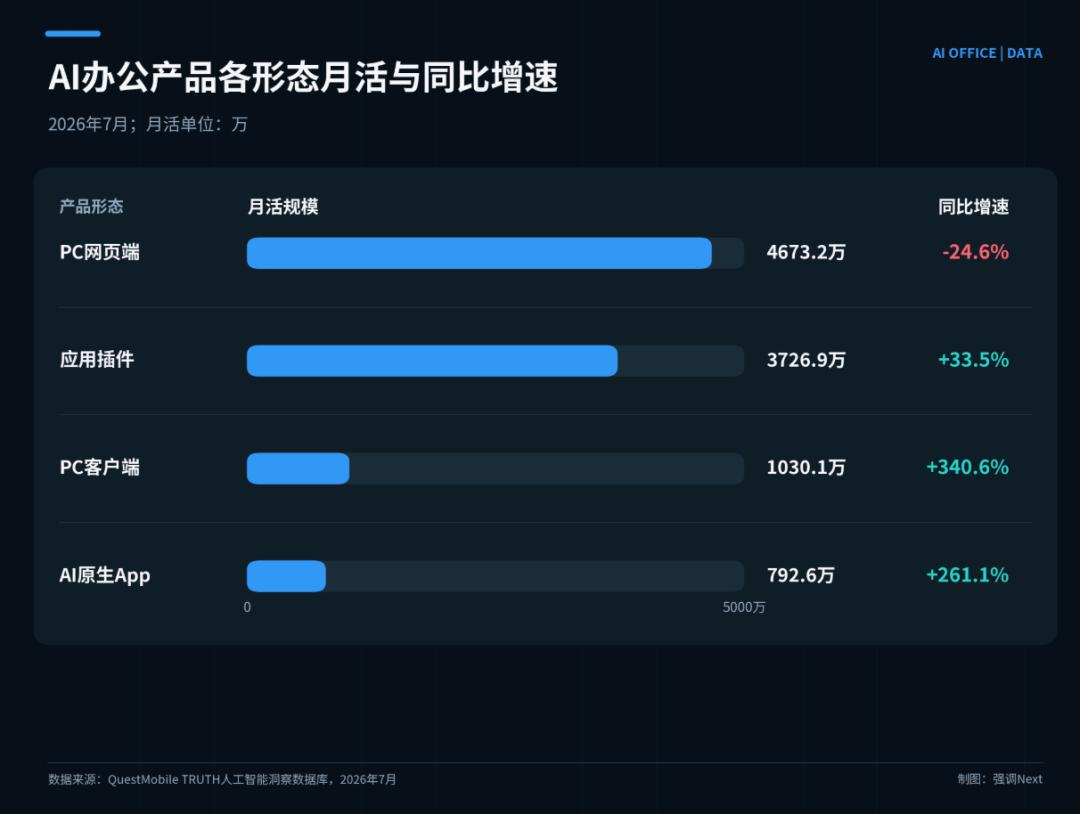
In July, the user scale of native AI office apps increased by 261.1% year-on-year, and the user scale of PC clients increased by 340.6% year-on-year. The fastest growing part is precisely the PC side oriented to work scenarios.
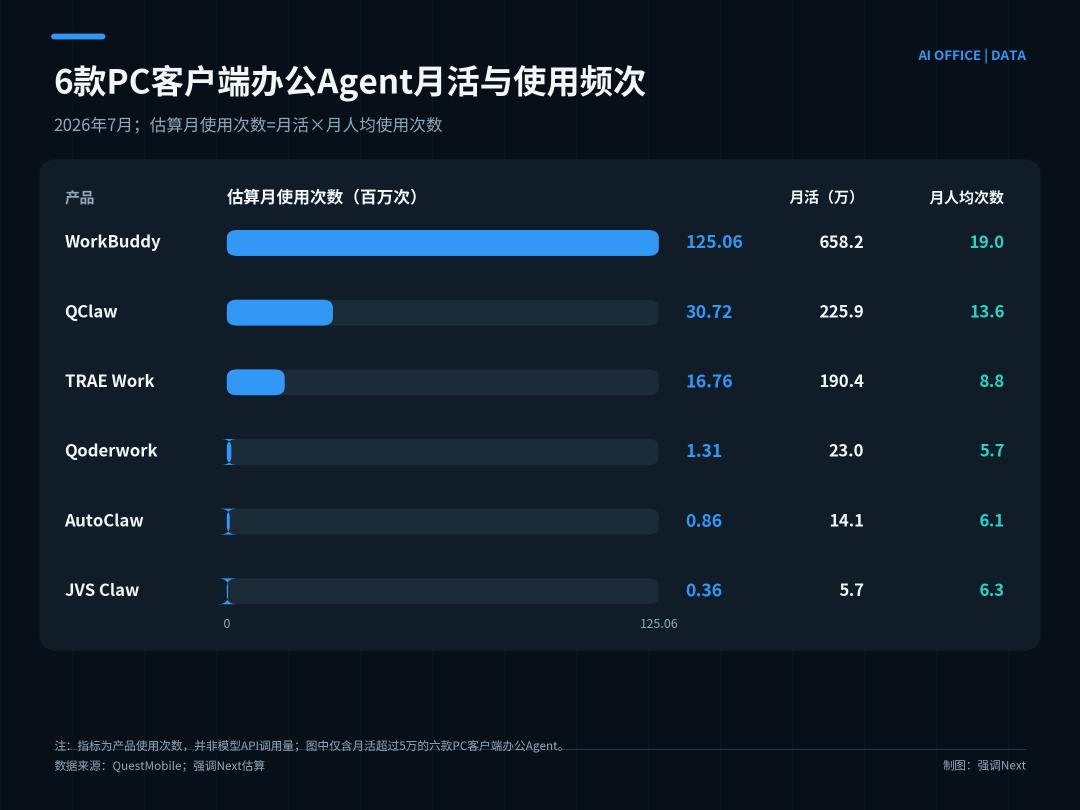
The monthly average usage times per user can better illustrate the problem: the monthly average usage of WorkBuddy's PC client is 19 times per user, and that of another Tencent product QClaw is 13.6 times. Calculated based on 22 working days a month, WorkBuddy users open the product almost once every working day.
Combined with the monthly active volume of 6.582 million, it is estimated that the monthly usage volume of WorkBuddy is about 125 million times, with more than 4 million times per day on average (estimated, based on QuestMobile's PC client caliber in July 2026).
This is not the usage pattern of chatbots like Doubao. Tools are things that people only think of when they have problems, while usage frequency is a signal of habit. Once a habit is formed, the migration cost will rise.
From the overall pattern, the Tencent ecosystem (WorkBuddy, QClaw) is currently in the leading position, followed by the Douyin ecosystem (TRAE Work). The Alibaba ecosystem does not have a single hit entry at present, and mainly relies on the combination of Qwen Office and DingTalk for implementation.
The surface architectures of the three companies have converged, but they actually have their own starting points: Tencent anchors personal productivity and connectivity, Alibaba anchors DingTalk's organizational processes, and Douyin overlays Doubao's traffic with Feishu's knowledge base.
The value of an entry point depends on which budget it reaches
Alibaba turns intelligence into a cost item, while Tencent turns intelligence into fuel. The common point is that neither of the two companies makes money from the model itself anymore.
The PC era went through the same value migration.
Intel made chips cheaper generation by generation, and Moore's Law ate up the profits from selling hardware. Microsoft turned the entry point into a long-term business. Later, long-term profits further concentrated in the application layer and enterprise process layer: Office earned the money from applications, and SAP earned the money from processes.
Value migrates upward along the path of hardware, system, application, process, and each layer has higher stickiness than the previous one.
AI office is retaking this path, and this time the giants understand it from the very beginning: Alibaba holds both the model and DingTalk at the same time, Tencent holds both the entry point and the application ecosystem, and neither of them intends to stay only at a single layer.
There is another harder constraint for the entry point competition: budget.
Individuals pay small sums to save time, but the payment rate and unit customer price of membership fees cannot support the valuation of the entry point. Enterprises pay large sums for results and processes, and the budget is written on the procurement order.
Tencent anchors personal productivity, with 6.582 million monthly active users to cultivate habits first, and its monetization relies on the leap of individual payment rate. Alibaba anchors organizational processes, with DingTalk directly connected to enterprise budgets, betting on penetration rate. Both types of entry points are appreciating, but their appreciation logics are completely different. The end with budget has a ceiling an order of magnitude higher.
A deeper problem lies on the organizational side. When the cost of an intelligent call approaches the cost of electricity, the competitiveness of an enterprise no longer depends on how much intelligence it owns, but on its ability to organize work into tasks. Breaking down vague demands into tasks that AI can deliver is becoming a new management skill. When this day comes, what will be rewritten is not the toolbar, but the cost structure of the organization.
The outcome of the price war will probably be known in three months, while the outcome of the entry point competition will take three years to come out.
The only really important question right now is: when AI actually starts working, will enterprises and users be willing to pay for "being smarter", or for "being more convenient and more worry-free"?
Every renewal and subscription of users will be their respective answers.
Note: The data in this article comes from public reports and materials, and does not constitute investment advice.
This article is from the WeChat official account "Emphasis Next" (ID: leo89203898), author: Qing Yun, editor: Xiao Bai, published with authorization from 36Kr.