Even tenbaggers will grow old, there is always someone in the prime of youth.
Last year, the investment circle spawned a widely spread meme: the Old Generation, the Middle Generation, and the Young Generation.
Originally a term describing intergenerational differences, it was quickly adopted by investors to refer to stocks, bearing distinct imprints of the times: the Old Generation mainly covers traditional industries such as baijiu and infrastructure construction, focusing on value investment; the Middle Generation includes non-ferrous metals, power equipment, and biomedicine, balancing value and growth; the Young Generation refers to cutting-edge technology sectors including AI, computing power, semiconductors, robotics, communications, and media, which are driven by technological disruption and future imagination space.
The meme is new, but the logic behind it is long-standing. Dividing stocks by generational attributes essentially answers one question: What kind of era narrative are people willing to pay for with their capital at the moment?
The main investment line has always kept pace with the pulse of the times. Since 2000, the main line of the A-share market has undergone several changes, and each shift is deeply tied to the guidance of national policies and the transformation of the economic structure. The so-called main line is itself part of the consensus — we are immersed in the torrent of the times, and thus share a common destiny with the era.
The Relay of Main Lines: From "Cycle Supremacy" to "Technology Leadership"
Looking back over the past two decades, the main line of the A-share market started from "Cycle Supremacy", went through the "Rise of Consumption", and now has fully shifted to "Technology Leadership". Behind these three keywords lie five successive stages of relay.
Stage 1: Infrastructure Cycle (2000–2010), the era of rapid urbanization.
The core driving force of this stage was industrialization and urbanization after China's accession to the WTO. The main investment line revolved around pro-cyclical sectors. The inflation driven by infrastructure construction and the sharp increase in financing demand were the main themes. Steel, coal, petrochemicals, non-ferrous metals, and finance (banking) took turns leading the market, which were dubbed the "Five Golden Flowers" by the market, and this period was known as the era of "Cycle Supremacy".
Evidence of this can be found everywhere: China Merchants Bank was among the top ten heavily held stocks of public funds for 9 consecutive years from 2002 to 2010; the market value of Baoshan Iron & Steel held by public funds at the end of 2007 reached as high as 39.388 billion yuan; while Anhui Conch Cement is the most representative 10-bagger stock in the heavy chemical industry cycle, widely known as the "Baijiu of the Cement Sector" in the market.
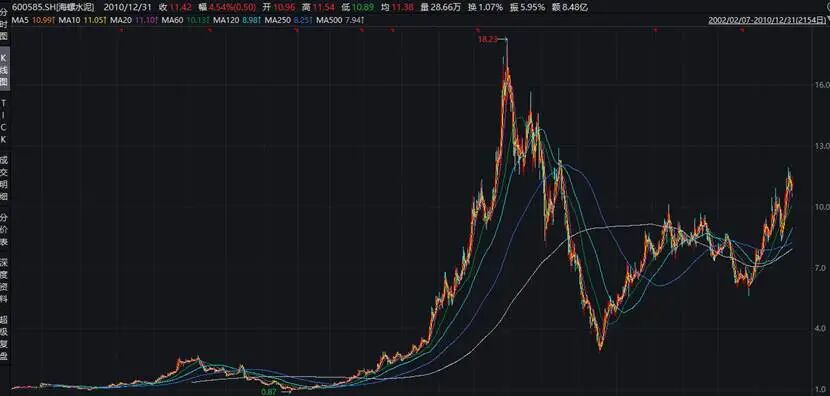
Figure: The stock price trend of Anhui Conch Cement from its listing in 2002 to the end of 2010 (forward adjusted)
Stage 2: Mobile Internet Cycle (roughly 2010–2015).
If the Internet around 2000 was still in the PC era, with the popularization of smartphones — marked by the release of the iPhone in 2007 and the launch of the Android system in 2008 — the world officially entered the widespread mobile Internet era after 2010, and saw its real explosive growth during 2010–2015.
Representative industries were TMT and downstream Internet applications, corresponding to a large number of players such as the Apple industrial chain, Tencent, NetEase, and East Money. In the bull market from 2013 to 2015, the TMT sector became the most dazzling star, and the industrial logic also completed the shift from hardware manufacturing to Internet applications.
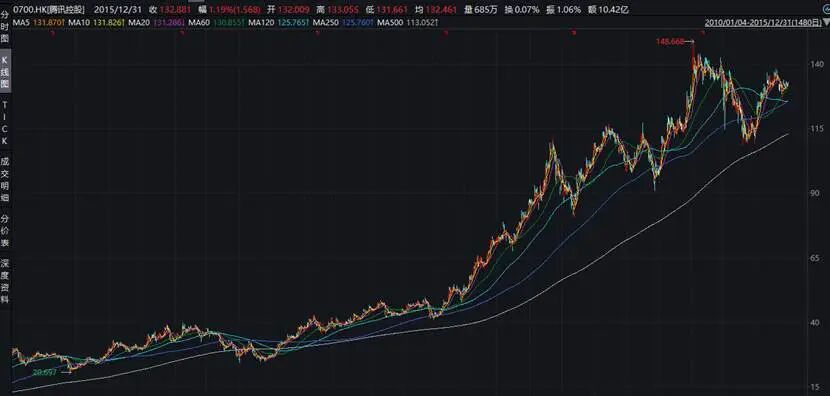
Figure: The stock price trend of Tencent from 2010 to the end of 2015 (forward adjusted)
Stage 3: Consumption Upgrade Cycle (roughly 2010–2020).
With the continuous increase in residents' income levels, domestic demand took over as the new driving force for economic growth. The main investment line focused on profit quality and cash flow stability, and leading consumer companies rose collectively. Representative industries were food and beverage (especially baijiu), home appliances, and pharmaceutical biology.
The heavily held stocks of public funds fully shifted from "cyclical sectors" to "consumer sectors". In this decade, the consumer sector produced a batch of 10-bagger stocks in 10 years: Kweichow Moutai was the benchmark, and Haitian Flavouring & Food was the sample; in the post-real estate cycle era, Oriental Yuhong in the building materials track also delivered a return of more than 10 times.
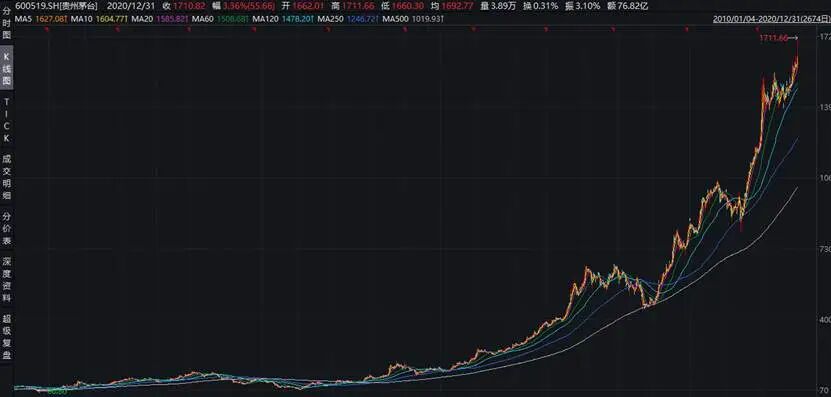
Figure: The stock price trend of Kweichow Moutai from 2010 to the end of 2020 (forward adjusted)
Stage 4: New Energy Industry Cycle (roughly 2020–2022).
In September 2020, China put forward the "Dual Carbon" goal — peaking carbon dioxide emissions before 2030 and achieving carbon neutrality before 2060. Coupled with technological breakthroughs in new energy vehicles, photovoltaics, and wind power, the main investment line revolved around the energy revolution, with new and old energy sectors taking turns leading the market, and core targets focusing on the new energy vehicle industrial chain, photovoltaics, and wind power.
CATL is the strongest representative of this cycle, and the market even jokingly called the leading new energy companies the "Ning Portfolio". The power of the cycle is evident: once the industrial narrative becomes a consensus, capital will vote with its feet.
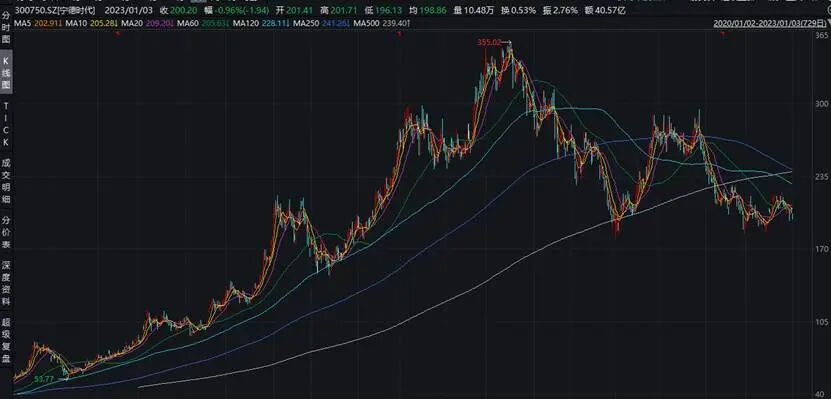
Figure: CATL's cumulative increase from 2020 to the end of 2022 was nearly 3 times, with the highest point nearly 6.5 times (forward adjusted)
Stage 5: Artificial Intelligence Industry Cycle (2023 to present).
Marked by the release of ChatGPT at the end of 2022, artificial intelligence ushered in its "iPhone moment". The explosive growth of large models first drove AI hardware and power sectors into a long-cycle large-scale investment era, with the core still following the logic of "AI shovel sellers"; as for downstream applications, revolutionary products have not yet emerged, and the profit model still needs to be verified.
Technology and high-end manufacturing have thus become the latest main line of heavy holdings for public funds. The computing power industrial chain represented by the "Yi Zhong Tian" concept has achieved a Davis double-click on performance and stock price — the stock price of Innolight Technology increased by more than 30 times in the three years from 2023 to 2025.
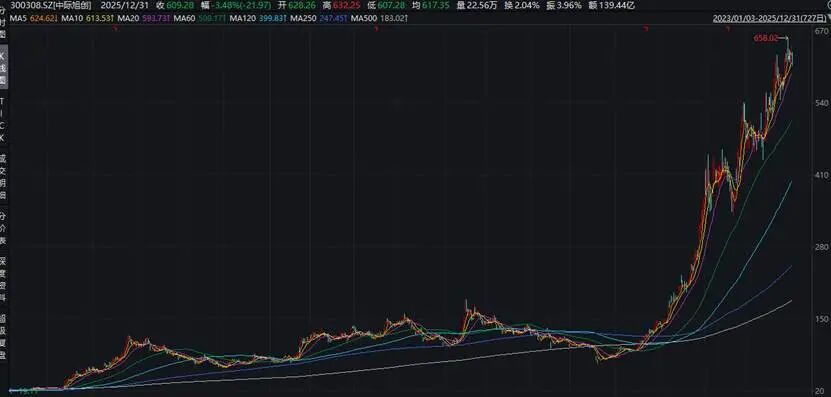
Figure: The stock price trend of Innolight Technology from 2023 to 2025 (increase of more than 30 times)
The current confusion also follows: if downstream applications cannot find a profitable model for a long time, will capital reduce investment in AI hardware, thus breaking the shortage logic of GPUs, CPUs, and storage? This is the suspense left by this round of cycle to the market.
The Relay of First-Generation Entrepreneurs: Every Generation of Entrepreneurs is a Respondent to the Times
When we shift our perspective from the main trading line of the market to the perspective of founders, we will find another equally clear intergenerational clue — the post-90s generation has begun to show their prowess.
Unitree Technology was listed on August 19, 2026, with its stock price surging to a maximum of 1100 yuan on the first day (of course, it has now retraced most of that gain). It only took 10 years from its establishment to listing — its founder Wang Xingxing is a post-90s. Liu Jingkang, the first-generation entrepreneur of Insta360, who competes with DJI, is also a post-90s.
The success of every generation of entrepreneurs is essentially a precise response to the needs of the times they live in.
The generation born in the 1940s ushered in the reform and opening up in the 1990s in their prime, seized the opportunity of "growing from scratch" in the shortage economy, and were mostly engaged in light industries closely related to people's livelihood — textiles, food and beverage, home appliances, mostly starting their businesses in the manufacturing sector.
The classic case in business school classrooms is the footnote belonging to them: Zhang Ruimin of Haier smashing defective refrigerators. In an era of material shortage and undersupply, a refrigerator was priced at 800-1760 yuan, equivalent to more than two years' salary of a worker. During a surprise inspection of the warehouse, Zhang Ruimin found that 76 out of more than 400 refrigerators in stock had quality problems such as scratches. He overruled all objections and smashed all of them. With one hammer blow, he awakened the quality awareness of the whole factory, and created the brand premium of Haier.
For the generation born in the 1950s, most paths to rapid wealth accumulation point to the real estate and related industrial chains. They have gone through the complete cycle of real estate from germination, prosperity to decline. As the heavy industry and infrastructure sectors entered their golden age in the 21st century, they were mainly involved in heavy asset fields such as real estate and building materials.
The compound interest of the generation born in the 1940s and 1950s essentially came from the leverage of bank loans and the era dividend of explosive growth in material demand.
The generation born in the 1960s and 1970s grew up after the resumption of the college entrance examination, and after graduation, they successively encountered the reform and opening up and the Internet bubble. They are veritable cross-era beneficiaries, and have made achievements in both traditional and emerging fields. Most of the first-generation entrepreneurs in this period are concentrated in the Internet industry — Tencent, Baidu, and Alibaba are all products of this generation.
The generation born in the 1980s grew up in a period of upward economic cycle. For those who can become first-generation entrepreneurs, high education is only the basic requirement. Essentially, they quickly built their business empires with the help of the mobile Internet, relying on innovative models such as algorithm recommendation and social fission: Zhang Yiming of ByteDance, Huang Zheng of Pinduoduo, and Liang Wenfeng of DeepSeek are all samples.
The compound interest of the generation born in the 1960s to 1980s came from the amplification effect of globalization and Internet traffic, and the speed of wealth creation was shortened to be calculated in years.
So what about the post-90s generation?
Gen Z are digital natives: they were born with the PC Internet, and embraced the mobile Internet when they reached adulthood, with almost innate intuition for algorithms, AI, and virtual interaction. Their consumption concept is both rational and perceptual — they have shifted from brand worship to emotional value, and love ACG, comic conventions, and blind boxes; on the other hand, they are extremely pragmatic, and carefully plan their daily consumption.
Their greatest competitive advantage is the innovation capability under high-intensity knowledge iteration, and the insight into emotional value. In the past, entrepreneurship relied on "exchanging resources for market" (the generation born in the 1950s and 1960s), then relied on "exchanging traffic for growth" (the generation born in the 1970s and 1980s), and future entrepreneurship will rely on "exchanging technology for barriers", using "aesthetics" and "emotional value" to deepen the moat: what Pop Mart sells is not plastic toys, but "the pleasure of collection and emotional projection"; Unitree's robots are not just tools, but "cyber pets".
The underlying logic of the business world is shifting from "capital hiring technology and creativity" to "technology and creativity selecting capital".
The Tickets of the Times Belong to Those Who Travel Light
"Chat with AI instead of chatting with humans", "Deactivate WeChat and switch to Doubao". Opinions vary, but the core is consistent: iterate your thinking, fully embrace AI, cut redundant parts, and fully bet on the future.
Each generation has its own Long March.
Only when young people take a different path from their predecessors can the society make progress, and it is long-term progress. From the perspective of founders alone, I believe we will see more and more enterprises founded by post-90s first-generation entrepreneurs land on the capital market and continue to grow and expand.
After all, the main lines rotate and generations replace each other, but the rule that the times issue tickets has never changed — it only issues tickets to those who travel light and see the direction of the tide.
This article is written based on public data, for information exchange only, and does not constitute any investment advice
This article is from the WeChat Official Account "Jinduan" (ID: jinduan006), Author: Qing Yu, published with authorization from 36Kr.