Cook has stepped back behind the scenes, and the Apple that Ternus takes over is a bit of a hot potato.
The challenges facing John Ternus go far beyond just making profits.
On September 1, Tim Cook stepped down as CEO of Apple and took the position of Executive Chairman of the Board of Directors. On the same day, Apple's official website updated its leadership roster, confirming that John Ternus took over the CEO role and joined the board of directors. This marks the second truly smooth power transition in Apple's history.
Cook posted two public messages to bid farewell, including a thousand-word all-staff letter. He specifically pointed out that what he is most proud of is "something that can never be recorded in financial reports" — the corporate culture of using technology to make the world a better place, which he called "culture conquers everything".
He mentioned Steve Jobs again and quoted his classic line: "leave a dent in the universe".
When talking about his successor, Cook spoke extremely highly of Ternus, stating that Ternus knows exactly how to build world-changing products, and he feels utterly at ease to hand the company over to him. He also attributed all the achievements the company has made in the past 15 years to the entire team.
Prior to this, Apple had already held a farewell party for Cook. On August 23, a send-off event with more than 200 attendees was held at Apple Park. Jobs' widow, former COO Jeff Williams and other guests were present, and Ternus also took the stage to deliver a speech to bid farewell to Cook.
After Apple's leadership change was finalized, Apple's closing price rose by 2.61%, adding 120 billion U.S. dollars to its market value in a single day. The feedback from the capital market was restrained, yet very positive.
Obviously, this transition has been in the works for a long time. Cook will not leave the core of power, and will continue to handle global government relations and major strategic affairs.
This arrangement is very similar to the dual-core governance model of Amazon's "Bezos-Jassy". At the same time, veteran Phil Schiller stepped down from his positions related to the App Store and product launches, marking the start of the systematic exit of the core team from the Cook era.
Steve Jobs gave Apple its soul, Tim Cook gave Apple its physical strength, and now it is the turn of a mechanical engineer with 25 years of working experience at the company to install a new brain for Apple.
In the past, the outside world cared about whether Apple could continue to make profits, but this proposition has now changed: can Apple still bring new surprises to the whole world? Can Ternus tell a new compelling story?
The Cook Era: The Best Commercial Era, The Worst Innovation Era
The "family fortune" Cook left for Ternus can be called a miracle in any company.
First, the profit-making capability. Apple's market value rose from 350 billion U.S. dollars to 4.6 trillion U.S. dollars, and briefly touched 5 trillion U.S. dollars this year; its revenue increased from 108 billion U.S. dollars to 416 billion U.S. dollars, nearly quadrupling in 15 years. At the 2026 Berkshire Hathaway Annual Shareholders Meeting, Warren Buffett praised Cook for inheriting Steve Jobs' legacy.
Then the business ecosystem. During Cook's tenure, the revenue of the service business has exceeded the total profit of the entire Apple when he took over. Relying on the dual engines of "hardware + software services", Apple got rid of its dependence on a single hardware product.
Product categories and technologies are also very solid. Apple Watch and AirPods have grown from concepts to the top two wearable products in global shipment volume, and the number of active devices has increased from 300 million to 2.5 billion; self-developed chips are the most undervalued legacy of the Cook era. The M-series and A-series self-developed chips have transformed Apple from an "assembly plant" to a technology leader, with gross profit margin staying above 40% all year round.
What supports all these achievements is operational discipline. Cook built the supply chain into an industry benchmark, compressing the inventory cycle from 30 days to 6 days. He himself gets up before 4 a.m. every day to process user emails and works out at 5 a.m., embedding this set of disciplines into the company's DNA.
But "being the largest" does not mean "being the fastest", and Cook also left a huge "unfinished debt".
Apple lags far behind in AI, falling behind the industry in almost all aspects. The root cause lies in Apple's long-term R&D logic of "hardware first, software conservative". The AI team lacks independence, and the iteration rhythm is too slow to keep up with the fierce competition in the industry.
Siri was born 12 years earlier than ChatGPT, but it became a laughing stock in the generative AI wave; Apple Intelligence was delayed twice, and a large number of core talents of the AI team left, leading to continuous setbacks in the internal R&D rhythm.
Hardware innovation has also become dull. Typical examples include Vision Pro, which maintains a high price tag and receives less-than-expected market response; Apple spent tens of billions of dollars on the car-making project over ten years, but finally made no splash at all; HomePod has been adjusted for many years, but it has never gained widespread popularity. Even though Cook launched hit products such as AirPods and Apple Watch, none of them reached the height of the iPhone.
More critically, Apple's growth narrative has already hit a ceiling. The 4-trillion market value is tied to the market expectation of "sustained high growth", but the global consumer electronics market has long been fully saturated, and Apple has failed to develop a brand new growth curve for a long time.
The service business is no longer a stable ballast either. In the third quarter of fiscal year 2026, the revenue of the service business increased by 12% year-on-year, lower than market expectations, while the total revenue growth rate in the same period was 16%.
Cook's core competence is large-scale implementation and optimization of mature products, he is good at maintaining the basic market and amplifying existing value, but he is not good at subverting from scratch and breaking through across boundaries.
He spent 15 years polishing "the coolest tech company" in the Steve Jobs era into "the most profitable tech company", but he appeared conservative and slow when the AI era arrived.
He probably knows very well in his heart that he has proved everything that financial figures can prove; what cannot be proved by numbers can only be left to the next successor.
This also belongs to the "things that cannot be recorded".
The Apple Ternus Took Over Is a Very Tricky Hand
At present, Apple's product capability, supply chain management and user ecosystem are still far ahead of most of its peers. But the situation Ternus faces cannot be summed up simply as a "smooth transition". I divide it into three levels:
Strategic level: Making up for AI lessons and building new growth curves determine what Apple's next story will be.
First of all, Apple needs to catch up on AI development, as hardware progress is now restricted by software. Many internal hardware projects at Apple have completed local polishing, but are stuck at the AI part. The camera-equipped AirPods and flagship smart home devices are all waiting for the "birth certificate" of the new version of Siri AI.
After the self-developed large model route suffered setbacks, Apple paid to introduce Google Gemini as the underlying base, which will be fully rolled out in September to directly compete with ChatGPT. Ternus' idea is very clear: embed the AI's environmental perception and interactive capabilities into Apple's mature hardware matrix, and take the route of integrating hardware and AI.
As for the growth curve, Apple is shifting from a single hit product to an "AI + full hardware family bucket" model. In the short term, the first foldable iPhone is expected to drive replacement demand and increase gross profit margin; the MacBook Neo breaks the high-end pricing strategy at 599 U.S. dollars, with 1.1 million units shipped in the first three weeks after launch, proving that the cost-effective route has market space.
In the medium term, the smart glasses codenamed N50 is planned to be launched in 2027, and camera-equipped AirPods and smart home security systems are all in the R&D pipeline.
In the longer run, home displays connected to robotic arms, wearable camera pendants — Ternus is trying to build an AI terminal network covering all personal portable and home indoor scenarios.
The future of Vision Pro will most likely be marginalized. Ternus has a cold attitude towards head-mounted devices. If the market of this category continues to be sluggish, it is almost inevitable to shrink resources and shift R&D focus to AI-native hardware.
Execution level: Management reshuffling and supply chain crisis determine whether Ternus can turn the story into reality.
The management is undergoing large-scale reshuffling, as veterans are leaving and new members are urgently needed to fill the positions. Phil Schiller's stepping down is just the beginning. In the next few years, Apple's management may see a 50% personnel turnover, and veterans including Srouji, Joswiak and O'Brien are expected to retire one after another. What is more troublesome is that competitors are poaching talents: for example, hundreds of former Apple employees have joined the hardware department of OpenAI, and brain drain has become a real threat.
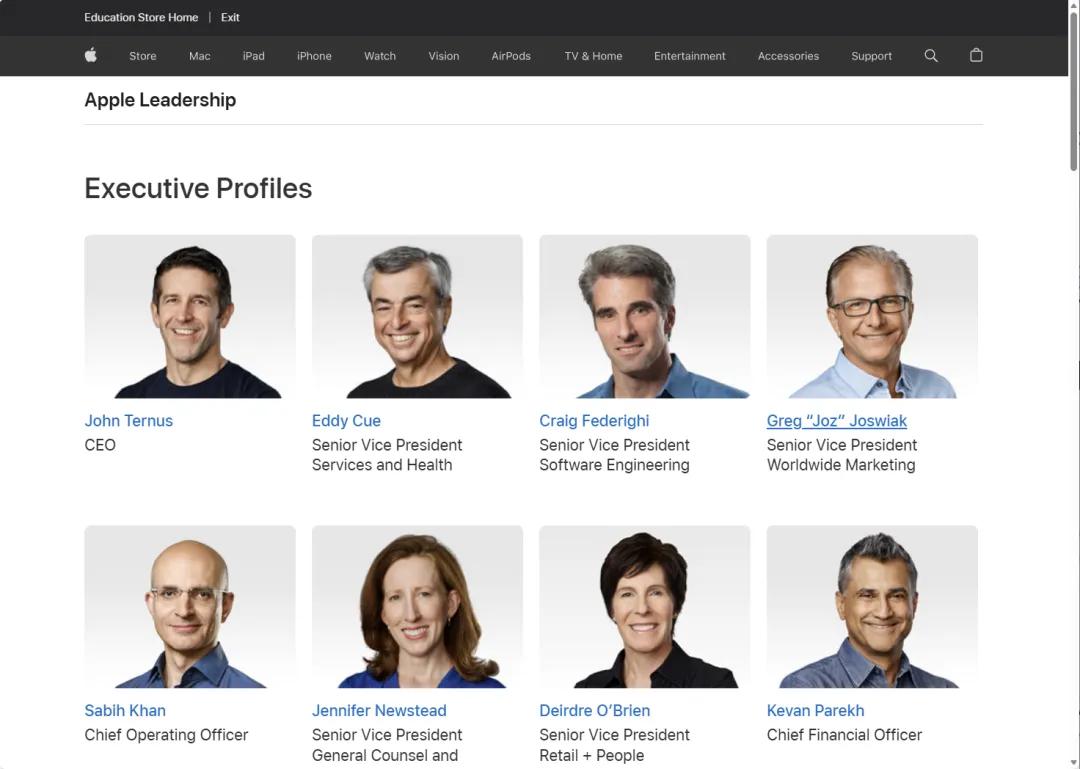
Apple's new management team Source: Apple official website
Veterans are leaving and new people are joining, and organizational turbulence during the transition period is the most headache for every new CEO.
The supply chain is also a tough battle, which is exactly the short board of Ternus, who is an engineer by training. The supply of memory chips is tight, and the construction of AI data centers is taking up production capacity. Cook described this round of price increases at the earnings meeting as "encountering a once-in-a-hundred-year flood", and Apple has raised the prices of many iPad and Mac models.
Cook, who was deified for his supply chain management capability, just handed over the baton, and the new CEO encountered this test on his first day in office, forming a sharp contrast. He can only rely on COO Sabih Khan, CFO Kevin Parekh and head of services Eddy Cue to fill in the gaps to get through this difficulty.
Constraint level: The 33x P/E ratio determines how much time and fault tolerance space Ternus has.
Apple's current P/E ratio is about 33 times, far higher than the average of 23 times in the past ten years. The market has paid a high premium for Ternus' reform expectations.
This is equivalent to saying: We believe you can create the next iPhone, but you'd better do it as soon as possible. If you cannot launch a landmark new product within three years, the 4.6-trillion market value will face re-pricing.
Its essence is the temperature difference between the market's eager expectation for Apple's next great product and the real bottleneck.
In addition, Ternus' salary is also amplifying this pressure. His base annual salary of 3 million U.S. dollars and maximum annual equity reward of 55 million U.S. dollars make his total compensation higher than that of Cook. The extremely high expectations from the market and shareholders leave him little time and space for trial and error.
Can Ternus Build His Own Era?
Now, all these "tricky" problems are weighing on this 50-year-old bachelor of mechanical engineering.
He has been at Apple for 25 years, and he has only done one thing: hardware engineering. He has been deeply involved in almost all core hardware products, including iPad, Mac, AirPods, Apple Watch and Vision Pro.
Cook's description of him is far more interesting than "very approachable". He said Ternus is an "elevator person": he can see the overall situation clearly from 30,000 feet in the air, and he can also go deep into the ground to tackle the precise details of problems.
Foreign media describe him as approachable and well-liked. He has long worked in the open office area side by side with engineers, and often organizes colleagues to participate in cross-country rally activities.
His graduation project was a "mechanical feeding arm" for patients with quadriplegia. This means that the core concept of "engineering serving people" was established when he was only 22 years old.
Ternus' first project at Apple was the Cinema Display monitor. He fought with suppliers over the number of screw grooves on the back, arguing over whether it should be 35 or 25, and refused to compromise. He called it "something that looks abnormal, but is the right thing to do".
He also completed a major cross-departmental initiative: he once convinced software chief Craig Federighi to develop the independent iPadOS for iPad, breaking down the wall between hardware and software.
If we look at the three leaders together: Steve Jobs is a genius designer who defines products by intuition and aesthetic standards; Tim Cook is an operation master who amplifies value through efficiency and scale; Ternus is a "tough engineer with a warm heart", who not only understands the underlying logic of hardware, but also believes that technology ultimately serves people.
Apple in the AI era exactly needs this kind of person, who can turn cold technology back into products that make people scream with excitement.
Of course, his shortcomings are also obvious: he has limited practical experience in finance, sales, legal affairs, government relations and procurement.
Fortunately, he has very strong cards in his hand. For example, 140 billion U.S. dollars in cash and marketable securities leave enough ammunition for new business trial and error. 2.5 billion active devices plus a closed ecosystem is the most unique platform for AI terminal monetization. The self-developed M-series and A-series chips provide a foundation for the integration of hardware and AI, and Cook will also "see him off and support him for a while".
In my opinion, whether Ternus can define his own era, in addition to solving the tricky problems mentioned earlier, there is another hidden challenge: how Ternus handles the relationship with Cook.
There is a detail that can illustrate this point. When Cook took over from Steve Jobs, he never moved into Jobs' office. That room has been locked and dark until now; Ternus is expected to directly use Cook's office.
The balance between "respecting the predecessor" and "establishing one's own authority" is a test harder to handle than any product. Under the dual-core power structure, how much real authority does the new CEO have? It only needs one judgment: whether he dares to make the final decision when facing differences.
But it is certain that the Cook era will not end quickly with the change of positions. His influence will still "hang over" Apple for a long time, which will make every step Ternus takes carry the mark of his predecessor.
This farewell is destined to last for a long time, more like a process of symbiosis and transcendence.
For Ternus, he does not have to copy Steve Jobs, nor does he have to completely follow the path Cook took. Just like when Cook took over as Apple CEO, Steve Jobs said to him, never ask "what would I do if I were you", just go and do the right thing.
The same goes for Ternus. He only needs to prove to the world that in the AI era, Apple is still "the greatest company in the world", and still has the capability to launch blockbuster products that make the whole world hold its breath.
The answer may be revealed for the first time at the conference on September 9.
But no matter what the result is, Apple in the Cook era will always be remembered. This somewhat tricky family fortune is handed over to Ternus, and his era has just pressed the start button.
References:
Jiupai News, "Apple's new CEO has an annual salary higher than Tim Cook"
Tencent News, "Apple's new CEO John Ternus releases first internal letter: Thank Tim Cook, the big test is coming next week"
This article is from WeChat official account "Tang Chen Students", author: Tang Chen, published with authorization from 36Kr.