Tencent WorkBuddy Open Platform Goes Online, Agents Extend to More Work Scenarios
By Li Zhaofeng
Yesterday, Tencent WorkBuddy Open Platform was officially launched. This marks the first full disclosure of its open ecosystem strategy since WorkBuddy was released in March this year.
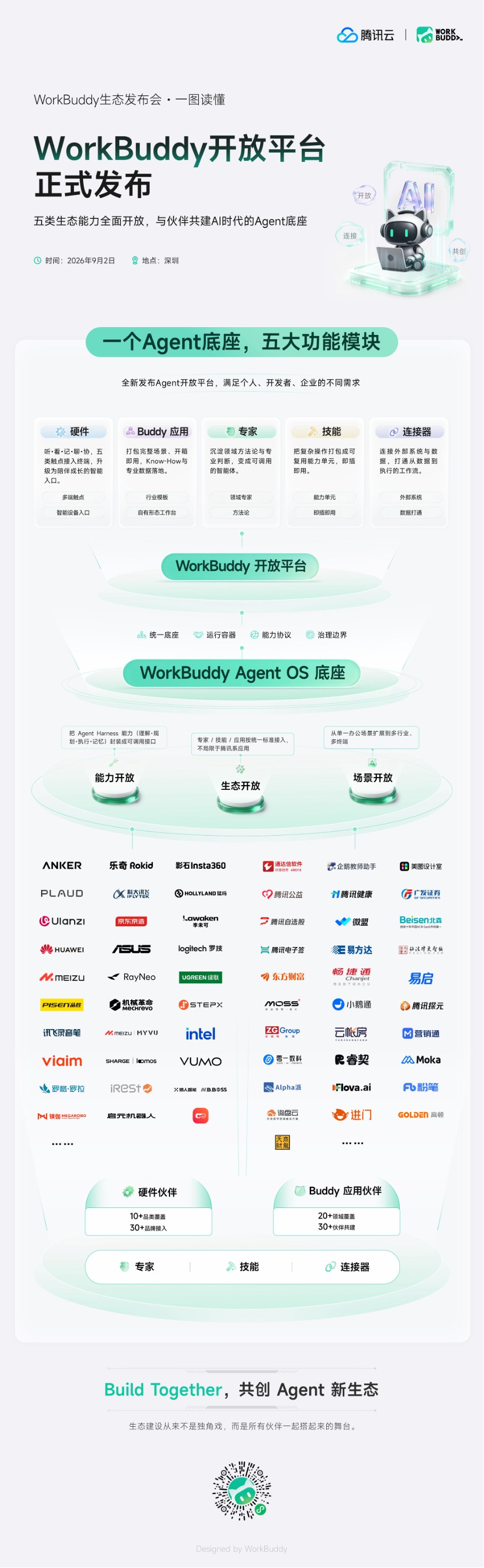
It is learned that more than 100 partners have joined the platform in the first batch, covering three sectors: smart hardware, industry applications and developers. Tencent positions it as the first Agent platform in China that connects these three layers of ecosystems at the same time.
At the launch event, products including smart glasses, voice recording cards, microphones and headphones were showcased collectively. WorkBuddy has now connected more than 30 hardware brands and over 10 device categories. Most of the 9 co-branded products launched this time are related to information collection such as voice and image.
Why are the first batch of partnerships concentrated on the input end? 36Kr asked Lin Zuolu, head of WorkBuddy Open Ecosystem at Tencent, about this question.
"Users can initiate tasks on the WorkBuddy workspace, or initiate tasks through portable devices, which is just one of the access points." Lin Zuolu said. Hardware makes the interaction between people and Agents more portable and more frequent, but in his view, the changes of office Agents do not only occur at the entry point.
"We believe that with the continuous development of Agents, they will become a kind of digital productivity and a digital employee for organizations and enterprises."
Most of today's office Agents are still actively invoked by humans: users put forward demands, and Agents give responses or complete a task. But if an Agent participates in a project for a long time, what it faces is no longer one-off question and answer, but continuously changing progress, shared knowledge space and multiple collaborators.
Lin Zuolu interprets this change in the context of organizational collaboration. In the past, much of the internal collaboration in enterprises was completed based on instant messaging tools; next, IM and AI workspaces may gradually integrate, "generating interactions between multiple people and Agents in the same knowledge space and the same context".
The role that Agents play in it will also change. "We believe that in the future, WorkBuddy experts can be awakened in more ways, or people can be called by Agents, instead of people calling Agents all the time."
As for where the task is initiated and where the next step of the workflow will reach, organizations of different scales and enterprises in different industries will form their own respective modes. WorkBuddy will not pre-define which mode is the best. Lin Zuolu said that what the team is doing now is to deliver "the best current productivity effect" to users and enterprise partners after models, Harness and industry capabilities are gradually connected.
WorkBuddy Open Platform
This is also the background why WorkBuddy started to accelerate the construction of its ecosystem less than half a year after its launch.
"Whether the final task is well completed is the result of multiplying every link from the base model to Harness, context, tool invocation, and then to scenario connectivity." Lin Zuolu said.
To support these capabilities, WorkBuddy has launched "Buddy Apps". Partners can integrate their own business scenarios, tools and brands into the platform to form AI workspaces for specific industries. At present, more than 30 industry applications have joined, covering more than 20 fields including finance, law, healthcare, education, public welfare and enterprise services.
Developers can also access professional capabilities through Skill, Expert and Connector. Skill provides Agents with methods to complete specific tasks, Expert corresponds to a professional agent or agent team, and Connector is used to connect external systems, currently supporting two modes: MCP and CLI.
Lin Zuolu mentioned that the earliest partners participating in platform construction are usually those who have accumulated professional data, knowledge or process experience in specific industries. They may have served customers through SaaS software in the past, but now they are trying to reorganize these capabilities on the Agent base.
Some SaaS enterprises have previously tried to develop Agent applications on their own, but invested heavily in engineering links such as operating environment and context management. "They are very familiar with the knowledge in their own field, but the investment in the engineering part is extremely huge, which is not the most cost-effective way for them." Lin Zuolu said. After cooperating with WorkBuddy, SaaS vendors can continue to focus on the industry scenarios they are familiar with, while the general Agent capabilities are provided by the platform.
However, accessing WorkBuddy does not mean that partners have to migrate all their original products to the platform.
At present, the functions and permissions opened by some software in WorkBuddy are still less than those of their independent clients. In this regard, Lin Zuolu believes that not all capabilities are suitable for being placed in Agents. Taking reading as an example, if users need immersive reading, an article is still more suitable to be presented in a dedicated container such as a browser, rather than being compressed by the Agent into a summary of dozens of words.
Partners need to judge by themselves which tasks are suitable to be initiated in natural language and completed automatically, and which ones should remain in the original clients and websites. At least at this stage, WorkBuddy is more like a task entry and execution layer on top of the original software and business systems, rather than a complete replacement for independent applications.
For the ecosystem itself, Lin Zuolu also holds a relatively restrained judgment.
"The ecosystem can hardly be planned. The ecosystem will not grow into what you expect just because you hope it to." In his view, whether there is a mature ecosystem is a result, the source of which still lies in whether the product is good enough, whether it has enough users, and whether the open design is reasonable. Only when users do need these capabilities, industry partners and developers will continue to invest.
Therefore, the first batch of more than 100 partners mostly reflects the willingness to participate in the initial stage of the platform's opening, which does not mean that the ecosystem has taken shape. WorkBuddy has not set a clear target for the number of partners. Meanwhile, the commercial mechanism is still under construction. WorkBuddy is developing operation, management and marketing tools for partners, and the payment capabilities and distribution channels have not been officially launched yet.
During the interview, Lin Zuolu believes that users will eventually pay for tasks that can truly solve problems and have productivity value. As more industry skills, data and experience enter the platform, users can complete more complex tasks, which may also generate higher willingness to pay. WorkBuddy hopes to guide part of the value to partners who provide Buddy Apps, Connectors and Skills, but the specific pricing and distribution methods have not been announced yet.
Since its launch in March this year, WorkBuddy has been updated for more than 50 versions, and has been implemented in more than 50 industries including government affairs, education, finance, and media. In Guangdong, some government agencies have carried out scenario docking and pilots; Laizhou, Shandong has equipped more than 6,000 primary and secondary school teachers with relevant AI teaching assistants; in the media field, WorkBuddy has also participated in CCTV's coverage of the Davos Forum and the World Artificial Intelligence Conference.
Smart hardware gives Agents more access points, while industry partners supplement the data, tools and experience required for tasks to continue executing. Whether these capabilities can be connected into a stable work chain determines whether WorkBuddy can further enter the daily collaboration of enterprises from an office tool that only responds to instructions.
"Opening up is the work we need to do, and the ecosystem is a result." Lin Zuolu concluded.