Welcome to the "Good Enough" World: When AI is adept at everything, is the collective intellectual capacity of humanity on the decline?
Shen Translation is a translation team under 36Kr, focusing on technology, business, workplace, life and other fields, and dedicated to introducing new technologies, new perspectives and new trends from overseas.
Editor's note: When AI makes all intellectual activities feel "pretty much the same", are we collectively slipping toward the abyss of skill degradation? This article is translated from foreign publications.
In 1924, Chinese scholar Hu Shi wrote *The Biography of Mr. Almost*. The phrase "almost" roughly equals "making do", "passable" or "good enough". In Hu Shi's writing, Mr. Almost once arrived at the railway station two minutes late, and wondered why the train had to rush to leave on time; he often wrote the character "ten" as "thousand", because in his view, the two characters only differed by a tiny extra stroke; when he was seriously ill, he called in a veterinarian Doctor Wang instead of the human physician Doctor Wang, on the grounds that both of them had the surname Wang so there was no need to tell them apart; on his deathbed, he mumbled intermittently that the living and the dead were more or less the same.
Today's AI is already "good enough". In the medium and long term, we will almost certainly witness AI tools outperforming humans in nearly all intellectual activities. For now, it seems only a matter of time before every industry sees its own "Stockfish moment". The so-called "Stockfish moment" refers to the era when top chess engine Stockfish was born: in a specific field, AI has reached the peak of performance, and human intervention cannot improve the output, but will only drag down its quality; humans who attempt to compete against it are doomed to suffer a crushing defeat from an absolute force that they can neither understand nor explain. We have not reached this point in most fields yet. However, in many industries, laypeople and even professionals can now glance at the result generated from a prompt, shrug and say "eh, it's almost right", then accept it readily. In other words, we are firmly trapped in an "almost world" — in this world, "good enough" AI outputs are increasingly eroding and replacing human thinking itself.
What does this mean for us? In short, most people may never polish most of their intellectual skills to a level above entry-level in their entire lives. Instead, they turn to rely on those "good enough" tools to produce semi-finished works that make senior experts feel awkward, but are far better than what newbies can produce on their own. In the past, highly threshold skills such as star navigation and manual movable-type printing gradually declined and disappeared as technology provided "good enough alternatives". Today, the picture we face is that all mental skills are moving toward full degradation to some extent at the same time.
Why does this matter?
The High Threshold of Professional Mastery
To hone most skills to expert or quasi-expert level requires hundreds or even thousands of hours of persistent effort. The process of skill acquisition is arduous, long, full of setbacks, and often accompanied by embarrassment — because at the initial stage, beginners are far from being "almost passable". They are just purely "bad", far from the qualified level.
Raw intelligence alone cannot skip this process. People with extremely high fluid intelligence may quickly make innovations in emerging fields that are not yet clearly defined and waiting for in-depth exploration. However, the physical and mental limits of human beings set an impassable red line for the speed of skill acquisition. Once a large number of people start to pursue the ultimate mastery of a certain skill seriously, these limits will be fully exposed. A bodybuilder cannot lift weights eight hours a day and progress eight times faster than someone who works out one hour a day. Similarly, in countless intellectual fields, no matter how efficient you are, the internalization of skills must go through a long period of time and repeated deliberate practice.
Max Deutsch, who calls himself a "geek learning fanatic", once publicly launched a series of attempts to "speedrun" skills. His ultimate goal was to learn to "play chess like a computer" through only one month of training, so as to challenge Magnus Carlsen, the world's top chess king at that time. This crash method does work in fields where almost no one is willing to invest more than a few hours, or where laypeople cannot see the doorway at all — such as practicing a set of magic tricks to show off in front of passersby, speaking a foreign language when the audience does not understand a single word, or cramming the basics of a niche topic in social sciences to barely strike up a conversation in front of top scholars. But chess is not such a field. In this field, even child prodigies who repeatedly break age records must invest thousands of hours of actual combat training over years to be able to compete on stage; in this field, the deepest insight that a talented amateur can squeeze out with all their efforts is only at the level that a grandmaster can achieve with a casual glance at the chessboard. A month passed in a flash. Deutsch played against Carlsen as scheduled, and was completely defeated.
Similarly, tools like Math Academy aim to optimize the math learning path with the help of cognitive science principles, and build it into a kind of "mental gym". Such tools may allow students to master mathematical concepts four times or even ten times faster than traditional classrooms. However, mathematics is a profound and fully explored discipline that contains thousands of subdivided specific skill points. These skills are often progressive, requiring the underlying skills to form "unconscious automated responses" — which requires you not to think hard to understand, but to implant them instinctively in your brain for instant use, so as to stimulate creative application. This means that even with the most advanced teaching tools, you can never "speedrun" the entire mathematics system in a month or two. The accumulation of professional mastery has always been inseparable from the tempering of time.
AI does not accelerate this process, it directly "short-circuits" it. The less thinking and struggle you put in to get a "passable" result, the less likely you are to develop the underlying skills to achieve that result independently. Of course, you will get a false sense of familiarity, just like after watching a bunch of popular science videos on YouTube, you think you really understand the content. But as for real mastery or instinctive muscle memory? It is impossible.
The Role of "Almost" AI
On the matter of adding illustrations to my articles, despite the disgust of some readers, I accepted the deal from Mr. Almost almost immediately. At least in this area, I am an early adopter: since this "magic drawing machine" produced its first images, I have regarded it as a miracle. It is a gateway to dream imagery, which can extract surreal fragments from the sum of all human creativity, and reproduce the ideas in my mind into tangible forms. I fell in love with AI painting from the very beginning, even though nowadays all major models cannot get rid of those kitschy plastic light effects, glowing particles and soulless corporate-style garbage images that make me cringe. But I know clearly the price I pay for it: as long as I continue to use AI, my own artistic attainments will always remain at a very low level. I will probably never develop a unique personal painting style, nor master the technical literacy to support that style. Once the AI tool is taken away, most of the so-called "my" visual art outputs will disappear completely. This does not mean that using AI does not require any skills, just like a film director who relies on a team of hundreds of people to realize his personal ideas also needs management skills. However, this is completely different from the skills that real artists hone. The existence of "almost art" means that anyone like me who takes shortcuts can never truly become an artist.
After all, if you only need to add a few illustrations to your essays occasionally, why should we spend thousands of hours studying personal styles and tempering our body and mind in a strict and narrow technical category?
You are certainly better than that. You are willing to invest those thousands of hours. Perhaps you have already put it into practice, and joined the group I admire and envy — they create breathtaking visual art as naturally as breathing, enriching themselves while illuminating the world. Hopefully that is the case. Art is such a sacred pursuit that it must not be completely handed over to machines.
But can you be so pure in every field?
Or, in those peripheral skills that are far from your passion but indispensable in daily work, have you also found yourself living in the "almost world"? Even, those skills are not peripheral at all: maybe you are like those excellent programmers, who have spent countless years honing solid skills, but now find that since you can just ask Codex to do the work, why bother to write code line by line yourself?
I think programming is completely dead to me today. I just wanted to modify a small part, but I felt it was too troublesome to even open Cursor, so I simply threw it to Claude to finish. Suddenly I realized that I will probably never write code by myself for the rest of my life. This feeling is really weird.
Or, you are faced with a strict deadline and a client who urgently needs to deliver results. After a rational and objective measurement, you find that handing over an "almost passable" AI work can better meet their demands than treating the client as a guinea pig and handing over a clumsy hand-made work for practice. To this day, almost every white-collar worker can find sufficient reasons to outsource the work they used to do personally to AI. In other words, they accept the price of their own skill degradation in exchange for more decent output at the moment.
This does not mean that efficiently using AI does not require skills — although as AI becomes more powerful, its requirements for humans seem to be getting lower and lower; I will not assert for the sake of defending AI that we will always need to learn new intellectual skills to master it. My friends who often play AI painting often call themselves "directors", and I think this title is quite appropriate: most of the skills required for AI at this stage essentially fall into the category of management and coordination. But my core point is: a large number of skills that require thousands of hours of careful tempering will eventually have far fewer followers. With the wild growth of AI capabilities, human potential in many fields will inevitably shrink and dry up.
How "Almost" AI Will Reshape Us
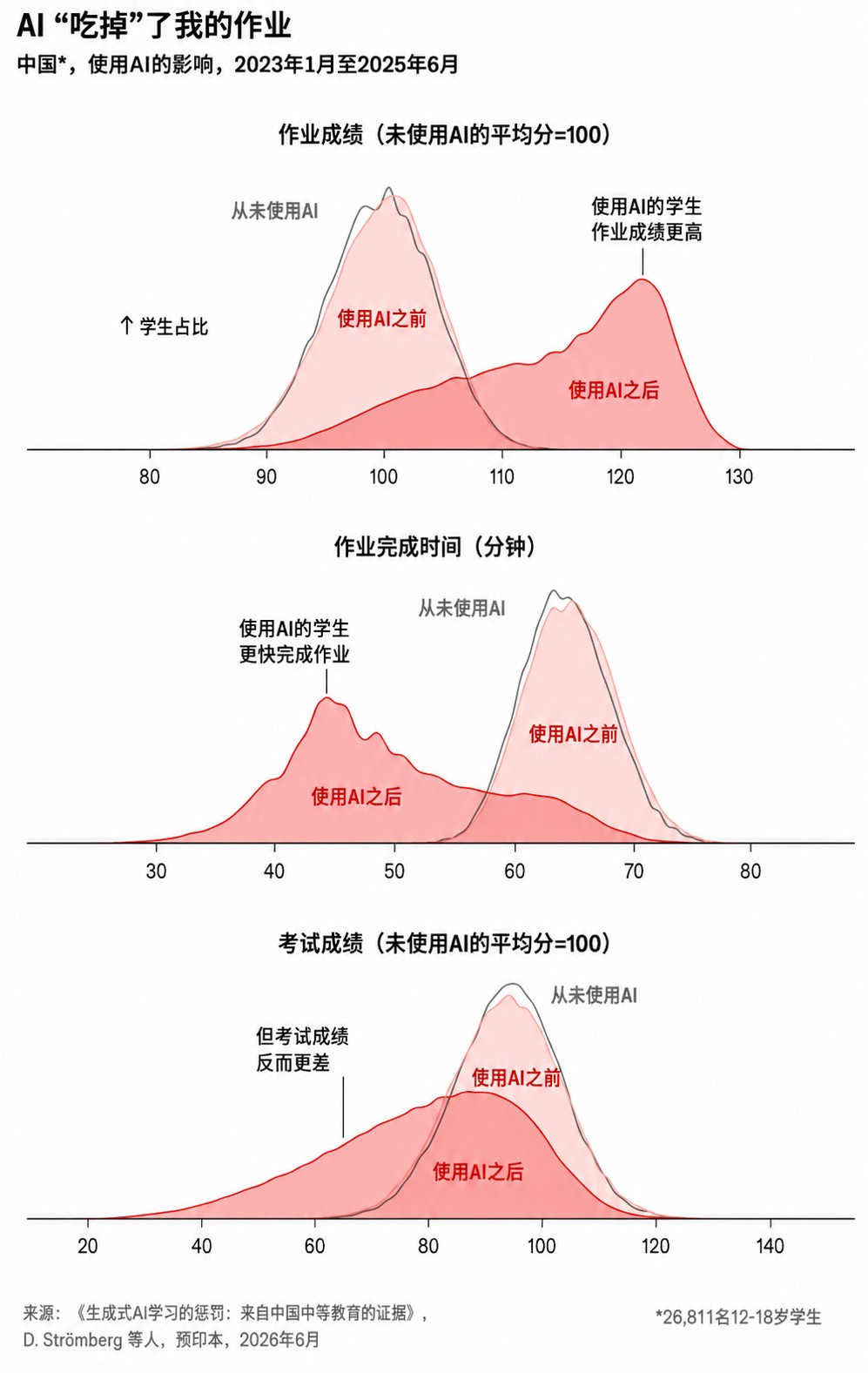
The Economist recently published a chart based on a survey of AI applications in Chinese campuses, which vividly reveals one of the most shocking consequences of the "almost world": in many classes, usual homework scores and exam scores show a negative correlation. That is to say, after a whole semester, students who completed their homework more perfectly usually tend to perform worse in the final exam. Students have never been known for being diligent or passionate about homework, and they have long used machines to do the work for them; in these usual school tasks, the only really valuable output should have been internalizing knowledge and achieving self-growth, but what they are avoiding is exactly that.
You can put all the blame on the students, and of course, to some extent, it is their own fault. If people are willing to calm down and learn the course content that they have paid tens of thousands of tuition fees for, they will definitely benefit a lot. But from the perspective of institutional design, our vision should be higher. Humans are naturally optimization machines that seek to save effort, and we have established countless systems to make short-term convenience easier to move towards long-term goals. If only one student in a class cheats, it is the student's problem; but as reported by *Inside Higher Ed* about a class at Brown University, if 56 out of 59 students are cheating, it is obviously the entire assessment system that has gone wrong.
Our newsletter has also long been open to public submissions. Having a public submission mailbox is always like opening a blind box, which is full of all kinds of spam all year round, asking for quotations for publishing promotional soft articles about cryptocurrency or cannabidiol (CBD). However, recently we have encountered a brand new phenomenon: those education practitioners with impressive titles actually openly sign their real names, and send AI-generated manuscripts or topics that are obviously fake and full of loopholes. In principle, I do not reject AI writing: I started trying AI generation even before the first version of ChatGPT came out, and I have also published a complete conversation with AI in this publication, and even sorted out more than 6 million words of my own manuscripts, hoping to train a dedicated model that fits my own style one day. My problem is not that they used AI, not even just that they did not disclose it, but that these submissions are often empty, full of stylized and annoying language tics. This is not a good article at all. Sadly, it is already "good enough" to make dignified education experts take the initiative to contact publishers, and willingly bind their names to that pile of nutrient-free text paste.
In every corner that requires written expression, this scene is just a microcosm. As shown in the report of Pew Research Center, more than one-third of the websites launched after the release of ChatGPT have obvious traces of AI writing. This is not surprising, really. The reason why there are various complicated styles of writing is often purely because people think there should be some high-sounding remarks on paper, rather than naked instructions — such as "Claude, help me write an apology letter to calm public outrage, don't make any mistakes", "ChatGPT, please write the text of a petition to argue why the media should be lenient when reporting academic fraud", or "Grok, help me write a *Wall Street Journal* style column review, make sure it is flawless". It is not that the previous articles of this kind were all brilliant and sincere, but they at least had distinct personality and diversity, at least tempered the writing skills of the writer to a certain extent, and at least really flowed through a human mind before being written down. Now, we are drowning in the "almost text" pieced together by a group of humans who are willing to be parasitized by Claude like cordyceps fungi to speak through their shells — those garbage contents that even the "authors" who generated them are too lazy to read.
At the moment, we are in the wave of rapid AI development, and the world is changing so fast that people have no time to digest. However, even if these tools stop making progress from now on, they are enough to drag us into the "almost world" in almost all intellectual fields. Only a very small number of firm and pious seekers — like saints — are still willing to take the trouble to spend thousands of hours pursuing physical and mental transformation, so as to experience their chosen vocation as experts rather than superficial laypeople.
As for the vast majority of the rest of the people, for most of the rest of the time? An input box, a prompt, a generated result. "It's almost right." What follows is a mind that can never build cognitive depth — those thinking circuits are now all outsourced to the exquisite machine whispering in the ear; the output of the user looks so amazing that they almost have the illusion that they are thinking deeply. Seriously, why bother? After all, you never intended to really master that skill from the very beginning, not to mention that what AI outputs is mostly "good enough".
Translator: boxi.