The steering system for domestic unmanned logistics vehicles occupies a market share of over 50%. The enterprise that benchmarks against Bosch and ZF has secured a strategic round financing of tens of millions of yuan | 36Kr Exclusive
Source / Enterprise
This article contains approximately 3300 words, with a recommended reading time of 8 minutes
Author丨Ou Xue
Editor丨Yuan Silai
Hard Krypton has learned that Hubei Hading Intelligent Technology Co., Ltd. (hereinafter referred to as "Hading Intelligent") has recently completed a tens-of-millions-yuan strategic financing round, led by Hongrong Capital, with follow-on investments from listed companies Desay SV, Wuzhou Zhongda, Yangtze River Industrial Investment, Haichuan Capital, Tianhong Investment, Jiangyuan Investment and other institutions. The funds will be mainly used for the mass production implementation of Steer-by-Wire (SBW) technology and the capacity upgrade of high-end EPS.
Founded in 2020 and headquartered in Wuhan, Hading Intelligent is a high-tech enterprise focused on the R&D and production of automotive Electric Power Steering (EPS) systems and Steer-by-Wire (SBW) systems. Liu Zejin, the founder of Hading Intelligent, has been engaged in automotive steering software development since graduating in 2010. He has successively served as the head of the EPS department and steering product manager at enterprises including Dongfeng Motor, Hubei Henglong and Nexteer, with nearly 20 years of industry experience. He had two entrepreneurial experiences before founding Hading Intelligent.
The steering system is the core executive component of the automobile chassis. The traditional passenger vehicle steering market has long been dominated by foreign giants such as Bosch, ZF and Nexteer, and foreign-funded and joint-venture enterprises occupy most of the market. Especially in high-end product fields such as R-EPS, overseas manufacturers have almost formed a monopoly.
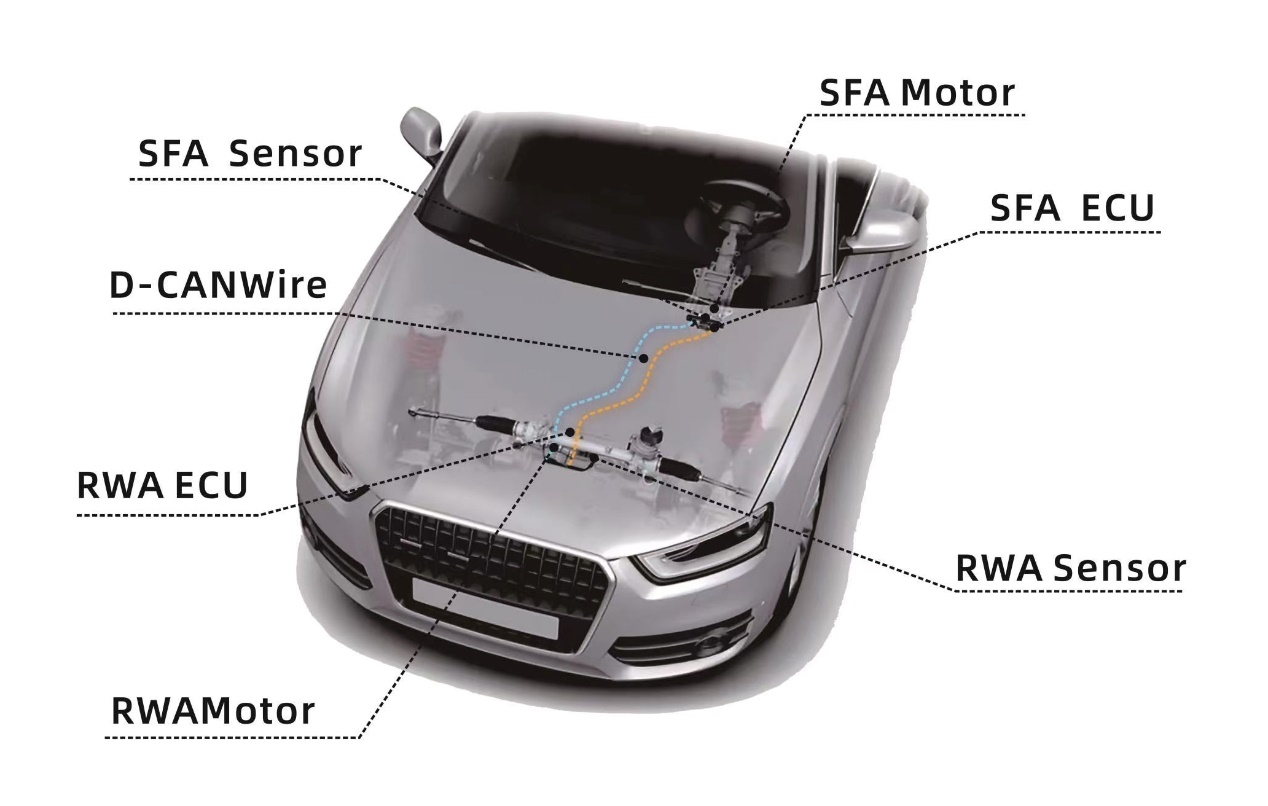
At present, automotive electrification and intelligence are reshaping this pattern: C-EPS is being upgraded to higher-performance DP-EPS and R-EPS; as an irreplaceable executive component for L3 and higher-level autonomous driving, Steer-by-Wire (SBW) completely eliminates the mechanical connection between the steering wheel and the wheels, and transmits steering instructions entirely through electrical signals.
This structural change provides a window of opportunity for local suppliers.
Hading Intelligent seizes this opportunity. At present, the company is one of the few steering suppliers in China that has simultaneously deployed a full range of steering products including Rack-and-Pinion EPS (DP-EPS), Recirculating Ball EPS (X-EPS), Ball Screw EPS (R-EPS), Planetary Gear EPS (G-EPS) and Steering Column EPS (C-EPS), all of which have obtained designated project orders in hand.
In terms of technical routes, Hading Intelligent adopts the strategy of "three parallel business segments":
The existing business is dominated by Electric Power Steering (EPS), covering all types of models such as C-EPS, P-EPS, DP-EPS and R-EPS. Among them, R-EPS is the product with the highest technical level and maximum rack force in EPS, which features high process difficulty and high price. The company has realized the mass production of R-EPS assembly, breaking the technical barrier of long-term monopoly by foreign capital.

R-EPS Steering Assembly (Source / Enterprise)
The second business segment is the steering system for unmanned logistics vehicles. This is the field with the highest market share of the company at present, with a total of more than 40 matched unmanned logistics vehicle models, shipments exceeding 20,000 units in 2025, and a domestic market share of over 50%.
The third segment is Steer-by-Wire (SBW) for passenger vehicles, which is also the largest growth pole of the company in the future. SBW eliminates the mechanical connection between the steering wheel and the steering gear, and steering instructions are completely transmitted through electrical signals.
Hading Intelligent has carried out SBW technology verification since 2021, completed the redundant safety architecture verification of dual power supply, dual communication, dual controller and dual motor winding, and completed the -40℃ extreme cold test in Heihe with fault-free operation for more than 200 hours. The company is currently designated by a leading domestic new energy vehicle enterprise to carry out SBW R&D and has entered the tuning and calibration stage, making it one of the few local Tier 1 enterprises in China with complete SBW real vehicle verification capabilities
The commercialization path of Hading Intelligent presents the feature of "unmanned logistics vehicles take the lead, followed by passenger vehicles".
In the unmanned logistics vehicle track, the company has built significant first-mover advantages. It has deployed more than 16,000 vehicles in total for leading unmanned vehicle enterprises, covering more than 300 cities across China. As its exclusive steering supplier, Hading Intelligent has received 40,000 units of orders in hand in 2026. In addition, the company is also the exclusive supplier for many unmanned vehicle enterprises including Desay SV.
In the passenger vehicle sector, the company has obtained designated orders for multiple domestic DP-EPS projects and R-EPS designated orders for three models of a local Southeast Asian brand. Among them, the R-EPS project will be exported to the Southeast Asian market, and mass production is expected to start in September 2026. In the commercial vehicle sector, the company's high-power planetary gear solution is the first of its kind in China, and has been verified by many OEMs such as Shaanxi Automobile, BYD and Dongfeng.
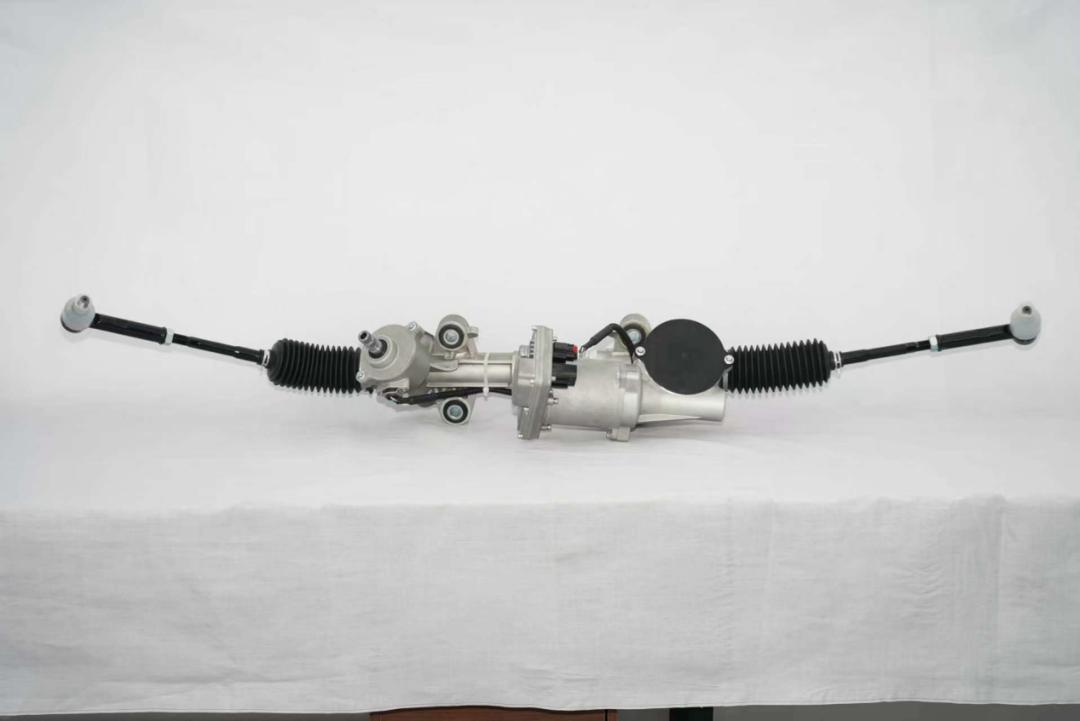
DP-EPS Steering Assembly (Source / Enterprise)
In terms of performance, the company's revenue reached nearly 100 million yuan in 2025. The company aims to achieve revenue of 200 million to 300 million yuan in 2027.
In terms of production capacity, the company has now built 5 assembly production lines for C-EPS, P-EPS, DP-EPS, R-EPS and X-EPS, with an annual production capacity of over 1 million units; 2 PPK automated production lines with an annual capacity of 1 million units; 2 SMT production lines with an annual capacity of 2 million units. After this round of financing, the company will focus on expanding the production capacity of redundant EPS for unmanned vehicles, aiming to increase the monthly production capacity from less than 10,000 units at present to 100,000 units.
In the long run, the company will rely on the cost advantage of the domestic supply chain to expand overseas markets, starting from the Southeast Asian market and gradually extending to Europe and the United States. In addition, the company has been laying out the "corner module" technology, that is, independent steering control for each wheel, which is one of the evolution directions of steering systems in the next 5 to 10 years.
The following is the edited conversation between Hard Krypton and Liu Zejin, founder of Hading Intelligent:
Hard Krypton: What are the specific technical barriers of Steer-by-Wire? Why are there not many companies in the industry that can really do it well?
Liu Zejin: The two core difficulties of Steer-by-Wire are safety and road feel simulation. The first one is safety. There is no mechanical connection between the steering wheel and the steering gear, and the failure of any link will affect the safety of the whole vehicle. Therefore, the system must meet the ASIL-D level of functional safety, and the failure rate should be controlled within 10 FIT — that is, no more than 10 failures per 1 billion hours. This requires the system to adopt a full redundant architecture, with full dual backup from sensors, controllers to motor drives. There are more than a thousand test cases related to safety alone.
The second difficulty is road feel simulation. Traditional steering has a mechanical connection, and the feedback of the road surface is transmitted physically. Steer-by-Wire eliminates the mechanical connection, and the "road feel" perceived by the driver is completely generated by algorithms. How to simulate real and delicate road feedback through software, and adapt to the tuning requirements of different models at the same time, is a field that highly relies on experience and technical accumulation.
Hard Krypton: The passenger vehicle steering market has long been monopolized by foreign capital. What is the breakthrough point for domestic substitution?
Liu Zejin: The first point is the cost pressure brought by electrification. Domestic OEMs are very sensitive to costs. We have three sets of core control schemes with different specifications — the fully domestic scheme, the Infineon scheme and the cost reduction scheme, which can be flexibly configured according to customer needs. The second point is the technical iteration brought by intelligence. Steer-by-Wire is a brand new technical route, and foreign teams and domestic teams are on the same starting line. In addition, the new national standard officially "loosens the restriction" on Steer-by-Wire at the end of 2025, and the technical window has been opened.
Our strategy is to first achieve the top market share in the unmanned logistics vehicle track, accumulate mass production experience and safety verification data, and then extend to the passenger vehicle market. Passenger vehicles have higher safety requirements and longer verification cycles, but with the mass production resume of unmanned logistics vehicles, the trust of OEMs will be much higher.
Hard Krypton: Why did you choose to cut in from the unmanned logistics vehicle track first?
Liu Zejin: Unmanned logistics vehicles have several characteristics that are favorable to us. First, China is leading the world in this market, and more than 95% of the unmanned vehicles running on the road are in China. Second, unmanned logistics vehicles have no steering wheel, and steering is completely controlled by autonomous driving. It has higher requirements for the reliability, accuracy and response speed of the steering gear than traditional passenger vehicles, but the application scenarios are relatively closed, and the verification cycle is shorter than that of passenger vehicles. We can polish the technology to maturity on this track, run through the full redundant scheme, and then migrate these capabilities to the Steer-by-Wire system of passenger vehicles.
At present, our market share in the unmanned logistics vehicle market exceeds 50%. Although this niche market is not large in scale, it is a "training ground" for our technical verification and mass production experience.
Views of Investors:
Shi Chenghao, Founding Partner of Haichuan Capital, said: Everyone is talking about physical AI recently, but the most difficult step for AI to enter the physical world is "precise control". The traditional mechanical steering architecture limits the performance of autonomous driving algorithms. Steer-by-Wire eliminates the hard mechanical connections such as the steering column, and truly realizes "controlling physical movement through electrical signals". What Hading Intelligent is doing is to install the most accurate and reliable "executive nervous system" for physical AI.
From the perspective of investment, we should not only look at the long-term ceiling of technology, but also the current landing rhythm. Hading's customer structure is very healthy: unmanned logistics vehicles help to quickly realize technical verification and mass production; domestic and foreign passenger vehicle OEMs bring them the ability of large-scale mass production, and enter the global market along with the current boom of Chinese passenger vehicle OEMs going overseas, while new energy heavy trucks realize dimensionality reduction strikes in high value-added and high-threshold scenarios. This "multi-driven" commercial landing capability is extremely scarce in the current capital market. As an industrial capital deeply rooted in the smart transportation field, Haichuan Capital will work hand in hand with Hading in supply chain collaboration and OEM designated order breakthroughs in the future.
Yin Pengfei, Investor of Yangtze River Industrial Investment Group, said: We continue to be optimistic about the domestic substitution opportunity in China's automotive intelligent steering track. Hading's team is one of the earliest teams engaged in the development of underlying EPS steering control programs in China. In the fields of commercial vehicles and unmanned logistics vehicles, Hading has firmly taken a leading position in China, and has obtained exclusive supply or A-supply designated orders from many customers such as Neolithic, Jiushi, JD, Desay SV. Driven by both the 30-billion-yuan EPS market and the 10-billion-yuan SBW market, Hading has both the advantages of high-end breakthrough and cost leadership. We believe that this team, which has been deeply engaged in the steering field for more than ten years, is pushing China's intelligent steering industry to a new height. Hading has not only a solid basic disk for support, but also a clear second growth curve, which is a high-quality target that combines certainty and growth in our eyes.
Wang Peicheng, Investor of Hongrong Capital: Hading Intelligent Technology is a leading target in the domestic Steer-by-Wire field. Its core highlight is the full-chain independent controllability of SBW from R&D to production, without relying on overseas technical solutions. DP-EPS and R-EPS products have formed a leading market position in the fields of unmanned vehicles and commercial vehicles, and successfully cut into the passenger vehicle track at the same time, opening up a larger growth ceiling. Different from most peers that are still in the prototype stage, the company has realized product landing in multiple scenarios and continuously built technical and customer barriers. The development of the project is expected to solve the "neck sticking" problem of domestic automotive steer-by-wire chassis, and fully benefit from the outbreak of the autonomous driving industry, with outstanding industrial value and investment value.