Health 160, Zhiyun, Fangzhou, Xikang: Four internet medical enterprises have taken the first bite of the "AI dividend".
In the first half of 2026, if you want to select several most worthy internet healthcare companies' financial reports for research, the answer may be somewhat unexpected.
They are not the three giants including JD Health, Alibaba Health and Ping An Good Doctor.
Instead, they are Health 160, Ark Health, Smart Cloud Health and Seacon Cloud Hospital.
These four companies have rarely been discussed together in the past, and they are not even engaged in the same type of business.
Health 160 goes deep into hospitals, Smart Cloud Health covers hospitals and pharmacies, Ark Health connects doctors with chronic disease patients, and Seacon Cloud Hospital delivers nurses and medical services to patients' homes.
But precisely because of this, they have almost pieced together the part of internet healthcare that is hardest to scale: hospitals, pharmacies, doctors and nurses.
As of the end of June 2026, Health 160 has connected more than 45,100 medical and health institutions; the number of registered doctors on the Ark Health platform has reached 282,000; Smart Cloud Health's AI pharmacy platform covers more than 280,000 pharmacies; Seacon Cloud Hospital has 168,000 resident nurses with more than 5 years of clinical experience.
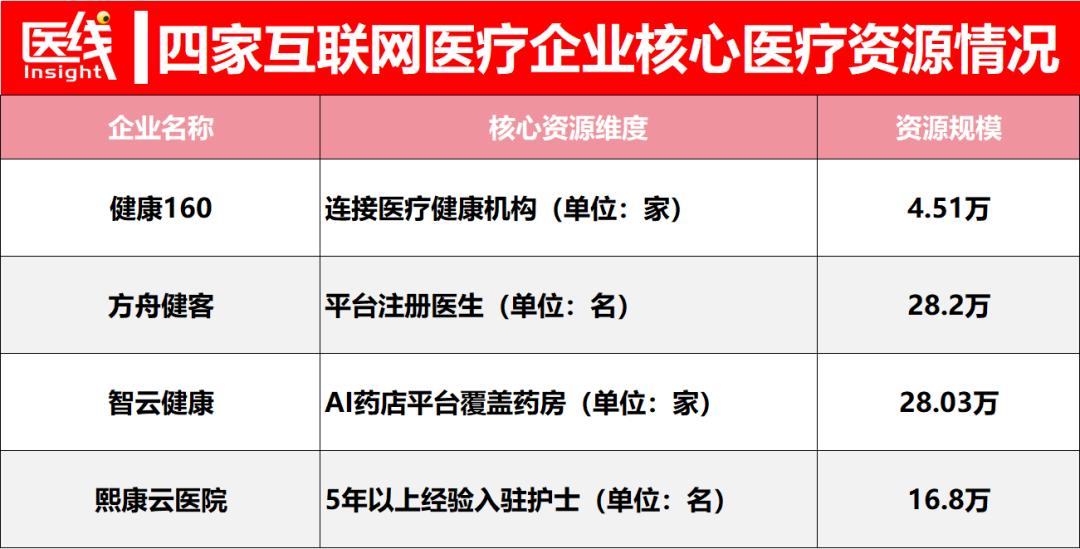
Data source: H1 2026 financial reports of the four internet healthcare enterprises
Behind these numbers lies the most intractable business problem that internet healthcare has faced for a long time — the internet can replicate traffic and information quickly, but it cannot infinitely replicate the time of doctors and nurses.
As a result, over the past decade, most of the first internet healthcare models that achieved sustainable operations avoided labor-intensive medical services.
JD Health and Alibaba Health expanded their pharmaceutical retail business relying on e-commerce and supply chains, while Ping An Good Doctor organized services with the help of insurance payers and group ecosystems.
However, once you go deep into hospital operation, chronic disease management, pharmacy prescription, and home care, revenue growth often means more doctors, nurses, auditors, dispatchers and operation staff. The larger the scale, the easier it is for costs to rise simultaneously.
This is exactly where AI begins to become important. These four companies are becoming a special group of samples for observing the commercial value of AI.
Because here, to judge whether AI is useful, you do not need to look at model parameters first. Checking the cost and profit is enough.
In the first half of 2026, Health 160 crossed the break-even line, with adjusted net income reaching 5.452 million yuan.
Ark Health continued to make a profit with a revenue scale of 1.824 billion yuan, and its adjusted net profit was 18.708 million yuan.
Smart Cloud Health's adjusted net loss narrowed by 86.0% year-on-year to 8.86 million yuan.
Seacon Cloud Hospital's adjusted net loss also narrowed by 43.1% year-on-year to 21.847 million yuan.
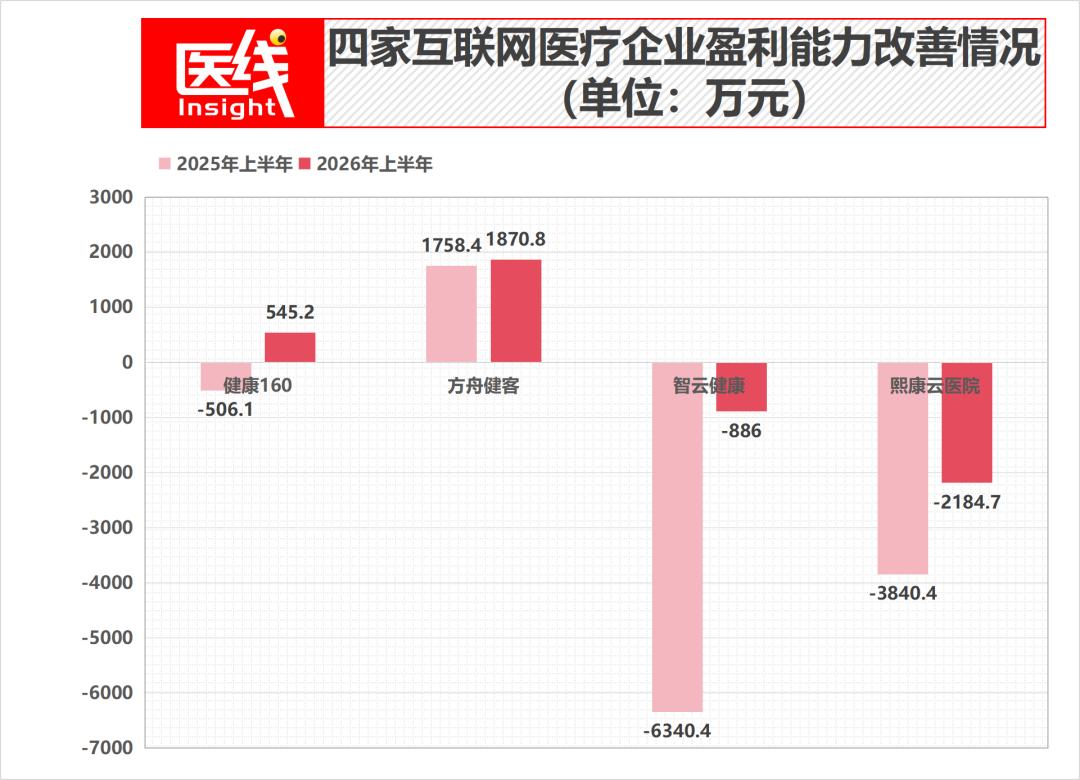
Data source: H1 2026 financial reports of the four internet healthcare enterprises
The four companies have different businesses and are at different development stages, but similar changes have emerged at the same time. Behind this, AI is entering the links that they used to rely most on manual labor: prescription review, chronic disease management, operation, scheduling, order receiving and follow-up visit.
This means that the really noteworthy question about medical AI is whether it can change the cost structure of internet healthcare, so that medical services can truly have economies of scale for the first time.
What AI changes first is not revenue, but the cost curve
The first wave of changes can be observed from the cost side.
Smart Cloud Health is a typical sample. In the first half of 2026, Smart Cloud Health's revenue dropped to 629 million yuan, and the company voluntarily withdrew from some low-profit and cash-consuming businesses.
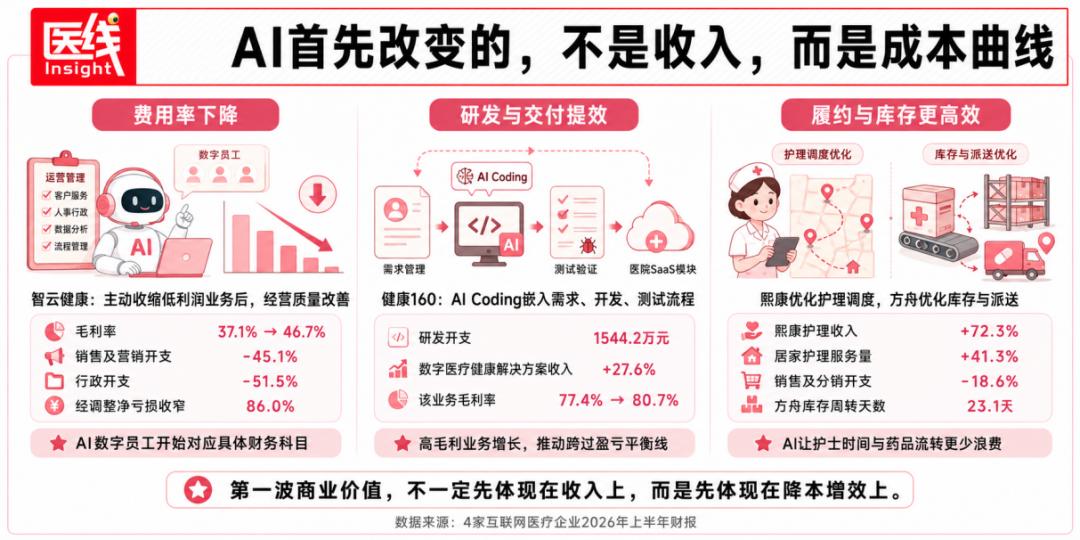
At the same time as the revenue declined, the operating quality improved, the overall gross profit margin increased from 37.1% in the same period of last year to 46.7%, and the adjusted net loss narrowed by 86.0%.
This is a growth mode that internet healthcare was not good at in the past but the industry has become increasingly familiar with — voluntarily giving up low-quality revenue, and shifting the goal from "expanding scale" to "improving revenue quality".
The change on the expense side is more direct. In the first half of the year, Smart Cloud Health's sales and marketing expenses dropped from 454 million yuan to 249 million yuan, down 45.1% year-on-year; administrative expenses fell 51.5% to 57.59 million yuan.
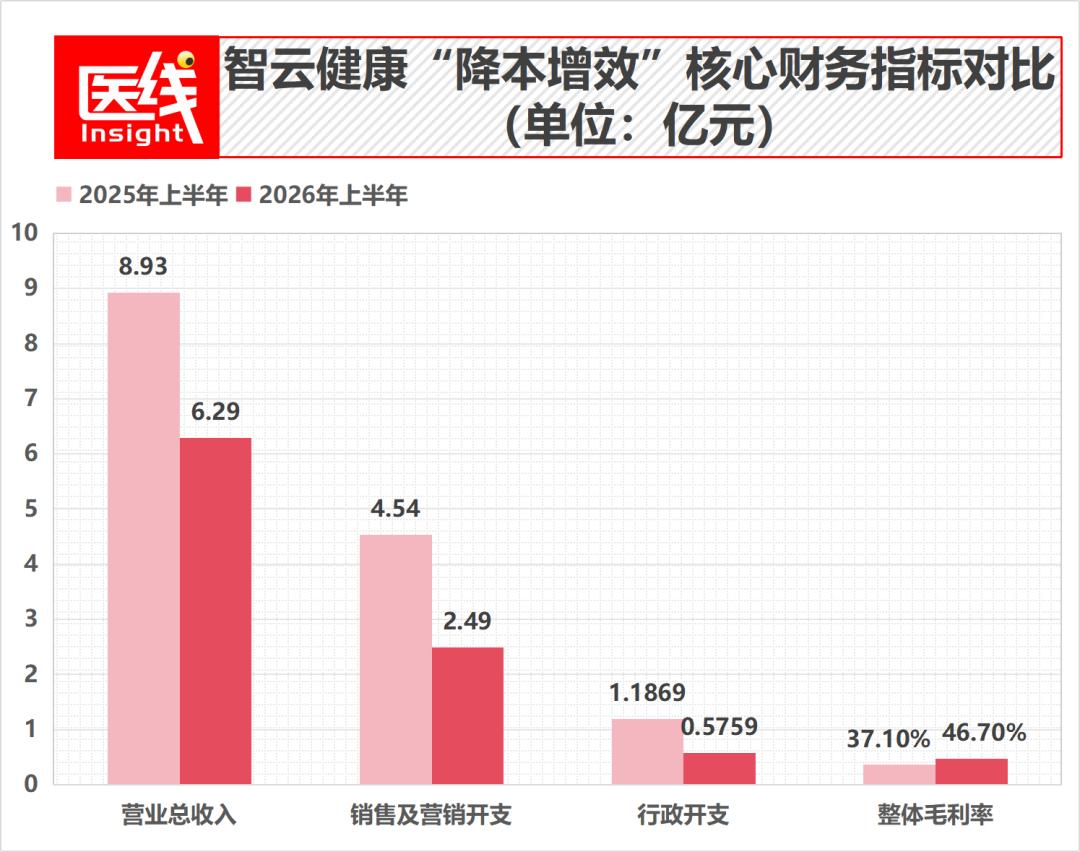
Data source: Smart Cloud Health H1 2026 financial report
One explanation given by the company is "digital employees": relying on the vertical large model ClouD GPT, AI is deployed into some processes that were originally completed manually to reduce labor and compliance costs.
"Digital employees" is not a new concept. What is worth observing behind it is that for the first time, AI is corresponding to specific financial accounts.
The reason is that the traditional technical investment in hospital informatization, internet hospitals and internet healthcare platforms first means increasing the cost of servers, R&D, systems and operations, and it takes a long chain to convert it into profit.
Generative AI provides another possibility, that is, technical investment itself can reduce part of repetitive manual work.
The changes of Health 160 took place on the R&D side.
Internet healthcare enterprises face highly complex customer demands. The information systems, business processes, procurement requirements and data interfaces of different hospitals are different. It is difficult for SaaS products to be copied as simply as consumer internet software. The more projects there are, the more development and delivery personnel are often required to increase synchronously.
Health 160 embeds AI Coding into R&D processes such as demand, development and testing, and pilots digital employees in different departments.
In the first half of 2026, its R&D expenditure was 15.442 million yuan; at the same time, the revenue of digital medical health solutions increased by 27.6%, and the gross profit margin increased from 77.4% to 80.7%.
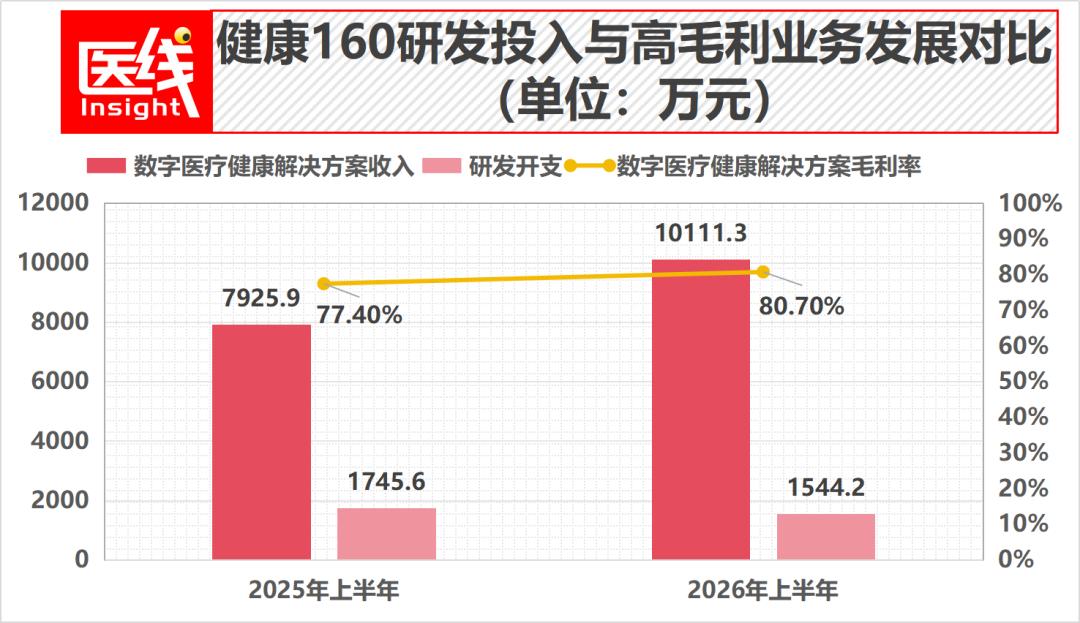
Data source: Health 160 H1 2026 financial report
The growth of high gross profit margin business constitutes a clear business logic for the company to achieve adjusted profitability in the first half of the year.
Seacon Cloud Hospital is facing a more "asset-heavy" business: nurse home care services.
In the first half of 2026, Seacon Cloud Hospital's total revenue was 183 million yuan, a year-on-year increase of 2.4%; among which, the revenue of nursing services increased by 72.3% to about 59.67 million yuan, becoming the business segment with the most obvious growth. In the same period, the volume of home care services exceeded 308,000 person-times, a year-on-year increase of 41.3%.
At the same time, Seacon Cloud Hospital's platform services are also extending from basic nursing to more specialist scenarios. At present, it has covered more than 260 home care services in 13 major categories, and is exploring home rehabilitation in some regions, which means that what the platform needs to dispatch is not just more orders, but increasingly complex medical service supplies with growing professional differences.
According to the logic of traditional service industry, the growth of service volume usually means more scheduling, customer service and performance costs, but in the same period, Seacon Cloud Hospital's sales and distribution expenses decreased by 18.6%.
Seacon Cloud Hospital embeds the AI intelligent middle platform into the three business processes of medical treatment, nursing and health management, forming a service closed loop of "intelligent matching - precise scheduling - whole-process quality control - continuous optimization" in nursing scenarios, trying to further standardize the service processes that used to rely heavily on manual coordination.
This type of AI is far less noticeable than "AI doctors", but it directly solves problems like how nurses should take routes, where to go, which order to take, and how to avoid wasting tens of minutes.
For a platform that has 168,000 nurses with more than five years of clinical nursing experience, and the scale of nurses is still increasing by 15.9% year-on-year, the tens of minutes scattered in each order will accumulate into performance cost and service radius.
Ark Health corresponds to another type of scale cost.
In the first half of 2026, the company's revenue reached 1.824 billion yuan, a year-on-year increase of 22.2%; what is more noteworthy than the revenue growth is that the proportion of sales and distribution expenses in revenue dropped from 12.8% to 10.6%.
Its supply chain covers more than 1,800 suppliers and more than 1,000 pharmaceutical companies. After using AI to optimize inventory allocation and order delivery, the inventory turnover days are compressed to 23.1 days.
The four companies seem to be doing completely different things.
Some reduce sales and administrative costs, some lower R&D and delivery costs, some improve nurse scheduling efficiency, and some optimize inventory.
But from the perspective of the income statement, they are answering the same question.
That is, when the business scale expands, do costs still need to grow at the original speed?
This is exactly the key to the first wave of commercial value of medical AI.
It may not immediately increase revenue by 30%, but it may first prevent the manpower, inventory, R&D and performance resources needed to support larger revenue from increasing in the same proportion.
In plain terms: achieve cost reduction.
For an industry that has long been trapped in the logic of "burning money for scale", the importance of this change may be higher than adding one more AI consultation entrance.
Of course, the financial improvement cannot be fully attributed to AI.
The rise of Smart Cloud Health's gross profit margin is directly related to its withdrawal from low-profit businesses; Health 160 is also driven by the growth of high gross profit margin digital medical health solutions; Seacon Cloud Hospital's nursing business itself is expanding rapidly; Ark Health has already had obvious economies of scale.
A more accurate statement is that when these companies shift from "scale priority" to "profit priority", AI just provides a set of efficiency tools.
The first areas penetrated by medical AI are those "repetitive but error-free" tasks
Cost change is only the first layer. What really determines whether AI can become a long-term productivity is whether it can enter the medical site.
Medical treatment is different from most internet industries. If you recommend a wrong short video, the loss may only be a few minutes; but if you review a wrong prescription, miss a hospital infection risk, or give patients wrong medication advice, the consequences are completely different.
Therefore, it is difficult for medical AI to quickly replace the whole process starting from a universal chat box, and it is more likely to enter narrow scenarios with clear responsibility boundaries first.
Prescription review, chronic disease management, patient follow-up, medical quality management, pharmacy management and resource scheduling are exactly the key application directions of "artificial intelligence + medical health" at present.
The areas where the four companies' AI landing is most concentrated exactly conform to this feature.
Seacon Cloud Hospital chooses nursing scheduling.
The company has continued to expand outward on the basis of the two provincial-level nursing platforms in Zhejiang and Henan, and added the "Tongcheng Nursing" platform in Nantong, Jiangsu. The relevant nursing platforms have cumulatively covered more than 200 million people; at the same time, its urban cloud hospital platform project has also expanded to "Baoding Cloud Hospital" in Hebei.
The more home care orders there are, the core problem the platform faces is no longer just "whether there are nurses", but "where the nurses are and how to match orders more efficiently".
If the order is 30 kilometers away from the nurse, even if the system shows that there are available nurses, it is difficult for this nurse to actually serve the patient. Therefore, home care is not only a medical problem, but also a complex spatial scheduling problem.
Seacon's intelligent route planning assistant integrates data and path algorithms to arrange service routes for nurses; the intelligent order receiving assistant supports voice and other operations to reduce the time nurses spend completing repetitive steps on mobile phones.
Here AI is used to free nurses with real clinical experience from invalid time on the road and in the system.
Health 160 puts AI inside hospitals.
As of June 30, 2026, its platform has connected more than 45,141 medical and health institutions, including more than 14,658 hospitals (including 3,549 tertiary hospitals).
Compared with adding a chatbot for patients, medical institutions are more willing to continuously pay for tools that solve clear management problems.
Health 160 launched the overall solution of "160 AI Hospital", and applied the "Blue Inspiration Quality Control GPT" to the hospital infection prevention and control scenario, which is used for internal hospital data processing, risk profiling, automatic intervention, clinical dynamic supervision and feedback optimization.
As of the end of the reporting period, "160 AI Hospital" has carried out operation cooperation with 163 public medical institutions, 78 of which are tertiary hospitals, accounting for about 47.9%.
Hospital infection prevention and control is worthy of continuous observation by the industry, because it has a sufficiently narrow boundary, relatively clear data, clear hospital management responsibilities, and real demand for risk reduction. This type of scenario may form a commercial closed loop earlier than "whether AI doctors can fully diagnose diseases".
Smart Cloud Health chose the high-frequency link of pharmacy prescription review.
As of the end of June 2026, its AI platform has been installed in 280,