The four top new EV automakers in H1 2026: Leapmotor turns profitable, NIO swings back to profit, Xpeng and Li Auto are undergoing growing pains
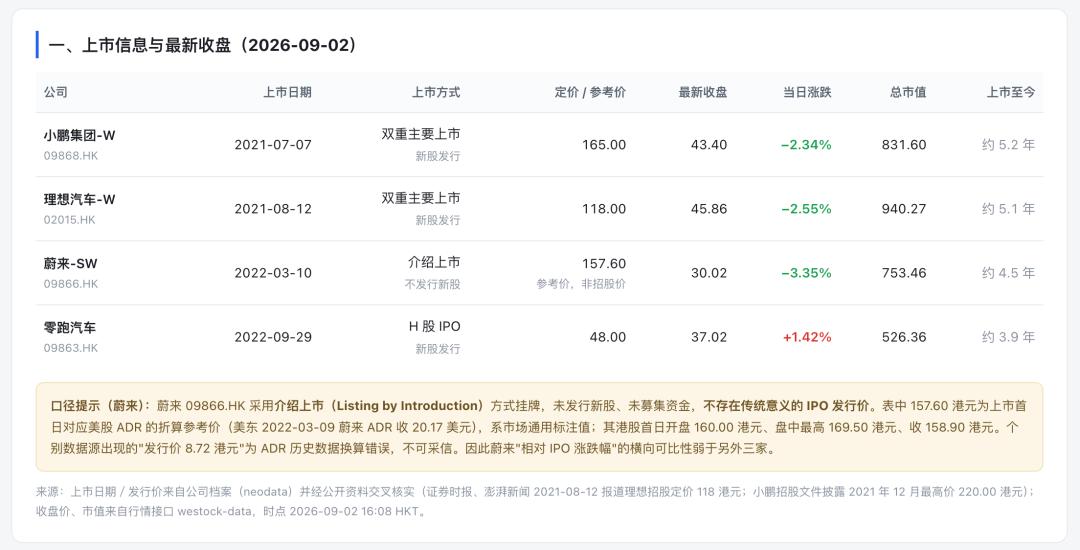
As of September 2, Beijing time, the four new EV-making forces listed on the Hong Kong Stock Exchange that step onto the [Financial Statement PK Platform] today are, in the order of their Hong Kong listing time: Xpeng Inc.-W (09868.HK) listed on July 7, 2021, Li Auto-W (02015.HK) listed on August 12, 2021, NIO-SW (09866.HK) listed on March 10, 2022, and Leapmotor (09863.HK) listed on September 29, 2022.
The following shows the latest closing price and closing market capitalization of these four companies (as of September 2), as well as the rise and fall of the latest closing price compared with the IPO offering price, all-time high price and all-time low price.
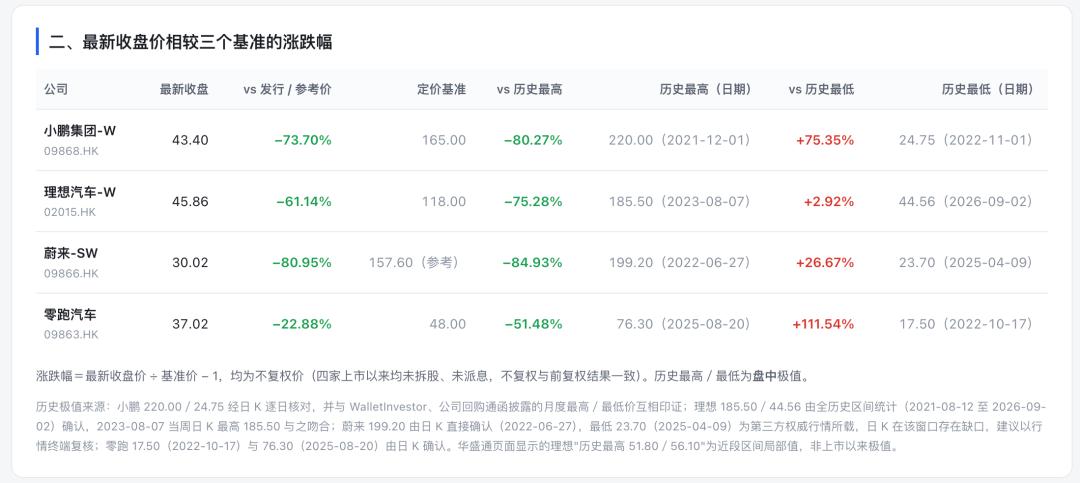
It can be clearly seen from the above table that these four new EV-making forces have all fallen to varying degrees compared with their IPO offering prices or all-time high prices. Compared with the offering price, NIO has the largest decline. Of course, NIO, which was listed by way of introduction, priced its shares with reference to its US stock price, followed by Xpeng and Li Auto, while Leapmotor has the smallest decline of 22.88%.
Compared with the all-time high price, NIO still has the largest decline of 84.93%, Xpeng and Li Auto have declines of 80.27% and 75.28% respectively, and Leapmotor still has the smallest decline of 51.48%.
If compared with the all-time low price, the latest closing prices of these four companies are all higher than their all-time low prices. Among them, Leapmotor has the largest increase of 111.54% compared with the all-time low price, followed by Xpeng's 75.35%, then NIO's 26.67%, and Li Auto has the smallest increase of 2.92%.
That is to say, Li Auto is currently basically at the worst level since the company was listed on the Hong Kong Stock Exchange, the reason for this can also be seen from the subsequent financial statements, which is mainly reflected in the substantial decline in losses and gross profit margin.
In contrast, it can also be seen that Leapmotor performs the best. Its price has more than doubled from the all-time low, which means Leapmotor has walked out of the historical trough, and its decline from the all-time high and IPO offering price is the smallest, which also means Leapmotor is in a relatively good period of company development. This is inseparable from Leapmotor's current monthly sales exceeding 100,000 units, ranking first among new EV-making forces. If the gross profit margin can be improved, it is believed that Leapmotor's stock price performance will be better.
Next, let's take a look at the core financial situation of these four companies.
It should be noted that NIO, Xpeng and Li Auto are all listed on the US stock market, while Leapmotor is only listed on the Hong Kong stock market. Therefore, the financial statements of NIO, Xpeng and Li Auto are prepared in accordance with GAAP, and Leapmotor's financial statements are prepared in accordance with IFRS. The following is a summary of the core contents of the financial statements of these four companies.
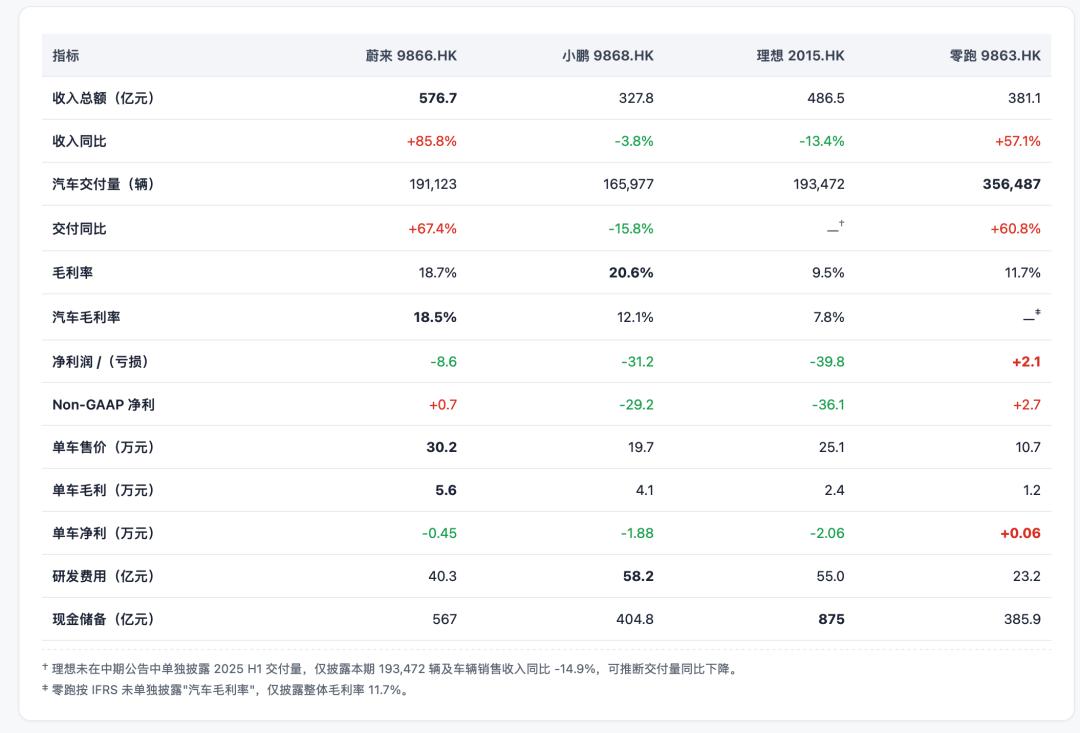
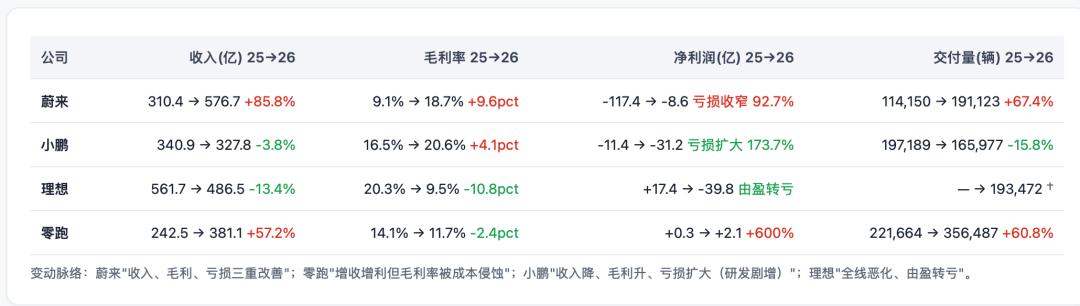
The following analyzes the core financial indicators mentioned above.
1. Vehicle delivery volume, as an automaker, this is the most important indicator without exception.
Leapmotor ranks first with 356,500 units, a year-on-year increase of 60.8%; followed by Li Auto with 193,500 units, a year-on-year decline; then NIO with 191,100 units, a year-on-year increase of 67.4%; the smallest is Xpeng with 166,000 units, a year-on-year decline of 15.8%.
2. Total revenue, this is the most important indicator for an enterprise.
NIO ranks first with 57.67 billion yuan, a year-on-year increase of 85.8%; followed by Li Auto with 48.65 billion yuan, a year-on-year decline of 13.4%; then Leapmotor with 38.11 billion yuan, a year-on-year increase of 57.1%; Xpeng ranks at the bottom again with 32.78 billion yuan, a year-on-year decline of 3.8%.
Note that Xpeng's vehicle delivery volume declined by 15.8% year-on-year, but its revenue only declined by 3.8% year-on-year. This is not because the average selling price per vehicle increased, but because the increase in other service revenues offset the revenue decline caused by the drop in vehicle deliveries.
3. Overall gross profit margin and vehicle gross profit margin
Xpeng leads in overall gross profit margin, reaching 20.6%, an increase of 4.1pct over the same period last year; followed by NIO with 18.5%, an increase of 9.6pct over the same period last year; then Leapmotor with 11.7%, a decline of 2.4pct over the same period last year; finally Li Auto with 9.5%, a decline of 10.8pct over the same period last year.
The reason why Xpeng's overall gross profit margin leads is that the gross profit margin of the "Services and Others" business is as high as 71.4%, which is mainly the revenue from technology R&D services provided by Xpeng to the public.
In terms of vehicle gross profit margin, NIO ranks first with 18.5%, followed by Xpeng with 12.1% ranking second, a year-on-year decline of 0.5pct, and Li Auto ranks third with 7.8%. Leapmotor does not separately announce vehicle gross profit margin because it adopts IFRS rules.
NIO is the only one that makes money by selling vehicles, which is the result of NIO's brand effect in the high-end market.
From the perspective of gross profit margin, Li Auto's year-on-year deterioration is the most serious, followed by Leapmotor. But the reasons for the two are different: Li Auto cut prices to clear inventory during the product replacement cycle, while Leapmotor has low vehicle selling prices leading to poor affordability in the face of rising component prices.
4. Average selling price per vehicle, gross profit per vehicle, net profit per vehicle, these three indicators measure the profitability of an automaker.
In terms of average selling price per vehicle, that is, ASP, the highest is NIO reaching 302,000 yuan, followed by Li Auto's 251,000 yuan, Xpeng ranks third with 197,000 yuan, and the bottom is Leapmotor with only 107,000 yuan. The sales volume of NIO ES8 + ES9 in the 400,000+ yuan market is very impressive, and the average selling price per vehicle is expected to further increase.
In terms of gross profit per vehicle, the highest is still NIO's 56,000 yuan, followed by Xpeng's 41,000 yuan, Li Auto ranks third with 24,000 yuan, and the bottom is still Leapmotor with only 12,000 yuan.
In terms of net profit per vehicle, the only profitable one is Leapmotor, which has the lowest unit price and gross profit, which shows how much the scale effect affects automakers. The other three are all loss-making. Li Auto has the largest loss of 20,600 yuan per vehicle, followed by Xpeng's loss of 18,800 yuan per vehicle, and NIO's loss of 4,500 yuan per vehicle.
5. Net profit and Non-GAAP net profit
In terms of net profit, only Leapmotor is still profitable with 210 million yuan, the other three are loss-making. Li Auto has the largest loss of 3.98 billion yuan, followed by Xpeng's loss of 3.12 billion yuan, and NIO's loss of 860 million yuan. The year-on-year situation is that NIO's loss has narrowed significantly, with a loss of 11.74 billion yuan in the same period last year; Xpeng's loss has expanded, with a loss of 1.14 billion yuan in the same period last year, and the loss expanded by 173.7%; Li Auto turned from profit to loss, with a profit of 1.74 billion yuan in the same period last year. Leapmotor's profit expanded by 600%, because the profit in the same period last year was only 30 million yuan.
It is worth mentioning that a year ago, Li Auto was still the most profitable among new EV-making forces. A year later, it became the one with the largest loss, and the reason behind this is worthy of in-depth exploration by Li Auto.
Under Non-GAAP rules, Leapmotor's profit reached 270 million yuan, NIO turned losses into profits with a profit of 70 million yuan, Li Auto still has the largest loss of 3.61 billion yuan, and Xpeng lost 2.92 billion yuan.
6. R&D expenses, cash reserves, debt ratio
In terms of R&D expenses, Xpeng has the largest R&D investment reaching 5.82 billion yuan, with an R&D rate of 17.8%, showing very strong R&D investment intensity; Li Auto follows with 5.5 billion yuan in R&D investment, with an R&D rate of 11.3%; NIO's R&D investment is 4.03 billion yuan, a year-on-year decline of 34.9%, with an R&D rate of 7%, which is mainly because the R&D investment in previous years was too large, so it takes a break now; Leapmotor has the smallest R&D investment of 2.32 billion yuan, with an R&D rate of only 6.1%. Although Leapmotor advocates full-stack self-development, its R&D investment is not high, which may be due to relatively higher capital use efficiency.
In terms of cash reserves, Li Auto has the thickest cash reserve reaching 87.5 billion yuan, which previously exceeded 100 billion yuan, followed by NIO's 56.7 billion yuan, Xpeng's 40.48 billion yuan, and the bottom is Leapmotor's 38.59 billion yuan.
However, Leapmotor is the only one with positive operating cash flow reaching 2.17 billion yuan, and its free cash flow is 140 million yuan. NIO disclosed that its Q2 single-quarter operating cash flow turned positive, but did not disclose the specific situation of Q1 and H1. Li Auto's operating cash flow is -6.08 billion yuan, and Xpeng's is -11.72 billion yuan.
Although Leapmotor has the least cash reserve, it has started self-sustaining operation, while Li Auto has started to lose blood, and it remains to be seen whether it can reverse the situation in H2. Xpeng's cash outflow is the most serious, which is related to its large-scale investment in R&D.
In terms of debt ratio, NIO has the highest debt ratio of 89.5%, followed by Leapmotor's debt ratio of 81.6%, Xpeng's debt ratio of 73.4%, and Li Auto has the lowest debt ratio of only 53.1%.
7. Overseas business
China has become the world's largest automobile exporter. Under the industry background of declining domestic sales, overseas business has become a new business growth point for automakers. Overseas business has higher gross profit margin, which has also become a new profit growth point for automakers.
Due to the cooperation with its major shareholder Stellantis, Leapmotor is at the forefront of new EV-making forces in overseas business. Its H1 exports reached 96,300 units, a year-on-year increase of 372.6%, which has exceeded the total export volume of 2025, accounting for 27% of the total H1 sales volume.
Xpeng's overseas revenue reached 8.23 billion yuan, accounting for 25.1% of the total revenue, which is mainly from technology service exports.
In fact, Xpeng and NIO went overseas very early, but the scale has not been able to expand. Li Auto's overseas business is in its initial stage. Previously, some dealers exported and sold Li Auto's models in a way similar to parallel import.
Summary:
From the perspective of automakers' fundamental business - selling vehicles, Leapmotor and NIO performed very well in H1 2026, especially Leapmotor, which has ranked first in monthly sales among new EV-making forces for a long time. Almost every new model it launched became a bestseller, with monthly sales reaching the level of 100,000 units, and it has exceeded 100,000 units for two consecutive months in July and August. Its overseas business also caught up with this wave of overseas expansion, expanding rapidly with the support of Stellantis' dealer network.
NIO has firmly established its foothold in the luxury market above 400,000 yuan with ES8 and ES9, which is the best reward for NIO's long-term cultivation of high-end brands. The hot sales of these two models can help NIO complete the 5566 product iteration. The sub-brand Firefly has achieved more than expected performance with monthly sales of 5,000 to 6,000 units relying on one model, and the key is to see if the sales of the sub-brand LeDao can pick up.
In contrast, Xpeng and Li Auto have problems in their fundamental vehicle-selling business, especially Li Auto, which has relatively big problems. It remains to be seen whether it can continue to achieve high sales volume after completing the replacement of L-series models and launching new pure electric models one after another. Xpeng's problem is that apart from MONA 03 which achieves high volume sales, the old problem that each new model becomes popular for a short time and then falls into slump has not been solved.
In addition, Xpeng and Li Auto have grandly proposed the Physical AI strategy, investing funds to develop large models, chips and humanoid robots.
Xpeng's humanoid robot business unit, Pengxing Dogotix, completed a $900 million financing in