Alibaba has spent 100 billion yuan on AI, while Meitu has spent less than 500 million yuan.
We do not pursue general AI, but focus on the experience in segmented vertical fields.
How much does it cost to develop AI?
Alibaba's total investment reaches 380 billion yuan. In the first half of 2026 alone, Alibaba's R&D investment and capital expenditure exceeded 100 billion yuan, which ate up its full-year profit in just six months.
Google's figure is 200 billion US dollars a year, equivalent to more than 1 trillion yuan, which is 1.5 times Google's annual net profit, or half of its annual revenue.
Tencent's annual investment may reach 200 billion yuan, and its free cash flow has turned negative in the second quarter.
What about Meitu's figure? Less than 500 million yuan. In the first half of 2026, the sum of Meitu's R&D expenses and capital expenditure was less than 500 million yuan, of which capital expenditure was less than 20 million yuan.
The total amount is only equivalent to its revenue of half a quarter, less than its profit of half a year.
01 Big Techs Spend Big on Trivial Matters, Meitu Spends Little on Major Undertakings
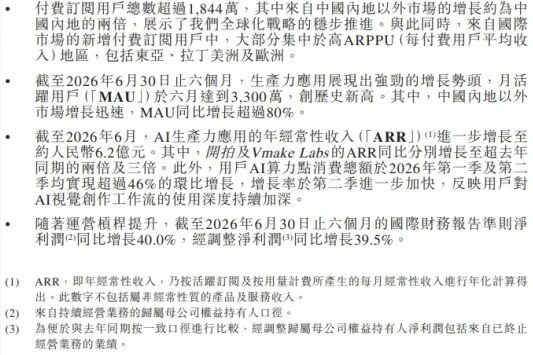
Meitu is undoubtedly an AI company now. As of the end of June 2026, the total number of global paid subscription users has exceeded 18.44 million, and the annual recurring revenue (ARR) of AI productivity applications is about 620 million yuan.
Its AI-related content and growth rate are no less impressive than Kuaishou, and far better than traditional big techs such as Tencent.
But it seems that Meitu and big techs are not playing the same game.
What game are big techs playing? Throwing 100 billion yuan in, you can barely hear a splash.
At the 2026 Alibaba earnings call, Wu Yongming "overturned" the "380 billion yuan in three years" promise made last year. It turns out that the previous estimate was too "conservative", and the scale of future investment will far exceed the previous forecast.
In the 2024 fiscal year, Alibaba's capital expenditure was only 28.421 billion yuan. But the next year, Alibaba's capital expenditure soared directly to 84.278 billion yuan. The increase in funds alone is enough for Alibaba to acquire Ele.me once again. In the second quarter of this year, the capital expenditure of a single quarter directly hit 67.678 billion yuan, more than twice the capital expenditure of 2024.
The other domestic giant Tencent is the same. Its capital expenditure in the first half of 2026 was as high as 84.72 billion yuan, three times that of 2023 (before the AI wave); overseas leader OpenAI, although its revenue reached 13.07 billion US dollars in 2025, its annual operating loss was as high as 20.92 billion US dollars.
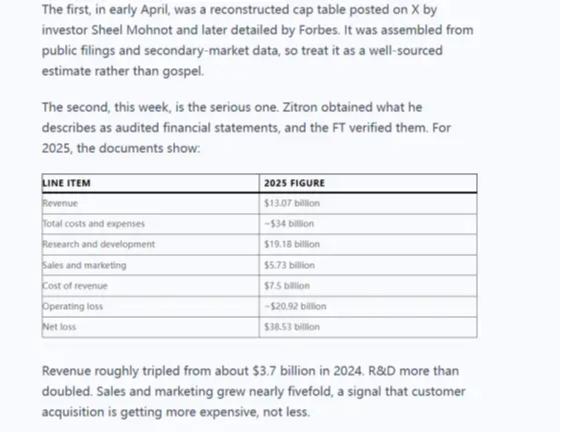
Caption: Audited OpenAI financial statements verified by the Financial Times
AI investment includes not only capital expenditure, but also R&D expenses. In the latest financial report, Alibaba has split out two AI business segments. Among them, the "AI Lab and Applications" segment lost more than 13.8 billion yuan in the second quarter alone.
This is the AI game of big techs, which is more expensive than many wars.
But when we turn to Meitu, the situation changes completely: in the whole first half of 2026, Meitu's capital expenditure was only 16.26 million yuan, and its R&D expenses in the first half year were less than 500 million yuan. From 2023 to 2026, Meitu's cumulative R&D expenditure during the entire AI transformation period was about 3 billion yuan.
As a company whose annual revenue is expected to reach 5 billion yuan this year, spending such a small amount of money in three years is really extremely frugal. Google has taken its profit of one and a half years as the expected capital expenditure for 2026.
But this is Meitu's strategy.
Meitu's chairman's report points out that instead of pursuing the "Meitu Wondrous Large Model" to handle every possible demand, it concentrates resources highly on the most core portrait light and shadow reconstruction, makeup, hairstyle and portrait details. It does not pursue general AI, but focuses on the experience in segmented vertical fields.
Therefore, Meitu refuses to build a huge team. Instead, it sets up studios and launches a "challenge" mechanism, providing only about 10 million yuan of initial budget for each independent application studio. If the team fails to make progress after the budget is exhausted, Meitu will adjust the team or even terminate the project directly.
Can Meitu make money with AI by spending such a small amount of money? Of course it can. Its growth rate is even faster than most big techs.
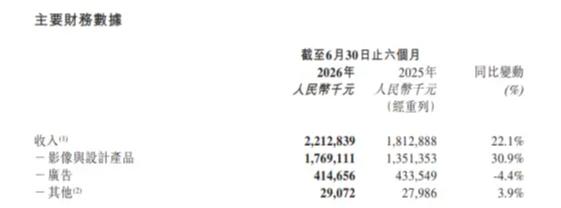
In the half-year report just released by Meitu, revenue, especially AI-related businesses, continues to grow. The total number of global paid subscription users has exceeded 18.44 million, of which productivity users have surged to 2.35 million. The total consumption of AI computing power points has achieved a quarter-on-quarter growth of more than 46% for two consecutive quarters. Overall, Meitu's revenue growth rate reached 22.1%, with a total revenue of 2.212 billion yuan in the first half year, a net profit margin of nearly 30%, and a net inflow of free cash flow of about 590 million yuan.
Among those big techs that have spent so much money, how many can achieve such a growth rate, such a profit margin, and such healthy cash flow?
This is spending little money to accomplish great things.
02 AI Developers Earn Less Than Photo Editing Practitioners?
Compared with Alibaba and Tencent, Meitu is a very small company. But the significance of its success is by no means trivial.
Behind its story lies a very valuable question: If AI washing machines rise one day, will making washing machines make more money, or making general AI models make more money?
In other words, in the "AI+" story, is AI more important, or the content after the plus sign more important?
Meitu's answer is definitely the latter.
In the 2026 interim report, Meitu's management expounded its unique understanding of AI.
In the view of the management, once the general model capability (mainly based on computing power and scale) is developed, it will be rapidly popularized across the whole industry and will not be scarce.
——This is a judgment quite consistent with the facts. Up to now in the development of AI, do ChatGPT, Claude and Gemini really have huge differentiation? Is a powerful model capability really scarce in the current market? Isn't it something you can buy with money? Not to mention there are completely free open source models.
This is the first layer of Meitu's logic.
The second layer is more important: No model can stably hit the expected effect with one single instruction, and repeated fine-tuning is required. AI is not a "silver bullet" that will subvert the application layer directly, it still relies heavily on human fine-tuning.
The real key to AI models is not computing power, but "aesthetics". Whoever can make the AI output as close as possible to the ideal effect in the user's mind has differentiated competitiveness.
Based on these two judgments, Meitu has taken a unique path: in the AI photo editing business, we focus less on general AI development and more on photo editing itself.
This logic may also have a third layer: AI models are available to everyone, but business assets are not.
For Meitu, this asset is: users and data.
In the pre-AI era, Meitu once had 300-400 million monthly active users, who are the female users in China that know best about "beautification". Thanks to them, Meitu has countless portrait photo editing databases, billions of data on skin smoothing, face slimming, skin tone, and facial feature proportions, which are natural data assets for AI development.
Meitu was born to understand "user aesthetics" better than others. It knows what kind of skin smoothing and cool white skin Chinese girls want, knows the facial feature proportion under Chinese aesthetics, and will not turn Chinese people into Western-style makeup. Meitu also knows well what the promotional style of product images on Taobao and Pinduoduo should be, and what kind of filters videos on Douyin should have.
Users don't care if your model has trillion-level parameters, or if its benchmark score beats GPT-5. Users just want images that can be posted to Moments immediately, or put on Taobao shelves right away.
In this regard, Meitu has a natural advantage over big techs. It can use the data and aesthetics accumulated over the past ten years to achieve the ideal effect with fewer prompt words.
With Meitu's "Meitu Design Studio AI Tool", users only need to upload product images to Meitu, and the AI can directly generate a complete set of product promotional images. The most critical point is that the effect of the first generation can almost be directly used for product promotion pages, which is difficult for similar general models to achieve.
In addition to product images, AI can also directly generate models, realize AI fitting and other functions, and every time users call these functions, they need to pay Meidou (AI computing power points) to Meitu.
This is called "embedded in the workflow". Just like Microsoft's Copilot, the most valuable part of it is not the model, but that it can be directly integrated into the Office ecosystem.
Users, templates, data, and communities, these ecosystems accumulated over more than ten years, are links with greater differentiation than the general capability of models. You may get a better model than Meitu, but you don't have the Meitu Xiuxiu app.
Duan Yongping once put forward a similar judgment: In the AI era, he is optimistic about Google and Apple. No matter how powerful AI is, it has to run on mobile phones, and Apple has iOS while Google has Android.
Meitu's scale is certainly not comparable to Google, but the principle is similar. No matter how excellent the multimodal model is, it ultimately faces users directly for photo editing, and Meitu is the king in the photo editing field.
Meitu is only a very small company in a segmented field, but its success is undoubtedly a huge inspiration: people always focus on whose model is a little more advanced, but the scarcest thing in AI may not be the model. The one that makes the most money from AI may not be the one with the largest investment.
This article is from the WeChat Official Account "Lue Reference" (ID: hyzibenlun), author: Lin Jiu, authorized for release by 36Kr.