The more you look at Momenta, the more it seems like a very promising business.
Two forces reinforce each other, and the two small flywheels form a larger flywheel.
At the very early stage of a business, the growth of an enterprise often does not have much to do with the enterprise itself, which depends more on how strong the industry trend is.
From the Internet to new energy vehicles, and then to AI, all the early star enterprises had terrifying growth rates of 50% or even 100%. For investors, there was little difference between companies, and even the star targets at this point in time were often the industry index.
But the wind cannot blow that strongly forever. As the scale expands, the growth rate will almost inevitably decline. In the period with the fastest industry growth, people can only see the crest of the wave, and when the tide gradually recedes, the gross profit margin, net profit margin and business model hidden underneath will begin to emerge.
——It will gradually become clear which is a good business and which is a bad one.
01 From Good Track to Good Business
A few years ago, the automotive industry, the "parent industry" of intelligent driving, went through this exact moment. After two years of explosive growth, the capital market began to calculate accounts, to see whether they could achieve profitability according to the current trend.
Some car companies have shown passable profitability, while others have shown rather weak profitability.
A few years later, the intelligent driving industry has also arrived at this moment. Although the industry is still a blue ocean and the growth is still very fast, the quality of different businesses has begun to show initial signs.
After all, you don't have to wait until the end of the industry to tell whether a business is good or not. A good business loses relatively less money when it is unprofitable, and achieves profitability very quickly when it pursues profit.
Momenta is moving into the second stage, and it has already demonstrated the characteristics of a good business: The inflection point of break-even comes faster than everyone expected.
The semi-annual report shows that in the first half of the year, excluding non-operating factors such as share-based payment and changes in the fair value of financial liabilities, Momenta's adjusted net loss was only 14.097 million yuan, narrowing by 97% year on year.
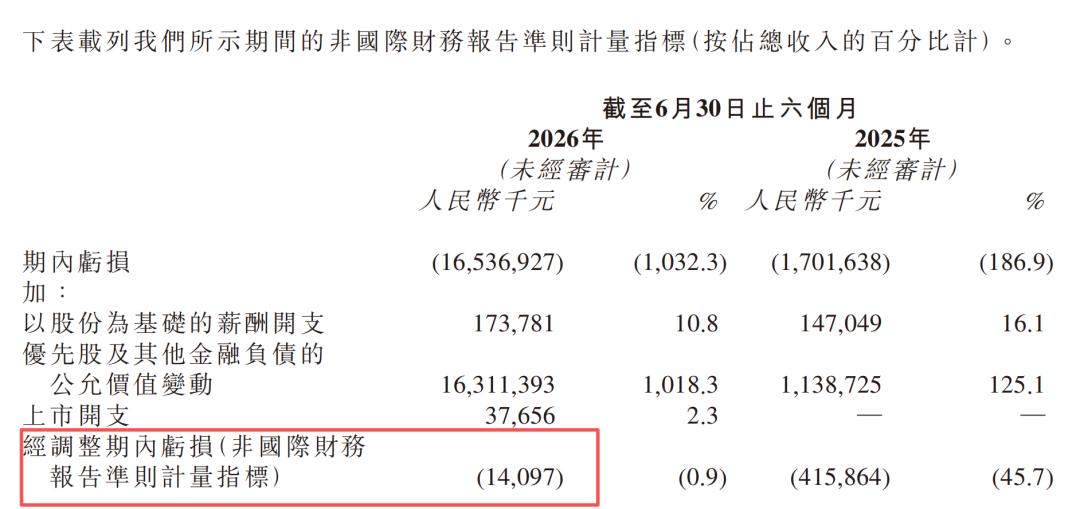
Intelligent driving is an industry with high R&D expenditure, and massive expenses are invested in the future. In the first half of the year, Momenta's R&D expenditure reached 1.163 billion yuan, with an R&D rate exceeding 72%. But as Huang Zheng said, many expenses, although called expenses, are not actually burned out, but form a kind of business asset that can bring more income in the future.
One word to describe Momenta's profit data is: early.
Momenta's revenue growth rate is still 75%. It completed its IPO just two months ago, which is equivalent to Pinduoduo in 2015 or NVIDIA in 1999. Normally, it should still be in the stage of "burning money for market share".
But it has already shown the good quality of its business. Momenta's gross profit margin is already very high. In the first half of the year, it increased by 1.4 percentage points year on year to 73.2%. The growth of the three expenses is also lower than the growth rate of revenue — this is the so-called "organic growth". Customers use its products because they are good, not because a large amount of marketing expenses have been invested.
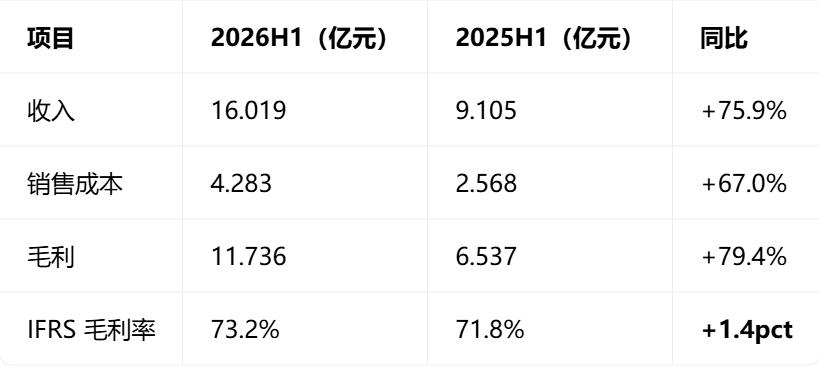
For a business with a 75% growth rate, profitability, loss reduction and gross profit margin are definitely not the top priorities. Cao Xudong, CEO of Momenta, also made it clear at the performance meeting: "Short-term profitability is not our primary goal at this stage."
But a good business is always like this — it can approach break-even even at the stage when profitability is not required.
Momenta's data also reflects a trend of the industry: this business is about to enter the era when profit assessment and accounting become necessary.
For many years in the past, the market had only one indicator for intelligent driving: how large the growth rate is and how large the remaining space is. But with Momenta's significant loss reduction, the market will start to calculate: what is the gross profit margin? Where is the moat? Can it generate stable cash flow?
This is the "rite of passage" that every young industry has to go through. Behind these data are determined by the different business models of each enterprise.
02 Compared with the Automotive Industry, Intelligent Driving Is More Like an AI Platform
Although it is part of the automotive industry chain, Momenta's business logic is not similar to that of traditional automakers.
The most important moat for the automotive business is the ultimate cost control capability and brand power. The former is the magic weapon for low-cost vehicles to survive, while the latter is the secret for luxury brands to endure for a long time.
What kind of business is Momenta running?
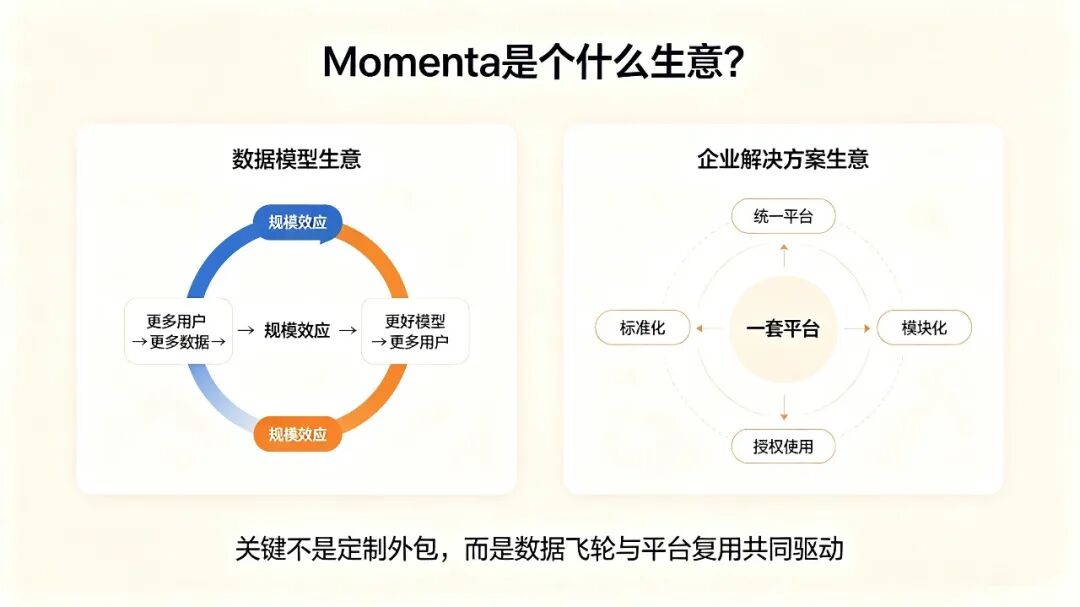
First, it is a data model business. Second, it is an enterprise solution business.
The core of the former is whether it can form economies of scale and make the data flywheel spin. The most typical examples of data model business at present are OpenAI, Anthropic and the like — the more people use it, the more data it obtains, the more accurate the content it outputs, which in turn attracts more users.
The core of the latter is whether it can reuse a set of platforms repeatedly, instead of becoming a human resource outsourcing service for clients. Just like Microsoft, which does not provide customized services, it creates continuous value for customers and makes profits for itself by authorizing the use of a set of software and modular components.
At the same time, these two forces can reinforce each other, and the two small flywheels form a larger flywheel.
This is Momenta's business model.
As a data company, Momenta has a strong advantage in vehicle installation volume.
By the middle of this year, Momenta's cumulative vehicle installation volume exceeded 1 million units, and soon exceeded 1.1 million units afterwards, covering a total of 110 mass-produced vehicle models and more than 230 cumulative designated projects. In terms of incremental volume: in the first half of 2026, Momenta's new installed volume reached about 321,000 units, with a year-on-year increase of 83.7%.
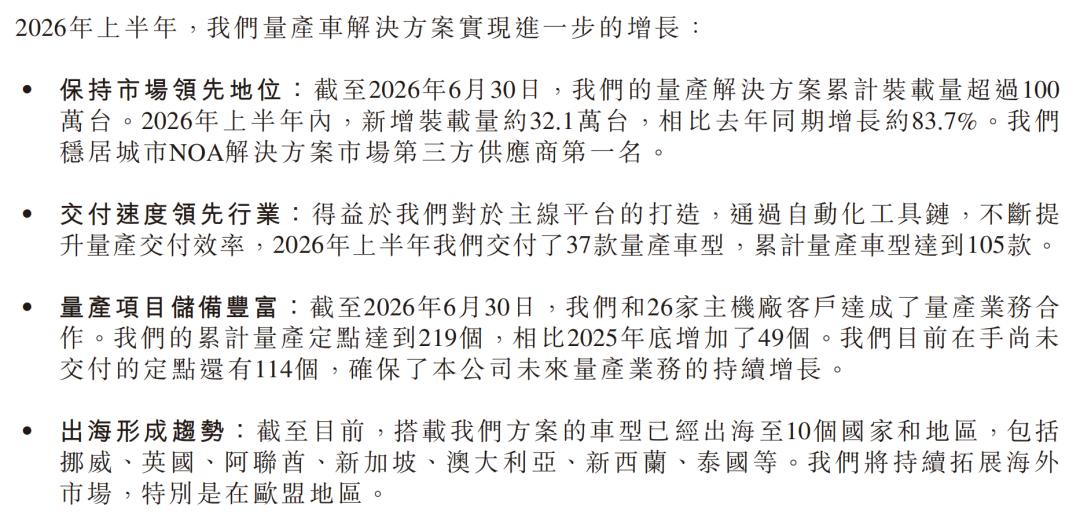
Enterprises do not have magic, and R&D personnel are not superheroes. Most of the time, the technical gap comes from the gap in data and capital. More vehicles mean more data and more revenue, and data and revenue can in turn feed back technology.
The business of data-driven companies has always been a business of economies of scale. Cao Xudong clearly stated at the performance meeting: We are targeting the truly scalable Robo track, and will not compete in small-scale niche markets.
Momenta's business model amplifies the compound interest effect of economies of scale.
As a solution provider, Momenta's technology has excellent reusability. It has not followed the path of many B2B service enterprises, which either become scattered component suppliers or fall into project-based service enterprises, and eventually get stuck in the mire of high marginal cost and low gross profit margin.
On the contrary, its business model is somewhat similar to SaaS — it sells the reusability of a complete system.
In the passenger vehicle sector, we can already see the power of this model: Momenta's licensing and service business has a gross profit margin as high as 90.4%, which is more than twice the average gross profit margin in the industry.
The reason is very simple: because it is "reuse", the marginal cost is low, and the gross profit margin is naturally high.
However, this is not the end of the reuse story.
Although Momenta is a passenger vehicle solution provider, the technology of "driving" itself is interoperable. Many taxi drivers used to drive private cars, and many heavy truck drivers used to drive buses.
It is no different for intelligent driving. The software algorithms and sensor solutions for passenger vehicles can be directly reused to support Robotaxi — these two completely different business models have no barriers at the underlying technology level.
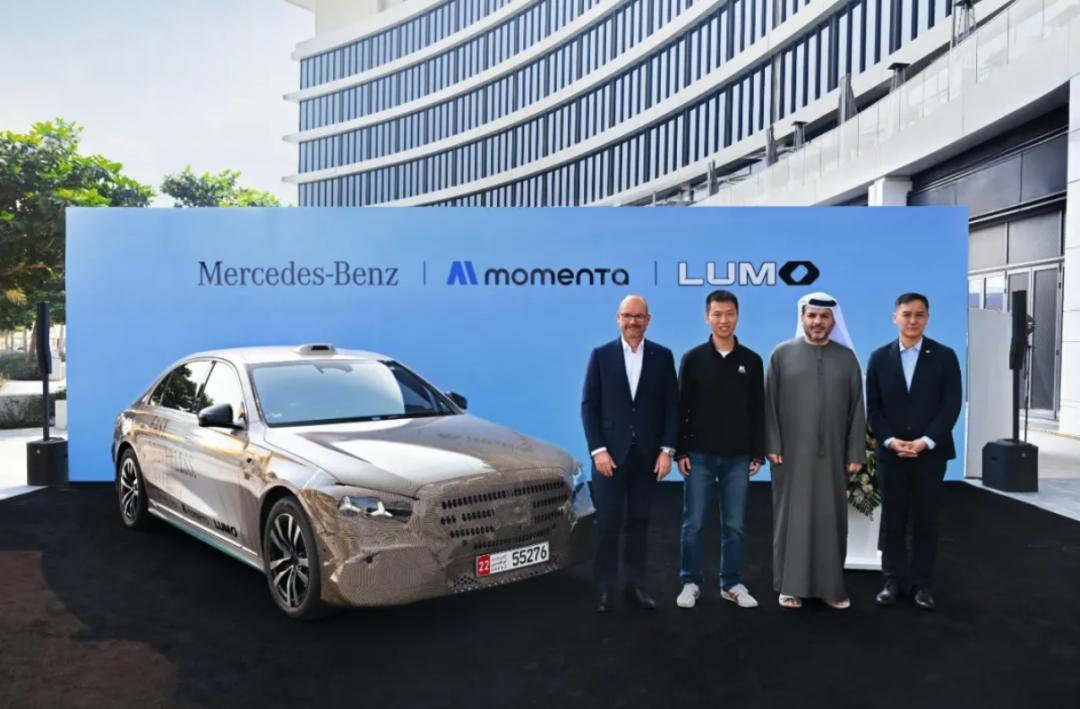
Even the partners are its own customers: last December, Momenta cooperated with Mercedes-Benz and a UAE mobility operator to launch autonomous driving taxi services. In 2026, Momenta's intelligent driving business is accelerating. For example, in July this year, Momenta obtained the test qualification in Shenzhen and started the actual road test of Robotaxi there.
This set of capabilities can even be used for cargo transportation.
According to media reports, Momenta's Robovan has been operating in Suzhou for several months. At the performance meeting, Momenta revealed that the technical base of this business has been completed, and it has already obtained customers such as JD Logistics, SF Express and ZTO Express. It will gradually verify the commercial closed loop afterwards, and finally realize large-scale operation in China in 2028, becoming the global leader in Robovan.
In addition to Robovan, there are also heavy trucks. In March 2026, Momenta increased its investment in intelligent heavy truck manufacturer Zero One Auto. Cao Xudong revealed that in 2027, Momenta's autonomous driving business will expand to Robotruck, the heavy truck sector.
In the freight sector, Momenta is a newcomer, but also a veteran — because the technology ecosystem of mass-produced vehicles can be very smoothly reused in the cargo transportation sector. Moreover, the intelligent driving technology of mass-produced vehicles has been verified by more vehicle installations. Such manufacturers look like newcomers, but from the perspective of data volume and model maturity, they are actually more "experienced" enterprises.
This reusability will in turn feed back technology and enhance the capability of the R7 world model. Finally, a flywheel is formed: the better the technology — the more users — the more users — the better the technology — reuse in more fields — feed back more data.
The story of this spinning flywheel is not rare among technology enterprises. The reason why Google Search has 90% of the market share for many years is not that Google's engineers are 10 times smarter than those of Microsoft and Yahoo, but that only Google has massive users and massive data, so that it can continuously optimize its engine.
NVIDIA's gaming graphics cards have the largest number of players, which makes manufacturers focus on optimizing for NVIDIA hardware. NVIDIA can also improve its ecosystem from massive data, forming a network effect of software ecosystem — this software ecosystem later gradually expanded to AI, autonomous driving, robotics and other fields. Facing this moat, let alone new entrants in the industry, even AMD, which is also a giant, can hardly catch up.
This flywheel is very difficult to form. It requires huge scale to spin, and huge scale in turn requires competitive products. Even a strong enterprise like NVIDIA spent many years and a lot of capital building the CUDA ecosystem, and did not see returns until ten years later.
But once this flywheel spins, it is very difficult to stop. It will make the economies of scale of some enterprises larger and larger, the cost lower and lower, and the technical capability stronger and stronger.
The differentiation between good businesses and bad businesses is often deepened as the flywheel spins.
This article is from the WeChat official account "Lueda Reference" (ID: hyzibenlun), written by Yang Zhichao, authorized for release by 36Kr.