Zhipu lost 2 billion yuan in the first half of the year. Can selling Tokens on Tmall solve its profitability dilemma?
You can now purchase Tokens on e-commerce platforms!
On September 2, Chinese large language model vendor Zhipu AI officially settled in Tmall to open its official flagship store, where it will sell products including Coding Plan packages online.
It is reported that the currently available products include personal versions of Lite, Pro, Max and other categories, which can be purchased on a monthly/quarterly/annual subscription basis.
Just two days before settling in Tmall, Zhipu AI just released a mixed mid-term report card. In the first half of this year, Zhipu AI achieved a revenue of 954 million yuan, a year-on-year surge of nearly 4 times, and its revenue scale exceeded the total of last year at one stroke.
In the same period, Zhipu AI's loss for the period narrowed by 12.1% to 2.072 billion yuan, but the adjusted net loss widened by 12.1% to 1.964 billion yuan. Meanwhile, its gross profit margin also dropped sharply from 50% in the same period of last year to 26.4%, a year-on-year decrease of 23.6 percentage points.
During the reporting period, Zhipu AI completed the core replacement of its revenue structure, with cloud deployment revenue increasing by 2735.7% year-on-year to 825 million yuan, and its revenue proportion rising from 15.2% in the same period of last year to 86.5%.
In this regard, Zhipu AI stated that the change in the company's revenue structure is essentially the evolution of transaction methods brought about by the improvement of model capabilities.
It is worth mentioning that Minimax, which is called the "two leading domestic large model players" together with Zhipu AI, has also changed its business structure, and both have turned to the model of mainly generating revenue through APIs.
Revenue surged nearly 4 times, adjusted net loss expanded year-on-year
On the evening of August 31, Zhipu AI, known as the "world's first large model public company", released its first semi-annual report since its listing.
From the perspective of revenue data, Zhipu AI's performance is quite impressive. In the first half of this year, Zhipu AI recorded a revenue of 954 million yuan, a year-on-year increase of 399.7%. In 2025, Zhipu AI's total annual revenue was only 724 million yuan.
For the surge in revenue scale in the first half of the year, Zhipu AI explained in the financial report that it was mainly due to the explosive growth of cloud deployment business.
However, the "rapid growth" on the revenue side has not completely pulled Zhipu AI out of the quagmire of losses. In the first half of this year, Zhipu AI's loss for the period narrowed by 12.1% year-on-year to 2.072 billion yuan.
In this regard, Zhipu AI explained that it was mainly due to the increase in gross profit during the reporting period and the fact that the financial instruments issued to investors after listing have been converted into common shares, resulting in a significant reduction in the loss from changes in related book values, but part of the reduction was offset by the increase in R&D expenditure.
However, in the first half of this year, Zhipu AI's adjusted net loss was 1.964 billion yuan, and the loss scale increased by 12.1% compared with 1.752 billion yuan in the same period of last year.
At the same time, Zhipu AI's profitability is also declining. In the first half of this year, Zhipu AI's gross profit increased by 163.7% year-on-year to 252 million yuan, but the gross profit margin dropped sharply from 50% in the same period of last year to 26.4%, a year-on-year decrease of 23.6 percentage points.
In this regard, Zhipu AI explained that it was mainly due to the transformation of revenue structure. The proportion of cloud deployment has expanded rapidly. This type of business is still in the initial stage of explosive growth, and the gross profit margin is still climbing, which has structurally diluted the overall gross profit margin.
In the first half of this year, Zhipu AI's sales cost was about 702 million yuan, a year-on-year surge of 635.4%, which was mainly due to the increase in computing service costs to support business expansion and revenue growth.
In terms of expenses, Zhipu AI's R&D expenditure increased from 1.595 billion yuan in the first half of last year to 2.131 billion yuan, an increase of 33.6%. This growth is mainly due to Zhipu AI's continuous increase in R&D investment in model training to support the continuous breakthrough of the intelligence ceiling of the GLM series models.
In the same period, the company's sales and marketing expenses decreased by 14.8% year-on-year to 178 million yuan, which was mainly due to optimizing the allocation of marketing resources and improving the conversion efficiency of marketing investment.
The company's general and administrative expenses in the first half of the year were 103 million yuan, a decrease of 44.2% compared with the same period of last year. This decrease was mainly due to the reduction of professional service fees and equity-settled share-based payment compensation expenses during the reporting period compared with the same period of last year.
Growth engine switched, cloud deployment business takes the lead
Radar Finance noted that the semi-annual report released by Zhipu AI this time also conveys a signal that its revenue structure has completed core replacement during the reporting period.
According to the financial report, divided by deployment method, Zhipu AI's revenue mainly consists of two segments: cloud deployment and local deployment.
In the first half of 2026, the company's cloud deployment revenue increased from 29 million yuan in the same period of last year to 825 million yuan, with an increase rate of up to 2735.7%.
At the same time, the revenue proportion of this business has also risen sharply from 15.2% in the same period of last year to 86.5%, becoming the absolute engine of the company's revenue growth.
Zhipu AI stated that this growth mainly reflects that the company's model capabilities are gradually improving for high-value task scenarios, and the continuous progress of the model's long-range task capabilities allows users to make continuous calls in complex scenarios, which in turn leads to a significant increase in the average daily Token calls of users; the scale of users on the MaaS platform continues to expand, and the trend of both volume and price rising continues.
Specifically, as of the date of the financial report release, the Token call volume on Zhipu AI's MaaS platform has increased by more than 40 times compared with the beginning of the year, of which the Coding Plan call volume has increased by more than 23 times; in the same period, the average API selling price increased by about 101%, and the Coding Plan subscription price was also raised.
The simultaneous rise in volume and price further drives the improvement of gross profit and gross profit margin of Zhipu AI's cloud deployment business. In the first half of this year, the gross profit of this business increased to 203 million yuan, turning from negative to positive compared with the same period of last year; the gross profit margin also increased from -0.4% in the same period of last year to 24.6%.
It is worth mentioning that in terms of user scale and usage depth, as of the date of the financial report release, the number of users on Zhipu AI's MaaS platform has exceeded 7.4 million, an increase of 144% compared with the beginning of the year; the number of paying daily active users has increased by 603% compared with the beginning of the year. The top ten users in terms of revenue have an average daily call volume 98 times higher than that at the beginning of the year.
The increasing growth rate of the above three indicators means that Zhipu AI has more users, paying users are growing faster, and existing paid heavy users are using the services more deeply, with the models gradually moving from trial use to production deployment within customers.
Against the backdrop of the explosive growth of the cloud deployment business, Zhipu AI emphasizes the quality of local business and industry selection to consolidate the foundation for future model capabilities to move from general scenarios to high-value specialized task scenarios in vertical industries.
Affected by this, Zhipu AI's local deployment revenue dropped from 162 million yuan in the same period of last year to 129 million yuan in the first half of this year, a decrease of 20.5%, and its revenue contribution also dropped from 84.8% in the same period of last year to 13.5%.
At the same time, the profitability of this business has also weakened. In the first half of the year, the gross profit decreased by 49% year-on-year to 49 million yuan, and the gross profit margin dropped by 21.2 percentage points to 37.9%.
In this regard, Zhipu AI explained that it was mainly due to the group's promotion of business model adjustment, the change in the product structure of local deployment, the shrinkage of the private deployment scale of enterprise-level general large models with higher gross profit margins, and the increase in the proportion of enterprise-level agent products that are still in the stage of large-scale expansion; at the same time, some customers have migrated from local deployment to cloud services.
For the change in the company's revenue structure, Zhipu AI stated that its essence is the evolution of transaction methods brought about by the improvement of model capabilities: from selling models to selling calls, then to selling subscriptions, and finally realizing the sale of end-to-end task results.
When the two leading players meet, Zhipu AI's ARR reached 1.6 billion US dollars in August
Shortly before Zhipu AI released its financial report, another domestic large model company Minimax also released its semi-annual performance report. Coincidentally, Minimax's business structure has also changed.
According to the latest financial report disclosed by Minimax, in the first half of this year, Minimax achieved a revenue of 117 million US dollars, a year-on-year increase of 283.1%.
Among them, the revenue from open platforms and other AI-based enterprise services was 74 million US dollars, a year-on-year increase of 703.1%, and its revenue proportion jumped from 30.3% in the same period of last year to 63.4%, becoming the largest source of revenue for the company.
Minimax stated that the growth of this business revenue is mainly due to the increase in the number of paying individual users and enterprise users, the increase in API call volume, and the rapid adoption of the company's Token plan.
Looking back at 2025, the main revenue of Minimax at that time came from the AI-native product business, which contributed 53 million US dollars in revenue for the whole year, accounting for more than 67% of the total. In the same period, Zhipu AI's revenue mainly relied on local deployment business for enterprise customers.
But after entering 2026, the two leading domestic large model players have both turned to the model of generating revenue through APIs.
In fact, according to the 21st Century Business Herald, the main revenue sources of overseas large model giants such as OpenAI and Anthropic are also API plus subscription systems, and their valuation anchor is ARR (Annual Recurring Revenue).
Minimax disclosed at the 2026 mid-term performance meeting that the company's ARR in August has exceeded 800 million US dollars, the revenue in the second quarter increased by 81.8% quarter-on-quarter compared with the first quarter, the Token consumption in July has reached 20 times that of January, and the B-end business's contribution to the overall ARR has exceeded 80%.
According to Zhipu AI's disclosure, as of the end of August, the company's latest ARR reached 1.6 billion US dollars (calculated by multiplying August's revenue by 12). If calculated based on a more aggressive caliber (multiplying the revenue of the latest week by 52), its ARR will exceed 2 billion US dollars. From this dimension, Zhipu AI is slightly ahead.
It is worth mentioning that as of the end of the first half of the year, Minimax's products and services have covered more than 230 countries and regions.
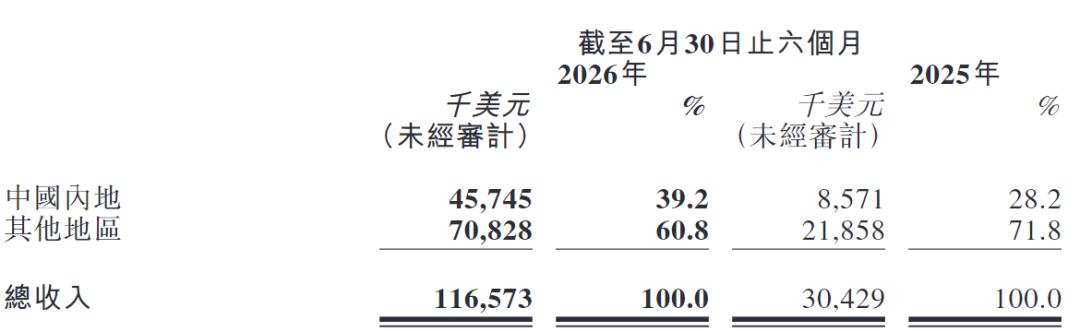
In the first half of the year, the company's revenue from regions outside mainland China reached 71 million US dollars, and its revenue proportion dropped from 71.8% in the first half of last year to 60.8%, but it is still higher than the revenue proportion of mainland China.
Radar Finance will continue to pay attention to the subsequent development of the two leading domestic large model players.
This article is from the WeChat official account "Radar Finance", written by Zhou Hui, edited by Meng Shuai, and published with authorization from 36Kr.