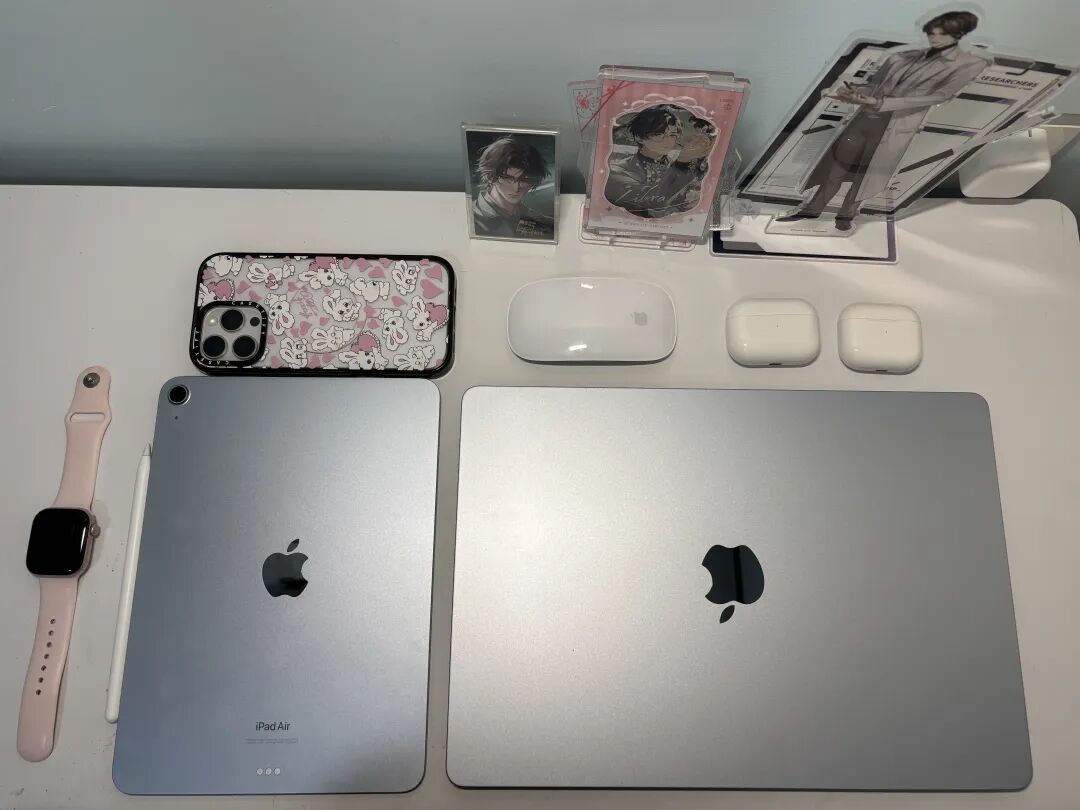
At the beginning of the new semester, students have to spend tens of thousands of yuan first, and the price rise of the "digital three-piece set" makes new college students feel a real pinch in their wallets.
"Do you have to have a computer to go to college? Is it okay to write code by hand?" This summer, many people have come across similar posts on social media. In these posts, parents often raise thunderous questions that seem to belong to the last century: "Why do you bring a computer to class instead of pens and notebooks?" "I just don't believe he can't study computer science without a computer." However, apart from some cases where people create accounts just to trick others into replying, most of the people who post these are students themselves, who need to cite replies from the comment section to prove to their parents that a series of electronic devices are indeed necessary for college.
In recent years, during the summer vacation after the college entrance examination, the "back-to-school essential set" has become a trend exclusive to soon-to-be college students. Young people who are used to unified school uniforms and unified schedules have not yet stepped into the university campus, but the consumption gap has already appeared in advance. With the new round of price hikes on digital products, this expense has gradually become an invisible burden for some families.
As the new semester approaches, compared with parents of primary and secondary school students who are cheering that "the little beasts are back to their cages", parents of college students have more complicated moods.
Every July and August, the purchase of admission equipment by soon-to-be college students will set off a consumption boom. A 2025 survey by the Social Survey Center of China Youth Daily of 1337 incoming freshmen showed that electronic products, driving licenses, and travel ranked the top three on the summer consumption list.
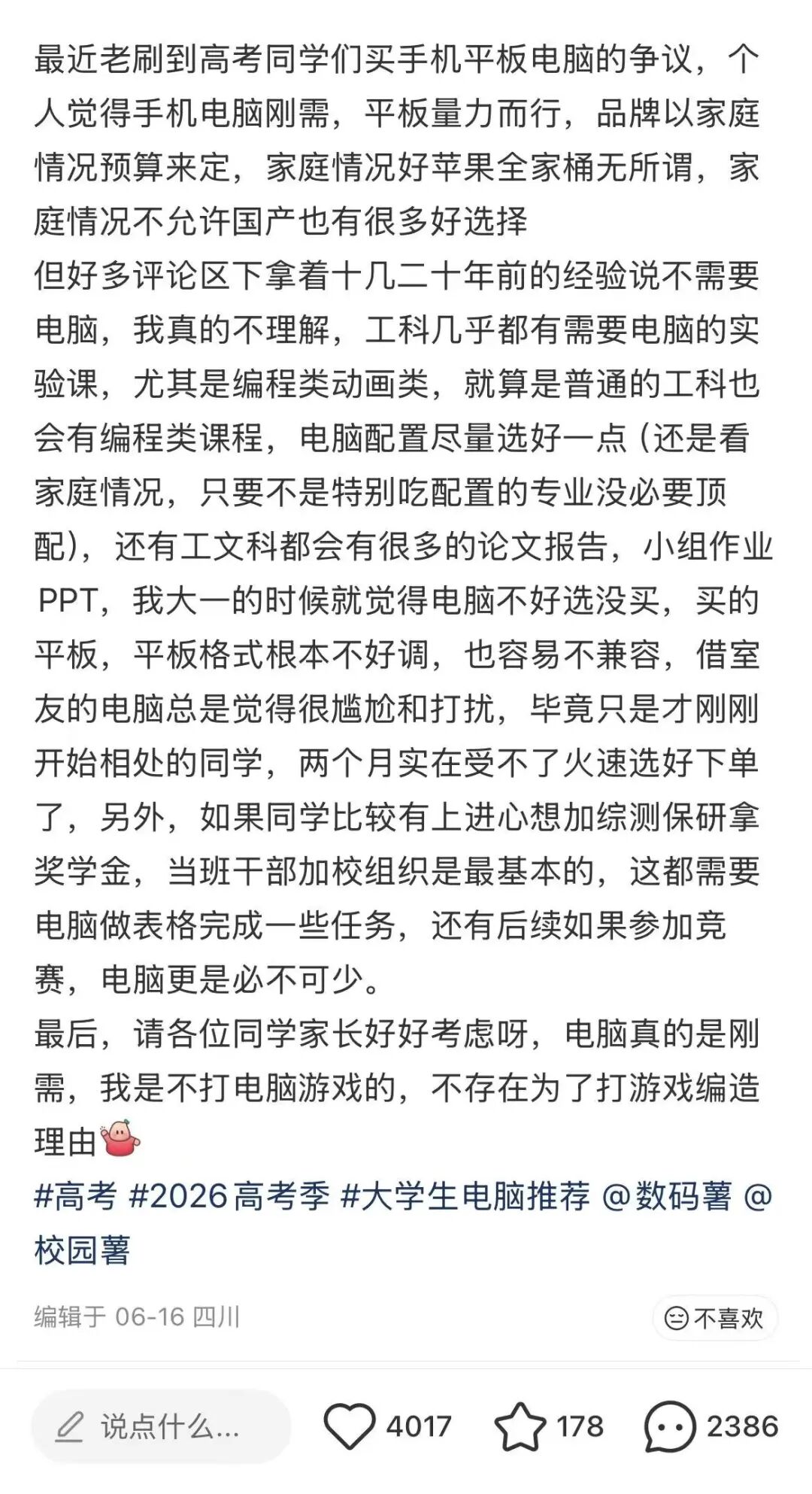
Some experienced users posted seriously, saying that buying a computer is indeed a rigid demand for college freshmen. (Photo/Screenshot of social platform)
The digital "three-piece set" consisting of mobile phones, computers, and tablets takes up the largest part of the soon-to-be college students' expenses. If you add headphones and a smart watch, a complete "digital full bucket set" is ready. According to forecasts from institutions including iiMedia Research, the overall comprehensive consumption of examinees after the 2026 college entrance examination will reach 4150 billion yuan, of which the digital product market is expected to reach 1890 billion yuan. A parent said with a bitter smile: "After buying a full set of digital products for my child, tens of thousands of yuan are gone."
Since the beginning of this year, prices of products including mobile phones, laptops, and solid-state drives have risen across the board. Major mainstream manufacturers such as Apple, Samsung, Xiaomi, and Lenovo have adjusted product pricing and configurations. At the same time, digital purchase guides are flooding social media, and discussions among freshmen about showing off their equipment and choosing brands remain extremely popular.

The back-to-school season coincides with the price surge of electronic products, which indeed creates a burden for some families. (Photo/Screenshot of social platform)
Topics such as "You just finished the college entrance examination, not your family got rich" have topped the hot search lists. Compared with struggling over brands and models, "whether it is necessary to buy the full digital set" and "whether ordinary families should pursue high-end equipment" have become practical problems faced by more families.
For soon-to-be college students, new digital devices are a sense of ritual to start college life, which some call a "digital coming-of-age ceremony". However, this "coming-of-age blessing" has become a little heavier than in previous years.
Buy one month later, pay 1000 yuan more
After the college entrance examination, Qiqi's parents drove to pick her up home. The three-year high school life came to an end, and the whole family felt a huge weight lifted off their shoulders. Taking advantage of this relaxed mood, Qiqi discussed with her parents that she wanted to buy an iPad. Her reasons were fully justified: she could use the tablet to take notes and read academic papers in college, and she could also use it to watch dramas and learn English during the current summer vacation, killing two birds with one stone.
The offline authorized store is more than 20 kilometers away from her home, so it's not worth making a special trip. At that time, online shopping had government subsidies, which was even cheaper than physical stores. So she placed an order for her long-cherished rose-pink iPad on the official website that night for more than 2400 yuan, and it was delivered the next day.

Qiqi brings her iPad when traveling during summer vacation. (Photo/Provided by the interviewee)
Unexpectedly, only a month later, her classmate bought an iPad with exactly the same configuration, and the price had already risen by more than 1000 yuan.
In this round of digital price hikes, the price increase of laptops is the most prominent. The core driving force behind the price surge is the explosive growth of global AI computing power demand, which has led to a structural imbalance in the supply of memory chips. Data from the China Academy of Information and Communications Technology shows that in the first quarter of 2026 alone, domestic AI computing power demand surged 417% year-on-year, while the supply growth rate was only 128%, and the gap between supply and demand continued to widen.
To seize the high-profit market, leading global memory giants including Samsung Electronics, SK Hynix, and Micron Technology have diverted more than 70% of their advanced production capacity to AI-dedicated High Bandwidth Memory (HBM), directly squeezing the production capacity of consumer-grade DRAM memory and NAND Flash SSD required for personal computers.
In addition to the tightening supply of core chips such as CPUs and discrete graphics cards, the price of laptops has been pushed up. In industry terms, this is called "chip inflation", but for consumers, it is a real and tangible price increase.
Besides, the annual June e-commerce promotion combined with the summer buying wave will lead to a periodic rise in the prices of electronic products. Qiqi avoided the price increase of tablets, but could not escape the laptop price surge. As a liberal arts student, she does not have high requirements for laptop performance, and planned to buy a basic office laptop for about 5000 yuan, waiting for the admission results to confirm her major before making a purchase. But when she paid in July, the same model was more than 1000 yuan more expensive than when she checked the models in April.
This summer, Qiqi bought two of the "three-piece digital set for college students", and the iPhone 16 in her hand was bought a year ago when she was a sophomore in high school. Before that, she used a domestic mobile phone worth about 2000 yuan for five consecutive years. Its battery drained extremely fast, so she had to carry a power bank whenever she went out.

The DSLR and instant camera that Qiqi bought on second-hand platforms. (Photo/Provided by the interviewee)
Chen Yu, a soon-to-be freshman majoring in computer science, is also facing the same price increase as Qiqi. After the college entrance examination, she first replaced her phone with an iPhone 15 with better camera performance, paired it with 4th-generation headphones, and signed up for driving school. After adding up these expenses, her parents had already spent more than 10000 yuan. When it was time to buy a computer, her parents discussed with her to postpone the purchase until after the National Day holiday.
"Prices are rising too fast during summer vacation, and we don't need a computer for military training in the first month of school. We'll wait until the price drops a bit to buy it." Her parents set a budget of 4000 yuan for Chen Yu, but the computer science major has higher requirements for device configuration, and Chen Yu decided to cover the part exceeding the budget by herself.
Choose affordable alternatives, or choose big brands?
Generation Z, born between 1995 and 2009, grew up in an era of rapid development of digital technology. They have a clear understanding of digital products, value both brand experience and user experience, and are willing to pay for emotional value and a sense of cutting-edge technology. In recent years, they have also paid more and more attention to "cost-effectiveness", preferring to go through reviews and watch evaluation videos before making a purchase.
Qiqi's choice strategy is very typical. She likes Apple's design and ecosystem, so she chose Apple for her mobile phone and tablet, but when it came to computers, she did not blindly complete the "full set". She first consulted seniors and schoolmates, and watched a lot of evaluations, and found that the Mac system is not ideal for compatibility with some professional software, so she decisively turned to ASUS which has higher cost performance.
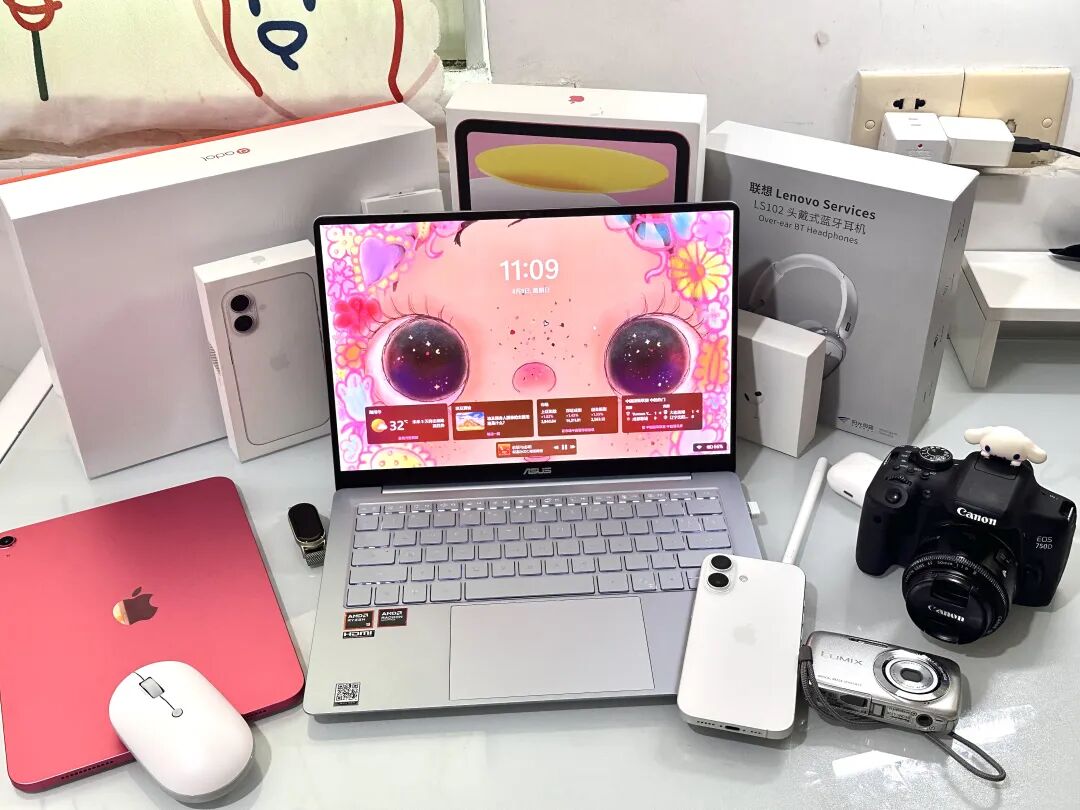
Qiqi's full digital set for soon-to-be college students. (Photo/Provided by the interviewee)
As for the touch pen that costs seven to eight hundred yuan for iPad, she did not hesitate to buy an affordable alternative for more than 100 yuan. After all, she is a liberal arts student, and she mainly uses it to take notes, not for drawing, so the alternative is completely sufficient. For headphones, she chose the 69-yuan Huaqiangbei version, the pop-up window and settings interface are almost the same as the genuine one, and it has been working well for three years. She is very calm about it: "When someone asks me what headphones I use, I just say it's the Huaqiangbei version. It's my skill to find cheap and good products."
Xixi, who enrolled in 2021, is a practitioner of rigid-demand consumption. When she first entered college, she was still using her old mobile phone from high school. Her thought was very simple: "If I don't need it, I won't buy it." Until one time she was in the cafeteria, queuing up to pay by scanning the QR code, the phone's camera was not good to begin with, and it was completely blurry when zoomed in, and it was lagging so badly that people queuing behind were all waiting for her. She immediately thought: "This phone has to be replaced no matter what."
This was also the first time she spent her own money on a mobile phone. At that time, her budget was set at 3000 to 4000 yuan, no more than 5000 yuan at most. She believes that "you get what you pay for", and she did not dare to buy something too cheap, after all, she would rely on it for four years of college. Her requirements for mobile phones are very clear: "Large battery capacity, clear camera, and good appearance."
After locking in her needs, she first went to Bilibili to watch evaluations, picked out two or three models that met the requirements, and then went to shopping apps to check reviews from real users. If there was the same model in a physical store, she would make a special trip to touch the real device to feel the hand feel and weight. Finally, she bought a Realme mobile phone for 3000 yuan, which takes clear photos and has a durable battery, and she used it until graduation without any problems.
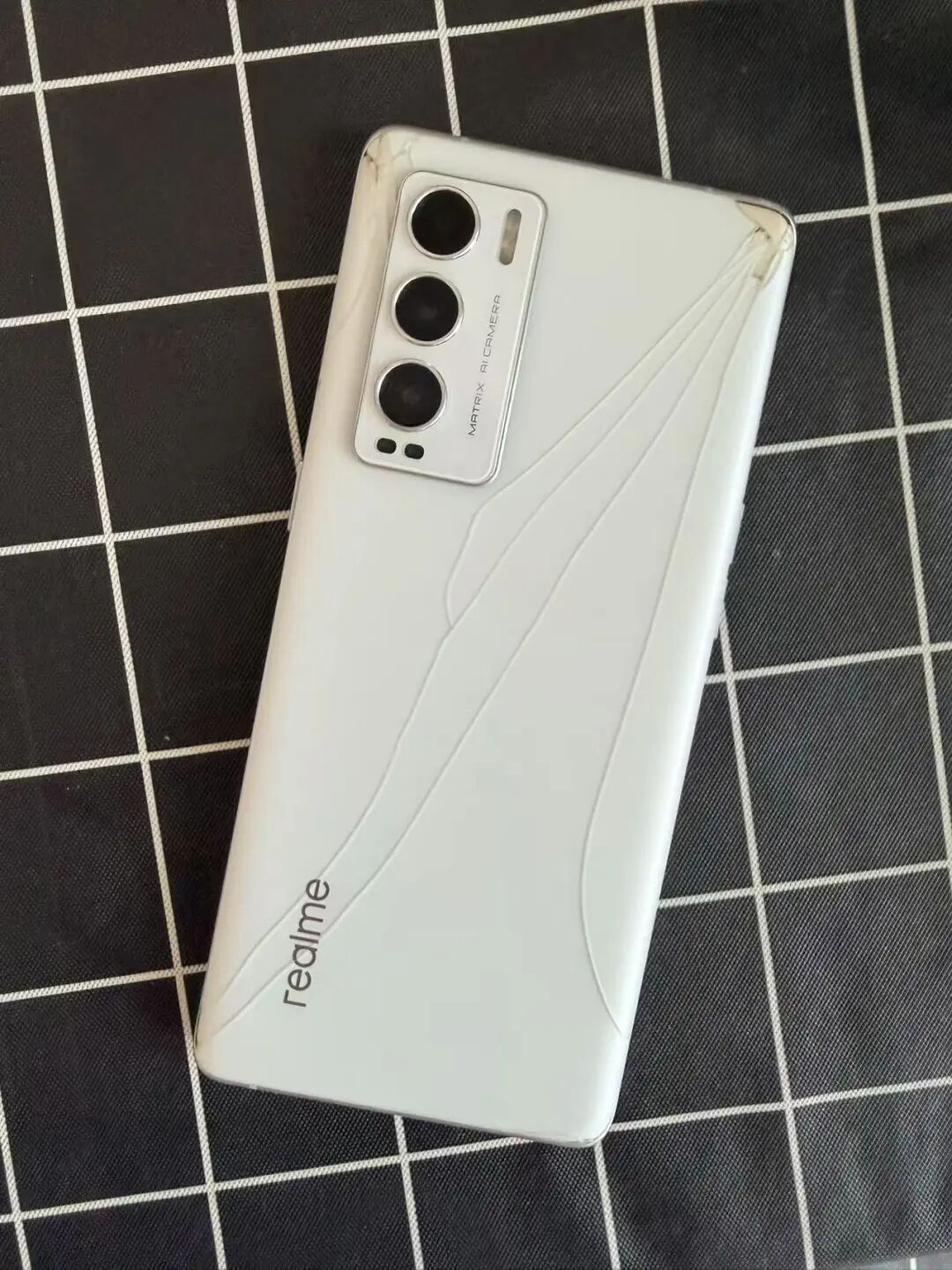
The mobile phone Xixi used throughout college, she said it is "extremely drop-resistant". (Photo/Provided by the interviewee)
Xixi's laptop was also bought after she entered college. She majored in architecture, which requires drawing, so the configuration requirements are high. The budget was set at about 10000 yuan, and no more than 12000 yuan was acceptable, and her parents were willing to pay for it. "Others have computers to use, if you don't, how do you finish your homework? So you definitely need one."
Xixi went to college locally, and her usual expenses were low. She saved a small fortune before college, and she also worked a summer job in a milk tea shop after college, with two days off a month and a salary of just over 3000 yuan, most of which she saved. She never bought a tablet, because she heard many people say "productive before purchase, only for watching iQiyi after purchase", she said bluntly: "I thought about it, but later found out I just don't need it."
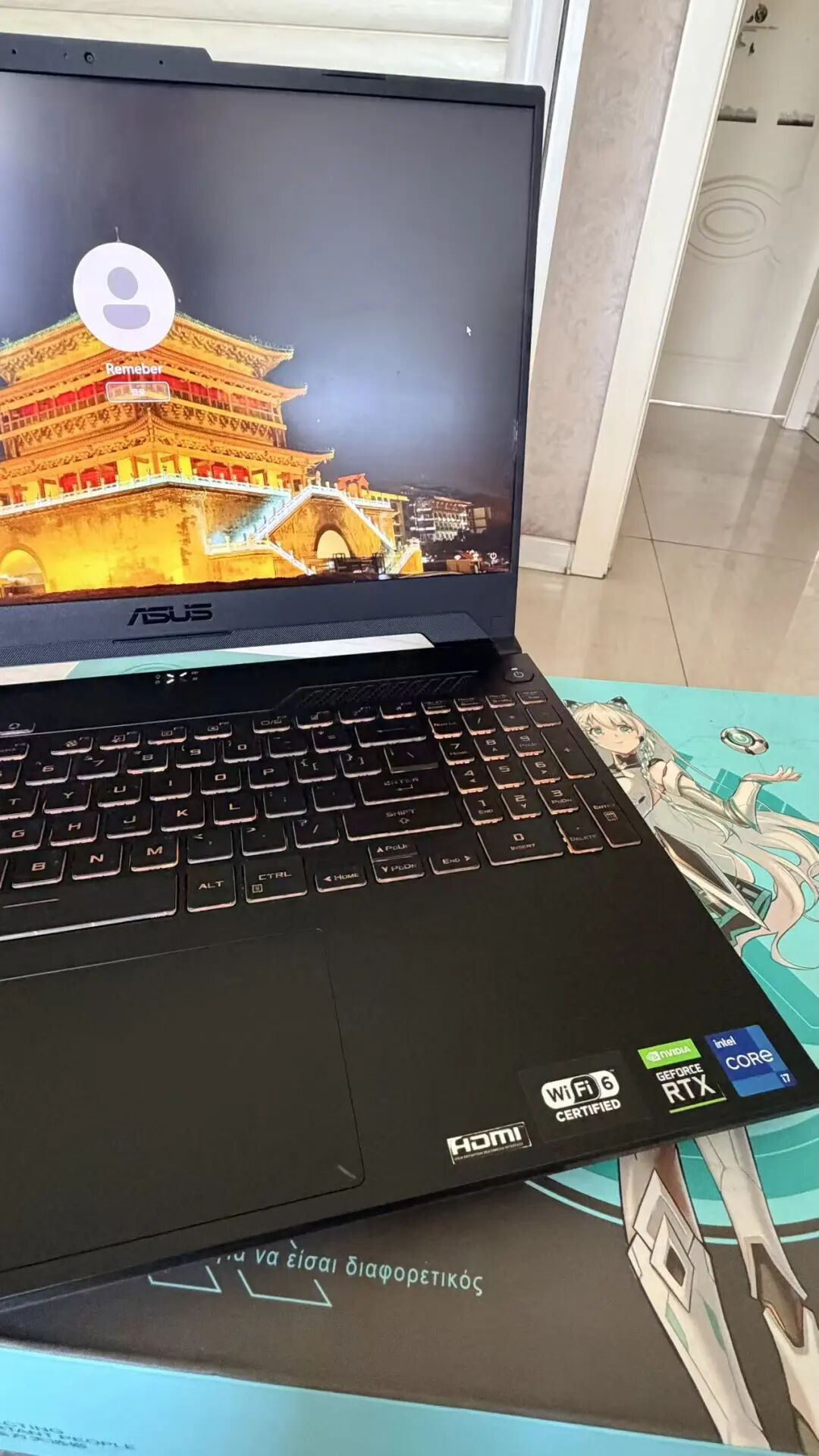
The laptop Xixi used during college. (Photo/Provided by the interviewee)
Before Jinyu enrolled as a freshman in 2022, her family had prepared an Apple mobile phone, headphones and a laptop for her, and she was also equipped with an Apple Watch during high school to facilitate campus contact. She admitted that she prioritizes brands. On the one hand, her mother has been using iPhones, and she got used to it under the influence of her family; on the other hand, she thinks Apple's ecosystem is complete, and the supporting devices are comfortable to use.
Speaking of budget, she said she would not set a limit for herself in advance, and only consider whether the price is acceptable after she fancies a product: "If I really like it, I can grit my teeth and afford it." She thinks you can't save money on food, and you have to replace electronic products when you need them. After she was recommended for postgraduate admission this year, she became obsessed with photography, and her family also gave her money to buy an instant camera and a mirrorless camera. This summer vacation, she often went offline to participate in various anime activities.