Infuse hydrogen into facial masks, Qilin Zhengwei has secured tens of millions of yuan in Series A financing | 36Kr Exclusive
Text by Lingguo Liu
Edited by Ruojing Hai
36Kr learned that Qilin Zhengwei, an enterprise focused on new hydrogen molecule materials, has recently completed a Series A financing of tens of millions of yuan. This round of financing is led by the Beauty Pilot Fund under Tiantu Investment, and the raised funds will be used for core technology iteration, construction of the Huzhou production base, expansion of the R&D team, and development of the market and customer system.
In 2007, a paper published in *Nature Medicine* by a team from Jichi Medical University first brought hydrogen, which had long been regarded as a physiologically inert gas, into the medical field. The study found that hydrogen molecules have a selective antioxidant effect. Antioxidation, which is more widely known to the public as anti-aging.
Based on this, in recent years, many merchants have taken the opportunity to make false propaganda, packaging drinking hydrogen water, inhaling hydrogen, and taking hydrogen baths as a "universal solution" for cancer prevention and treatment, which has repeatedly made hydrogen molecules controversial on the Internet.
In fact, although hydrogen molecules cannot cure all diseases, their broad-spectrum anti-aging effect has been verified by a number of scientific studies. For example, a study published in *Nature Communications* by a team from the Shenzhen Institute of Advanced Technology of the Chinese Academy of Sciences, Shanghai Jiao Tong University, and East China University of Science and Technology shows that local hydrogen release can inhibit the aging-related secretory phenotype, delay the aging of stem cells, macrophages and bone cells, and improve the local inflammatory environment.
The reason why illegal merchants can take advantage of the situation is that although the underlying mechanism of hydrogen molecules has been supported by research, there is a delivery problem between the scientific mechanism and product efficacy. For hydrogen to work, a sufficient dose of hydrogen must enter the body's tissues; but hydrogen is hardly soluble in water and extremely easy to escape, which has long been difficult to achieve stably in consumer-grade products.
And this is exactly the original intention of Qilin Zhengwei, the pioneer of new hydrogen molecule materials — to deliver hydrogen molecules into cells truly.
Zhejiang Qilin Zhengwei Medical Technology Co., Ltd. was founded in 2022. It is an enterprise incubated by Hangzhou Industrial Investment Group and jointly carries out achievement transformation with the College of Chemistry and Materials Engineering of Jiangnan University. Founder Li Qibin has experience in material R&D and industrialized entrepreneurship, and Professor Wang Jing from Jiangnan University serves as the company's chief scientist. The company mainly provides hydrogen molecule raw materials and material products for beauty brands and manufacturing enterprises.
"We hope to solve the problems of stable hydrogen storage and hydrogen release, and turn hydrogen molecules into industrial-grade materials that can be implemented and reused," introduced Guo Liwei, co-founder and CMO of Qilin Zhengwei.
Qilin Zhengwei first put hydrogen into facial masks. Its first hydrogen molecule product (also known as hydrogen-rich dry membrane cloth) is positioned as a "mask partner" and is used with ordinary wet masks. According to the industry report jointly released by Nox Bellcow and User Research, the scale of China's facial mask market is expected to reach 83.78 billion yuan in 2026. However, the industry is highly saturated and has long been trapped in low-price competition. "We did not build an end brand to participate in the vicious competition, but became an underlying material supplier and do a good job as a 'supporting role'," Guo Liwei said.
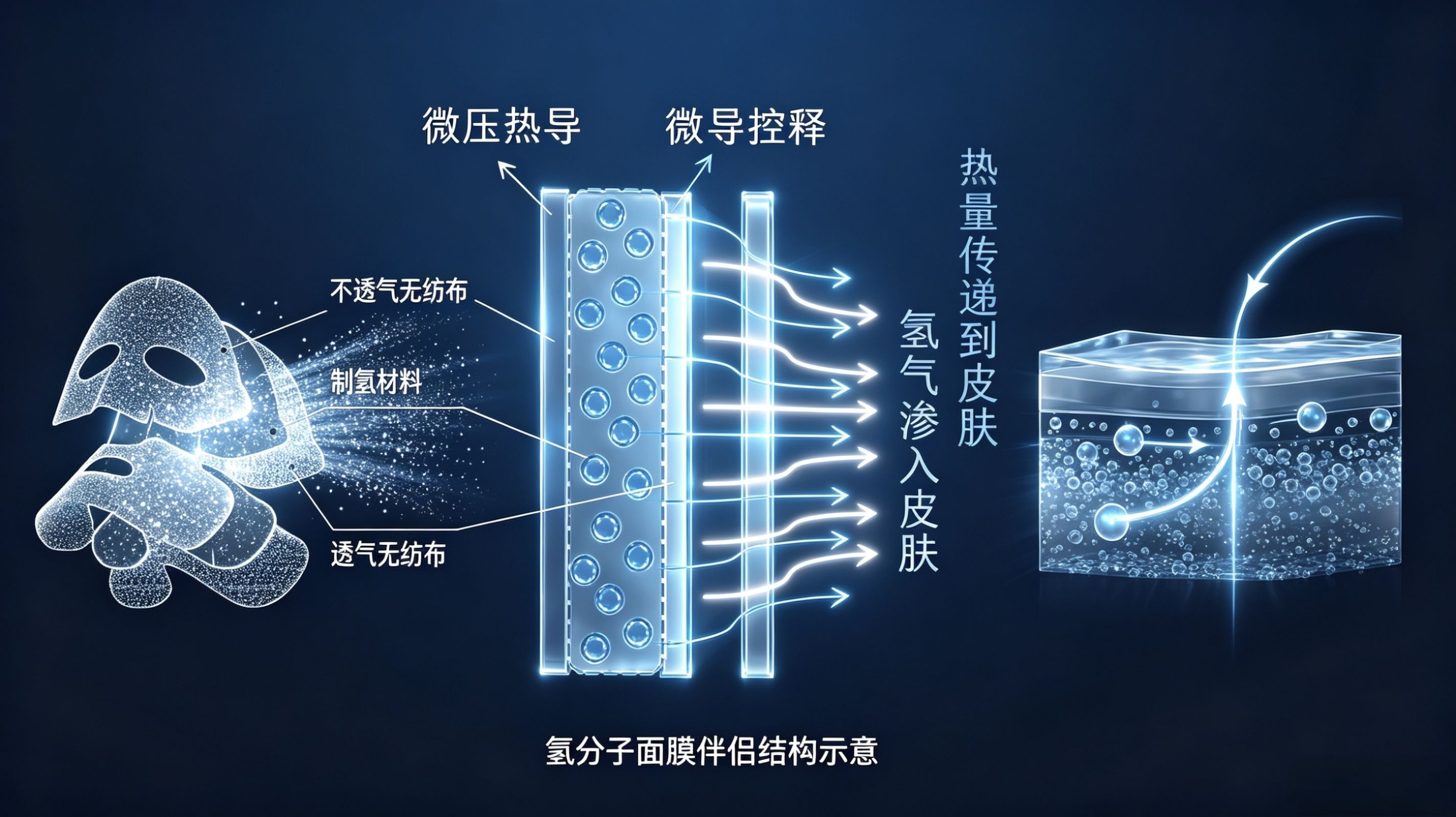
Schematic diagram of the structure of the hydrogen molecule mask partner
The hydrogen molecule mask partner of Qilin Zhengwei has three layers in total. The side close to the skin is a special non-woven material that is breathable and water-permeable, the middle layer is a solid-state hydrogen storage slow-release material, and the outer layer is a relatively air-impermeable special non-woven material, which together form a relatively closed hydrogen production space facing the face.
When using it, consumers first apply the wet mask, then apply the dry membrane cloth on the wet mask. As the essence in the wet mask penetrates through the inner non-woven layer of the dry membrane cloth and enters the hydrogen release layer, the hydrolysis reaction starts immediately. The slowly released hydrogen, under the micro-pressure thermal conduction effect of the outermost air-impermeable non-woven fabric, penetrates the wet mask and diffuses towards the skin.
This "produce when use" mechanism can prevent hydrogen from escaping in advance. But how to ensure that the generated hydrogen can enter the deep part of the skin?
In fact, hydrogen molecule is the smallest known molecule in the universe, with a molecular weight of only 2 Daltons. Theoretically, it is not difficult to pass through the skin barrier. The main bottleneck is still the escape property of hydrogen.
In response to this, Qilin Zhengwei's solution is to provide a sufficient dose, and use the heat generated by the reaction to make more hydrogen diffuse towards the skin. Guo Liwei introduced that early products could only produce tens of milliliters of hydrogen per piece. After repeated tests, the current mass-produced version has a total hydrogen production of about 800 milliliters per piece, lasting for about 15 minutes. "From the in vitro skin model test carried out by Jiangnan University, after 800 milliliters of hydrogen is released, the amount entering the skin is about several milliliters. It may sound very little, but no other enterprise in the world can reach this level at present."
On this basis, Qilin Zhengwei has also developed a dual-gas technology for the coordinated release of hydrogen and carbon dioxide. Guo Liwei introduced that carbon dioxide can play a role with the help of the Bohr effect: when carbon dioxide acts on the skin, it will promote the hemoglobin in capillaries to release oxygen, expand local microcirculation, open skin penetration channels, and create favorable conditions for hydrogen penetration. The company's actual measurement data shows that after adding carbon dioxide for coordination, the transdermal rate of hydrogen increases by more than 50%, and this technology will be prioritized in higher-end product lines.
With high dose and warm environment, the following problem is how to precisely control the temperature to ensure product safety?
"When we were running in with the world's leading cosmetics brands, they had very high safety requirements and did not allow the listed products to have the hidden danger of low-temperature scalding. This is the problem we must solve first, so we adopted a series of slow-release temperature control technologies," Guo Liwei said. On the one hand, the company highly disperses the hydrogen-producing materials to avoid local heat accumulation; on the other hand, it optimizes the structure and material of the inner and outer non-woven fabrics to control the speed of water entry, hydrogen release and heat release, so as to realize the slow rise and slow fall of temperature.
In terms of efficacy, Guo Liwei said that after using the hydrogen molecule mask partner, the transdermal absorption rate of some active ingredients in the wet mask is increased to about 2.8 times at most; according to the test data of a third-party authoritative testing agency provided by the enterprise, after 28 days of continuous use, the indicators related to wrinkles and pigmentation of the subjects were improved.
Guo Liwei introduced, "At present, the company has cooperated with COSMAX, Shiseido, Lin Qingxuan, Plant Doctor, Shanghai Jahwa and other enterprises. Some customer orders have grown from early small batch tests to 500,000 to 1 million pieces at a time. Up to now, the cumulative shipment of hydrogen molecule mask partners is close to 50 million pieces, which is the main source of revenue for the company at this stage."
After the completion of this financing, Qilin Zhengwei plans to build a new production base in Huzhou, with a planned annual output of 1 billion hydrogen molecule mask partners.
For an upstream raw material enterprise, the mask scenario is obviously not enough.
In order to make hydrogen enter more skincare product categories such as essence, lotion and cream, Qilin Zhengwei has developed a second technical route to further reduce the hydrogen production device and put it into a micron-level reactor. This set of HybridH2Gen™ liposome microcapsule hydrogen production reactor is named "HyperHydrogen".
Specifically, the microcapsule is wrapped with hydrogen-producing substances. After consumers apply skin care products of various liquid dosage forms such as water, lotion and cream added with "HyperHydrogen" raw materials to the skin, under the light conditions of natural light, indoor light, etc., the catalytic reaction starts immediately and continuously generates hydrogen.
Both are "produce when use", the difference between the hydrogen molecule mask partner and HyperHydrogen is that the former relies on hydrolysis reaction to slowly release hydrogen and heat in more than ten minutes; the latter relies on photocatalytic reaction to produce hydrogen slowly, without obvious warm feeling, and does not need to apply an additional mask, so it can enter the skincare scenarios with higher use frequency.
At present, HyperHydrogen has completed laboratory R&D and pilot test verification, and is carrying out formula adaptation, stability and efficacy tests with many brands. It is expected to generate commercial revenue by the end of this year.
Apart from the skincare and beauty scenarios, Qilin Zhengwei also plans to expand the hydrogen production and release materials to fields such as sanitary care, scalp care, medical dressings and medical devices. "Sanitary napkins and pads already have water-absorbing materials. After being compounded with our materials, they can release hydrogen and mild heat in a humid environment," Guo Liwei said.
In the longer term, the company also plans to develop products such as liquid hydrogen storage materials and hydrogen-releasing probiotics.