Single-day share buybacks dropped to HK$100 million, Tencent's "Large-scale Capital Reallocation"
Tencent's large-scale share repurchases, once regarded as the "anchor" of the Hong Kong stock market, have recently witnessed a significant slowdown. From being the "repurchase king" who spent hundreds of billions of Hong Kong dollars in 2024 to the current situation where the amount of single-day repurchase has shrunk to HK$100 million, Tencent's strategy has taken a complete 180-degree turn.
This does not mean that Tencent is facing cash flow difficulties, but a long-planned "major capital reallocation". At the critical node of technological transformation, Tencent's management has resolutely decided to reduce the weight of intervention in the secondary market stock price, and concentrate real funds on artificial intelligence, the "new infrastructure".
Data Review: The "Stepwise" Decline of Repurchase Scale
Through the repurchase data of the past three years, the contraction trajectory of Tencent's secondary market operations is extremely clear:
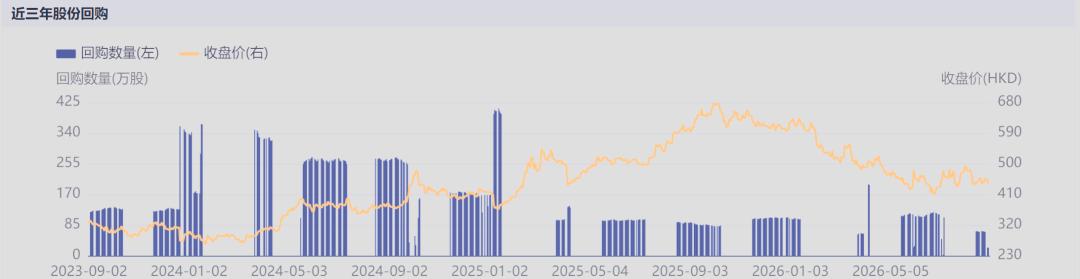
2024 (Surge Period): It spent a total of HK$112 billion throughout the year to repurchase 307 million shares, firmly ranking first in the Hong Kong stock market in terms of repurchase scale. When the stock price was sluggish, the single-day repurchase volume once exceeded 4 million shares.
2025 (Cooling Period): The repurchase pace began to slow down, the total annual consideration dropped to HK$80 billion, a year-on-year decline of more than 28%. In the second half of the year, the single-day repurchase volume plummeted to around 1 million shares.
2026 (Restraint Period): As of August this year, the total cost is about HK$29.1 billion, and the total annual amount is expected to be between HK$40 billion and HK$60 billion, with the scale almost halved compared with 2024. On September 1, the single-day repurchase scale even bottomed out at 226,000 shares (only about HK$100 million).
Motivation Analysis: Why Hit the "Brake" on Repurchases?
Tencent took the initiative to press the "brake" on repurchases, and the core motivation behind it is to cope with the increasingly fierce technology arms race, which is specifically reflected in four dimensions:
First: The AI arms race triggers "capital siphon"
Against the backdrop of explosive demand for Agent Tokens and rising upstream GPU prices, capital efficiency is declining. Faced with the heavy bets from ByteDance and Alibaba, Tencent's capital expenditure of only 79.2 billion yuan in 2025 (up 3% year-on-year) is already insufficient. In March 2026, Martin Lau, President of Tencent, clearly stated that the company will drastically reduce share repurchases and redirect funds to AI.
Second: Executive crisis-driven "full-stack" catch-up
Pony Ma rarely admitted that Tencent is "behind" in the AI field. To this end, Tencent recruited Yao Shunyu, a former core researcher at OpenAI, as its chief AI scientist, and implemented a rare "dual reporting" system to take charge of AI Infra and the large model department. This "full-stack" layout covering computing power, large models and AI Agent application layers requires massive and long-term capital input, which will inevitably crowd out the space for repurchases.
Third: "Exchanging profits for space" in the heavy asset cycle
The construction of AI infrastructure is a high-capital expenditure, which will easily dilute the current profit margin. Martin Lau has already given the market a heads-up, saying that "we can fully accept that the revenue growth rate in 2026 is faster than the profit growth rate". This means that Tencent is prepared to withstand the pain before AI infrastructure can realize large-scale monetization.
Fourth: Capital redistribution under capital reallocation tactics
Tencent has not completely abandoned shareholder returns, but changed the source of funds. The management revealed that it is accelerating the reduction of holdings in investment portfolios such as Meituan and SEA to serve as "ammunition" for repurchases. This is a reallocation tactic of "using stock assets to maintain shareholder returns and using incremental operating cash flow to bet on the future".
Market Game: Short-term Pain vs Long-term Bet
The weakening of repurchase intensity will inevitably trigger a chain reaction in the market. Due to the loss of "unconditional bottom-supporting" capital support, coupled with investors' concerns that high capital expenditure will drag down profits, some funds that regard Tencent as a "high-dividend safe-haven stock" have chosen to leave the market. For example, the day after Martin Lau announced the redirection of funds to AI (March 19, 2026), Tencent's stock price plummeted by nearly 7% in a single day.
However, from the perspective of a broader business cycle, this is a tough battle that has to be fought. The industry generally believes that under the pressure of aggressive expansion by peers, if Tencent continues to stick to high repurchases to stabilize the stock price and ignores the underlying technological upgrading, what it faces will not only be short-term valuation fluctuations, but also the systemic risk of being completely marginalized. For Tencent, the current pain is to buy a ticket to the next era.
This article is from the WeChat Official Account "CLS AI Daily", author: Hu Jiarong, published with authorization from 36Kr.