Another company valued at 60 billion yuan has emerged from Tsinghua's "class of top chip billionaires".
Abstract:
The EE85 Class of Tsinghua University (the 1985 intake of the Radio Department of Tsinghua University, later renamed the Department of Electronic Engineering) is to China's chip industry what the Yao Class of Tsinghua University is to China's artificial intelligence industry. Zhao Lidong, founder of Enflame Technology, graduated from this class. Unlike his classmates who charged into the capital market as early as around 2017 and became "China's richest man in the chip sector", Zhao Lidong is the last one in this Tsinghua "dream class" to step into the wealth creation wave, but he is destined to shoulder a greater mission.
The four leading domestic GPU players are about to complete the last piece of the puzzle today.
Enflame Technology officially opens subscription today, with an issue price of 142.18 yuan per share, corresponding to a market value of about 61.2 billion yuan — for a company that has lost nearly 5 billion yuan in three and a half years, what makes it worth this valuation?
The answer lies in one name: Tencent. Before the issuance, Tencent Technology directly holds about 19.95% of the shares, and the Tencent ecosystem holds a total of 20.26%, making it the largest institutional shareholder; in addition, 83.79% of Enflame's revenue in 2025 came from Tencent.
The confidence that Tencent is willing to invest six consecutive rounds over eight years and bet on its core AI business lies in the hands of two AMD veterans, Zhao Lidong and Zhang Yalin.
Subscription Opens Today, One Lot Requires Paying 71,100 Yuan
Today (September 2), Enflame Technology, one of the "four leading domestic GPU players", officially opens subscription. The issue price is 142.18 yuan. According to the calculation of 500 shares per lot on the STAR Market, it means that investors who win one lot need to pay about 71,100 yuan.
Its initial inquiry has already attracted 337 offline investors and 11,805 placement targets; after excluding invalid quotations and the highest quotations, the total offline intended subscription volume reaches 72.959 billion shares, which is 2648.93 times of the initial offline issuance size.
From the strategic placement list, Xiaomi, GigaDevice, Fujian Fuzhou F-Tech Microelectronics, ZTE, National Council for Social Security Fund and other institutions are all on the list.
What does this mean? It means that institutions are not just optimistic verbally, but are genuinely scrambling for allocation. However, for ordinary investors, is it really worth subscribing for a domestic GPU company that has not been listed yet?
If you only look at the performance of several recent "senior peers", the answer seems not hard to guess.
On December 5, 2025, Moore Threads took the lead in landing on the STAR Market, with an issue price of 114.28 yuan. The maximum increase on the first day of listing reached 425%, and the market value once exceeded 300 billion yuan. Calculated at 500 shares per lot, the winning investors had a maximum floating profit of more than 200,000 yuan.
The subsequent MUSA Semiconductor saw even more frenzied market performance: its maximum increase on the first day once exceeded 700%, with a maximum floating profit of nearly 400,000 yuan for one lot, refreshing the record of single-lot profit on the first day of A-share listing in the past decade.
Biren Technology, which landed on the Hong Kong Stock Exchange on January 2 this year, did not replicate the increase of the previous two companies, but it still rose by 75.82% on the first day, and its market value once exceeded 100 billion Hong Kong dollars.
As the earliest established but last listed one among the four players, Enflame Technology has finally stepped into the spotlight of the capital market eight years after its founding.
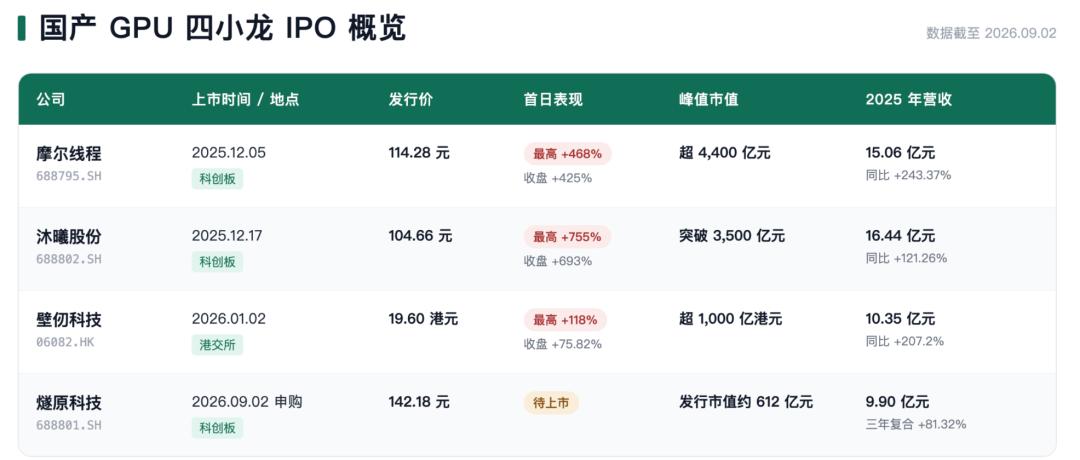
Figure | First-day listing performance of the four leading domestic GPU players
The first three companies have continuously left the market with the impression that "new domestic GPU stocks equal profit", will Enflame continue this track record?
In terms of performance, it has indeed grown rapidly in recent years.
From 2023 to 2025, Enflame Technology recorded revenues of 301 million yuan, 722 million yuan and 990 million yuan respectively, with a three-year compound annual growth rate of 81.36%.
The momentum is even stronger this year. In the first half of the year, the company achieved revenue of 1.12 billion yuan, exceeding the full-year revenue of last year in just half a year; the company also expects that the revenue in the first three quarters will reach 2.3 billion to 3 billion yuan, with a maximum year-on-year growth of 455%.
While revenue is rising, losses are also narrowing. For a GPU company that has been established for eight years, the market's biggest concern in the past was whether its products could be sold. Today, the question has become when it will turn profitable.
The timetable given in the prospectus is: it can basically achieve break-even in 2026, and realize profitability no later than 2027.
If it can advance at this pace, Enflame is likely to become the first of these domestic AI chip companies to achieve full-year profitability.
However, investors have to calculate the valuation account: calculated at the issue price of 142.18 yuan, Enflame Technology corresponds to a diluted static price-to-sales ratio of about 61.8 times in 2025, which is lower than the average level of comparable companies in the same industry. At first glance, this figure is not outrageous, but after new shares are listed, the transaction price is often a different story.
Not long ago, the newly listed Unitree Robotics experienced such a gap. Before listing, the company's issuance market value was about 61 billion yuan, and the market once had an optimistic expectation of around 200 billion yuan; as a result, after the opening on August 19, the stock price once rushed to 1100 yuan, corresponding to a market value of 444.9 billion yuan. Then the stock price fell all the way. By the opening on September 2, the market value had returned to about 221 billion yuan, nearly halved from the highest point.
Of course, this cannot be directly used to judge how Enflame will perform, but it at least shows that the price of new shares on the listing day can be completely different from the reasonable value in the eyes of institutions.
Back to Enflame, is a price-to-sales ratio of 61.8 times expensive? It ultimately depends on whether its subsequent performance can keep up.
NVIDIA Anxiety of Internet Giants Nurtures 60-Billion-Yuan Enflame
There is always a name that cannot be separated from Enflame: Tencent.
The story between the two dates back to 2018. As Sino-US tech frictions escalated, China's large internet giants collectively suffered from anxiety over "NVIDIA dependency".
As one of China's largest buyers of AI computing power, Tencent's WeChat, advertising recommendation, content security, and later its Hunyuan large model all consume massive computing power, so it must find stable domestic suppliers as early as possible.
But at that time, Moore Threads, MUSA Semiconductor and Biren Technology had not yet been established, and there were few mature alternatives available on the market. Enflame was one of the very few teams that had already started working on this. So right after Enflame Technology was founded in March 2018, Tencent led the investment in its Pre-A round.
In addition, Zhao Lidong, who graduated from the EE85 Class of Tsinghua University, is also one of the reasons why Tencent dared to place a heavy bet. In 1992, as a high-tech talent, after graduating from Tsinghua University, Zhao Lidong went to the United States for further study, and then engaged in chip work in Silicon Valley for a long time, serving in key positions such as Senior Director of AMD's Computing Business Unit and Senior Director of the Product Engineering Department. He also participated in the founding of AMD China R&D Center. In 2014, when China first established the national large semiconductor fund, Zhao Lidong officially resigned and returned to China, joining Unigroup Communication Technology Group Co., Ltd. as Vice President, in charge of semiconductor investment related work.
In 2018, another key turning point came. Zhao Lidong resigned from his position at Unigroup and brought in another AMD veteran, Zhang Yalin.
Zhang Yalin has been engaged in chip design since 2000, then joined AMD, serving as Senior Chip Manager and Technical Director of China R&D Center. As one of the main leaders of AMD's global chip R&D, he led the development and mass production of multiple products including the main chip for Microsoft Xbox One.
In the second year after its founding, Tencent and Enflame launched cooperation immediately. Over the next six years, Enflame's chips expanded from marginal scenarios such as Tencent Meeting and OCR recognition all the way to Tencent's core AI business; at the end of 2024, the 10,000-card inference cluster in Qingyang, Gansu Province was put into operation, and Enflame S60 became one of the core computing power products, marking the first time that a domestic AI chip has been tested by real business scenarios at the 10,000-card scale.
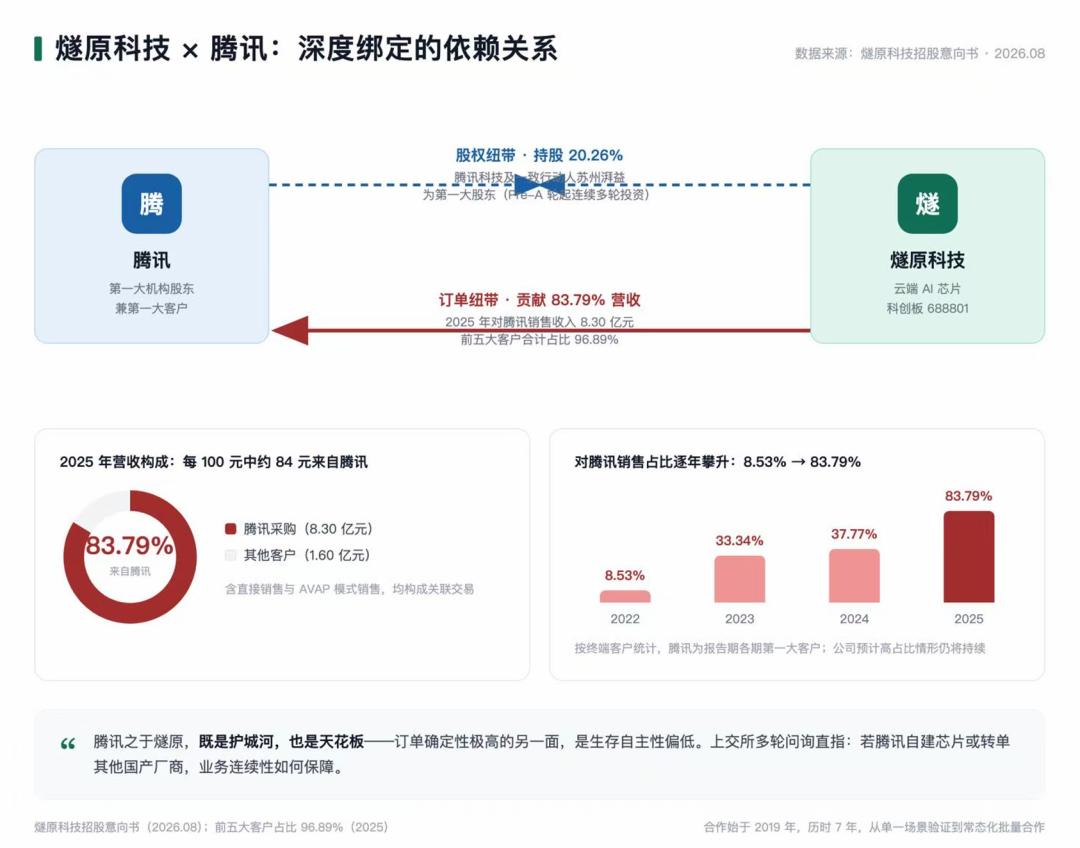
This partnership later became a distinctive label for Enflame: Tencent is not only its earliest investor, but also one of its most important customers. However, every coin has two sides.
For a chip startup, having a big customer that is willing to use its core business to accompany you to test and correct errors is a life-saving thing. Enflame has successfully taped out all four generations of architectures and five chips in eight years. This engineering track record is inseparable from real combat polishing in actual scenarios.
But for other investors, hidden worries also lie here. In 2025, the proportion of Enflame's revenue from direct sales to Tencent and sales through related-party models has reached 83.79%, while this figure was only 33.34% in 2023. In other words, the more resources Enflame obtained from Tencent over the years, the deeper its dependence on Tencent.
In particular, the dual setting where Tencent is both the largest institutional shareholder and the largest customer has kept the market questioning its independent customer acquisition capability. In the prospectus, Enflame Technology even made it clear in advance: "It is expected that the situation where the proportion of sales to Tencent remains relatively high will continue in the future".
Enflame also admitted that if Tencent makes major changes to its procurement strategy, or the expansion of new customers falls short of expectations, its performance will be directly impacted.
In addition, in terms of product structure, Enflame has another hidden worry: most of its existing products are applied in inference scenarios. Although the fourth-generation training and inference integrated product L600 has returned from tapeout, it has not yet been mass-produced and delivered on a large scale. This means that in the larger market of large model training, Enflame has not yet gained a firm foothold.
With the four leading players all listed, the story of domestic GPUs has entered the second half — listing is just getting the admission ticket, and the second half of the competition is about who can truly seize market share from NVIDIA.
Enflame has quite a few cards in its hand: self-developed DSA architecture, no dependence on the CUDA ecosystem, the big customer Tencent, and a clear profitability timetable on the table.
But all these cards must eventually be converted into orders and profits to give the market a reason for sustained optimism.
This article is from the WeChat official account "Phoenix Tech", Author: Phoenix Tech, published by 36Kr with authorization.