Is NVIDIA ramping up its supply? Dell: The good times can get even better.
Dell Technologies (DELL.N) released its Q2 FY2027 earnings report (covering the period ending July 2026) after U.S. market hours in the early morning of September 2, Beijing Time:
1. AI Revenue: In the Infrastructure Solutions Group (ISG) business, the sequential increment of high-growth AI servers this quarter turned out to be relatively small. But this is not a problem, the main driver is that the backlog of orders has surged sharply this time.
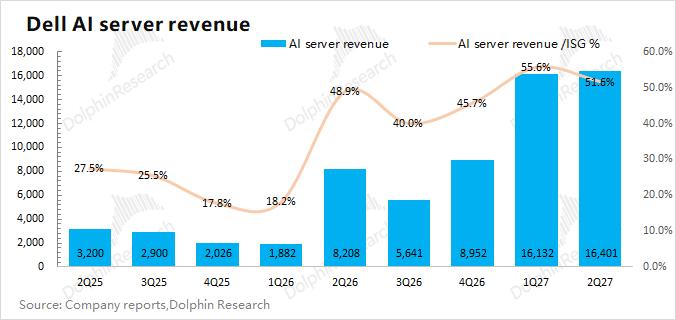
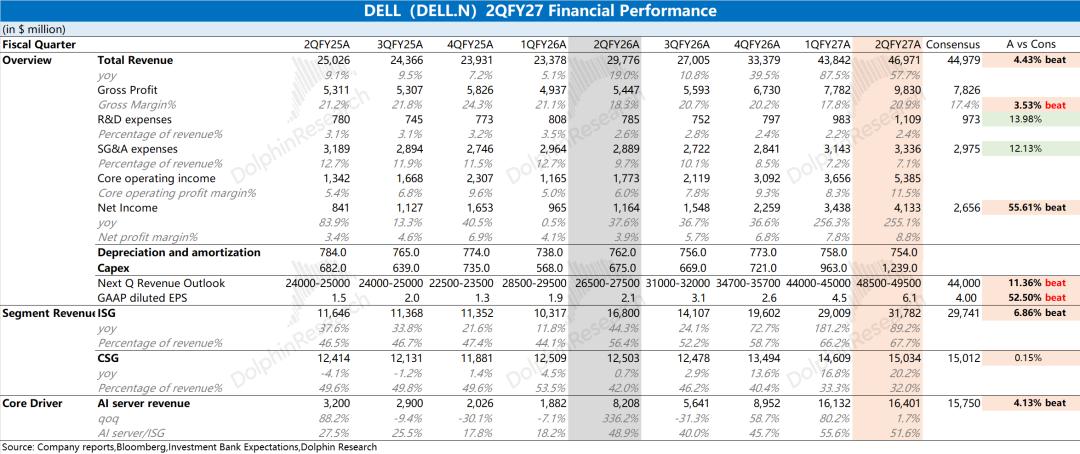
Dell's AI server revenue this quarter is approximately $16.4 billion, beating market expectations of $15.8 billion. The company's new AI orders this quarter "skyrocketed" to $60.9 billion, and the AI backlog at the end of this quarter reached $95 billion.
Dolphin Analyst estimates that the company's AI server revenue next quarter is expected to hit $20 billion, representing a sequential increase of over $3 billion. The ramp-up of mass production of the Rubin series will accelerate AI revenue growth.
2. Company Guidance: The company expects revenue of $49 billion for the next quarter (Q3 FY2027), beating market expectations of $44 billion; the company's GAAP EPS for the next quarter is $6, exceeding market expectations of $4.
Since the company has already given full-year guidance of $190-194 billion (the previous quarter's guidance was $165-169 billion), which is significantly better than the market's upward-adjusted expectation of $170-180 billion, it can be estimated that the company's fourth-quarter revenue is approximately $50-54 billion, with a sequential quarterly increase of only $1-5 billion. Against the backdrop of Rubin starting to ramp up deliveries, this full-year guidance is obviously still conservative, and the company is expected to raise its guidance again later.
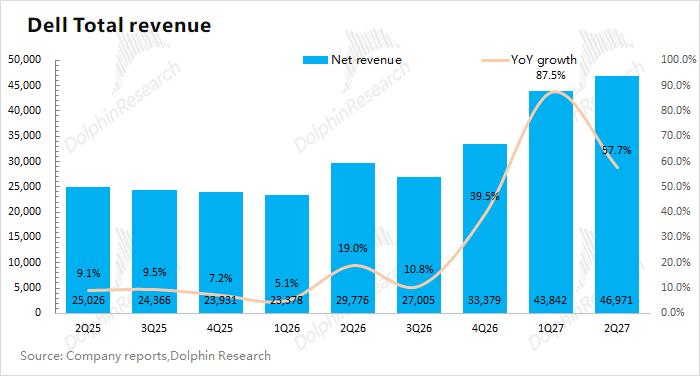
3. Operating Metrics: Revenue this quarter reached $47 billion, up 58% year-on-year, beating market expectations of $45 billion. The company's sequential revenue growth of $3.1 billion this quarter mainly comes from the growth contribution of the ISG business.
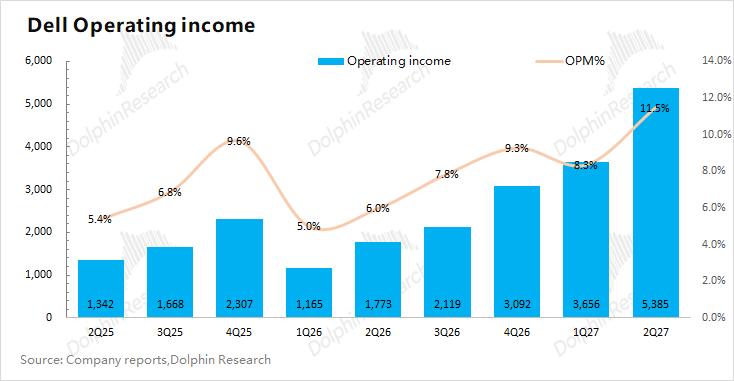
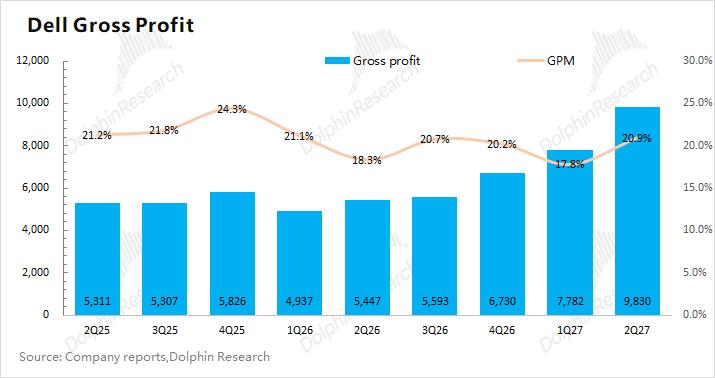
The company's gross margin this quarter is 21%, up 3 percentage points quarter-on-quarter, significantly exceeding market expectations of 17.4%. The sharp rebound in gross margin (price increases are the main cause, structural factors are the secondary cause) is mainly in response to rising storage prices and other situations, the company raised prices for its product lines, which is also a strong response to market concerns that the company is "seeing revenue growth without profit growth".
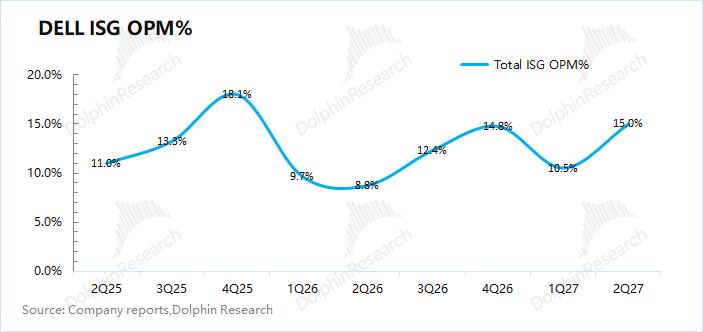
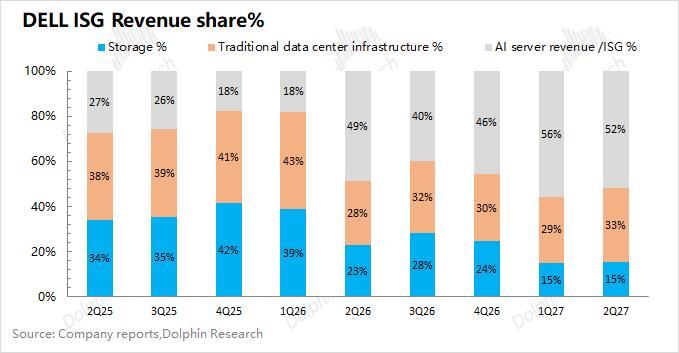
4. ISG Business (Infrastructure Solutions): It includes traditional servers, AI servers and storage-related products. ISG business revenue this quarter was $31.8 billion, up $2.8 billion quarter-on-quarter, far exceeding market expectations of $29.7 billion. The sequential increment this quarter is mainly driven by traditional servers, while the sequential growth of the AI business is not obvious this quarter.
Among them, the traditional server-related business contributed approximately $10.5 billion in revenue, up 122% year-on-year, beating market expectations of $9.4 billion, and is also the main source of the expectation difference this quarter. The demand for traditional servers mainly comes from two aspects: ① Most of the growth comes from the upgrade and renewal demand of existing customers; ② The other part comes from the need for a large amount of CPU computing power to support AI and agentic workflows.
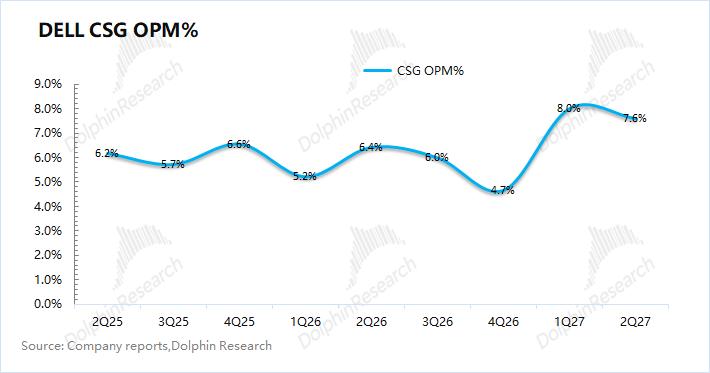
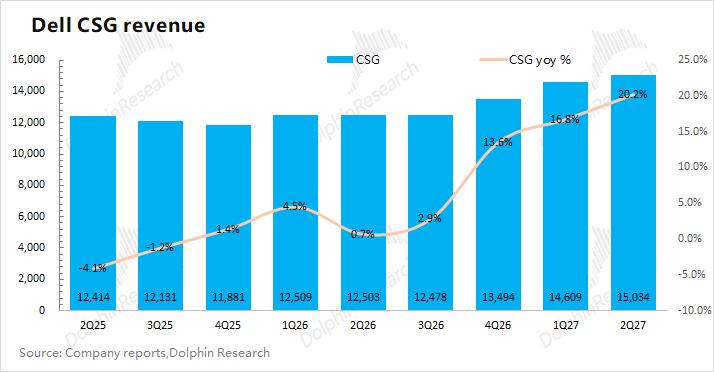
5. CSG Business (Client Solutions): Revenue this quarter was $15 billion, up 20% year-on-year, in line with market expectations of $15 billion, the growth is mainly driven by price increases. Specifically: Dell's client business still focuses on commercial customers. Commercial customer revenue this quarter was $13.2 billion, up 22% year-on-year; while revenue from individual consumers was only $1.84 billion, up 7% year-on-year.
Dolphin Analyst's Overall View: AI Orders Are Off The Charts, Price Increases Protect Profitability, Guidance Remains Conservative
Dell's current performance fully exceeds expectations, with sequential revenue growth of $3.1 billion, which is mainly driven by the growth of the ISG business (servers), where the demand for traditional server renewal and upgrade is quite strong.
Dell's AI business achieved revenue of $16.4 billion this quarter, up $300 million quarter-on-quarter, beating market expectations of $15.8 billion. The company's new AI orders this quarter skyrocketed to $60.9 billion, and the backlog of orders at the end of this quarter has reached $95 billion.
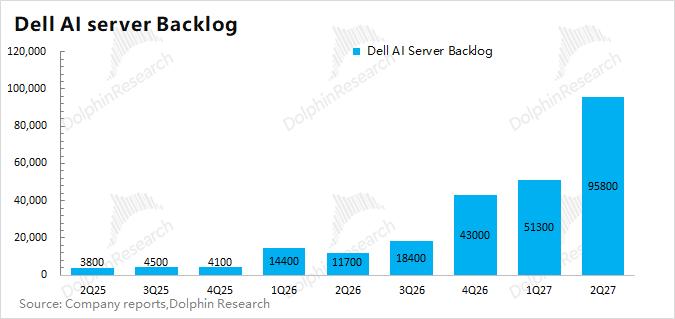
The company's AI backlog has continued to increase over the past three quarters (43→51.3→95 billion), while AI revenue this quarter only increased by $300 million quarter-on-quarter. This indicates that market demand for AI servers remains "high", which is mainly affected by tight upstream supply. As the mass production of the new Rubin product ramps up in the second half of the year, it is expected to drive further release of AI revenue.
Although the company's management has raised its full-year guidance again, the company expects revenue for FY2027 (corresponding to the 2026 calendar year) to reach $190-194 billion, an increase of $25 billion (the previous quarter's guidance was $165-169 billion). If we calculate the fourth quarter revenue separately, it roughly corresponds to $50-54 billion. Considering the ramp-up of Rubin, Dolphin Analyst believes that the current guidance is still relatively conservative, and the company is likely to raise it again to above $195 billion later.
Apart from this earnings report, the market is also paying attention to the following aspects of the company:
1) AI Servers
Dell has launched the first server rack using GB200 NVL72 and shipped it to CoreWeave, the company has established a deep cooperative relationship with NVIDIA. The company can currently provide customers with different solutions such as Blackwell and Vera Rubin, and participate in the cooperation of NVIDIA's next-generation Feynman platform.
NVIDIA raised its outlook for the 2027 calendar year after its earnings report: ① Raise the capital expenditure expectation of the five major CSPs to $1.3 trillion (the original market expectation was $1.1-1.2 trillion); ② Directly give NVIDIA's FY2028 (corresponding to the 2027 calendar year) revenue growth guidance of 70%+ (the original market expectation was around 40%).
Dell itself is a company in NVIDIA's industrial chain. After NVIDIA raised its guidance, the market also expects the company's management to give a higher full-year guidance, and even the growth outlook for the next earnings period (FY2028).
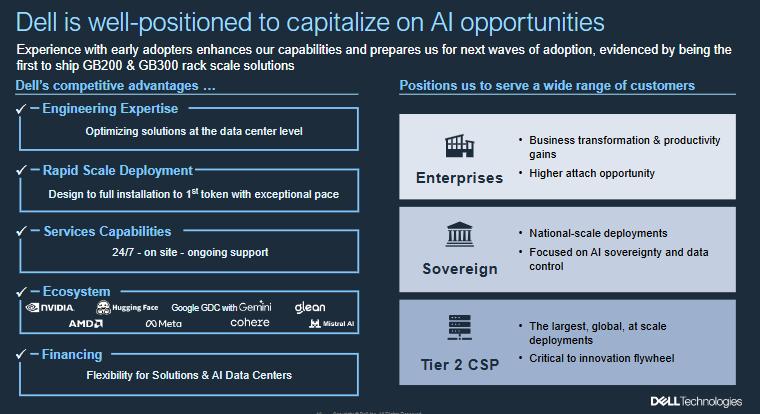
Dell has full-stack service capabilities, specifically covering from desktop AI workstations (GB10/GB300 DGX) → rack-level servers → storage → network switches → software orchestration (OpenManage) → services (installation, commissioning, 7×24 support). Dell's "end-to-end" services allow the company to gain more order opportunities among AI cloud/enterprise customers.
2) CSG Business (PC)
Affected by storage shortages, the overall performance of the PC market is still under pressure. Global PC shipments this quarter were 68.2 million units, a year-on-year decline. Dell's CSG business grew 20% year-on-year this quarter. Dolphin Analyst estimates that the company's growth is mainly driven by ASP (partially passing on the impact of rising storage prices through price increases), while shipments are also under pressure from overall market demand.
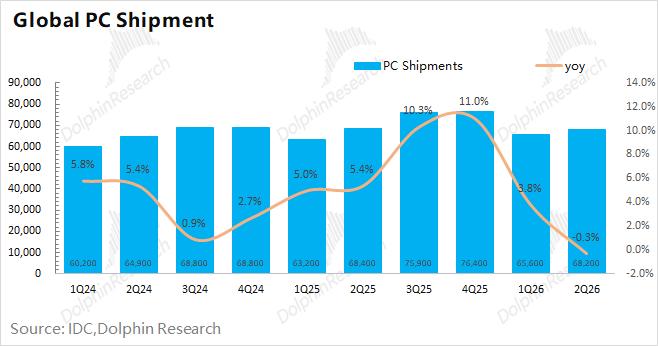
Combined with market expectations for storage prices, most mainstream institutions currently expect storage prices to peak in the first half of 2027 and fall in the second half of the year. Most major storage manufacturers have signed LTAs. Dolphin Analyst estimates that even if storage prices fall, there will be no "price flash crash", and they are more likely to remain at a relatively high level. This means that the pressure on the PC market is "alleviated" rather than "eliminated".
Compared with other companies in the AI industrial chain, Dell's stock price correction is relatively small, mainly because the company has a large number of backlog orders in hand. The upcoming ramp-up and delivery of NVIDIA's Rubin is expected to bring deterministic growth opportunities to the company.
For Dell's earnings report, the market mainly focuses on two aspects: ① Although AI revenue did not increase much sequentially (300 million US dollars), the backlog of orders increased sharply by 44 billion US dollars, indicating that "AI demand is still very strong, but supply is insufficient, and Rubin shipments may continue to exceed expectations"; ② The company passed on the impact of rising storage prices and other factors through product price increases and other methods, and the company's gross margin "rose instead of falling", which is a reflection of the bargaining power of the industrial chain.
On the whole, Dell's earnings report this time is quite good, showing strong AI demand, product price increases passing on the cost-side impact, and traditional servers also bringing a "pleasant surprise". Even if the company raised its full-year guidance, it is still relatively conservative, and further upward adjustments may follow.
Compared with many growth-themed narratives, Dell DELL has solid performance and order support. Performance upward revisions can directly digest the company's valuation. NVIDIA has previously clearly given a high-growth outlook for the 2027 calendar year, and the market also expects Dell to go a step further and give guidance for the next fiscal year on the basis of raising its full-year guidance. Driven by the deterministic high-growth performance brought by the new Rubin product, it is expected to bring more opportunities to the company.