Has the across-the-board surge in computing power come to an end?
As the 2026 A-share market semi-annual reports enter the intensive disclosure period, the computing power industry chain has once again delivered a remarkable performance report card.
Overall, the performance of some core companies is still growing at a high speed. Zhongji Xuchuang (300308.SZ) posted a revenue of 417.78 billion yuan in the first half of the year, up 182.49% year on year, and a net profit attributable to shareholders of 136.51 billion yuan, up 241.70% year on year; Foxconn Industrial Internet (601138.SH) recorded a revenue of 5578.61 billion yuan, up 54.63% year on year, and a net profit attributable to shareholders of 237.40 billion yuan, up 95.99% year on year; Hygon Information (688041.SH) achieved a revenue of 90.99 billion yuan, up 66.52% year on year, and a net profit attributable to shareholders of 17.98 billion yuan, up 49.69% year on year.
What deserves more attention is that companies including Changxin Technology (688825.SH), Xuchuang Data (300857.SZ), Tongfu Microelectronics (002156.SZ), and Dongshan Precision (002384.SZ) also recorded rapid performance growth. From the quarter-on-quarter perspective, the profit growth rate of some companies in the second quarter of 2026 continues to rise, indicating that investment in AI infrastructure has not cooled down significantly after entering 2026.
However, if we extend our focus from the income statement to inventory, cash flow and quarter-on-quarter changes, we will find that an important change is taking place in the computing power sector. Although industry demand remains strong, the stage of "universal growth across all computing power segments" is passing, and companies that can continuously obtain orders and profits are increasingly concentrated in the core links of the industrial chain.
This is also the most important signal released by the 2026 semi-annual reports to the market.
Demand has not cooled, AI capital expenditure is still expanding
How far this round of computing power cycle can go ultimately depends on the demand side.
From the perspective of the global market, although divergences have emerged in the market, there are currently no obvious signs of a slowdown in AI infrastructure investment.
In July this year, Gartner raised its forecast for global data center system spending in 2026 to $822 billion, a year-on-year increase of 62.5%. Infrastructure as a Service (IaaS) spending is expected to reach $287.3 billion, up 29.3% year on year. Gartner believes that the workload expansion brought by generative AI is driving hyperscale cloud vendors and enterprises to continuously build next-generation data centers.
IDC's judgment is also relatively optimistic. IDC data shows that global server market spending in the first quarter of 2026 increased by 30.7% year on year, and the main driving force still comes from the large-scale deployment of GPU servers. At the same time, IDC believes that the main bottleneck of the current server market has gradually shifted from "insufficient demand" to "supply constraints", especially for storage resources such as DRAM and NAND.
This means that the computing power industry is not facing the traditional "demand peak", but a new rebalancing of supply and demand.
TrendForce further estimated in August that the year-on-year growth rate of global AI server shipments in 2026 will be raised to nearly 31%, and the total capital expenditure of the world's nine major cloud service providers in 2026 is expected to exceed $886.7 billion, with a year-on-year increase of about 90%. Among them, large North American cloud vendors are still the main contributors, and companies including Google, Microsoft, Amazon, Meta and Oracle continue to increase their investment in AI infrastructure.
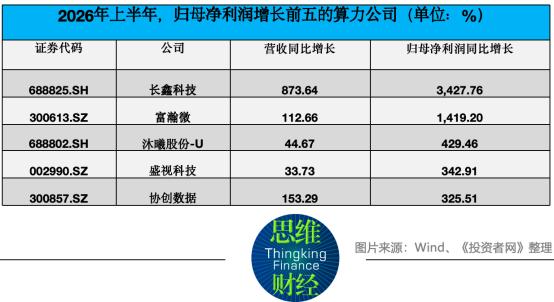
The growth of computing power demand has been reflected in the 2026 semi-annual reports of A-share listed companies. For example, Changxin Technology, a storage supplier, recorded year-on-year growth rates of 873.64% and 3427.76% in revenue and net profit attributable to shareholders respectively in the first half of 2026, and Fuhan Micro (300613.SZ), a communication integrator, recorded year-on-year growth rates of 112.66% and 1419.2% in revenue and net profit attributable to shareholders respectively.
It should be pointed out that this round of performance release has not benefited the entire industry. In the Wind computing power sector, nearly 40% of enterprises still saw a year-on-year decline in their net profit attributable to shareholders in the first half of 2026. Among them, Kaipuyun (688228.SH) recorded a year-on-year decline of 26.73% in revenue and 601.58% in net profit attributable to shareholders.
With the continuous rise of prices of upstream core components and the expansion of performance scale, the growth of some enterprises also shows signs of peaking. For example, Changxin Technology, a star A-share company, recorded a quarter-on-quarter growth rate of 939.98% in net profit attributable to shareholders in the first quarter of 2026, while the figure dropped to 113.4% in the second quarter of 2026.
Similarly, the quarter-on-quarter growth rate of net profit attributable to shareholders of enterprises including Torch Electron (603678.SH) and Aofei Data (300738.SZ) also recorded a significant decline.
Therefore, for the A-share industrial chain, this global capital expenditure expansion has first spread to fields such as servers, optical modules, PCBs, connectors, storage and chips, and there has been no universal growth across the entire industry.
With the increasing market divergence and the slowdown of growth of star enterprises, the computing power market in the second half of 2026 is no longer a simple question of "whether AI demand still exists", but has entered a new cycle of "how long global capital expenditure will last and to what stage computing power infrastructure will be upgraded".
Optical modules, servers and storage become the first scene of performance differentiation
If we break down the computing power industrial chain, the most obvious change in the 2026 semi-annual reports of the A-share computing power sector is that the performance growth slopes of different links are rapidly widening.
The segment with the highest current return is high-speed optical modules.
In the first half of the year, Zhongji Xuchuang's optical communication transceiver module business revenue reached 41.355 billion yuan, up 186.56% year on year, with a gross profit margin of 46.59%, up 6.63 percentage points year on year. The proportion of the company's 800G and 1.6T products continues to increase, and the order growth has begun to transition from "volume expansion" to "simultaneous rise in volume and price".
New Yisheng (300502.SZ) also maintained high growth. The company's revenue in the first half of 2026 increased by 100.34% year on year, its net profit attributable to shareholders increased by 90.98% year on year, its operating revenue in the second quarter increased by 50.78% quarter on quarter, and its net profit attributable to shareholders increased by 70.81% quarter on quarter.
The industrial logic behind this is not complicated. After the scale of AI clusters continues to expand, the data transmission volume between single cabinets and between cabinets is getting larger and larger, and high-speed optical modules have become a key link in computing power infrastructure.
TrendForce predicts that the global AI optical transceiver module market will reach $26 billion in 2026, with a year-on-year increase of more than 57%; demand for 800G and higher-speed optical modules is still growing rapidly, and is evolving to higher rates such as 1.6T.
In the server field, the performance of Foxconn Industrial Internet is also representative.
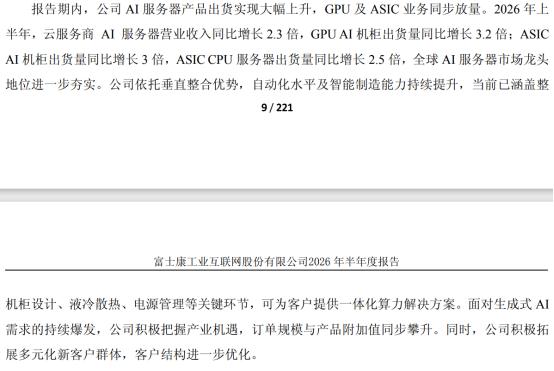
Image source: Foxconn Industrial Internet semi-annual report
The company recorded a revenue of 5578.61 billion yuan in the first half of the year, up 54.63% year on year, and a net profit attributable to shareholders of 237.40 billion yuan, up 95.99% year on year. The company has previously made it clear that it will continue to focus on AI computing power, AI servers and high-speed data center networks, and strengthen cooperation with large global cloud service providers.
In contrast, as an assembler, another feature of the server industrial chain is "huge scale but low profit margin". Therefore, when demand for AI servers grows rapidly, enterprises with large customer certification, supply chain integration capabilities and large-scale manufacturing capabilities are more likely to obtain orders, but at the same time they need to bear greater working capital pressure.
Storage has become another main line worthy of attention.
Changxin Technology's operating revenue in the first half of the year increased by 873.64% year on year, and its net profit attributable to shareholders increased by 3427.76% year on year. At the same time, the company's inventory rose from about 285.68 billion yuan at the end of last year to 351.30 billion yuan, and its operating cash flow increased significantly from 365.20 billion yuan to 1311.56 billion yuan, fully demonstrating the company's profitability.
In its latest judgment in August this year, Gartner also pointed out that global semiconductor revenue is expected to reach $1.6 trillion in 2026, up 92% year on year, of which memory chip revenue is expected to reach $837 billion, and the proportion of AI data center related revenue in global semiconductor revenue will continue to rise.
From this perspective, optical modules, AI servers and advanced storage are becoming several core directions that have realized performance first in this round of computing power cycle.
Behind inventory and cash flow, the computing power industry begins to "focus on quality"
However, analyzing this round of semi-annual reports, we will find that this is not just a story of "high growth".
What is really worthy of market attention is the change in working capital of some leading companies during the rapid expansion process.
For example, Foxconn Industrial Internet's inventory increased from 1509.13 billion yuan at the end of 2025 to 1921.09 billion yuan at the end of the first half of 2026; Inspur Information (000977.SZ)'s inventory rose from 465.08 billion yuan to 526.79 billion yuan; Zhongji Xuchuang's inventory increased from 126.81 billion yuan to 198.26 billion yuan.
Looking at the absolute value alone, these changes are not small. But inventory growth itself cannot be directly equated with inventory risk. The key is to observe turnover efficiency and order fulfillment.
Zhongji Xuchuang is a typical case. Although the company's inventory increased by about 7 billion yuan, its inventory turnover days decreased from 160.24 days to 130.29 days, which means that while the company expands stockpiling, the product digestion speed has not deteriorated simultaneously.
On the other hand, among more than 60 companies under the Wind computing power concept, 45 companies have seen a significant increase in inventory turnover days. Among them, Kaipuyun's inventory turnover days increased by 330 days compared with the end of 2025; while the inventory scale of Tianfu Communication (300394.SZ) increased, its inventory turnover days also rose from 61.13 days at the end of 2025 to 112.73 days in mid-2026.
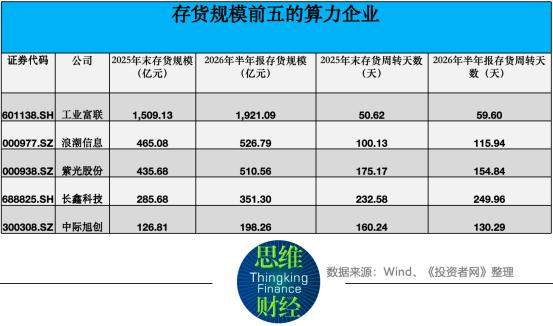
This shows that differentiation is emerging in the computing power sector. While observing the high growth of related companies, the market may also need to pay attention to indicators such as orders, inventory and cash flow of these enterprises.
The net cash flow generated by Zhongji Xuchuang's operating activities in the first half of the year was 1.8 billion yuan, down 44.08% year on year. The company's profit growth rate is much higher than the cash flow growth rate, which is related to the expansion of business scale and the increase of working capital occupation.
For enterprises in the period of rapid expansion, this does not mean that the fundamentals will deteriorate immediately, but it means that the quality of subsequent earnings will become a more important observation indicator for the market.
This change is also in line with IDC's judgment on the global server market. At present, demand for AI servers remains strong, and the main constraint on market growth is gradually shifting from the demand side to the supply side. The price and supply of core components such as storage may affect the industry profit distribution in the next stage.
Therefore, the future of the computing power industry is not necessarily "the one with faster revenue growth wins", but more likely "the one that can maintain inventory turnover, cash flow and capital expenditure efficiency while growing rapidly can survive the cycle".
From GPU to "computing power network", the next round of opportunities is spilling over
Compared with the computing power market in 2024 and 2025, another change in 2026 is that the boundary of the industrial chain is becoming wider and wider.
After AI models are put into large-scale application, the demand for computing power has gradually expanded from training to inference.
Gartner predicted in August that global AI inference related spending will reach $23.3 billion in 2026, higher than the $19 billion spending on training. At the same time, AI-optimized IaaS spending is expected to grow by 96% for the whole year, reaching $42.28 billion.
This means that computing power construction is gradually moving from "large-scale training clusters" to continuously operating inference infrastructure.
Data source: Muxi Co., Ltd. semi-annual report
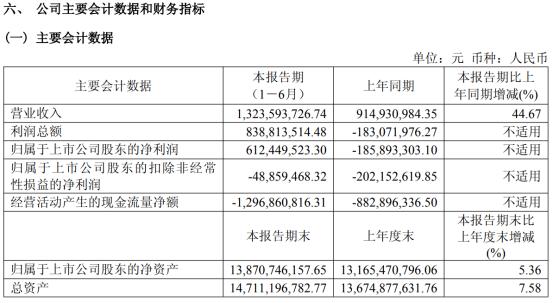
This trend is also reflected in the A-share market. In the first half of 2026, the revenue of Muxi Co., Ltd. (688802.SH) and Moore Threads (688795.SH), new A-share GPU stars, increased by 44.67% and 147.42% respectively, of which Muxi Co., Ltd.'s net profit attributable to shareholders increased by 429.46% year on year