The social security contribution base has risen slightly in multiple regions.
In 2025, the growth margin and growth rate of the lower limit of social insurance payment base in 31 provinces all declined across the board, and the monthly increase of the lower limit of payment base in 24 provinces was less than 100 yuan. In 2026, the increase of the lower limit of social insurance payment base shows a feature of further contraction on the whole. Among the 13 provinces with published data, the growth rate of 9 provinces has further decreased compared with last year.
According to the information released by Beijing Human Resources and Social Security Bureau on August 21, the monthly lower limit of social insurance payment base in Beijing in 2026 is 7270 yuan, ending the rapid growth trend in previous years, with a year-on-year increase of 1.5%.
From 2021 to 2024, affected by factors such as the rise of average social wage and social insurance compliance, the lower limit of social insurance payment base in most provinces has witnessed a relatively high growth. Among them, the year-on-year growth rate of the lower limit of social insurance payment base in 21 provinces in 2024 exceeded 5%. In 2025, the lower limit of social insurance payment base finally ended the previous four consecutive years of high growth, and the growth rate of the lower limit of social insurance payment base in 31 provinces was mostly around 2%.
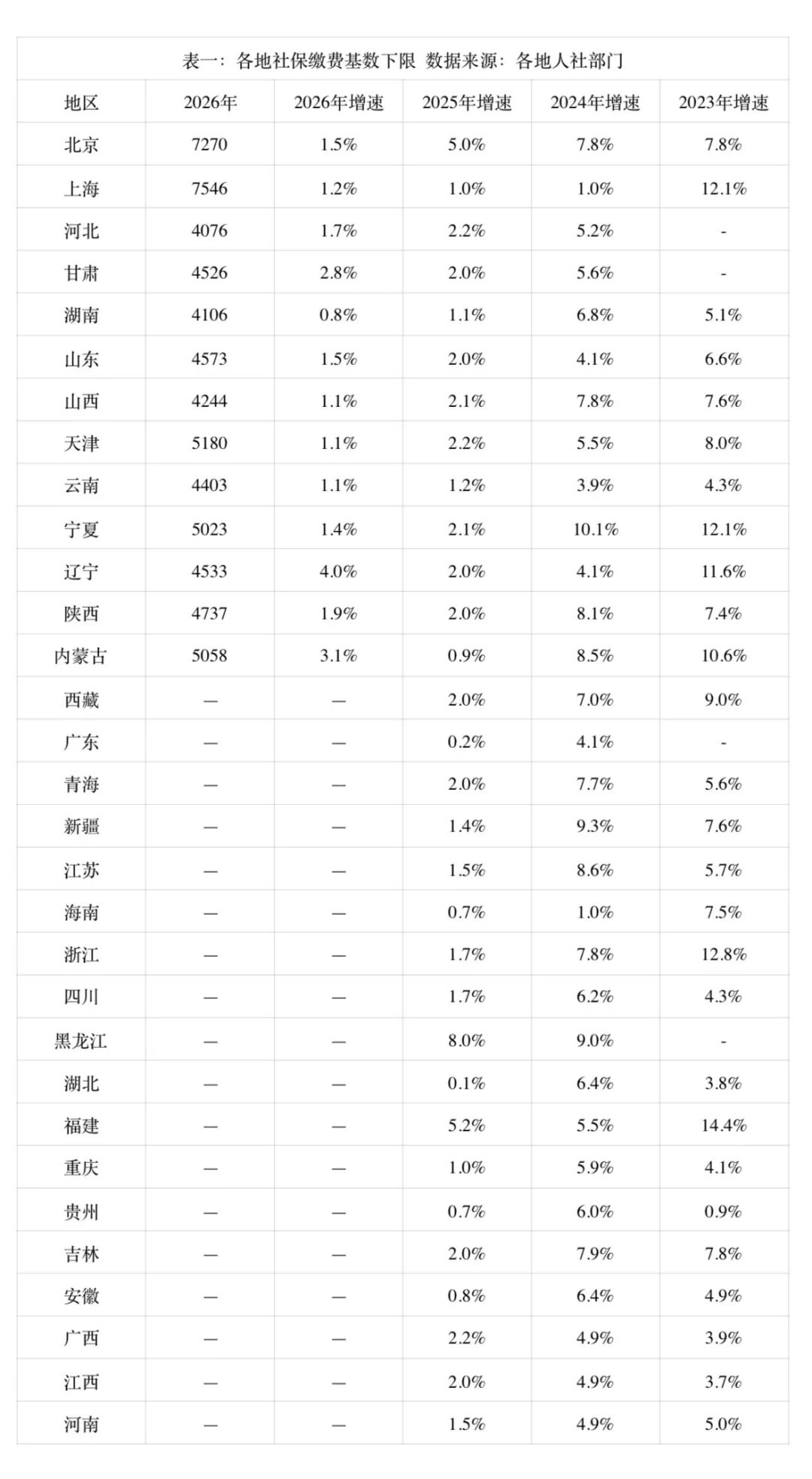
Entering 2026, the feature of slowing growth of social insurance payment base has become more obvious. According to statistics from The Economic Observer, as of August 30, 13 provinces have announced the lower limit of social insurance payment base for 2026 (as shown in Table 1). Among them, the growth rate of the lower limit of social insurance payment base in 8 provinces including Beijing, Shanghai, Hunan and Tianjin has dropped to 1.5% or below, entering the "1% era".
Xiang Yunhua, a professor at the Social Security Research Center of Wuhan University, said that from a positive perspective, the low growth of the lower limit of social insurance payment base can significantly reduce the social insurance payment pressure of micro, small and medium-sized enterprises and low- and middle-income groups. However, some provinces are consolidating the social insurance payment base recently. With the compliance of social insurance payment, the changes of social insurance payment burden on enterprises and individuals and their far-reaching effects need further observation.
Graphics by The Economic Observer
Growth Margin Drops Below 100 Yuan
According to statistics from The Economic Observer, from 2021 to 2024, the growth rate of the lower limit of social insurance payment base in most regions of 31 provinces was in the range of 5%-12%, and the monthly increase was concentrated between 200 yuan and 500 yuan.
Taking Tianjin as an example, the monthly lower limit of social insurance payment base rose from 3364 yuan in 2020 to 5013 yuan in 2024, with an annual increase of more than 260 yuan. Affected by this, from 2020 to 2024, for flexible employees in Tianjin who continuously pay social insurance according to the lower limit of social insurance payment base, the monthly endowment insurance premium rose from 672.8 yuan to 1002.6 yuan, with an increase of over 49%.
In 2025, the growth margin and growth rate of the lower limit of social insurance payment base in 31 provinces all declined across the board, the monthly increase of the lower limit of social insurance payment base in 24 provinces was less than 100 yuan, and the lower limit of social insurance base in Guangzhou and the provincial entities of Guangdong, Wuhan and the provincial entities of Hubei only increased by 10 yuan and 4 yuan per month respectively. According to this calculation, in the above 24 provinces, the monthly additional social insurance payment burden of flexible employees who participate in social insurance continuously according to the lower limit of social insurance payment base in 2025 will not exceed 20 yuan compared with 2024.
In 2026, the increase of the lower limit of social insurance payment base shows a feature of further contraction on the whole. Among the 13 provinces with published data, the growth rate of 9 provinces has further decreased compared with last year.
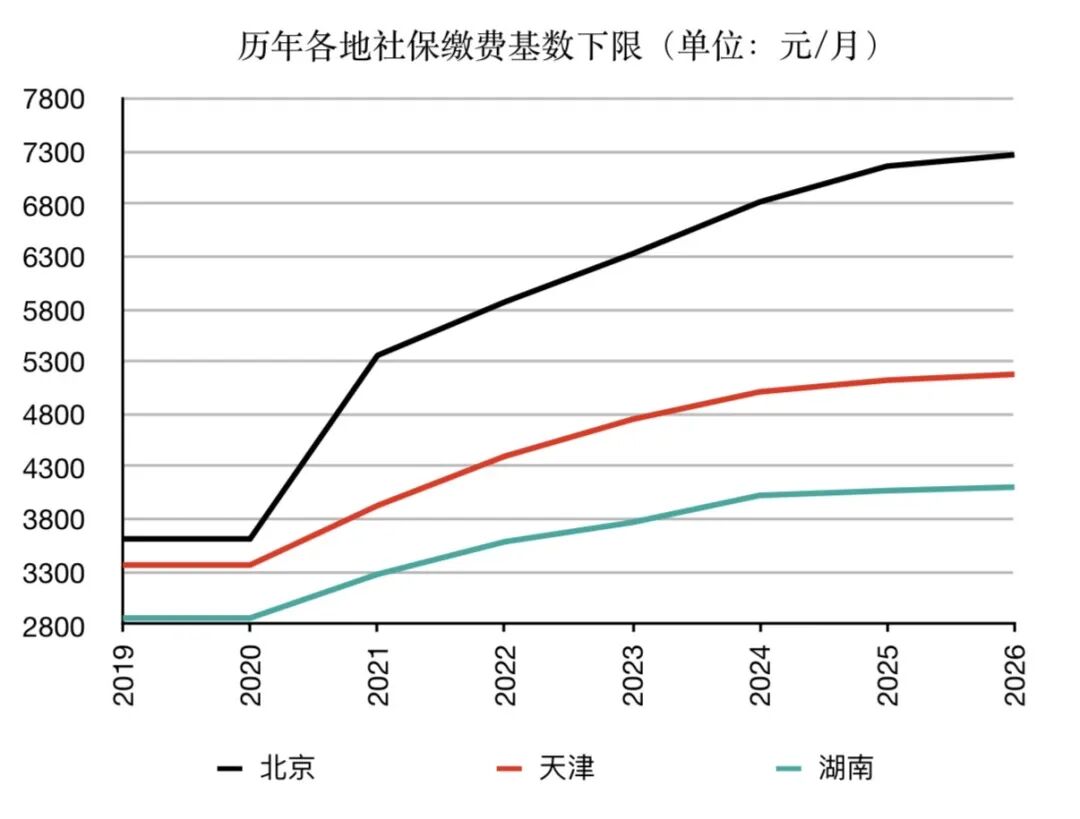
For example, as can be seen from the curves of Beijing, Tianjin and Hunan in Figure 2, from 2020 to 2026, the three red, black and blue curves gradually become gentle from steep, indicating that the upward momentum of the lower limit of social insurance payment base in these three regions is weakening. Among them, the increase of the lower limit of social insurance payment base in Hunan in 2026 is only 34 yuan, which is a significant drop compared with the increase of 257 yuan in 2024.
Graphics by The Economic Observer
Tracing to the source, the decline of the average wage growth rate of each province is the biggest factor affecting the low growth of social insurance payment base in the past two years.
Every mid-year, provinces across the country will successively announce the average wage of employees in urban units on the full-caliber of the previous year (hereinafter referred to as "average social wage"), and the human resources and social security departments of each province will verify and announce the upper and lower limits of the latest social insurance payment base of the current year accordingly — the upper limit is usually 300% of the average social wage of the previous year, and the lower limit is usually 60% of the average social wage.
At the same time, according to the caliber of the Ministry of Human Resources and Social Security, the average social wage of each province is calculated by weighting the average wage of employees in urban non-private units and private units of the previous year (hereinafter referred to as "average wage of non-private and private units"). Therefore, the low growth of the lower limit of social insurance payment base in many provinces in 2025 and the further decline of the growth rate in 2026 reflect that the average social wage growth rate of a large number of provinces has further dropped in the past two years.
Xiang Yunhua also mentioned that the fluctuation of the lower limit of social insurance payment base corresponds to the decline of the average social wage growth rate, and the fluctuation of the average social wage in recent years is closely related to the trend of the macro economy.
For example, in recent years, the average social wage of Shanghai has always ranked first among 31 provinces, and the lower limit of social insurance payment base has always been the highest level in the country. From 2019 to 2022, the average social wage growth rate of Shanghai was above 6.9% for four consecutive years, but it dropped sharply to 1% in 2023, and the average social wage growth rate in the following two years was 1% and 1.2% respectively.
Therefore, in practice, from 2021 to 2023, the monthly increase of the lower limit of social insurance payment base in Shanghai was above 500 yuan, while from 2024 to 2026, the monthly increase all dropped below 90 yuan.
Qiao Qingmei, associate professor at the School of Labor and Human Resources of Renmin University of China, said that the fluctuation of the average social wage growth rate is mainly affected by factors such as economic cycle fluctuations, the mismatch between labor structure and market demand brought by industrial structure upgrading and adjustment, and the diminishing marginal wage growth rate. The decline of the average social wage growth rate in the past two years should be treated normally.
However, the increase of social insurance payment base in some regions does not fully match the increase of the average social wage. Taking Hebei Province as an example, data released by Hebei Provincial Medical Security Bureau shows that the average social wage of Hebei in 2024 is 6521.67 yuan, lower than the average social wage of 2023 (6534.25 yuan), showing a negative growth of average social wage. However, the lower limit of social insurance payment base of Hebei in 2025 is not strictly calculated according to 60% of the average social wage of Hebei in 2024, so the phenomenon of "the average social wage decreased in the previous year, but the lower limit of social insurance payment base increased in the current year" appeared in Hebei in 2025.
Above the Baseline
The social insurance payment base of Beijing released every mid-year is the most concerned information for the person in charge of a chain elderly care institution in Beijing. Since 2021, the average monthly wage of the caregivers in her elderly care institution has been continuously lower than the lower limit of Beijing's social insurance payment base, and the elderly care institution also pays social insurance for the caregivers according to the lower limit of social insurance payment base. However, the continuous high growth of the lower limit of Beijing's social insurance payment base has led to rising labor costs of the enterprise.
From 2021 to 2025, the lower limit of Beijing's social insurance payment base rose from 5360 yuan/month to 7162 yuan/month, with an average annual growth rate of about 7.5%. The social insurance premium paid by the elderly care institution for each caregiver also increased from 1447 yuan/month to 1934 yuan/month (note: the total social insurance premium rate for five types of insurance for enterprises is calculated at 27%). Calculated based on the scale of 100 caregivers, from 2021 to 2025, the annual social insurance payment burden of this elderly care institution rose from 1.7364 million yuan to 2.3208 million yuan.
This year, the above-mentioned person in charge can finally "take a little breather": according to the adjustment proportion of Beijing's social insurance base, the social insurance premium paid by her elderly care institution for each caregiver is expected to increase by only 29 yuan per month this year.
The lower limit of social insurance payment base has mandatory effect and is the baseline of the entire social insurance system. In fact, a large number of workers and enterprises in China pay social insurance according to this base, so its rise and fall will directly affect the actual burden of a large number of enterprises and individuals.
In August 2025, the "2025 White Paper on Social Insurance of Chinese Enterprises" released by 51 Social Insurance under Zhonghe Yunke shows that 22.7% of the surveyed enterprises pay social insurance "uniformly according to the minimum lower limit of social insurance payment base", and the survey covered a total of 6689 enterprises across the country. In addition, a large number of flexible employment groups also pay according to the lower limit of the base.
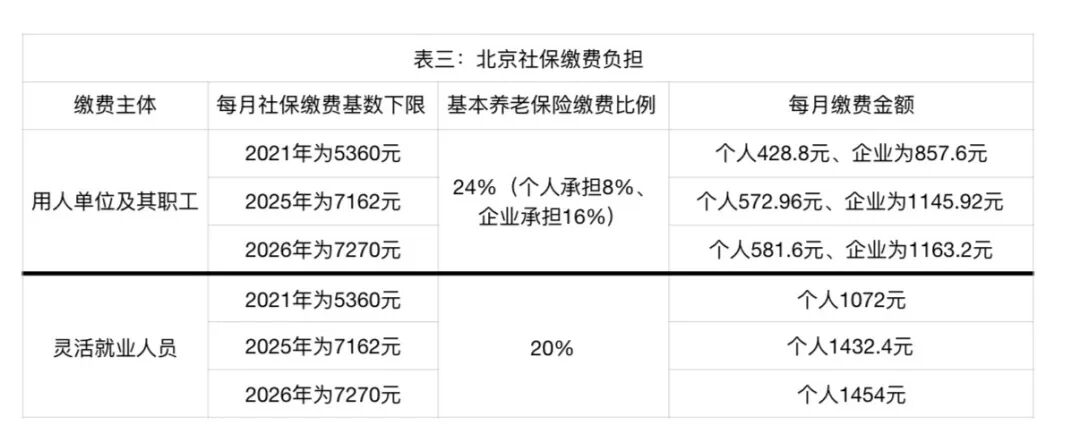
Taking the Beijing region as an example, Table 3 clearly shows the changes of social insurance payment burden that individuals and enterprises need to bear only for endowment insurance for the above three groups during the high and low growth stages of the lower limit of social insurance payment base.
Graphics by The Economic Observer
Since the social insurance payment base in various regions is linked to the increase of the average social wage, this means that when personal income and income growth rate are lower than the average social wage or the average social wage growth rate, paying social insurance will bring greater pressure.
In recent years, with the steady growth of GDP, the national average wage level has risen rapidly. In 2025, the average wages of employees in urban non-private units and private units reached 10787 yuan/month and 5966 yuan/month respectively, both significantly higher than most of the lower limits of social insurance payment base.
However, it cannot be ignored that the actual wages of some groups are significantly lower than the average wage level of the whole society. In May 2021, the National Bureau of Statistics once published an article stating that the average wage of employees in urban units reflects the pre-tax wage, so the published average wage is higher than the actual wage received by individuals. In addition, wages generally show a positive skewness distribution, and the wage level of most individuals will be lower than the average value.
According to the "2025 Migrant Worker Monitoring and Survey Report" released by the National Bureau of Statistics, the number of migrant workers engaged in accommodation and catering industry, resident services, repair and other service industries is about 21.683 million and 37.041 million respectively, and the average monthly income of these two industries is 4208 yuan/month and 4130 yuan/month respectively. In contrast, the lower limit of social insurance payment base in 25 provinces in 2025 was higher than these two income figures.
In terms of flexible employment, taking a food delivery rider in Chongqing with a pre-tax monthly income of 5000 yuan as an example, if he pays social insurance according to the lower limit of Chongqing's social insurance payment base, the payment burden of endowment insurance alone in 2025 will be 880.8 yuan/month, accounting for 17.6% of his monthly income.
Qiao Qingmei found through investigation that a large number of food delivery riders have low willingness to pay for employee endowment insurance, and are more inclined to convert this part of social insurance funds into their disposable wages of the current month. "Paying for employee endowment insurance means that individuals need to sacrifice part of their current income every month in exchange for pension after retirement. Affected by factors such as insufficient awareness of food delivery riders on employee endowment insurance and inconvenient social insurance transfer, they are more inclined to obtain short-term income."
In November 2024, the report on the inspection of the implementation of the "Social Insurance Law of the People's Republic of China" released by the Law Enforcement Inspection Team of the Standing Committee of the National People's Congress mentioned that the actual income of many low-income people is lower than the minimum payment base. With the annual increase of the average social wage, the social insurance premium of low-income people rises synchronously, resulting in low-income people being "averaged", which increases the payment burden, and this is also an important reason for some low-income groups to "discontinue social insurance" in recent years.
From Minimum Payment to Compliance
In recent years, local governments and relevant departments have continued to pay attention to the actual burden of social insurance payment. Previously, in order to reduce the social insurance payment burden of enterprises, some regions took the initiative to explore "flexible adjustment" of the lower limit of social insurance payment base to slow down the rising pace of social insurance payment base.
For example, the Zhejiang Provincial Department of Human Resources and Social Security proposed in 2025 that in order to appropriately reduce the payment burden of enterprises and individuals, the lower limit of individual payment base in 2025 is determined at 60% of the average social wage of 2023 (maintaining a one-year gap with the national overall planning regulations), while the upper limit is still determined at 300% of the average social wage of 2024.
Qiao Qingmei said that currently all parties are discussing about reducing the social insurance payment base to attract more flexible employees to participate in employee social insurance and reduce the social insurance burden of enterprises, for example, reducing the lower limit of social insurance payment base to 50% or even 40% of the average social wage.
Based on multiple interviews, the current main view is that the lower limit of social insurance payment base can be moderately reduced on the basis of 60% of the average social wage, but it cannot be reduced too much.
Xiang Yunhua said that under the background of consolidating the social insurance payment base and the continuous growth of the lower limit of social insurance payment base, it is necessary to pay attention to the possible heavy social insurance payment burden faced by low-income worker groups and micro, small and medium-sized enterprises. However, setting the lower limit