The Later Journey to the West is such a huge hit that it drives Mango Excellent Media to record two consecutive 20% daily limit surges, with its market value skyrocketing by 10 billion yuan. Industry insiders point out that the production cost of AI long dramas can be as low as half of that of live-action dramas, yet it is far from easy to make profits, and investors are still cautious.
On August 31, *The New Journey to the West*, China's first AIGC-produced long drama that premiered in prime time on a satellite TV, was launched on Mango TV and landed on Hunan Satellite TV the same night. The release of this drama immediately ignited the capital market: Mango Super Media's stock price hit the 20% daily limit for two consecutive trading days on August 31 and September 1, with its market value surging by over 10 billion yuan in just two days.
Reporters from *National Business Daily* interviewed a number of industry insiders and learned that the production cost of some AI-generated long dramas can be reduced by more than half compared with live-action dramas of the same scale, and a team of less than 20 people can also complete full-length content. Industry insiders also stated that there are no technical obstacles in the production of AI long dramas at present, and what capital is worried about is that the business model has not changed, with revenue still coming from advertisements and membership fees.
The summer film and television slot is just coming to an end, and the drama market has not yet seen a widely recognized national hit, but the stock price of Mango Super Media (SZ 300413, stock price 20.38 yuan, market value 38.125 billion yuan) has hit the daily limit one after another on August 31 and September 1.
On August 31, *The New Journey to the West*, which features no live-action actors, was launched on Mango TV and entered the prime time slot of Hunan Satellite TV the same night. This is China's first AIGC (Artificial Intelligence Generated Content) long drama that has premiered in prime time on a satellite TV, with 5 episodes of the "Huaguo Mountain Chapter" released in the first batch, each about 40 minutes long. The little stone monkey Sun Xiaosheng born from the immortal stone will later form a new scripture-seeking team with Tang Banfo, Zhu Yijie and Sha Mi, and the whole drama is planned to produce 30 episodes.
On the day *The New Journey to the West* premiered, Mango Super Media closed with a 20% increase. On September 1, the company's stock price hit the daily limit again, closing at 20.38 yuan per share, notching two consecutive 20% daily gains in two trading days. Within two days, Mango Super Media's market value increased by more than 10 billion yuan.
The *National Business Daily* sent an interview outline to Mango Super Media regarding the project positioning of *The New Journey to the West*, cost changes, user performance, and the company's views on the consecutive daily limit of its stock price, and no reply has been received as of press time.
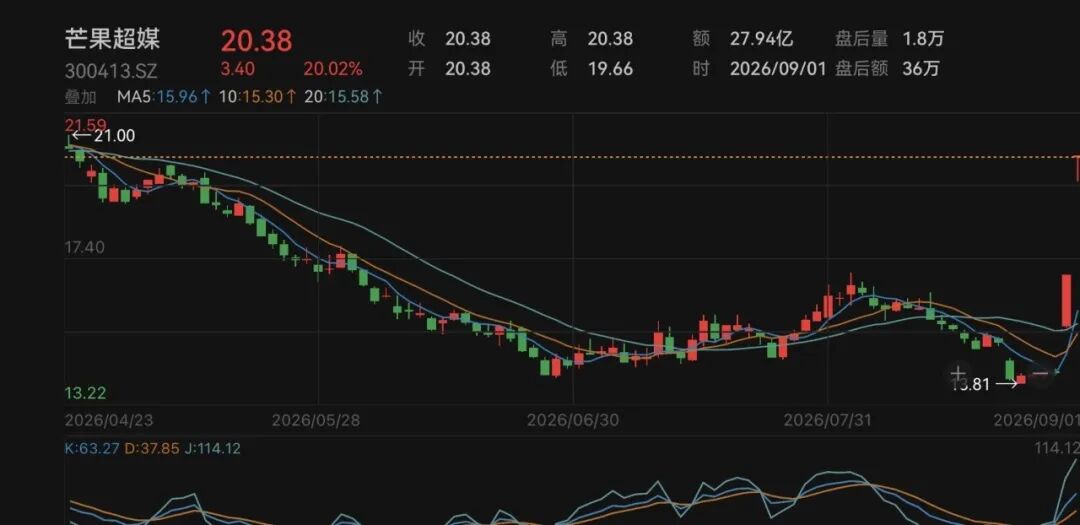
Mango Super Media has hit the 20% daily limit for two consecutive days. Image source: WIND
Behind the two daily limit gains, Mango Super Media has just released a half-year report that is not very optimistic. In the first half of 2026, the company achieved operating revenue of 6.194 billion yuan, a year-on-year increase of 3.86%; the attributable net profit was 202 million yuan, down 73.58% year-on-year. Mango TV's membership business revenue reached 1.933 billion yuan, and advertising business revenue reached 1.684 billion yuan.
Therefore, the release of *The New Journey to the West* has also become an outlet for the traditional film and television industry to cope with cost pressures. "We originally expected that the first mature AI long drama that could be judged by the market would not really appear until the end of the year," said Zhao Bin, Chairman and General Manager of Chengdu Tianfu Kuanzhai Cultural Communication Co., Ltd. He has many years of experience in the film and television industry, participated in the production of many hit dramas, and has rich experience in the development and production of film and television projects.
"If we still follow the production process of traditional long dramas and only use AI as a supplement, AI will never be able to give full play to its role." Zhao Bin emphasized that the production mode of AI long dramas must be changed from the start of the project, and job roles such as screenwriter, director, and producer all need to be redefined.
Reporters from *National Business Daily* interviewed a number of AI film and television practitioners and learned that the production cost of some AI long dramas can be reduced by more than half compared with live-action dramas of the same scale, and a team of less than 20 people can also complete full-length content; at the same time, the computing power and Token consumption of some projects account for more than 70% of the total investment.
Why did Mango Super Media see two consecutive daily limit gains?
Traditional film and television companies that disclosed their half-year reports in the same period are all facing various pressures. Huace Film and Television recorded an operating revenue of 685 million yuan in the first half of 2026, down 13.22% year-on-year, of which the revenue from TV drama production and distribution dropped by 90.35% year-on-year; although Huanrui Century achieved an operating revenue of 248 million yuan, a year-on-year increase of 25.24%, its attributable net profit suffered a loss of 144 million yuan, compared with a loss of 6.39 million yuan in the same period last year. Huanrui Century mentioned in its half-year report that the pressure on traditional film and television drama business and the credit impairment loss brought by the extended account age led to the expansion of the company's losses.
Therefore, it has been a long time since the capital market has been so lively that the release of a single drama drove two consecutive daily limit gains of a listed film and television company. Reporters from *National Business Daily* learned from multiple sources that even if practitioners have not watched *The New Journey to the West*, they already know that Mango Super Media's stock price has risen sharply.
"We are extremely excited and very encouraged," many industry insiders admitted.
Public information shows that *The New Journey to the West* is produced by Mango TV, produced by the AIGC Innovative Content Center, and co-produced by Bojing Culture. The entire work is completed relying on Mango TV's self-developed AIGC content creation platform "Mango Lingchuang". During the production period, the team accumulated 109 digital assets of characters and 143 digital assets of scenes, with nearly 100 people in the project team.
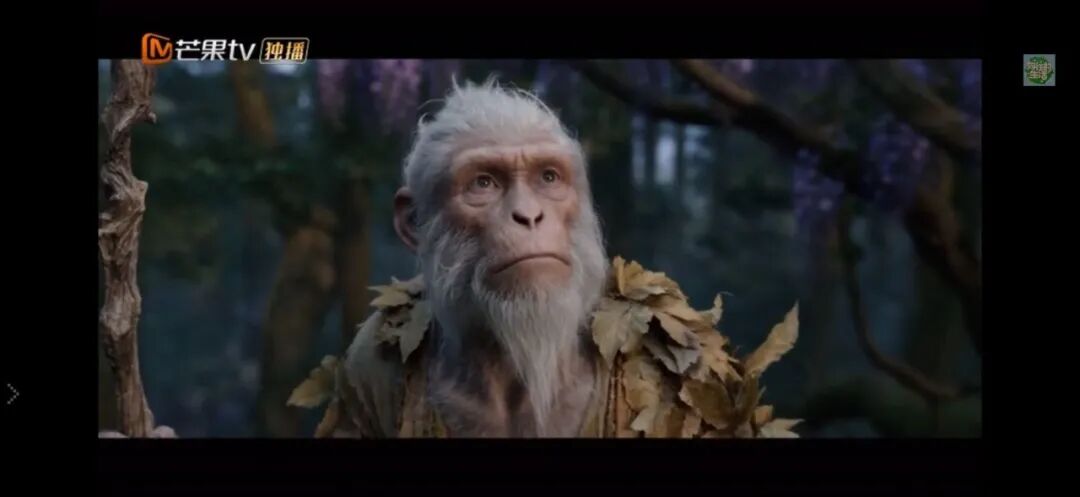
Screenshot of *The New Journey to the West*. Image source: Mango TV
"It is more inclined to animation and multiple visual forms, and it is not a direct substitute for realistic themes and costume live-action dramas," considered Li Xiu (pseudonym), a front-line film and television practitioner. Even so, an AI work that can enter the prime time slot of satellite TV with a single episode length of about 40 minutes has surpassed the common AI short videos, concept films and experimental works in the previous market.
In the last three months, Zhao Bin has contacted more than 30 or 40 AI film and television teams at home and abroad, including AI live-action long drama projects in Hangzhou and Thailand. In the finished films he has seen, the presentation effect of AI characters and images is close to that of live shooting, and the production team is no longer restricted by the venue, "we can restore the place described in the script as much as possible."
What shocked him even more is that AI dramas can also produce "promotional materials" in advance. Fan meetings, behind-the-scenes clips, on-set leaked content, and even the daily content of actors outside the camera can all be included in the simulated operation in advance. For long video platforms that rely on the popularity of dramas, character relationships and actor exposure to attract members and advertisements, these materials originally required the shooting team to organize production separately outside the main content.
Li Xiu has also come into contact with some AI long drama projects. Although the cost per episode is still a secret in the industry, he revealed that the overall cost can be reduced by more than half compared with live-action dramas of the same scale. He pays more attention to the controllability of the budget.
"Live-action dramas usually reserve about 10% of the floating space in the budget, and also need to deal with extreme weather, actor status, venue changes and other situations; the budget and final accounts of the full-process AI production are closer, and the overspending risk is relatively controllable," Li Xiu said.
Major film and television companies and video platforms are also seizing the upsurge of AI. Huace Film and Television announced this year the AIGC mid-length drama *The Missing 500 Years* with 6 episodes of 15 minutes each, and its full-AI production project *Crimson Pact* has also released a trailer; Youku launched an incentive plan for AIGC online story films, combining member viewing, IP serialization and project incentives; iQIYI applies AI more to script analysis, production efficiency improvement and content operation.
"All platforms are doing this, and new positions such as AI directors have been added, but many projects still put AI into the original film and television process as a supplement to a certain link," Zhao Bin believes, "To let AI undertake the production of the entire long drama, it is not enough to simply add a new tool. 'All roles including screenwriters, directors, and producers need to re-adapt to a new set of processes'."
Multiple AI long dramas will be launched in the next six months, and films are more vulnerable to impact than TV dramas
The nearly 100-person project team of *The New Journey to the West* can be regarded as a "large production crew" in AI film and television production. According to Zhao Bin's observation, some current AI long drama creation teams have less than 20 people, who can also complete full-length content, but the production speed is relatively slow.
In these teams, the proportion of "post-2000s" members is not low, and some of them have never participated in live shooting. "They are more familiar with AI tools and do not rely so much on the existing job roles and processes of traditional crews."
"Many people originally loved creation and did not expect to make a lot of money immediately. After AI lowers the threshold, the audience can feel whether the work is sincere or not," he said. The "industrial saccharine" and "pre-made hits" produced in batches by fixed routines may decrease, and creators' understanding of characters and stories will become important again.
It is a common order in traditional film and television production that the screenwriter finishes the script and the director organizes the shooting according to the script. But the new "AI teams" can split different scenes for separate production and then combine them, or they can first find satisfactory characters, scenes or shots, and then adjust the story in reverse.
"You can even produce the details first, and then deduce the whole story in reverse." Zhao Bin believes that this creation order will impact the original film and television teaching and talent evaluation methods. Among the dozens of teams he observed in the past three months, some newly established teams with little traditional film and television experience have shown stronger competitiveness instead.
For these young teams, platform procurement provides opportunities to enter the market. Li Xiu revealed that the pricing of live-action dramas can refer to actors, directors, production companies and past works, but AI long dramas have no star actors, so the original pricing basis is missing a part.
"At this stage, platforms will adopt the revenue-sharing model more, which can disperse risks and at the same time encourage teams to continue to improve the content, and finally the playback performance determines how much income the production party can get," Li Xiu said, after the production cost drops, individual creators and small teams may also participate in the production of long dramas. As long as the work meets the broadcast standards, there is an opportunity to cooperate with the platform.
When entering specific projects, platforms still tend to play "safe cards", preferring large IPs and classic stories. As the audience can see, *The New Journey to the West* follows the familiar Journey to the West system, and Huace Film and Television also proposes to develop the "Journey to the West Universe".
"This is a relatively conservative strategy. New technologies have brought many variables, but most platforms still hope to attract the audience with the existing popularity of IP first," Li Xiu admitted.
Mango Super Media is the first to eat the "crab" of AI long drama. Will more platforms follow up next? As of press time, Tencent Video and iQIYI did not reply to the reporter of *National Business Daily*, and iQIYI stated that it launched China's first AIGC online story film that obtained the "Online Drama Distribution License" in July.
Judging from the project progress mastered by Zhao Bin, multiple AI long dramas will be launched in the next six months, and the industry is on the eve of an outbreak. His judgment on AI films is more radical: "Films are easier to realize than long dramas, and the impact of AI technology on theater films may be even greater than that on long dramas."
Computing power and Token consumption account for more than 70% of the total investment of AI long dramas
Since the beginning of this year, the long drama market has not been very lively. According to Yunhe Data, in the first half of 2026, the total effective broadcast volume of the top 20 long dramas across the whole network reached 20 billion, down 8% year-on-year; 110 new domestic dramas were released, 27 less than the same period last year.
The traffic and quantity of live-action long dramas are both shrinking, so platforms are naturally more cautious when spending money to buy content. According to Zhao Bin's observation, some AI long drama projects are still looking for external financing. Investment institutions are willing to review the projects, but they are quite cautious when actually investing funds, and many teams still rely on self-raised funds to complete production at this stage.
"There are no obstacles at the technical production level. What capital is worried about is that the business model has not changed, and the revenue still comes from advertisements and membership fees," he said. The reduction of production costs can lower the capital threshold of a single project, but whether the content can bring paying members, advertising orders and continuous playback still needs to be confirmed after the work is launched.
After the expenditure on actors, venues and outdoor scenes is reduced, computing power has become one of the main costs of AI long dramas. In these projects, the highest proportion of computing power and Token consumption can account for more than 70% of the total investment. The higher the picture precision, the more times of generation and modification are needed, and the labor correction, rework and computing power expenditure will also increase.
"There are many tools now, but a truly universal, stable mainstream tool has not yet taken shape. I estimate that tool oligarchs will emerge within half a year," Zhao Bin gave an example. Most regions with abundant domestic computing power resources are concentrated in western China, while AI film and television teams and comprehensive service capabilities are more gathered in Jiangsu, Zhejiang and Shanghai, and more mature industrial services are needed to connect the two sides.
The problem of tools will naturally fall on every shot. Whether the face and body of the same character can remain consistent when changing to another scene, whether the movements are natural when multiple characters appear at the same time, and whether the completed pictures can be retained when partial modification is needed, all affect the production time and final cost.
After the first 5 episodes are broadcast, the subsequent content of *The New Journey to the West* can also be adjusted with reference to audience feedback. Can the mode of producing, reviewing and broadcasting at the same time reduce the risk of inventory formed after the traditional long drama is completed at one time? Li Xiu does not think this mode can eliminate the risk of content failure and inventory.
"Creators may make wrong judgments even if they see audience feedback. Now there is a lack of a mature big data system to analyze why the audience watches and why they leave, and many times it still depends on the personal judgment of the creator," Li Xiu said. Frequent modifications may also disrupt the original plan and increase the rework cost, "The AI film and television industry requires the upgrading of the entire industrial chain, and simply replacing one link cannot solve these problems".
As for which one is easier to