After the food delivery war, what cards does CHAGEE, which "stayed out of the fray", hold?
Author | Yang Shuo
In 2025, major internet giants launched an unprecedented subsidy war for milk tea.
Last April, JD announced its entry into the food delivery business. After that, high-frequency consumption categories such as milk tea and coffee were taken by internet giants as entry points to compete for users and orders. Under the crazy subsidies, "drink for free", "0-yuan purchase" and "1 cent for a cup of milk tea" once became hot topics on social platforms.
The traffic belongs to the platforms, but the cost is shared by the whole industry. As a result, the new tea beverage market, which was already in stock competition and fierce rivalry, has become even more "involution" due to this war.
Since August this year, listed tea beverage companies have successively released their first-half financial reports.
Some leading brands recorded negative same-store sales for two consecutive quarters. The brands attributed this to "the high comparable base last year driven by subsidies from food delivery platforms".
Almost at the same time, Chagee, which did not deeply participate in the food delivery war, released its latest financial report. In the second quarter of 2026, the company's total GMV reached 7.66 billion yuan, with a net revenue of 3.415 billion yuan, a year-on-year increase of 2.5%; operating profit was 525 million yuan, and adjusted net profit was 489 million yuan. This also marks the 14th consecutive quarter that the brand has maintained profitability.
If only looking at revenue, this is not the fastest-growing report card in the entire industry.
However, from the perspective of the industry environment after the food delivery war, it provides another sample worthy of observation — when prices, orders and traffic can all be amplified by short-term subsidies, can a tea beverage enterprise maintain its brand price system, franchisees' profits and its own operational efficiency at the same time?
What Chagee solves is exactly such a difficult problem.
01. The "Verification Moment" after the Food Delivery War
Looking back now, the food delivery war is more like a "stress test" that changed the rhythm of the catering industry.
With the change of the overall consumption environment, people's expectations for their disposable income in the future have become cautious, and consumers have become sensitive to prices. The "subsidy competition" among internet platforms has undoubtedly amplified this trend.
When a cup of milk tea is priced at only a few yuan or even "0 yuan" due to subsidies, low-priced products quickly become the price anchor for consumers.
For tea beverage brands, orders may increase as a result, but it does not mean that the business is getting better.
The real test of the food delivery war is: after the industry price system is disrupted, who can still sustain the operation of individual stores. After the subsidies recede, what enterprises really need to think about is — how much real income do these orders actually bring, and how much profit and cash flow are retained?
A close look at the financial report performance of various brands in the first half of the year shows that the entire industry presents a very clear differentiation trend.
In terms of operating profit margin, leading enterprises generally remain stable; while mid-tier enterprises are under relatively high pressure, and there are even cases of withdrawing from entire cities.
Cash flow is another touchstone. Although in the first half of the year, the cash flow of some listed companies dropped sharply, leading enterprises still maintained a level of several billion yuan. In contrast, mid-tier enterprises are not doing so well — their cash flow is under pressure, and the settlement method for franchisees has changed from "payment before delivery" to "installment policy".
It is in such an industry performance mixed with ups and downs that Chagee's achievements appear unique — not because of its eye-catching growth rate, but its robustness.
During the food delivery war, when the industry's price war was in full swing, subsidies for franchisees continued to increase but no profit growth was seen, Chagee actively adjusted its development rhythm, drew a clear line from the price war, and adopted a high-quality growth strategy.
At that time, Chagee's judgment was that the price war could attract consumption in the short term, but in the long run, it did not conform to the essence of enterprise operation.
This quarter, Chagee's profitability performance proves the correctness of the original decision.
During the reporting period, Chagee had a total of 7,639 stores worldwide, a year-on-year increase of 8.5%, and the overall same-store GMV growth rate improved by 6.9 percentage points compared with the same period last year.
In terms of total operating expenses, the company decreased by 10.4% year-on-year. Among them, sales and marketing expenses decreased by 21.7% year-on-year, general and administrative expenses decreased by 64.6% year-on-year, and other expenses decreased by 33.3% year-on-year. The gross profit margin was 54%, the same as the same period last year.
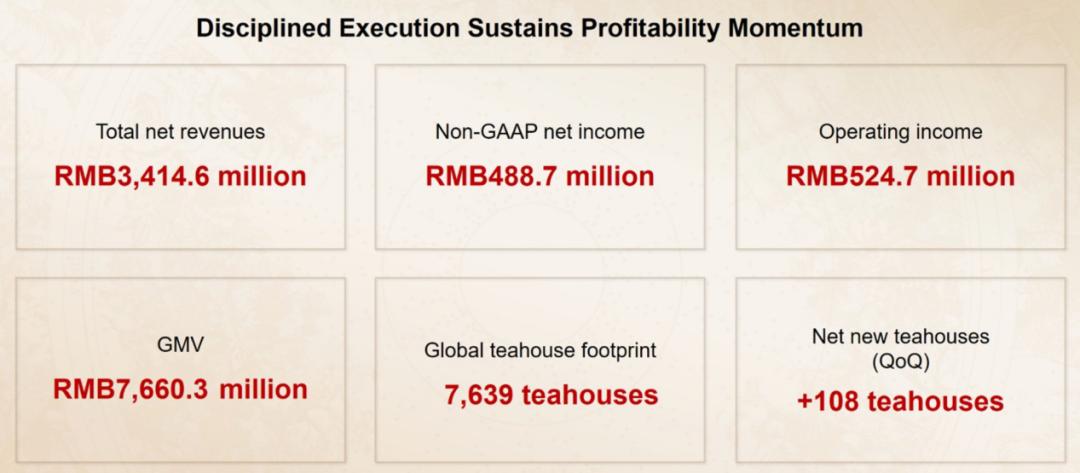
The picture is excerpted from the second quarter earnings report
The number of stores is expanding, the performance of individual stores is improving, and expenses are decreasing — Chagee has proved the correctness of its choice with solid financial performance.
At the same time, the company has always maintained stability in terms of cash reserves.
As of June 30, 2026, Chagee's cash and cash equivalents totaled 6.795 billion yuan; plus the 1.3 billion yuan of newly added short-term investments in the first half of the year, the company's total cash assets exceeded 8 billion yuan.
The management expressed its attitude towards the company's future development with "real money".
On September 30, 2025, the company's board of directors decided to distribute a special cash dividend to reward shareholders, with a total amount of about 177 million US dollars, equivalent to 1.18 billion yuan in cash, which has been fully paid within 2025. In addition, according to the share repurchase plan approved by the board of directors, within 12 months from June 1, 2026, the company will repurchase no more than 150 million US dollars of American Depositary Shares (ADS), equivalent to 1 billion yuan. At present, about 2.57 million ADS have been repurchased, with an expenditure of nearly 200 million yuan.
The capital market has also cast a vote of confidence.
Deutsche Bank reiterated its "buy" rating, and many institutions continued to raise their target prices. It can be seen that what investors generally recognize is the solidity of operating data, not concept hype.
02. From Super Single Product to Building a Product Innovation System
If the food delivery war tests the operational foundation of enterprises, then back to the consumer side, the first card in Chagee's hand is product.
The competition in the new tea beverage industry in the past few years has largely revolved around "hit products".
A product suddenly becomes popular, and the brand quickly expands its influence; then competitors follow up, and a large number of similar products soon appear in the market. Grapes, mango sago cream, wampee, kale... Almost every once in a while, the new tea beverage industry will usher in a new wave of raw materials and flavors.
However, the technical threshold of the tea beverage industry is relatively low, and brands are often difficult to retain the advantages of hit products. If a brand launches a hit product, other brands will follow up immediately. For a time, the market is full of "grape fruit tea" and "mango sago cream".
Nowadays, the arms race of launching new products has not cooled down. In the first half of 2026, some leading brands launched 142 new products, with an average of more than 20 products per month.
The number of new products is increasing, but it is another matter to make consumers truly remember a product. In contrast, Chagee presents a different path. It has a classic hit product rarely seen in the industry — Bo Ya Jue Xian.
According to data from Sullivan, from January 1, 2022 to June 30, 2025, Chagee's super single product Bo Ya Jue Xian has accumulated sales of over 1.25 billion cups.
However, compared with constantly looking for "the next Bo Ya Jue Xian", what Chagee is doing is gradually forming a product innovation system centered on "tea" from a super single product.
During the reporting period, Chagee launched 17 new tea beverage products in Greater China, hitting a new quarterly high, forming a product matrix of "original leaf fresh milk tea, tea latte, tea special mix, and light-ingredient products".
Category expansion also revolves around tea, extending from original leaf fresh milk tea to tea special mix, lemon milk, and geelato.
Taking geelato as an example, this new category more reflects Chagee's transformation from "drinking tea" to "eating tea". Its R&D team repeatedly adjusted the proportion of milk and tea base, simmering time, temperature control and other links to retain the aroma and sweet aftertaste of original leaf tea.
This means that Chagee is not simply entering a new ice cream category, but trying to answer a question: in what other forms can tea be consumed?
The same product logic also appears in regional products.
Chagee has a more systematic approach to localization. Around this year's May Day holiday, Chagee launched a number of regional limited products in a concentrated manner. Up to now, it has covered "Zhejiang Longjing, Anhui Lu'an Guapian, Henan Peony, Shaanxi Fu tea, Jiangxi Lushan Yunwu, Jiangsu Biluochun" and other regional characteristic tea and cultural elements.
On the surface, these are regional limited products; at a deeper level, they are part of Chagee's product system — continuously enriching consumers' perception of "tea" through tea and local specialties from different regions.
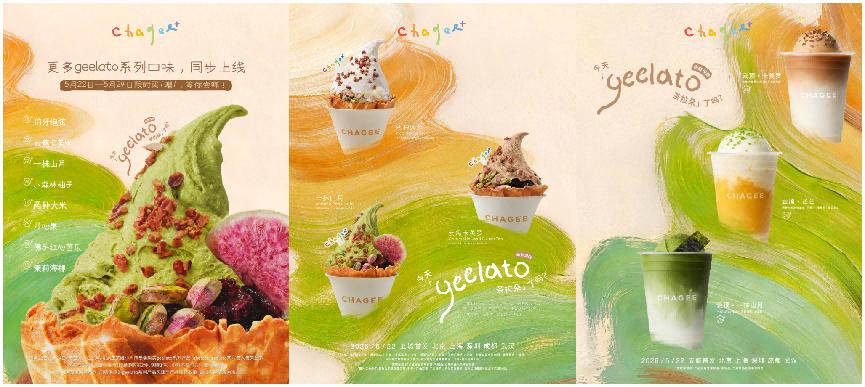
Chagee geelato products
Innovation in the scenario dimension is another extension of "tea" by Chagee.
Since Chagee launched "light-ingredient products" last March, the consumption period of its brand has expanded from the traditional "afternoon leisure" to the full time period of "morning, noon and night".
This year, Chagee has further expanded into multiple scenarios such as "birthday parties, small meetings, wedding banquets, team building" and so on.
In addition, Chagee's cooperation with Xiamen Airlines brought milk tea to an altitude of 10,000 meters; the "Chagee Imagine" pop-up store opened in Aranya in the first half of the year even explored a "extremely non-standard" community space.
If you put these actions together, you will find that Chagee's product innovation is not simply increasing SKUs. What it is really trying to build is a consumption matrix centered on "tea".
The product form can change, the consumption time can change, the consumption scenario can change, but the core has never left "tea" itself. This is also the key for a super single product to continuously evolve into a long-term product innovation matrix.
From the perspective of market data, this product system has begun to bring new growth, and indirectly drive member acquisition and repurchase.
In the first half of this year, the return of the product "Xingshi Chunshan" drove the overall GMV to increase by nearly 25% month-on-month during the Qingming Festival period. By the end of the second quarter, Gelato products have been launched in more than 190 stores, with the average offline channel GMV increased by more than 20%, bringing new user growth and awakening of dormant members.
For Chagee, which already has a classic hit product, what is really important may no longer be looking for the next hit product, but how to give consumers more reasons to stay after they first get to know Chagee through "Bo Ya Jue Xian".
03. High-value Brand, the Invisible Asset of Chagee
If product innovation solves the problem of "why consumers keep coming back", then the other card in Chagee's hand is the brand asset that takes longer and is harder to build.
In the past year, the food delivery war has changed consumers' perception of tea beverage prices to some extent, which is a relatively dangerous signal for brand development. Once consumers get used to "buying at low prices", brand loyalty and user stickiness will naturally be broken.
Chagee did not deeply participate in the food delivery war. Essentially, it is not that it "does not want orders". Its business model determines that long-term operation cannot be built on continuous low-price subsidies, which is also related to its brand gene.
At present, Chagee can be regarded as a relatively special existence among new tea beverage brands, and it is more like a branded consumer company.
In terms of pricing, Chagee is actually in the mid-range price band. It has higher quality, healthier and more stable products than tea beverages priced at a few yuan per cup, and is more affordable than tea beverages priced at 30 to 50 yuan per cup, belonging to the category of high cost-effectiveness — providing higher product value and brand experience within the price range that consumers are willing to pay.
The real challenge for a high-value brand is never to set a high price, but whether consumers are willing to continuously recognize this price.
Member data provides another observation window for Chagee's "high-value brand" positioning.
By the end of the second quarter, the total number of Chagee members reached 257 million, the repurchase rate of active members remained above 43%, and members who purchased more than twice contributed more than 78% of the order volume.
The ultra-high repurchase rate is sufficient to prove that Chagee does not rely entirely on one-time promotional orders to achieve growth, and it has a user group with stable growth and high stickiness.
From the perspective of the industry, many tea beverage brands that started with franchisees and sunk markets are more likely to ignore the value of brand assets.
As a mid-to-high end brand, Chagee invested in brand building relatively early.
The two co-branding actions in the second quarter are quite representative.
In early July this year, Chagee cooperated with Cai Gao, an 80-year-old Chinese picture book painter.
Cai Gao is the first Chinese winner of the "Hans Christian Andersen Award for Illustrators" in 2026. Chagee and her jointly launched three sparkling tea products, transforming the idyllic scenery, landscapes and childlike fun in her works into product language.
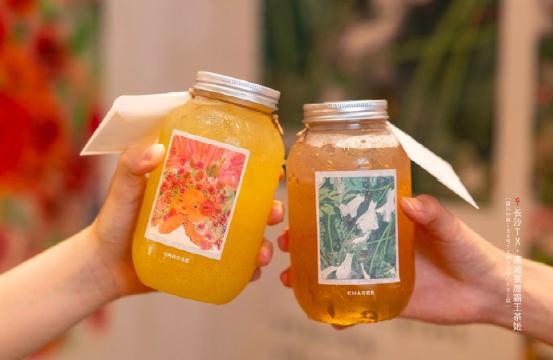
Chagee's co-branding with Cai Gao
At the end of the same month, the company cooperated with Honor of Kings to launch a special tea drink with Tieguanyin tea base.
The two partners are very different, but they solve the "dual demand" of consumer brands that need to maintain their own cultural temperament while continuously getting close to public life.
Going a step further, Chagee's visual and aesthetic system is also part of its brand assets.
For a long time, Chagee has continued to invest in "store space, packaging design, concept space" and other aspects, continuously strengthening consumers' perception of the brand. Such investments may not be directly converted into GMV growth in the short term, but when the industry enters stock competition or wants to open up a completely unfamiliar overseas market, the value of brand assets will become obvious.
In the downward cycle of consumption, the market always overestimates