Hema's breakneck expansion of front warehouses: making up for Alibaba's shortcomings, placing a high-stakes all-in bet on a do-or-die battle that cannot be lost.
Hema is undergoing a round of structural adjustments. On one hand, some offline physical stores have been shut down, on the other hand, its front warehouses are accelerating expansion and deployment across the country.
In July this year, market rumors spread that Alibaba intended to acquire Pupu Supermarket for nearly 10 billion yuan. The front warehouse system built by Pupu over many years is the core asset with the highest value in this transaction. At that time, the focus of the industry was still on path selection: to directly purchase Pupu's warehouse distribution network, or to build it independently through Hema.
Recently, Jiang Fan, CEO of Alibaba E-Commerce Business Group, gave the answer at the financial performance communication meeting. He mentioned that in the next step, the company will accelerate the integration of Hema, Tmall Supermarket and other related sectors, develop instant retail of non-food categories, especially accelerate the development of front warehouses.
This adjustment has already had specific landing points in the Beijing market. Within 3 kilometers around some closed Hema stores, two new front warehouses have been opened, and some Hema front warehouses are even located adjacent to Meituan's "Happy Monkey" stores. Tech Planet learned that Hema is also recruiting ground promotion channel service providers for front warehouses in many cities across the country.
From large offline stores to front warehouses, the form of Hema is changing, and the competition for online supermarkets among major internet giants is becoming increasingly fierce.
Spend 100 billion to buy Pupu, or let Hema enter the market on its own?
In Chaoyang District, Beijing, a Hema front warehouse is directly opened next to Meituan's "Happy Monkey" store on the B1 floor, without any Hema logo at the entrance. After getting off the elevator, you need to go through a passage to find the warehouse entrance.
Different from food delivery, a single order in the front warehouse usually contains a variety of goods such as beverages, vegetables, daily necessities and so on. After picking up the goods from the warehouse, riders can transport the goods from the warehouse entrance to the elevator entrance through a temporary elevator, and then put them into the delivery box with a trolley.
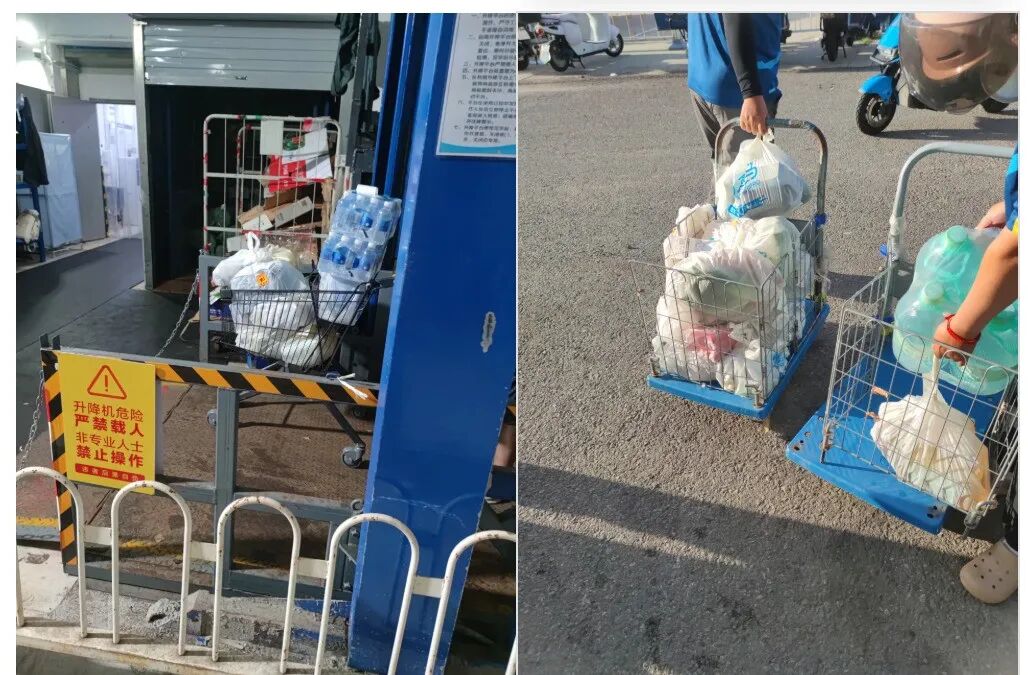
Caption: Hema front warehouse, photographed by Tech Planet
According to multiple Hema front warehouse riders interviewed by Tech Planet, the delivery fee per order is fixed at 4 yuan, and some overweight orders can reach 4.5 yuan. In Beijing, the average income per order for riders is lower than that in markets with denser riders such as Nanjing. This site is equipped with 20 riders, who can deliver up to about 2000 orders per day on the peak, with an average of about 100 orders per person per day. However, the riders also emphasized that such a order volume level rarely occurs.
One of the riders said that most of the orders he delivers are heavy goods, and the delivery categories change significantly with seasons. In summer, heavy goods such as barreled water and watermelons are the main items, while in winter, pork and Chinese cabbage are the main items. He once received an order containing half a pig.
Hema's front warehouses are accelerating their expansion across the country. In the past, offline physical stores were once the iconic feature of Hema, and the paid membership system was also one of its business priorities. For many members, they are used to consuming in physical stores, pursuing new product launches, and prefer store delivery services.
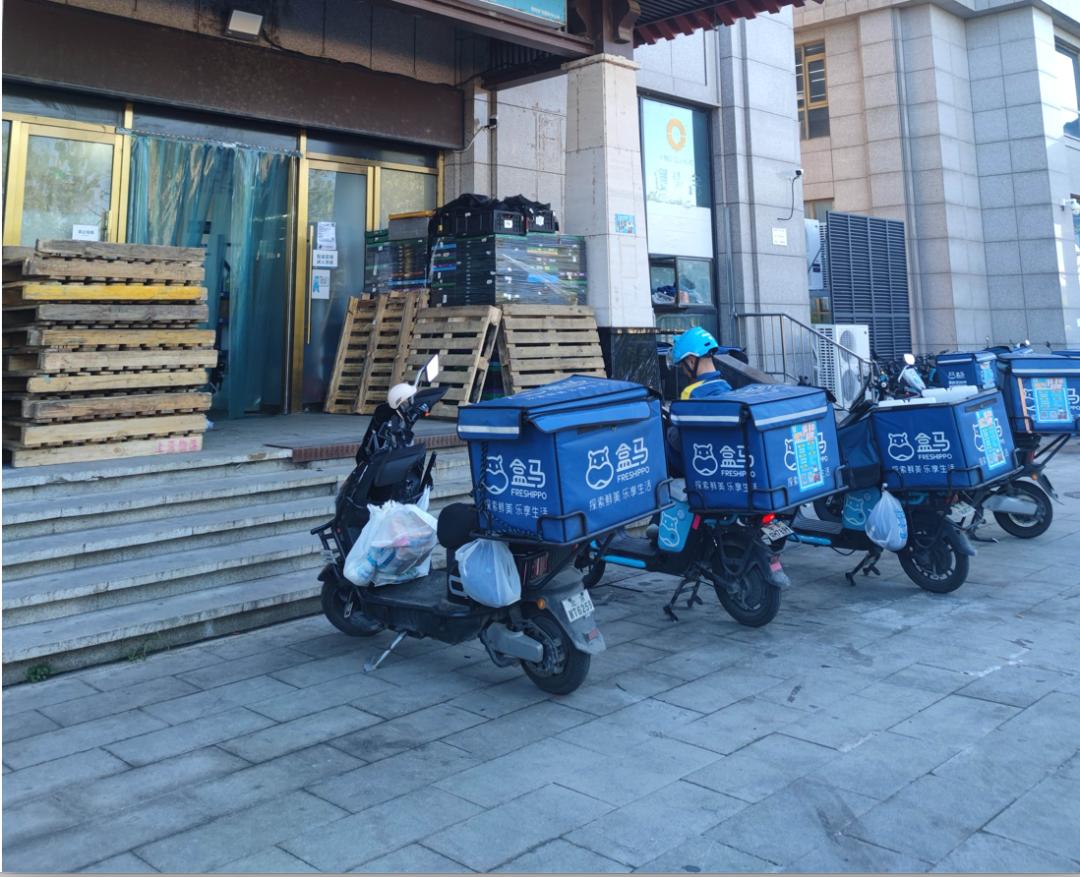
Caption: Hema front warehouse, photographed by Tech Planet
But the delivery logic is changing. Some Hema members have noticed that the system seems to prioritize shipping from front warehouses. A Hema user reported that her location is 2.7 kilometers away from the physical store and 3.2 kilometers away from the front warehouse. When placing orders recently, she found that the default shipping party is the front warehouse. Compared with offline physical stores, she feels that the front warehouse has fewer product categories, more frequent stockouts, and the advantages of fresh aquatic products are also declining.
According to a rider, the replenishment logic of front warehouses is different from that of physical stores. Front warehouses replenish goods on the same day, and once there is a stockout in the afternoon, the goods can only be replenished the next morning.
From the perspective of the whole industry, the area of front warehouses is becoming larger. Pupu Supermarket is a typical large-warehouse model, with a storage area of about 800 to 1500 square meters and about 6000 to 8000 SKUs. Retail industry analysts pointed out that acquiring Pupu was originally a shortcut for Alibaba to make up for the shortcomings of front warehouses in Fujian and Guangdong markets. However, with the acquisition not finalized, Alibaba chose to let Hema enter the market on its own, increase investment in self-built front warehouses, and try to build a fresh food instant retail network covering core cities across the country.
In terms of area, the front warehouses opened by Hema in Yancheng, Jiangsu Province this year are all 600 to 800 square meters. In April this year, Hema signed a 1200-square-meter front warehouse in Weifang, Shandong Province, which is called "the largest in the urban area", almost comparable to the scale of Pupu Supermarket.
However, staff from Hema front warehouse sites in many cities all told Tech Planet that front warehouses only support online orders, with limited delivery scope, and categories such as cooked food, aquatic products and fresh food are still not as complete as offline physical stores.
Opening stores close to Meituan's "Happy Monkey", front warehouse competition continues to intensify
The front warehouse business for Hema has experienced many twists and turns.
As early as 2019, Hema tested the front warehouse model and opened more than 70 "Hema Mini Stations", but it was soon shut down. At that time, Hema founder Hou Yi commented that the front warehouse was a "pseudo-proposition for investors" and could not make profits.
In August 2024, Hema restarted this model. According to reports from Ebrun, Hema has opened more than 500 front warehouses so far. Due to the adoption of the "store-to-warehouse" model, which directly transforms closed stores into front warehouses, Hema's warehouse opening speed is quite aggressive.
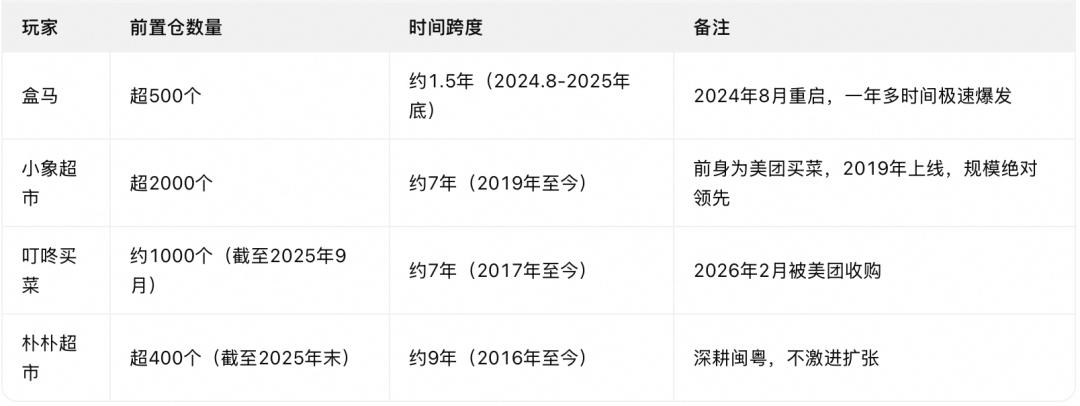
Caption: Comparison of the number of front warehouses of various brands, sorted out by Tech Planet based on public data
Since the beginning of this year, Hema has closed a total of 21 stores across the country, mainly old large stores with low operational efficiency and unclear positioned Ole stores. At the same time, Hema tilts resources to three new formats: front warehouses, Hema Fresh and Super Hema discount stores.
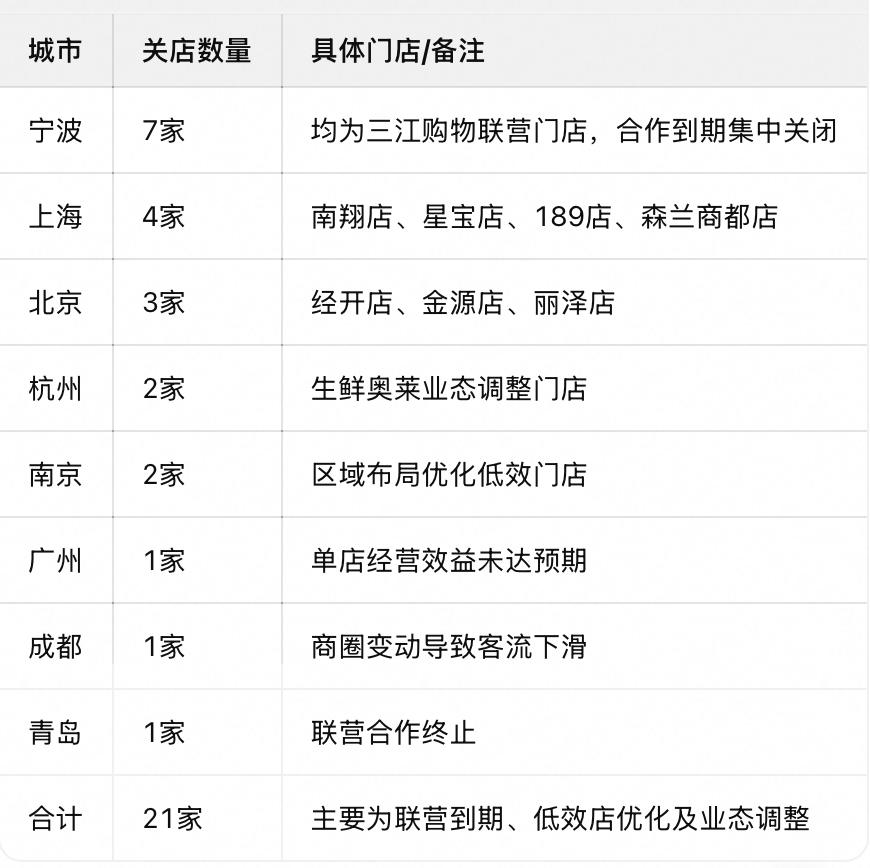
Caption: Recently closed Hema stores, sorted out based on public data
A front warehouse rider told Tech Planet that the input cost of a front warehouse is much lower than that of a physical store, which requires no decoration and no shop space in core business districts. The area of the front warehouse itself is not the key, and the purchasing power of the surrounding area is the core. He explained that the fewer orders, the less goods the large warehouse will allocate, and the number of staff in the station will be reduced accordingly.
Essentially, the front warehouse is a "density game". The denser the warehouses, the closer to users, the higher the order volume, the more stable the delivery efficiency, and the easier the model to be verified. 36Kr once analyzed that the effect of density on diluting fulfillment costs is not linear, but multiplicative.
Taking Pupu Supermarket as an example, it took nearly ten years in core areas such as Fuzhou and Xiamen with a penetration rate of over 70%, and its 800-1000 square meter large front warehouse can achieve a daily order volume of 3000-5000 orders.
Front warehouses have returned to the center of internet companies' competition this year, behind which pioneers such as Dingdong Maicai and Pupu Supermarket have already run through the profit model. In addition, various platforms increase gross profit by raising the proportion of private brands to hedge against the inherent high loss problem of fresh food categories.
However, different from the Xiaohuang Supermarket model of building warehouses first and then opening stores, Hema, like Sam's Club, used to adopt the model of integrating stores and warehouses. A retail practitioner said that Sam's Club's front warehouse has become an important source of its revenue, which also promotes other players in the industry to accelerate their layout in this track.
Walmart's first quarter financial report for fiscal 2027 shows that Walmart China's e-commerce business sales accounted for 50%, and about 75% of online orders were delivered within 1 hour.
The core of Sam's Club's current online fulfillment system is "integrated store and warehouse + cloud front warehouse". Each store is equipped with 8 to 10 cloud warehouses around, with an area of 200 to 500 square meters, about 800 to 1000 SKUs, covering a service radius of 3 to 6 kilometers, focusing on one-hour express delivery. Walmart International CEO Kathryn McLay publicly stated that "80% of Sam's Club China's orders are delivered within 1 hour". As of May 2026, the number of Sam's Club cloud warehouses has exceeded 500.
On July 26 this year, Jiang Xu, former CTO of Dingdong Maicai, officially joined Sam's Club China, which attracted much market attention. Subsequently, on August 1, Walmart APP and mini-program updated the freight rules, and the threshold for free basic freight for express delivery was reduced from 69 yuan to 49 yuan.
The above retail practitioner introduced that the core advantage of Sam's Club's front warehouse lies in high customer unit price, and the most critical fulfillment cost rate problem in the profit model is hedged.
A front warehouse research report from Guolian Securities also mentioned that in the case of low order volume, the customer unit price must reach a certain level to achieve profitability, such as Sam's Club cloud warehouse; in the case of low unit price, the order volume must reach a certain scale to achieve profitability, such as Dingdong Maicai.
Hema is following the path that Sam's Club has already run through. When Hema re-entered the Henan and Fujian markets this year, it also adopted the strategy of "warehouse first, store later", opening front warehouses first to cover online orders, verifying regional consumption power, and then setting up physical stores to test the market at a lower cost.
However, for the front warehouse model, the problems encountered by Sam's Club are also faced by Hema. On social media, under topics such as "Sam's Club mine avoidance" and "express delivery near expiration", short shelf life products such as fresh milk, baked goods and salads are frequently mentioned. In June this year, a consumer in Jiangsu placed an order for a vegetable salad through express delivery, and found that it was only 24 hours before the expiration date. He posted on social media that "I paid 680 yuan for a premium membership, and the things I bought are more expensive than those in the vegetable market, but Sam's Club quietly gave me near-expired vegetables."
Similar product quality and experience problems have also begun to emerge among Hema members with the expansion of front warehouses. Some members reported that new products in front warehouses are launched slowly, and the category selection is less than that in offline physical stores.
While Hema is switching tracks from offline physical stores to front warehouses, the competition in the entire market is also intensifying simultaneously. In addition to major internet companies, traditional hypermarkets represented by RT-Mart are also joining the battle, and they have deployed front warehouses in Tianjin, Shanghai, Wuxi and Tongliao in August.
Hefei, Anhui Province is a microcosm of this scuffle. This provincial capital city has gathered brands such as Sam's Club, Aldi, Hema and Xiaohuang Supermarket in a short period of time, and multiple formats such as instant retail, hard discount, integrated store and warehouse, and warehouse membership system compete on the same stage.
Who can make up for Alibaba's front warehouse shortcomings?
The shortcoming of Alibaba's instant retail lies in the density of front warehouses. From the perspective of Hema's overall strategy, this round of front warehouse expansion is a key step for it to integrate into Alibaba's instant retail system.
In addition, this is also an important measure to retain new users acquired during the food delivery war and prevent churn. The latest financial report shows that Alibaba China e-commerce customer management revenue (CMR) only grew at a rate of about 1% under the report caliber, and the growth of traditional e-commerce is flattening out. In contrast, instant retail business revenue increased by 45% year-on-year. Converting high-frequency users of food delivery and instant retail into e-commerce consumers is a smoother path than directly guiding catering users to traditional e-commerce.
At present, Meituan has a leading advantage in the front warehouse field, and the number of Xiaohuang Supermarket front warehouses has exceeded 2000. In February 2026, Meituan acquired Dingdong Maicai's China business for about 717 million US dollars, incorporating about 1000 front warehouses into its territory, making up for the shortcomings in the East China region, and then aggressively entering the South China market. These regions are all areas with high consumption frequency of fresh food e-commerce.
In contrast, Alibaba's instant retail consists of three directions, with differences in scale and positioning. The first is self-operated Taobao Convenience Store, which has signed more than 700 stores through the franchise model; the second is Hema, which is Alibaba's core fulfillment force in the instant retail field.
The third is Tmall Supermarket, which used to focus on e-commerce business of next-day delivery and half-day delivery based on large warehouse shipments. In July 2025, Tmall Supermarket fully accessed Taobao Flash Purchase; since January 2026, it has deployed flash purchase warehouses in 13 cities including Hangzhou, Shanghai, Guangzhou, Beijing and Shenzhen to build a "large warehouse + small warehouse" warehouse network system, and launched the "4-hour delivery" service on the basis of the original half-day delivery. However, this model is closer to the time-effect upgraded version of express e-commerce, which is essentially different from the former's "30-minute delivery" instant retail.
In addition, the acquisition of Pupu Supermarket is still pending. However, some clues have emerged. At the end of July this year, Pupu tested access to Taobao Flash Purchase in some front warehouses in Fuzhou. Consumers can place orders from Taobao, and the goods, warehousing and delivery are still the responsibility of Pupu. In the initial stage of the test, the monthly sales volume of some stores on the Taobao channel is only dozens to more than 300 orders, which is temporarily difficult to significantly increase the order density of a single warehouse.
For Hema at the moment, it is no longer the "new retail benchmark" that needs to independently prove its value to the capital market, but has become the core supplier and fulfillment base of Alibaba's instant retail system. Since Hema was officially merged into Alibaba E-Commerce Business Group in August this year, it has undertaken the important task of making up for Alibaba's front warehouse shortcomings.
Hema has crossed the threshold of 100 billion yuan in revenue, and front warehouses have been widely deployed across the country. But scale does not equal efficiency — the key problem in the next step is: can this heavy asset model really run through a profitable model?