The performance of 10 leading chip companies on China's A-share market: their total operating revenue in the first half of the year reached 267.9 billion yuan, and the net profit attributable to shareholders amounted to 111.8 billion yuan; Changxin, Biway Storage and Muxi turned losses into profits; the storage segment contributed 90% of the total profit, and Changxin boasted the highest gross profit margin.
As of August 31, all A-share listed companies have fully disclosed their 2026 semi-annual reports.
According to the collation of China News Finance, in the first half of 2026, the total operating revenue of 10 leading chip enterprises amounted to about 267.903 billion yuan, the net profit attributable to shareholders of the parent company (hereinafter referred to as attributable net profit) reached about 111.78 billion yuan, and the R&D investment was about 15.668 billion yuan.
Among them, in the first half of the year, three companies including Changxin Technology, Biway Storage and Muxi Co., Ltd. turned losses into profits; Jiangbo Long had the highest year-on-year growth rate of attributable net profit, which was about 715 times; Changxin Technology had the highest gross profit margin, about 84.7%.
Why did the performance of leading chip enterprises increase collectively in the first half of the year? Can this round of high prosperity continue?
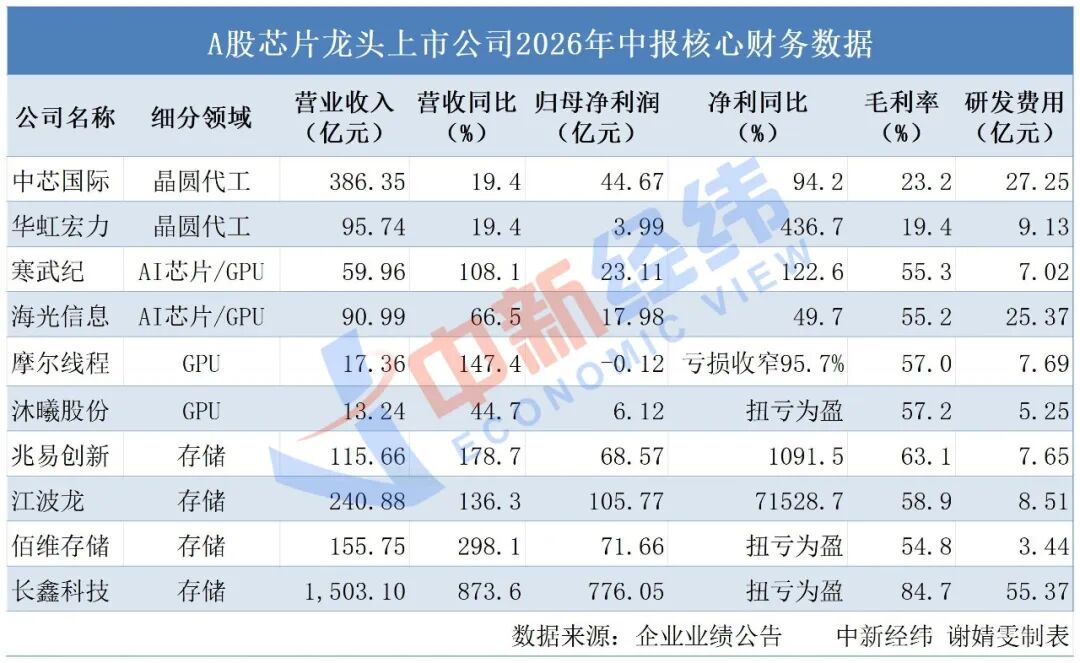
The storage sector contributes over 90% of the total profit
Divided by business, the 10 companies can be classified into three tracks: 2 wafer foundry enterprises (SMIC, Hua Hong Grace), 4 AI chip/GPU (graphics processing unit) enterprises (Cambricon, Hygon Information, Moore Threads, Muxi Co., Ltd.), 4 storage enterprises (GigaDevice, Longsys, Biway Storage, Changxin Technology). Among them, 3 companies including Changxin Technology, Biway Storage and Muxi Co., Ltd. turned losses into profits in the first half of 2026; Moore Threads still recorded an attributable net loss of 12 million yuan, but the loss narrowed by 95.7% year on year.
From the perspective of profit distribution, the three tracks show obvious differentiation.
The four storage companies including GigaDevice, Longsys, Biway Storage and Changxin Technology achieved a total operating revenue of about 201.539 billion yuan in the first half of the year, accounting for about 75.2% of the total; their attributable net profit reached about 102.205 billion yuan, accounting for as high as 91.4%, making them the main force driving this round of high performance growth.
Specifically, in the first half of the year, Changxin Technology ranked first with an operating revenue of 150.31 billion yuan and an attributable net profit of 77.605 billion yuan, its operating revenue increased by 873.6% year on year, its net profit turned from loss to profit, and its gross profit margin of 84.7% was also the highest among the 10 companies. In the first half of the year, Longsys achieved an operating revenue of 24.088 billion yuan and an attributable net profit of 10.577 billion yuan, with a year-on-year net profit growth of about 715 times, ranking first among the 10 companies in terms of net profit growth; the attributable net profit of GigaDevice increased by about 10.9 times year on year; Biway Storage turned losses into profits.
The profit growth benefits from the simultaneous rise in volume and price. Data from TrendForce, a research and consulting institution for the semiconductor and storage industry, shows that the contract prices of general DRAM (Dynamic Random Access Memory) and NAND Flash in the first half of 2026 rose sharply continuously. It is estimated that the contract price of general DRAM will increase by 13% to 18% quarter on quarter in the third quarter, and the contract price of NAND Flash will increase by 10% to 15% quarter on quarter.
Yueyang, chief electronics analyst of Huachuang Securities, pointed out in an interview with China News Finance that the underlying logic for the collective improvement of the performance of the 10 leading chip enterprises stems from the strong industrial beta brought by AI. At the global supply chain level, Samsung and SK Hynix have converted a large number of DRAM production capacities to HBM (High Bandwidth Memory), resulting in an obvious production capacity vacuum in the general-purpose DRAM market, which makes Changxin Technology the most significant beneficiary in this round of price increase cycle.
Yueyang emphasized that memory chips belong to the heavy asset industry with a long capacity expansion cycle, and the supply-demand gap is difficult to be fundamentally bridged before 2029. As long as the gap exists, the price center is expected to continue to move upward.
Zhang Cuixia, chief investment consultant of Jufeng Investment, said to China News Finance that the core driving force for the profit growth of the storage sector comes from the explosion of demand for AI computing power. The storage carrying capacity of AI servers is 8 to 12 times that of traditional servers. In addition, the production capacity of global manufacturers is tilted towards high-end storage, and the supply gap has promoted the continuous rise of prices. Institutions generally predict that the pattern of insufficient storage supply will last at least until the second half of 2027.
AI chip performance is released, and wafer foundry maintains steady growth
The AI chip track presents a pattern of leading enterprises making profits and emerging players catching up. In the first half of 2026, the total attributable net profit of the four companies in the AI chip/GPU sector reached about 4.709 billion yuan, accounting for 4.2% of the total attributable net profit of the above 10 companies, which is not even a fraction of that of Changxin Technology.
Among the two newly listed GPU companies, Muxi Co., Ltd. achieved an attributable net profit of 612 million yuan in the first half of the year, turning losses into profits; Moore Threads still recorded an attributable net loss of 12 million yuan, but the loss narrowed by 95.7%.
In the field of domestic AI chips, Yueyang believes that Cambricon is an undisputed leader, which has entered a substantial performance release stage this year; while companies such as Muxi are still in the customer introduction period, and it will take some time for their shipments to increase. He further analyzed that the overseas market is dominated by NVIDIA, while the domestic market is accelerating the promotion of domestic substitution. Coupled with the continuous increase of computing power capital expenditure by leading Internet enterprises, the overall demand for domestic GPUs is being rapidly driven.
Zhang Cuixia said that domestic GPU manufacturers have stepped into the commercial inflection point of mass shipment from the technology verification stage.
For the two wafer foundries, their revenue growth rates are consistent, but the elasticity of net profit growth varies. In the first half of the year, SMIC and Hua Hong Grace both recorded a year-on-year revenue growth rate of 19.4%, with attributable net profits of 4.467 billion yuan and 399 million yuan respectively, representing a year-on-year increase of 94.2% and 436.7%.
Zhao Haijun, Co-CEO of SMIC, said at the performance meeting that the growth of the company's turnover is mainly driven by the dual factors of increased shipments and price increases. He specially pointed out that in the growth of gross profit margin, the contribution of price increase factors is greater than that of capacity optimization.
The gross profit margins of the 10 companies show obvious echelons. Yueyang said that it is not appropriate to make simple cross-track comparisons. Wafer foundry adopts a heavy asset model, so its gross profit margin is naturally low; chip design companies adopt the light asset Fabless model, which only needs to entrust TSMC, SMIC and other enterprises to carry out tape-out, so their gross profit margin is inherently higher. In the current tight supply and demand environment, manufacturers will inevitably prioritize allocating production capacity to high gross profit margin products such as storage and AI chips, and these customers are more likely to pass costs on to the downstream.
Can the rise of storage prices continue?
Data from the National Bureau of Statistics shows that from January to July 2026, the profit of the integrated circuit industry increased by 18.5 times year on year, contributing more than 80% to the profit growth of the electronics industry.
What is the trend of the semiconductor sector in the second half of the year, and can the rise of storage prices continue?
Zhang Yi, CEO of iiMedia Research, told China News Finance that this round of high profit growth in the chip industry is the result of the resonance of three factors: cycle reversal, AI computing power release and the low base in the same period of last year. Coupled with the production control of overseas original manufacturers and the continuous release of domestic substitution orders, the growth rate has been jointly amplified. However, although the center of storage prices is still at a high level, the upward momentum has weakened, the increase may narrow in the second half of the year, the price increase momentum of general storage is weaker than that of HBM, and signs of loosening have appeared in the NAND link. It is necessary to continuously pay attention to the production capacity release rhythm of original manufacturers.
At the valuation level, Yueyang believes that the sector has not fully reflected the AI prosperity. The market usually carries out valuation switching in the fourth quarter, and AI is still in the early stage of development in China, relevant companies are still expected to maintain high growth in the next two years, so the valuation after switching is not expensive. But he also reminded that it is necessary to be alert to misinterpreting the cyclical attribute as the growth attribute; for some pure cyclical storage targets, the expectation has been overdrawn to a certain extent when the valuation is 23 to 25 times price-earnings ratio. In general, opportunities outweigh risks at the current point in time.
Zhang Cuixia judged that the long-term growth logic of the industry has not changed. From the perspective of semiconductor valuation, the whole sector still has upward space, but certain bubbles have accumulated in some local areas.
The views in this article are for reference only and do not constitute investment advice. Investment is risky, and you need to be cautious when entering the market.
This article is from the WeChat official account "China News Finance" (ID: jwview), author: Xie Jingwen, editor: Lin Wansi, chief responsible editor: Xue Yufei, Chang Tao, 36Kr is released with authorization.