AI companionship, monthly revenue exceeds 10 million US dollars
In the topic "AI Companion Breaks Ice in Japan, Single Market Monthly Revenue Exceeds $1 Million", we previously observed that the revenue of "Zeta" in March was close to 3 million US dollars, which has reached the top tier in the AI companion track.
What is even more surprising is that in less than half a year, the revenue of "Zeta" has skyrocketed as if it was on a rocket. Its revenue after share deduction in August has exceeded 10 million US dollars, a figure that is already comparable to some hit popular games.
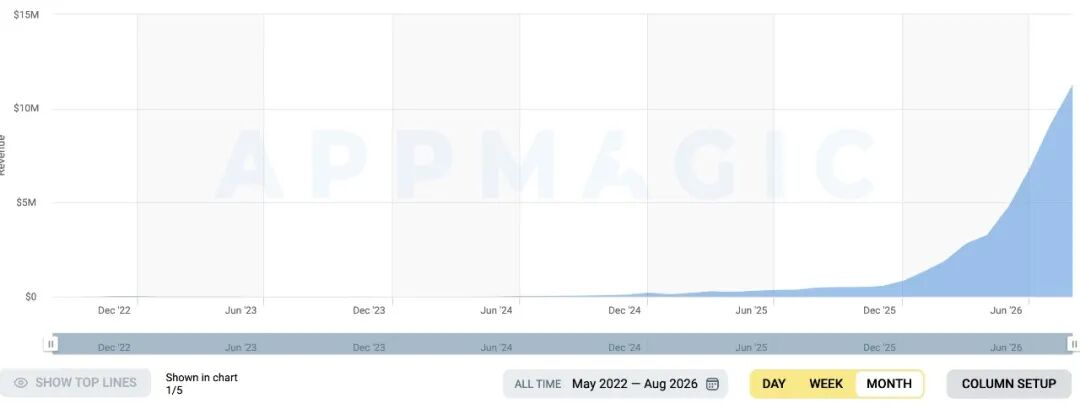
Zeta's revenue in August has exceeded 10 million US dollars | Source: App Magic
According to statistics, the revenue of mainstream AI companion products in the first half of 2026 has increased to varying degrees, but the growth momentum of "Zeta" is particularly staggering. In just a few months, a clear gap has been formed between the revenue of "Zeta" and its competitors in the same track. After achieving monthly revenue of millions of US dollars, what did "Zeta" do to push its revenue several times higher?
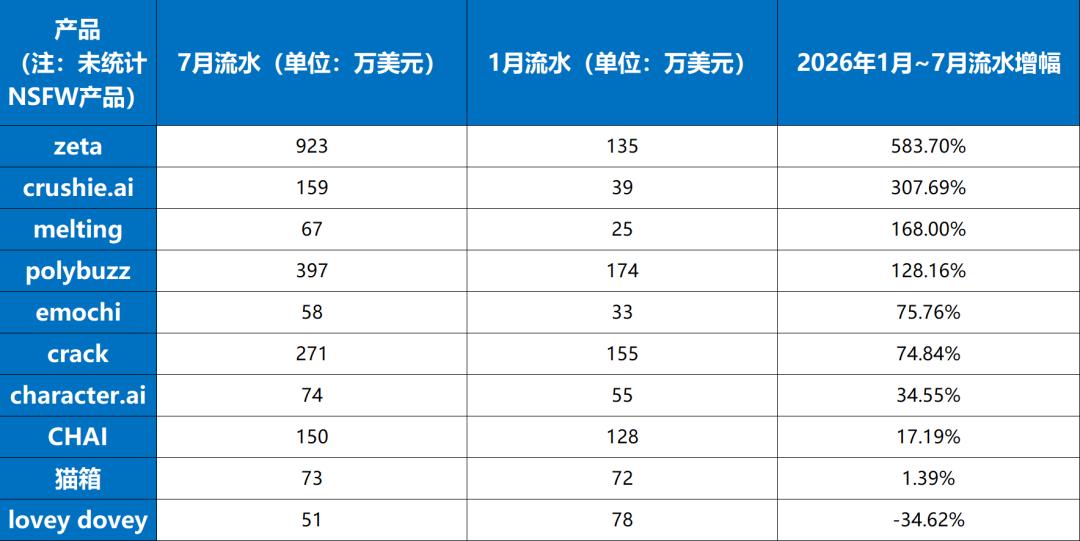
Statistics on the revenue growth of mainstream global AI companion products from January to July 2026, Data source: AppMagic, sorted and drawn by Baijing Chuhai
I. The "Second Explosion" in the Japanese Market
According to AppMagic data, the current revenue of "Zeta" is highly concentrated in Japan, contributing more than 80% of its total revenue; South Korea and the United States rank next, but the revenue growth in these two markets has not been obvious in the past few months.
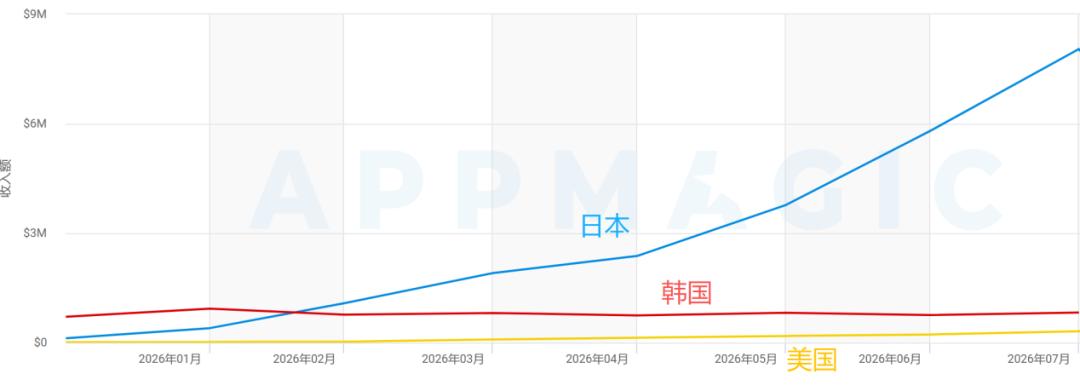
The regional revenue curve of "Zeta" since 2026 | Source: AppMagic
The growth of "Zeta" from millions of US dollars to 10 million US dollars in monthly revenue can be clearly attributed to the "second explosion" that occurred within the Japanese market.
Looking at the download and revenue trends in the Japanese market, the growth of "Zeta" in the first half year is not a simple curve of "more users, higher revenue". From January to May, as the product's popularity increased, the number of downloads indeed grew rapidly, reaching a phased high in May; however, from June to July, the number of downloads did not increase but decreased, remaining stable at around 300,000 times, while the revenue continued to rise sharply, rising from about 3.7 million US dollars in May to about 8 million US dollars in July. During the same period, RPD continued to climb.
In other words, after May, the revenue growth of "Zeta" has significantly outpaced the growth of new users. Users no longer poured in at the same speed, but each user became increasingly valuable.
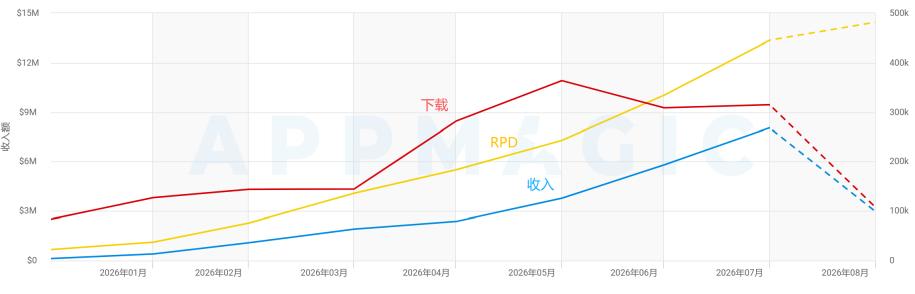
The curve of downloads, revenue and RPD of "Zeta" in the Japanese market since 2026 | Source: AppMagic
To supplement our perspective, we retrieved MAU-related data of the application from Diandian Data. The data shows that, the monthly active users of "Zeta" in the Japanese market during the same period remained basically unchanged with no significant growth; while ARPMAU (average monthly revenue per user) has increased about 10 times in half a year.
After re-testing "Zeta", the author found that the commercialization model of the product has not fundamentally changed. Basic chat is still free and unlimited, and the platform monetizes through advertisements, Zeta Pass subscriptions and Pieces virtual currency top-ups; there is no sudden "killer feature" in paid rights that can explain the several-fold revenue growth.
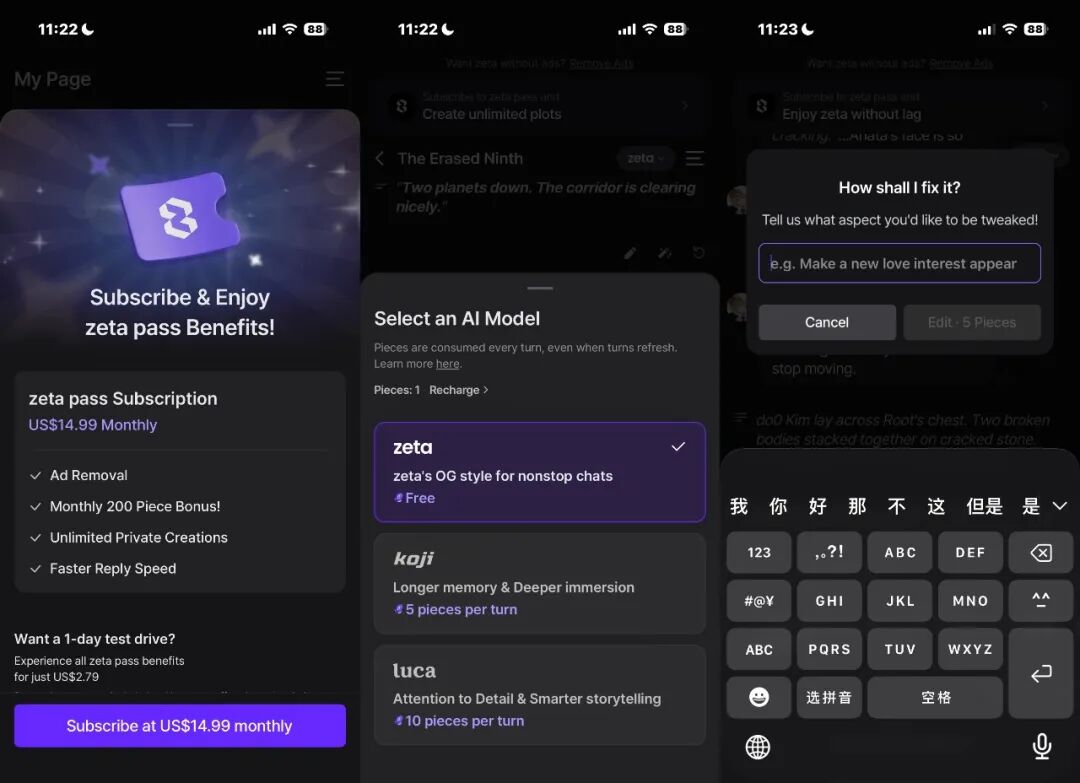
Zeta pass rights and the main consumption points of virtual currency | Source: product screenshot
The biggest change after the experience is the content supply of "Zeta". In the past, "Zeta" had little difference in design from mainstream AI companion products, with various characters on the platform for users to interact with one-on-one, and the product's advantage mainly came from its rich long-text narrative capability.
But now when you open "Zeta", the most popular content on the homepage is no longer single-character chat, but plots composed of multiple characters, character relationships and a complete worldview. Current users in "Zeta" prefer to follow storylines and manage relationships in small independent worlds one by one.
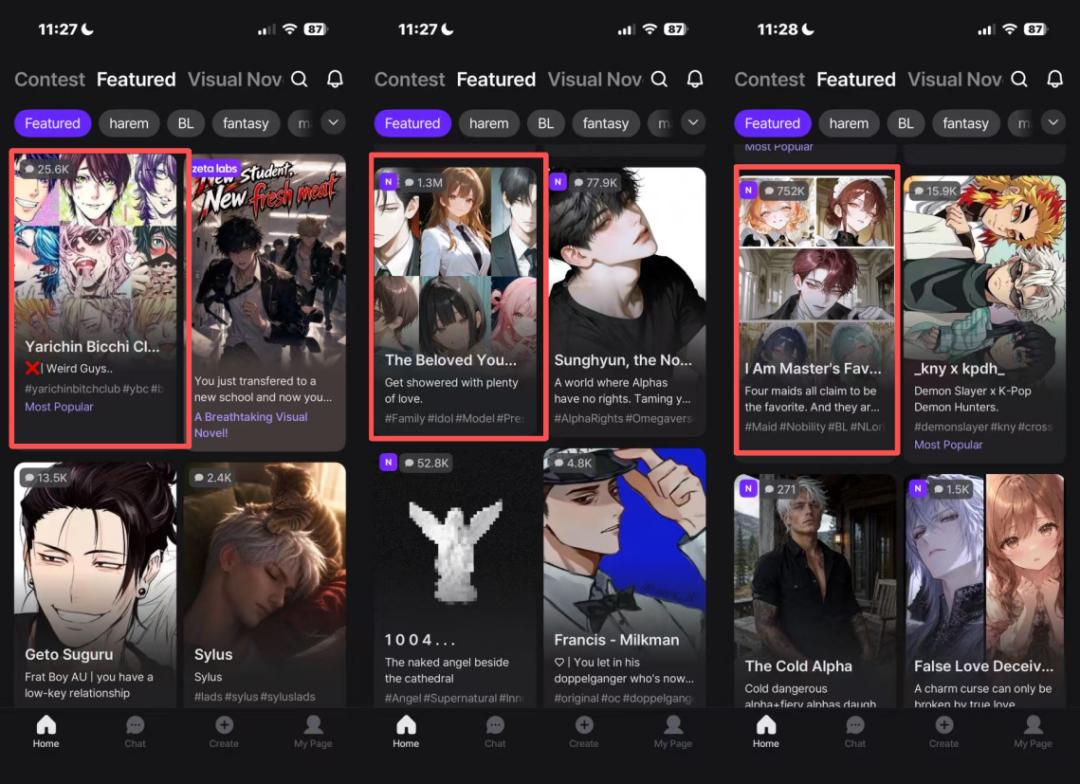
The popularity of multi-character plots in "Zeta" is significantly higher than that of single-character chat | Source: product screenshot
The increase of high-quality "multi-character" plots, multiplied by users' higher requirements for product experience after use, has completely opened users' wallets.
II. The More Free, The More Users Pay
Judging from the revenue and download curves, the time when the two curves "diverged" was after May this year. If you observe the product updates and user discussions during this period, you will find that "Zeta" not only lowered the creation threshold for complex storylines, but also lowered the usage threshold for ordinary users to access in-depth plots, which laid the foundation for the popularization of more complex plots, especially multi-character content.
In March 2026, "Zeta" officially renamed the platform content unit from "Character" to "plot", and emphasized that the current platform content is "stories containing multiple main/supporting characters + worldview"; on May 21, "Zeta" lifted all restrictions on advanced storyline functions. The four storyline tools, namely Lorebook (worldview setting), character status window, Style (narrative style) and "choice branch" (plot option progression), which previously required paid use of advanced models such as Koji and Luca to generate, can now be accessed by users with the free model Zeta (sharing the same name as the product).
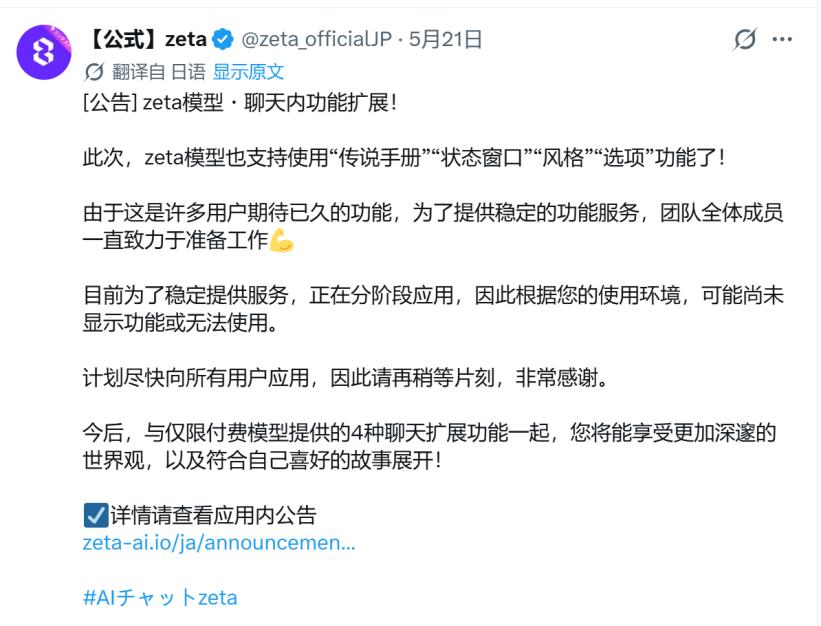
Source: X
These moves seem to weaken the paid attractiveness of advanced models and their driven advanced functions, but in fact, they have cultivated more free players into in-depth storyline users. In the past, free users entered "Zeta" mostly to chat with a single character; when worldview, status display, narrative style and plot options can all be experienced for free, users can play a complete interactive story with complex structure even without recharging.
In addition, for creators, the threshold for making complex plots has also been greatly reduced. They no longer need to frequently use advanced models when creating complex storylines. This move of "Zeta" has expanded both "the supply of complex plot content" and "users willing to deeply consume content" at the same time.
This also explains why multi-character stories, which were launched as early as August 2025, did not become mainstream until this summer. Multi-character plots require a more complete worldview, complex character relationships and plot branches, with high creation difficulty and threshold. As in-depth storyline tools are gradually completed and opened for free, creators can make complex plots more easily, and the supply of "multi-character" plots on "Zeta" has become rich.
Observing the comment section can also verify this. From June to July, comments focusing on multi-character production, plot out-of-control and optimization methods increased significantly; by August, some users directly described the product as "now Zeta is all about multi-characters", and some people regarded "no multi-character function" as a shortcoming of competing products when comparing "Zeta" with other AI companion applications.
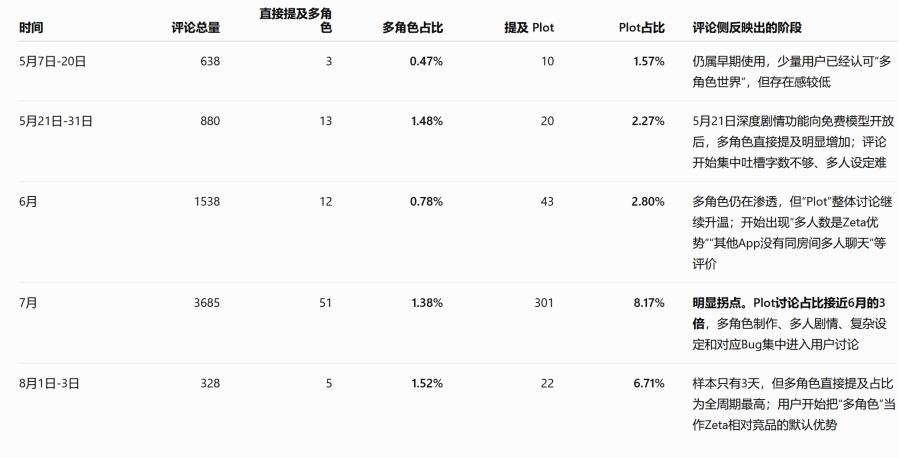
Analysis of user comments in the Japanese market from May to August, sorted out by Baijing Chuhai, drawn by AI
So far, "Zeta" has completed the transformation of content form, turning the product from "chatting with one character" to "experiencing a whole continuously developing multi-character story".
And this change also explains the rise of Zeta's revenue. The deeper users engage in the gameplay, the more some previously negligible issues become rigid paid demands.
First of all, it's the advertisements. In casual single-character chats, the interaction is relatively simple, and users can tolerate being interrupted by advertisements; but in multi-character plots, users need to continuously pay attention to character relationships, conflicts and story trends, with longer average usage time, and it is more difficult for them to accept that key plots are cut off by advertisements.
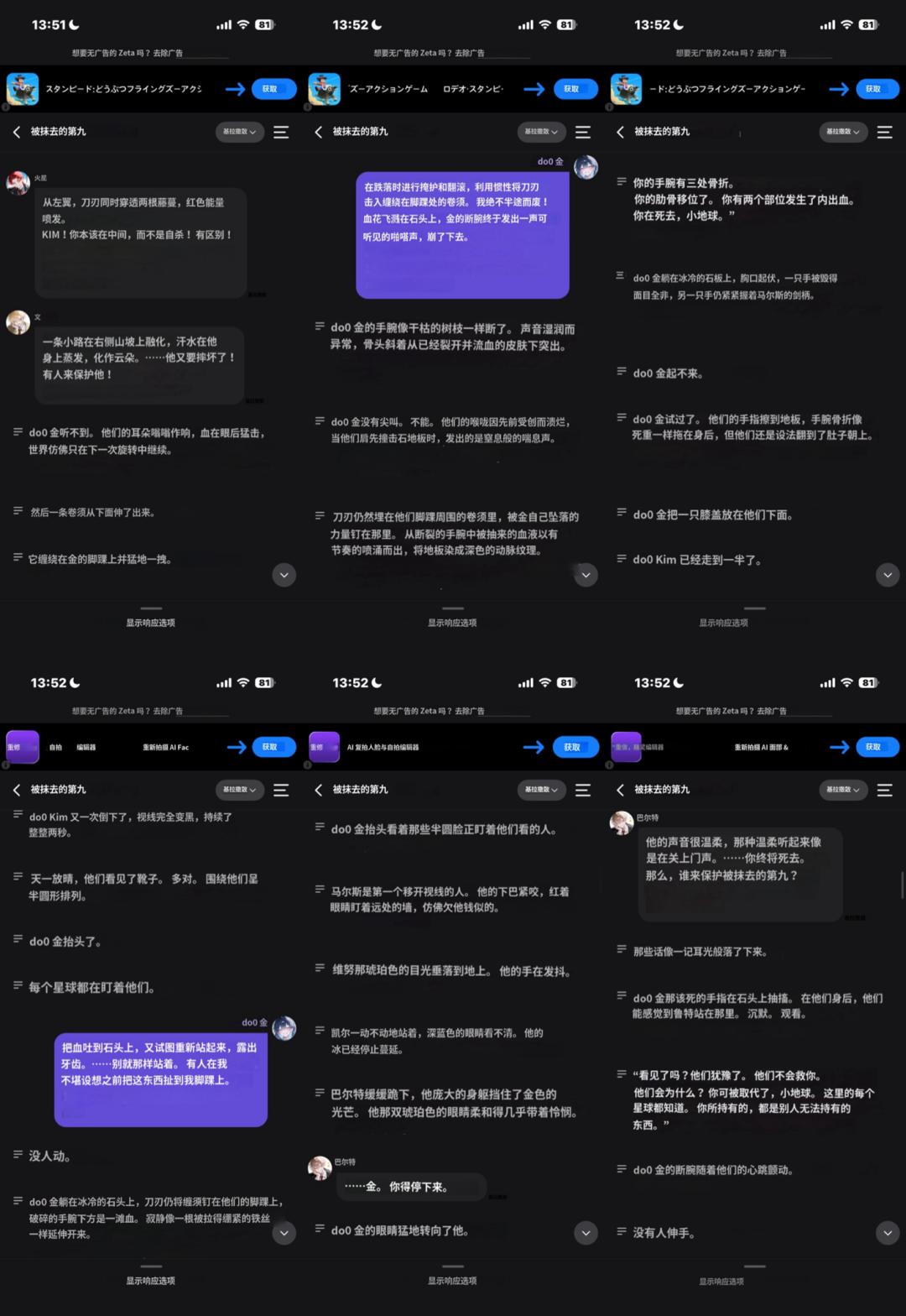
After experiencing the multi-character plot, you can feel that the plot description of the product is more vivid and compact. Based on the interaction between the rich worldview and different characters, the immersive experience of the product is stronger than that of single-character chat; and the pop-up nodes of advertisements almost all appear at critical moments, such as when a certain character appears, or at a certain plot turning point | Source: product screenshot
In the author's recent actual test, 10 advertisements appeared within about 40 minutes of using the product, and the frequency of ad pop-ups increased significantly compared with April; users who are experiencing confessions, conflicts or important plot turning points will have the whole story rhythm destroyed by suddenly inserted advertisements.
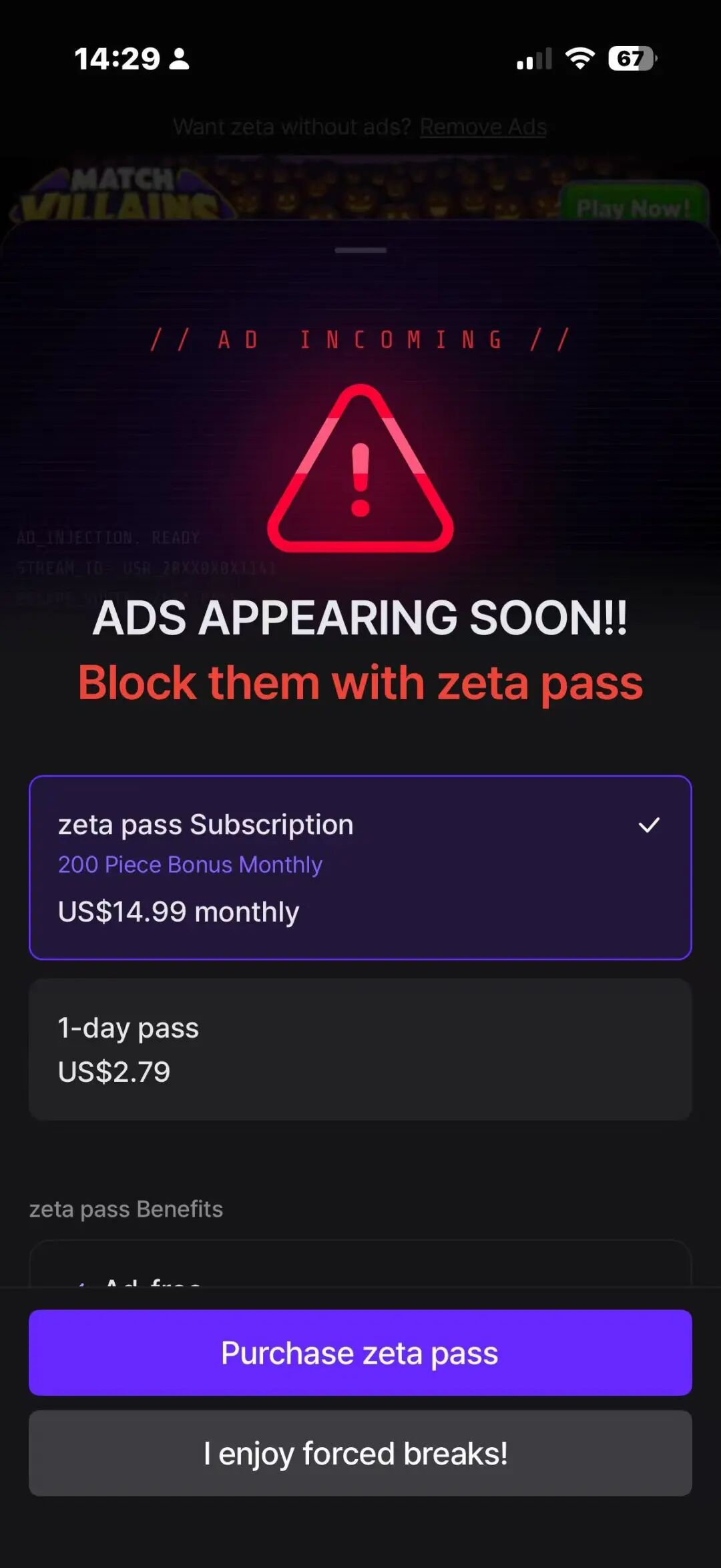
The copywriting of Zeta's pop-up advertisements is also very interesting. Users who do not purchase Zeta pass need to admit that they "enjoy forced breaks" | Source: product screenshot
A Japanese user who insists on using the product for free said that every time an advertisement appears, he does two pages of summer vacation homework, and unknowingly he has finished the 78-page math exercise book.
The longer the story is, the more immersed the user is, the higher the cost of being interrupted. The previously dispensable ad-free function is increasingly becoming a necessity for heavy users.
In addition, the increase of in-depth users has also brought higher requirements for plots. Although "Zeta" has opened advanced storyline functions to free users, "the functions are available" does not mean that the free model can stably control these functions. Especially after the model adjustment in late June, problems such as "unexpected intrusion", "instability" and memory decline of the free model broke out intensively.
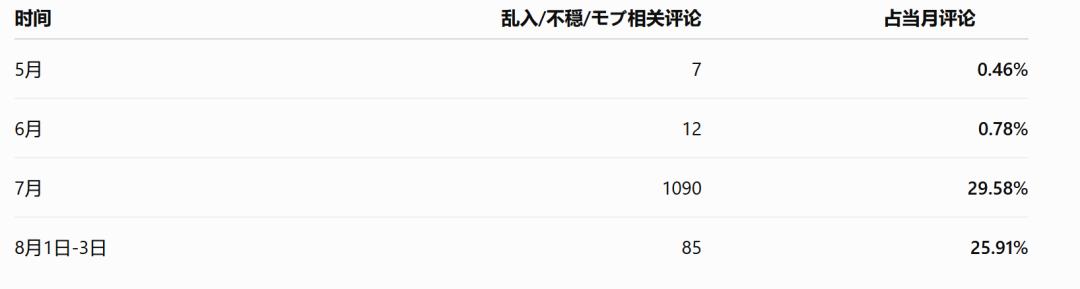
Analysis of user comments related to "unexpected intrusion" and "instability" in the Japanese market from May to August, sorted out by Baijing Chuhai, drawn by AI
The so-called "unexpected intrusion" means that the AI suddenly adds unrelated passers-by, phone calls, door-knocking events to the original story, or even forcibly creates conflicts. In one-on-one chats, it doesn't matter if the reply goes off track for one or two rounds, and it can be remedied by retrying or modifying; but in multi-character plots, once the AI gets the character relationship wrong, forgets the worldview, or suddenly inserts a strange character, it is equivalent to directly destroying the plot that the user has managed for dozens of rounds.
As a result, users began to actively look for "solutions". A large number of posts with prompt words and character setting skills to prevent unexpected intrusion appeared on X, and some users said after testing that "multi-character plots cannot be played at all without models above Koji". Therefore, many users purchase Pieces (direct in-app purchase of tokens) to switch to advanced models such as Koji and Luca, in exchange for better memory, character consistency and plot stability.
