Summary of 2026 H1 financial reports of leading advertising and marketing firms: Where did advertisers' funds flow in 2026?
The first half of 2026 has drawn to a close, and the financial reports of multiple listed advertising and marketing companies at home and abroad have all been released.
Taking 30 mainstream advertising and marketing companies at home and abroad as samples (covering multiple categories including international 4A agencies, A-share/H-share marketing agencies, AdTech platform companies, and OOH media), TopMarketing conducts a horizontal comparison based on their H1 financial reports, sorts out and summarizes the changes in the global marketing industry in the first half of 2026.
Mr. TOP found that the drastic reshuffling of the advertising and marketing industry is further intensifying:
Performance 1: 5 giants rewrite their rankings through mergers, acquisitions and AI transformation; Performance 2: Local listed marketing companies are generally strengthening, but the growth differentiation of enterprises in different tracks is intensifying; Performance 3: Whether overseas or local, the phenomena of "revenue growth without profit growth" and "revenue decline with profit growth" are occurring at the same time, which essentially achieve profit improvement by scaling down operations; Performance 4: Finally, advertising budgets are looking for new outlets, and high-profit tracks such as overseas marketing and sports marketing are helping advertising and marketing companies improve their profits.
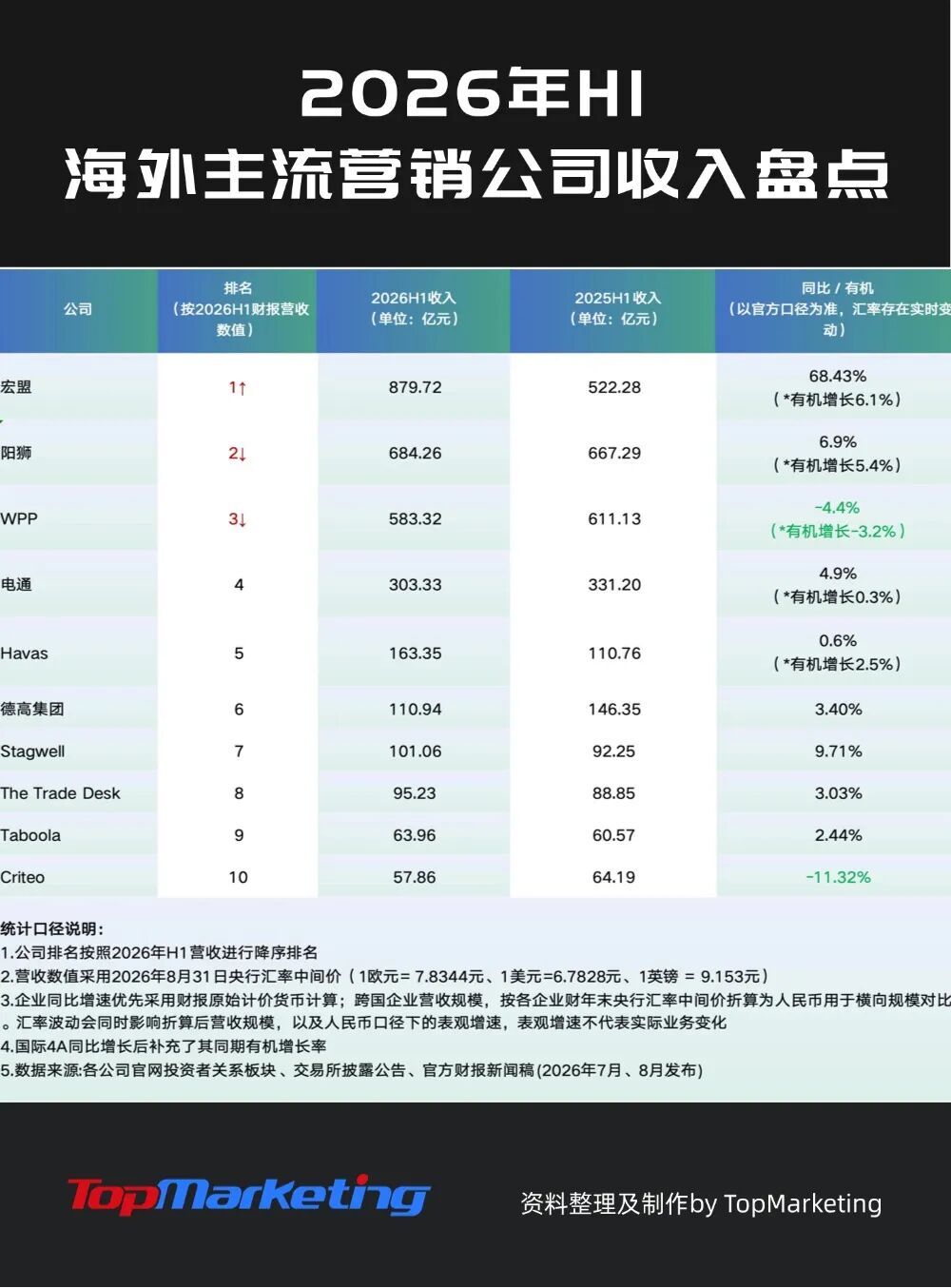
Ranking List 1
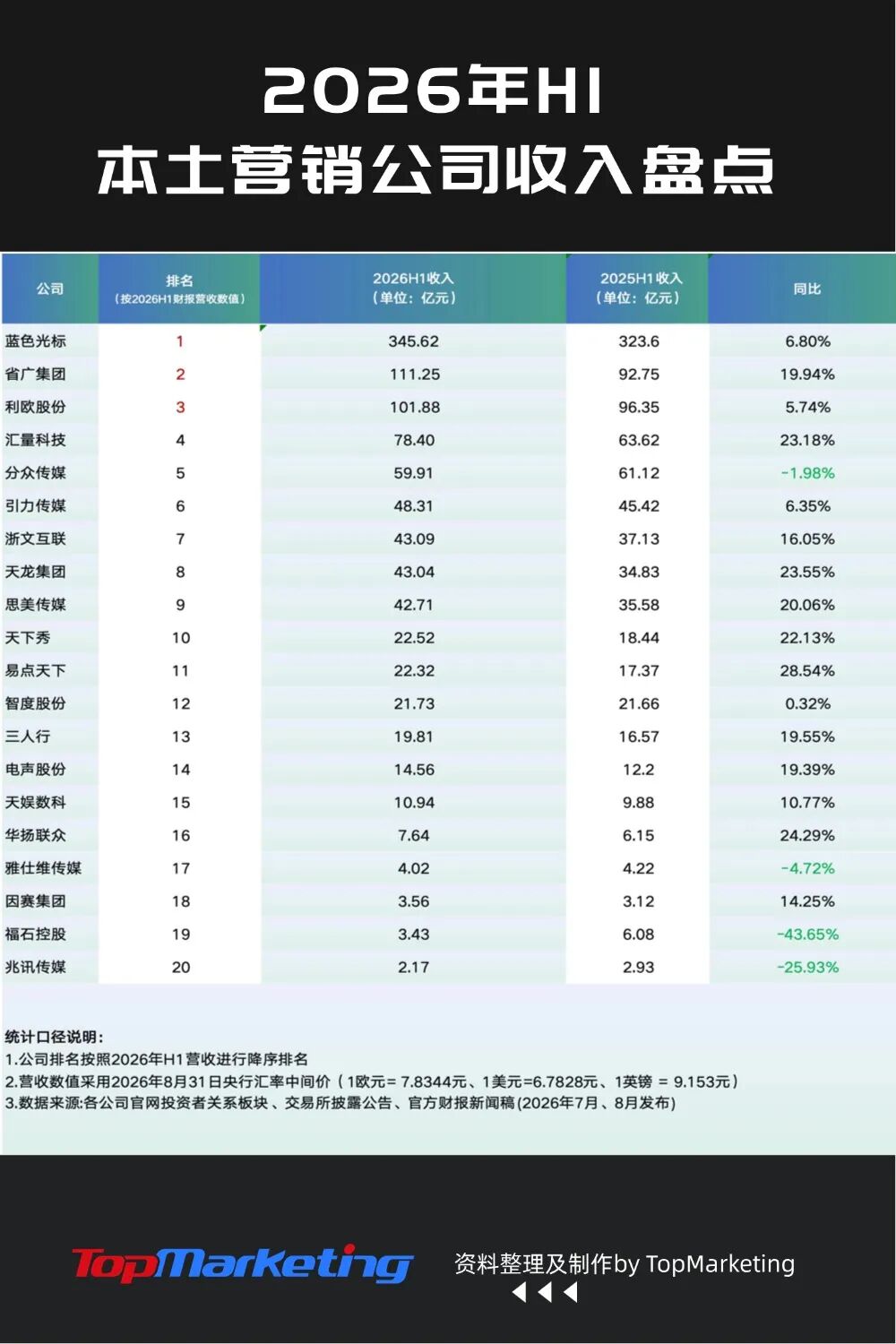
Ranking List 2
Detailed interpretation of the ranking list is as follows:
The duality of international 4A agencies: Ranking reshuffling, mergers and acquisitions reshape the global first echelon of 4A agencies
Judging from the H1 2026 revenue ranking, Omnicom directly jumped to the first place in the list by acquiring IPG, with H1 revenue reaching 879.72 billion yuan, a year-on-year surge of 68.43%, and organic growth maintained at 6.1%. This heavyweight merger and acquisition has directly rewritten the ranking order of global advertising groups.
Publicis ranks second, with revenue of 684.26 billion yuan, a year-on-year increase of 6.9%, and organic growth of 5.4%. Its endogenous growth is steady, but its ranking drops due to the impact of giant mergers and acquisitions. It is worth noting that Publicis completed three major acquisitions in the first half of the year: it acquired sports marketing agency 160over90 for more than 500 million US dollars, data collaboration platform LiveRamp for 2.2 billion US dollars, and AI predictive analytics company Adge.AI, so as to expand its business volume and supplement the sports resources, data capabilities and AI technology sectors.
The veteran giant WPP falls to the third place, with revenue of 583.32 billion yuan, a year-on-year decrease of 4.4%, and organic growth of -3.2%. It has been under continuous pressure and is still in the adjustment cycle of business contraction and divestment of low-margin businesses. However, the decline in corporate revenue is not a deterioration of operation, but a strategic choice to actively cut off the low-profit media flow business.
Dentsu ranks fourth, with revenue of 303.33 billion yuan, a year-on-year increase of only 4.9%, and organic growth of only 0.3%, and its endogenous business is almost stagnant.
Havas ranks last among the 5 giants, with a year-on-year growth of 0.6%. Since the beginning of 2026, Havas has completed the acquisition of majority stakes in 8 agencies, 4 in the first quarter, and 3 representative enterprises added in the second quarter: French corporate communication agency Format, American sports marketing agency Archrival, and Spanish sustainable experience marketing company MUT, to strengthen the three core business capabilities of corporate strategic consulting, youth culture and sports marketing, and sustainable offline activities. In July after the end of the financial reporting period, the group re-acquired Dutch sports marketing enterprise SportVibes to improve its sports marketing layout in the Benelux region.
It is not difficult to observe this round of 4A mergers and acquisitions that the acquisition targets of the groups have completely shifted to vertical capability-oriented companies, and they no longer acquire traditional media agencies. In essence, they are actively giving up low-profit media flow business and purchasing high-margin capabilities such as consulting, sports and technology.
Summary: The global traditional 4A camp has shown obvious stratification. Omnicom has achieved scale leap through mergers and acquisitions; Publicis has stabilized its foundation by relying on endogenous growth superimposed on acquisitions in vertical tracks; WPP and Dentsu have entered the stock adjustment stage, and the growth story relying solely on traditional media agencies has failed. In addition, international 4A agencies generally show the phenomenon of "revenue decline with profit growth": some enterprises have weaker revenue scale, but their profit side has improved instead.
Local marketing companies rise overall, with severe industry differentiation
Observing the H1 2026 ranking, it is found that the overall revenue of local marketing companies has risen, and a small number of them are under performance pressure.
Mobvista, Zhewen Interactive, Tianlong Group, Simei Media, Inmyshow, Eques, Three's Company, and Soundon have all achieved double-digit year-on-year growth.
However, the growth certainty and underlying logic of the above companies are different:
Mobvista and Eques are anchored in digital marketing technology, and the core driving force for growth comes from the overseas marketing track;
The growth of Three's Company comes from state-owned central enterprise commercial customers such as operators and large state-owned banks, and the automotive business also contributes important increments. The narrow-sense government procurement is only a supplement. As a state-owned marketing group, Guangdong Advertising has a government marketing sector, but its 100-billion-yuan revenue base still comes from the media business of commercial brands such as automobiles, FMCG, and overseas expansion. Government and state-owned system customers provide counter-cyclical certainty for local marketing companies, but such businesses often have limited gross profit, and it is easy to see the phenomenon of "revenue growth without profit growth".
As for Tianlong Group, Simei Media and Zhewen Interactive: they are rooted in domestic performance advertising and short video feed streaming business, undertaking the delivery needs of domestic brands.
Of course, not all the local camp is thriving, Astro Vision Media has a year-on-year growth of -4.72%, Fushi Holdings -43.65%, Zhaoxun Media -25.93%. Some enterprises have experienced a sharp decline in revenue, and serious differentiation has also occurred within local companies.
Warm and cold differentiation in vertical tracks: which tracks are growing and which are shrinking
Although there are significant differences in the service market, business scope and scale between Chinese and foreign advertising and marketing companies, some common rules can also be found through horizontal comparison at the track level.
1. Overseas marketing track delivers certain growth
BlueFocus, Eques and Mobvista, three representative overseas marketing enterprises, have all achieved positive revenue growth. Eques' H1 2026 revenue was 2.232 billion yuan, a year-on-year increase of 28.54%; Mobvista's H1 revenue was 1.156 billion US dollars, a year-on-year increase of 23.20%; BlueFocus ranks first in the total revenue of all sample enterprises with a total revenue of 34.562 billion yuan, and its overseas business is an important growth pole of the company.
This is due to the intensified competition of domestic advertisers in the domestic market, the continuous outward spillover of budgets, and overseas service providers have reaped the dividends.
Conversely, the performance growth of JCDecaux China, Criteo and Publicis China also benefits from the positive returns of their overseas business expansion.
2. Two-level differentiation in the outdoor advertising track
Outdoor offline media is under pressure: Focus Media's revenue is 5.991 billion yuan, a year-on-year decrease of 1.98%. The overall growth of building media is weak, and consumer brands tend to be cautious about offline building advertising; Zhaoxun Media's revenue has dropped sharply, which further reflects that traditional offline media traffic is under pressure. Among the samples, only JCDecaux, a world-famous outdoor advertising group, still maintains steady growth.
3. AI marketing and Ad-Tech advertising platforms show strong resilience
The new-type 4A agency Stagwell has a year-on-year increase of 9.71%, The Trade Desk 3.03%, and Taboola 2.44%. These technology-driven advertising platforms have not seen explosive surges, but they all maintain positive growth on the whole.
It is worth mentioning that the digital company Stagwell has also continuously grabbed the core customers of veteran 4A agencies in creative, social marketing and other businesses, confirming that advertisers no longer blindly believe in the aura of traditional groups.
4. Performance marketing and short video agency: the home court of local companies
Tianlong Group, Simei Media, Zhewen Interactive rely on short video and live streaming performance advertising to maintain double-digit growth. This signal indicates that in 2026, domestic brand delivery is increasingly inclined to quantifiable performance-based advertising, and the proportion of large-budget hard advertising for traditional brands is being squeezed.
Summary: Based on the comprehensive data of 30 samples, overseas marketing is the track with the strongest certainty of growth; the offline OOH track shows severe internal differentiation, and media in transportation scenarios are under pressure; Ad-Tech platforms maintain moderate growth on the whole but lack explosive momentum, and AI has not yet realized large-scale commercial revenue; domestic short performance agencies support the basic growth plate of local agencies.
The differentiation of heat and cold between tracks is essentially the migration path of advertisers' budgets. Funds continue to withdraw from inefficient and low-margin channels and concentrate on service providers with real value.
The real survival status of marketing companies: Scale does not equal health
Comparing the 30 companies together, it can be found that revenue scale and nominal year-on-year growth rate can no longer be simply equated with the business quality of enterprises. It is mainly manifested in the following 3 problems:
1. "False high growth" brought by mergers and acquisitions
The 68.43% year-on-year growth rate of Omnicom comes mostly from the acquisition of IPG, and the organic growth is only 6.1%. When looking at the financial reports of advertising and marketing companies, we should not only look at the nominal year-on-year growth, and organic growth is the real perception of endogenous business. Many enterprises have a sharp surge in book revenue, not because their own business has improved, but because the scale is piled up through acquisitions.
2. Head differentiation: some are expanding while others are shrinking
Some companies are advancing rapidly in revenue: Eques 28.54%, Tianlong Group 23.55%, Mobvista 23.18%; other companies are shrinking significantly: Fushi Holdings -43.65%, Zhaoxun Media -25.93%, Criteo -11.32%.
This situation shows that advertisers' budgets are not increasing as a whole, but being redistributed, withdrawing from inefficient channels and concentrating on tracks with higher certainty.
3. Large scale does not equal strong growth
WPP has a huge revenue volume, but it has negative year-on-year growth; Focus Media is at the forefront in scale, but its revenue has decreased slightly. The scale of traditional media flow is fading, and the industry trend has turned to "profit priority".
Whether international 4A agencies or local agencies, they are actively giving up low-margin media flow business and no longer blindly pursuing revenue scale.
2026, 3 major trends in the marketing industry
Combining the performance of the entire ranking list, 3 major signals of the marketing industry in the first half of 2026 can be summarized:
First, mergers and acquisitions have become a shortcut for international 4A agencies to expand rapidly, but mergers and acquisitions cannot solve the problem of endogenous growth. Publicis has not made large-scale mergers and acquisitions, and has achieved steady organic growth relying on its own business, which is a healthier sample instead. The acquisition focus of leading groups has shifted from traditional media agencies to high-barrier businesses such as sports marketing, data and AI.
Second, local marketing companies are facing opportunities, but the internal gap is widening. Overseas marketing and short video performance agencies are fertile ground for growth; companies with traditional offline media and pure media reselling models continue to be under pressure.
Third, the logic of advertisers' spending has changed completely. They no longer simply pay for media flow, but prioritize performance and ROI.
Conclusion
In the first half of 2026, the marketing industry still presents a picture of coexistence of ice and fire. Some enterprises are advancing rapidly with the help of popular tracks such as overseas marketing and sports marketing; some veteran giants are making difficult adjustments in the process of mergers, acquisitions and business divestment.
Advertising budgets have not disappeared out of thin air, but are migrating rapidly.
The marketing service providers that can survive in the future will no longer simply compete on revenue scale, but focus on who can obtain higher-quality and higher-margin businesses and deliver effective business growth for advertisers.
This article is from the WeChat official account "TopMarketing" (ID: TMarketing), author: Mr. TOP, published with authorization from 36Kr.