The gold retail sector is witnessing a sharply polarized performance in the first half of the year: Lao Feng Xiang's net profit fell by 41%, Chow Tai Seng's net profit dropped by 24%, CHJ Jewelry's net profit increased by 27%, and Yuyuan Inc.'s net profit surged by 157%.
Recently, 9 major listed gold and jewelry companies on the A-share market have all disclosed their 2026 semi-annual reports.
In the first half of 2026, the international gold price generally remained at a historically high level. Data from Wind shows that the average price of London spot gold reached USD 4688.62 per ounce, a sharp increase of about 52% compared with the same period in 2025. After surging at the beginning of the year, the gold price fell back somewhat, closing at around USD 4026 per ounce at the end of June, but still steadily stayed above USD 4000 on the whole.
Judging from the performance of relevant listed companies, differences in the degree of inventory impairment, inventory scale and product structure have led to extreme differentiation of the sector's performance, with a clear deviation between the market trend and corporate profitability, and many brands have even fallen into a situation where both sales volume and profit are squeezed.
Many enterprises see revenue growth but no profit increase
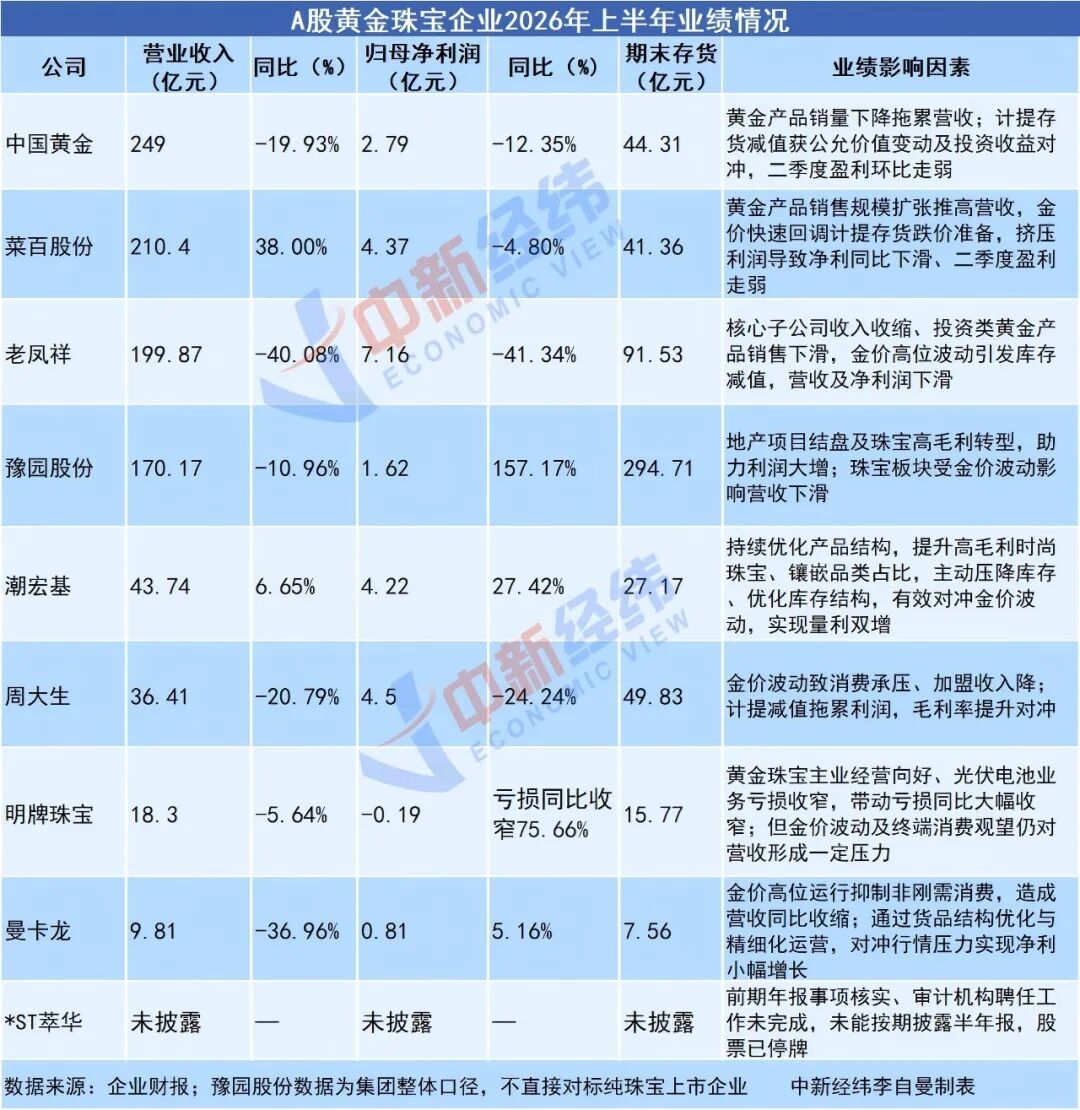
According to the semi-annual report data, the structural differentiation of revenue and profit performance of the 9 A-share listed gold and jewelry enterprises is prominent.
Traditional leading brands are generally under obvious pressure. In the first half of the year, the operating data of Laofengxiang dropped sharply, with revenue and attributable net profit falling by 40.08% and 41.34% year on year respectively, both indicators down by more than 40%; China Gold's revenue decreased by 19.93% year on year to RMB 24.9 billion, and its attributable net profit decreased by 12.35% year on year; Chow Tai Seng's revenue fell by 20.79% year on year, and its attributable net profit dropped by 24.24% year on year. Mingpai Jewelry's revenue fell slightly by 5.64%, and its attributable net profit suffered a loss of RMB 18.8864 million, with the year-on-year loss narrowing significantly.
Some enterprises see a deviation between sales volume and profit, that is, revenue expands but profit shrinks. In the first half of the year, Caibai Co., Ltd. recorded a 38% year-on-year surge in revenue to RMB 21.04 billion, but its net profit fell slightly by 4.80% year on year, and the profit growth was hedged by market fluctuations. Among them, the net profit in the second quarter alone dropped sharply by 72.4% year on year, showing a weakening quarterly profit performance.
A small number of other enterprises have shown certain resilience through differentiated operations. CHJ JEWELLERY has become one of the few targets in the sector that achieved double growth in revenue and net profit, with revenue up 6.65% year on year and net profit up 27.42% year on year. Although MCLON's revenue shrank by 36.96% year on year, its net profit achieved a slight increase of 5.16% through product structure optimization and refined operation.
It is worth noting that Yuyuan Inc. recorded revenue of RMB 17.017 billion in the first half of the year, down 10.96% year on year; but its attributable net profit was RMB 162 million, a sharp increase of 157.17% year on year. In the first half of the year, its subsidiary Shanghai Yuyuan Jewelry Fashion Group's revenue fell by 17.1% year on year to RMB 10.73 billion, accounting for 63.0% of the company's total revenue.
Regarding the decline in revenue, Yuyuan Inc. pointed out in the financial report that the main reason is the structural adjustment of the consumer industry caused by intensified fluctuations in the international gold price during the reporting period, which led to a decline in the operating revenue of some of the company's industrial operation sectors. The research report of Zheshang Securities believes that high and volatile gold prices lead to differentiation in demand for gold jewelry, putting pressure on the revenue side, but Yuyuan Inc. has promoted the quality improvement of products and channels, with impairment losses narrowing year on year, leading to improved profit and earnings quality.
In addition, *ST Cuihua failed to disclose its 2026 semi-annual report on schedule, and its shares have been suspended from trading since August 31, currently facing the risk of delisting.
Inventory impairment and structural differences drag down profits
Compared with the officially disclosed information in the semi-annual reports of various companies, the causes of this round of performance differentiation are relatively clear.
In the first half of the year, the gold price surged and then fell back with intensified fluctuations. Most enterprises stocked up at the high level of gold price. With the rapid pullback of gold price, the existing inventory goods generated large impairment losses, which directly squeezed the profit space of enterprises.
The semi-annual report of Laofengxiang shows that in the first half of the year, the revenue of the company's subsidiaries shrank, the sales of investment-oriented gold products fell, superimposed on the sharp and violent fluctuations of gold prices at high levels during the year and the structural adjustment of industry consumption, the high-level inventory generated obvious impairment pressure, and multiple factors jointly dragged down the performance of revenue and net profit.
As another traditional leading brand, Chow Tai Seng further dragged down its net profit by making large provision for inventory depreciation. The research report of Guotai Haitong Securities on August 30 pointed out that Chow Tai Seng made a provision of RMB 203 million for inventory depreciation in the first half of the year, most of which came from the impairment of inventory commodities. The gold-related impairment in the first half of the year was about RMB 140 million, and the rest came from the diamond sector, whose impairment was affected by international quotation and exchange rate fluctuations.
Chow Tai Seng also mentioned the channel situation in its financial report. In the first half of the year, the franchise channels of Chow Tai Seng achieved operating revenue of RMB 707 million, down 70.84% year on year, accounting for 19.42% of the company's total operating revenue, a significant drop from 52.76% in the same period of the previous year. The gross profit margin of franchise channels was 62.96%, a sharp year-on-year increase of 37.22 percentage points.
Chow Tai Seng stated in the financial report that the decline in franchise channel revenue is mainly affected by the following factors: First, due to the violent fluctuation of gold price, the downstream franchise customers' willingness to restock continues to be low, and they generally adopt the destocking strategy; second, the company continues to promote the channel optimization strategy of "expanding high-quality outlets and eliminating low-quality ones", and actively closes inefficient franchise stores to improve the overall quality of channels.
It is worth noting that CHJ JEWELLERY recorded simultaneous growth in revenue and net profit in the first half of the year. According to the financial report, its performance growth benefits from the continuous optimization of product structure, increasing the proportion of high-margin fashion jewelry and inlaid categories, while actively reducing conventional gold inventory and streamlining the overall inventory scale.
Wu Zewei, a special researcher at Sushang Bank, told CBN View that the performance differentiation of listed jewelry companies in this round is not simply dominated by the rise and fall of gold prices, but a concentrated reflection of the differences in the core operating capabilities of enterprises.
Wu Zewei analyzed that the continuous high volatility of gold prices has brought multiple tests to enterprises' inventory control, product layout and channel operation. On the inventory side, enterprises need to ensure the supply of stores while avoiding the risk of impairment, leading to rising pressure on inventory turnover; on the product side, market demand switches rapidly between investment and consumption attributes, putting higher requirements on enterprises' dynamic product adjustment capabilities; on the channel side, franchisees have different risk tolerance and fluctuating willingness to purchase goods, so enterprises need to balance the supply rhythm to avoid backlogged channel inventory or insufficient supply.
From the perspective of terminal consumption, the high-level operation of gold price in the first half of the year has to a certain extent restrained non-essential consumer demand, and some consumers have turned to a wait-and-see attitude. Many companies mentioned in their semi-annual reports that "the wait-and-see sentiment of terminal consumption is rising" and "market demand is weakening".
Wu Zewei pointed out that the subsequent consumption of gold jewelry will be deeply linked to the expectation of gold price, and consumer behavior will switch periodically with market expectations. The expectation of rising gold price will drive the release of demand for risk aversion and advance purchase, and the consumption of jewelry will show a periodic recovery with investment attributes; the rising expectation of price fall will push up wait-and-see sentiment, and non-essential purchases will be postponed. Rigid demand such as wedding consumption is less disturbed by prices, forming the basic market of the industry. Enterprises need to guide consumers to return to the consumption attribute of jewelry itself, weaken the logic of pure gold speculation, so as to smooth the impact of gold price fluctuations on terminal sales.
The views in this article are for reference only and do not constitute investment advice. Investment is risky, and caution is advised when entering the market.
This article is from the WeChat official account "CBN View" (ID: jwview), written by Li Ziman, edited by Lin Wansi, with Wei Wei and Luo Kun as chief editors, and published by 36Kr with authorization.