Sam Altman bluntly said: Four years is too long, two years of university is enough.
Recently, Sam Altman, CEO of OpenAI, stated bluntly:
There is no need at all to spend four full years in college, as the marginal return hits its limit after just two years.
Those once-enviable elite "golden internships" now look incredibly underwhelming.

This is by no means a case of misplaced arrogance from a high-achieving public figure, but a harsh fact rooted in underlying logic.
Today, AI has democratized productivity, and the traditional elite advancement template of "four years at a top university + top-tier internship + VP position at Wall Street or a leading tech giant" has completely collapsed.
Because the logic governing how the world operates has shifted.
In the past, you had to prove your "compliance" and "maturity" to a massive system to earn your entry ticket.
But today, all you need is yourself, a room, and a sufficient supply of Tokens, and you can directly build your own empire in the cyber wilderness.
Traditional academic credentials and prestigious titles are losing their value.
The Marginal Effect of University Education, and the Dropout Wave Among AI Prodigies
Sam Altman illustrated this point thoroughly with his own personal experience.
In 2005, he dropped out of Stanford after two years to found Loopt, later joined the first batch of Y Combinator programs, and eventually became the head of OpenAI.
In 2026, he addressed a group of interns at Silicon Valley's leading tech giants and said:
Two years is just the right length. Any further study will lead to a sharp decline in marginal returns.
Because from the perspective of knowledge acquisition and mental socialization, the four-year university program is a deal with severely diminishing marginal returns.
The first two years of university are the golden period.
You learn to live independently away from your parents, build social connections in a network where your hormones are at their peak and the density of high-IQ peers is the highest, and get hands-on experience messing up a few projects. At this point, your brain has completed the key socialization transformation.
The latter two years are a period of erosion.
The teaching content begins to suffer from "extremely severe diminishing marginal returns". The traditional four-year academic system uses the lengthy lesson plans of the last two years to discipline the destructive, free-spirited young people into compliant cogs that meet the standards of large corporations.
"As the world evolves, university education simply should not take this long," Sam Altman said.
Large language models are iterated every week, while university syllabuses may only be updated once every five years. When you spend the prime two years of your life in exchange for a diploma with an official stamp, you give up a huge amount of your freedom of choice.
This is why the new generation of AI leaders in Silicon Valley are showing a strong "centrifugal force" pulling them away from campus.
Anthropic co-founder and founding figure in the field of AI robustness and interpretability Chris Olah chose to leave campus to join the Thiel Fellowship instead of wasting his creative spark in the lengthy four-year academic program, so that he could directly study the deepest layers of neural networks.

In the computing power and semiconductor sector, James Dacombe, founder of Olix, the chip company challenging NVIDIA's dominance, dropped out of school to start his business at the age of 17.
Now at 25, he runs two cutting-edge enterprises focused on brain-computer interfaces and AI chips, with a total valuation of 3.3 billion US dollars, making him the youngest self-made billionaire in Europe.
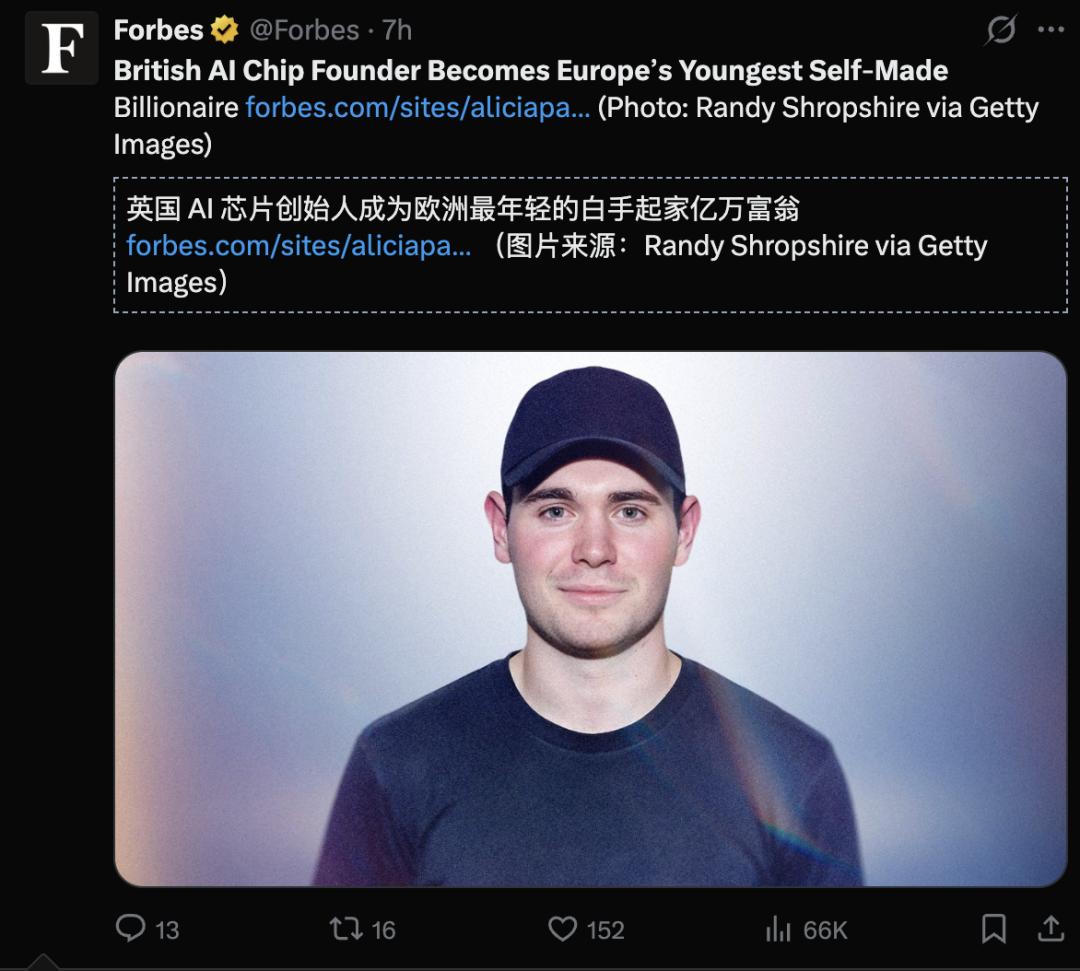
For this group of passionate, visionary minds, university education is like trying to chase the speed of light from an ox cart.
At the application layer, this phenomenon of being "forcibly pulled out of campus by the gravity of the times" has become the norm:
Alexandr Wang, a leading AI executive at Meta, dropped out of the Massachusetts Institute of Technology (MIT) at 19 to found Scale AI, now a giant in the AI data service sector, and became the world's youngest self-made billionaire at the age of 25.
Rudy Arora and Sarthak Dhawan, childhood friends, grew their startup to a valuation of 13 million US dollars by the age of 21.
Dropping out of university was the right choice — if there is any regret, it is that we dropped out too late.
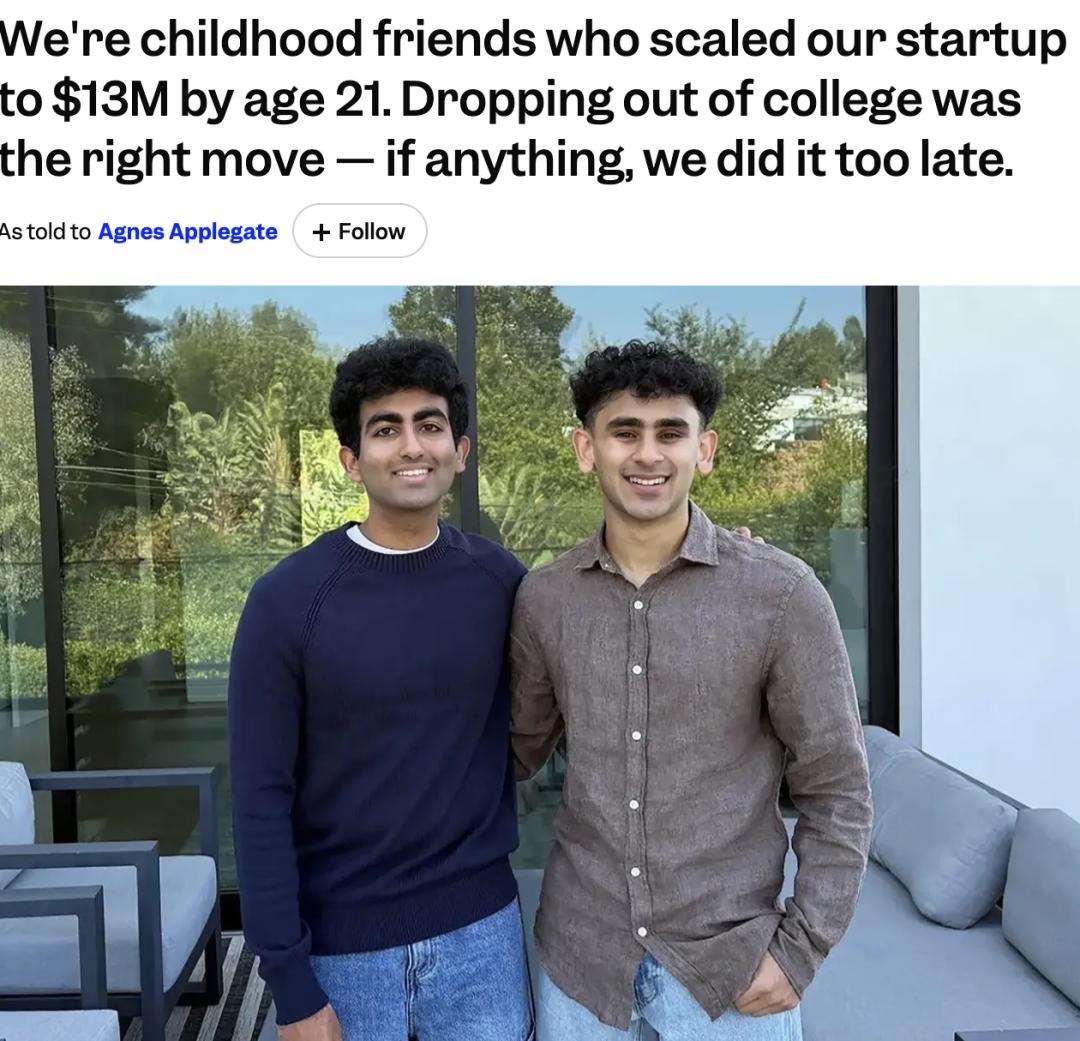
When they decided to suspend their studies, they said: "Staying in school and continuing to pretend to be a student following the established path has become an irrational decision."
American universities are increasingly losing their monopoly on the "American Dream".
Of course, top universities are well aware of this and are playing word games.
Sam Altman recalled that the smartest brand public relations move Stanford University ever made was to rebrand "dropout" as "Stopping out": students are allowed to leave school unconditionally, no one will ask any questions for eight years, and they can come back to attend classes at any time.
"Outsource a Seasoned Professional"
In addition to reflecting on the university academic system, Sam Altman also shared a highly disruptive workplace rule:
Young entrepreneurs who spend too much energy trying to make others "take themselves seriously" are usually wasting their efforts.
At the age of 19, Sam Altman had just suspended his studies at Stanford to found Loopt.
He had to negotiate with long-established, ideologically conservative large corporations to close enterprise-level sales deals for location-based services.
At that time, smartphones and the mobile Internet had not yet become widespread.
Large corporations looked at this underage, inexperienced teenager as if he was a lost child.
"I spent too much energy trying to look like a mature adult and get them to take me seriously, but I found it completely useless," Sam Altman said.
After countless failed attempts to pretend to be mature, he decided to stop proving himself under the traditional rules. He directly hired a 50-year-old middle-aged man.
He asked this well-dressed, serious 50-year-old professional manager to carry a briefcase and knock on the doors of those conservative large corporations on his behalf.
Sam Altman, who actually controlled the core algorithms, product strategies and business decision-making power, stayed behind the scenes and ran the business remotely.

The "desire to be taken seriously" is the first shackle for young people.
Many young people, after entering society, spend too much energy imitating the dressing style of adults, practicing bureaucratic jargon for reporting that reeks of patronizing arrogance, and acting cautiously and submissively in the workplace.
They think this is "growth", but in fact it is just a compliance test.
"You can go very far just by actually doing things," Sam Altman said, leaning back in his chair.

If some old corners of the world still force you to trade "social capital" and "false credentials" for resources, the smartest approach is not to integrate into them and internalize their rules, but to follow Sam Altman's example: directly outsource the patronizing bureaucratic demeanor.
Hire a rule-compliant agent at the lowest cost, and devote all your energy to the R&D and iteration of your core product.
When Computing Power Replaces Human Labor, the Myth of Large Corporates Is Fading
Why does Sam Altman think "don't try to cater to the rules"?
Because the structure of productivity has been completely overturned.
In the traditional industrial era and the early Internet era, starting a business was a battle of manpower and capital. You needed to rent office space, hire front-end developers, back-end developers, legal staff, financial staff and HR, and build a large sales team.
The size of a company was the top indicator to measure the strength of an entrepreneur. Under that paradigm, the hierarchical structure of large corporations was an insurmountable moat, because they monopolized the capabilities of organization and collaboration.
But today, when large language models and autonomous agents are sweeping across all industries, "Headcount" is rapidly evolving from an asset to a liability.
On the stage of Internapalooza, Sam Altman pointed out sharply:
You can even stay alone in a room, rely on a large amount of AI tokens, and barely need anything else to build a fully functional startup. And you don't need anyone to take you seriously at all to make this happen.
The essence of large language models is "extreme compression of organizational costs". You no longer need to persuade others or hold lengthy, inefficient cross-departmental meetings. All your instructions can be converted into runnable code or automated workflows in a few seconds via frictionless computing power.
A 20-year-old young person who has mastered advanced large language model prompting skills, knows how to call APIs and has a sufficient stock of Tokens, already has a personal productivity ceiling equivalent to that of a medium-sized software company with 30 top developers 20 years ago.
In the past, young people had to rely on huge institutions and go through layers of approval to mobilize even a tiny amount of social resources. But today, your Tokens are your army of thousands.
The most critical gap between ordinary people and truly great entrepreneurs usually occurs at the "convergence node" after the results of this experiment come out.
"The mistake people really tend to make is," Sam Altman said in a serious tone,
When you have already figured out which direction is the one you have the most faith in and are most certain of, you back down.
At this point, you must start doing that extremely painful thing — just like removing a tumor, coldly and painfully withdraw from all other matters, turn off those branch tasks that bring you a sense of security, and then bet all your stakes on this one single thing.

This is an extremely rare mental capability.
Most people, when faced with multiple fallback options, will be deceived by false prosperity and countless possibilities.
They do not want to give up the internship at a large corporation, nor put down their ongoing startup project, and also want to get a graduation certificate from Stanford.
They try to get full marks in every field, but end up spending their whole lives drifting in mediocre averages.
True ambitious people, when wandering in the wilderness, are more like homeless hungry wolves searching for prey than anyone else.
But once they lock onto their target, they must demonstrate extreme convergence, draw their sword to cut off all retreats, and go all out.
References:
https://x.com/karlmehta/status/2088611774614720596
https://www.businessinsider.com/sam-altman-college-stanford-dropout-advice-2026-8
https://www.axios.com/2026/08/15/tech-leaders-say-skip-college-elon-peter-thiel
https://blog.samaltman.com/advice-for-ambitious-19-year-olds
This article is from the WeChat Official Account "AI_era" (ID: AI_era), authored by ASI Revelation, and republished by 36Kr with authorization.