Is the AI office industry witnessing a winner-takes-all dynamic dominated by large tech companies?
On August 25, Feishu and Doubao integrated to form a new Doubao product team for less than a month, "Doubao Work" positioned as a unified product entry for AI office scenarios was officially announced. On August 27, Baidu Dazi announced a full package of upgrades for its personal version, enterprise version, professional suite and workbench capabilities.
A month ago, Alibaba just integrated and upgraded three agent products QoderWork, Wukong and MuleRun to "Qianwen Office", while Kingsoft Office launched the AI office agent "Lingxi Professional Edition" in Shanghai. One month earlier, Tencent officially released the WorkBuddy Enterprise Edition and the office agent suite Agent Suite on June 5, with native access to three collaborative office products: Tencent Docs, Tencent Cloud Drive and Tencent Enjoy. So far, from tech giants to office software companies, all have poured into the AI office track.
For a while, the upcoming "scramble" in the AI office sector has become a hot topic in the tech circle. From the outside world's perspective, the trend of large tech companies' AI collectively shifting to "systematic combat" has undoubtedly drawn up a new storyline of "giants take all" for the AI office track in advance. But the truth may not be the case.
Has AI Office Entered the "Era of Big Players"?
If we turn back the clock half a year ago, few people would have expected that AI office would be so sought after by tech giants as it is today. At that time, right after the Lunar New Year holiday, OpenClaw set off a "lobster farming craze". To chase the new AI hotspot of Agent, Tencent, Baidu, Alibaba Qianwen all launched their own Agent platforms as soon as possible.
From March to August, in just more than 5 months, tech giants have firmly confirmed their goal of entering the AI office track. Behind this efficient decision-making and implementation capability is not only the optimistic outlook for the development direction of AI in office scenarios, but also driven by deep-seated internal motivations of enterprises.
Since the beginning of this year, the revenue growth rate of large model companies has been exceptionally impressive. Public data shows that MiniMax's revenue in the first half of this year reached 1.5 times of that of the whole last year, DeepSeek's revenue in the first 7 months of this year is 10 times of that of the full year 2025, and in July this year, Zhipu's ARR (Annual Recurring Revenue) reached 1 billion US dollars.

However, behind the rapid growth of book data, most large model enterprises are still in a loss-making state. MiniMax's net loss in the first half of this year was 358 million US dollars, and DeepSeek's net loss in the first 7 months was 715 million yuan. Obviously, the high revenue growth has not filled the investment of large model enterprises in R&D and computing power.
Head internet giants are also facing the same situation. According to the latest financial report data released by Alibaba, the revenue of AI-related products has achieved triple-digit growth for 12 consecutive quarters, with quarterly revenue reaching 12.376 billion yuan, and the ARR of AI-related products has exceeded 49.5 billion yuan. However, the adjusted EBITA (Earnings Before Interest, Tax, Depreciation and Amortization) loss of the "AI Labs and Applications" business was 13.861 billion yuan, a year-on-year increase of 330%. Affected by the increase in AI investment, Alibaba Group's operating profit in the second quarter of this year decreased by 57% year-on-year.
On the other hand, Tencent's capital expenditure in the second quarter of this year reached 52.784 billion yuan, a year-on-year increase of 176%, and its free cash flow turned negative for the first time, reaching -13.8 billion yuan. If the prepayment for computing power procurement is excluded, the free cash flow is still 37.6 billion yuan. In addition, in May this year, Yicai reported that ByteDance had raised its 2026 AI infrastructure capital expenditure budget by about 25% to 200 billion yuan.
The attitude of pouring real money into AI has truly reflected the determination of tech giants to bet heavily on AI, but blindly "burning money" for AI without seeking returns is definitely not the result these giants want. From the accounts of large model companies, we can see that B-end APIs and enterprise calls have become the core growth driver. For example, Moonshot AI, the only large model company that discloses its profit status, has API revenue accounting for more than 70% of its B-end revenue, and DeepSeek's API business gross margin is as high as 82.9%.

*Screenshot of Moonshot AI's official enterprise website
When large model companies find a breakthrough to improve performance in a straightforward way by "selling Tokens", it is obviously not worthy of the real money that has been spent if tech giants are still tangled in the value narrative of high-frequency low-payment scenarios like "ordering a cup of milk tea with AI". Therefore, what the giants really need is a scenario with higher frequency, easier to generate high value, and easier to calculate ROI. Office scenarios not only perfectly meet all expectations, but ByteDance, Alibaba and Tencent also already have mature office business ecosystems.
This also exactly explains why Alibaba and ByteDance will reintegrate their office products and personnel structures while launching AI workbenches. Because the essence of giants entering the AI office track is not to start a new business from scratch like building a large model, but to find an effective path to reduce cost pressure and get closer to commercialization for their existing AI layout.
Four "Giant Routes" for AI Office
When giants gather in the same track, product homogenization seems to be an expected outcome. From the AI workbench interfaces of various companies, we can also see that processing documents, spreadsheets, PPTs, setting automated scheduled tasks, generating creative content, and operating browsers have almost become standard features. But in fact, since each AI workbench is the result of integrating the giant's AI ecosystem, there are obvious differences between various AI office products.
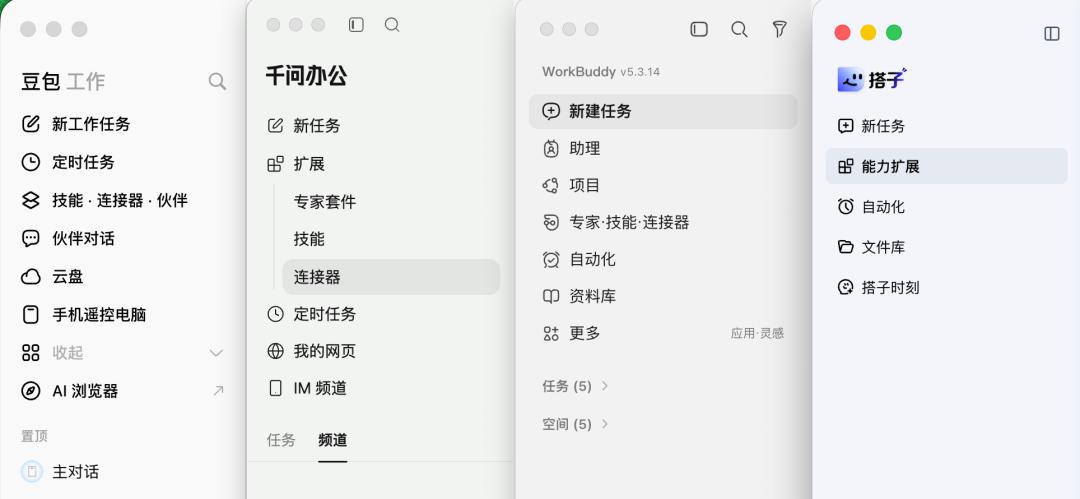
*Comparison of AI workbench interfaces
For example, Baidu Dazi is like a feature-rich AI toolbox, which combines native capabilities such as Baidu Search, in-depth research, Miaoda, Suansuan, Famou to form a full-stack of functions, and at the same time enables AI office to adapt to a variety of real office scenarios through professional suites.
Qianwen Office, which integrates QoderWork, MuleRun and Wukong, features inheriting the native capabilities of DingTalk and at the same time connecting with enterprise IM. To a certain extent, it is like an AI office product tailored for existing DingTalk customers.
Doubao Work, which is slightly similar to Qianwen Office, also integrates TRAE, Coze and Feishu with similar attributes, but its desktop sidebar's "Skills · Connector · Partner" and "Partner Chat" seem to consciously emphasize the superposition of multiple functions in task scenarios, making it convenient for users to call content generation, system-level computer operation, multi-agent collaboration and other functions, and form their own "team" to work.
In addition, the deep binding between Doubao Office and Feishu allows AI to call team context such as group chats, documents, meeting minutes and schedules within the scope of user authorization. This means that before starting each work, users no longer need to sort out a long list of project backgrounds and "feed materials" to AI, but let AI precipitate real business data in daily office scenarios and become a "team member".
Also coming from a giant, WorkBuddy, although deeply bound to Tencent's own WeChat and WeCom, is the only AI workbench that does not forcibly bind its own large model. In addition to Tencent's Hunyuan large model, WorkBuddy also supports domestic large models such as DeepSeek, GLM, Kimi and MiniMax.
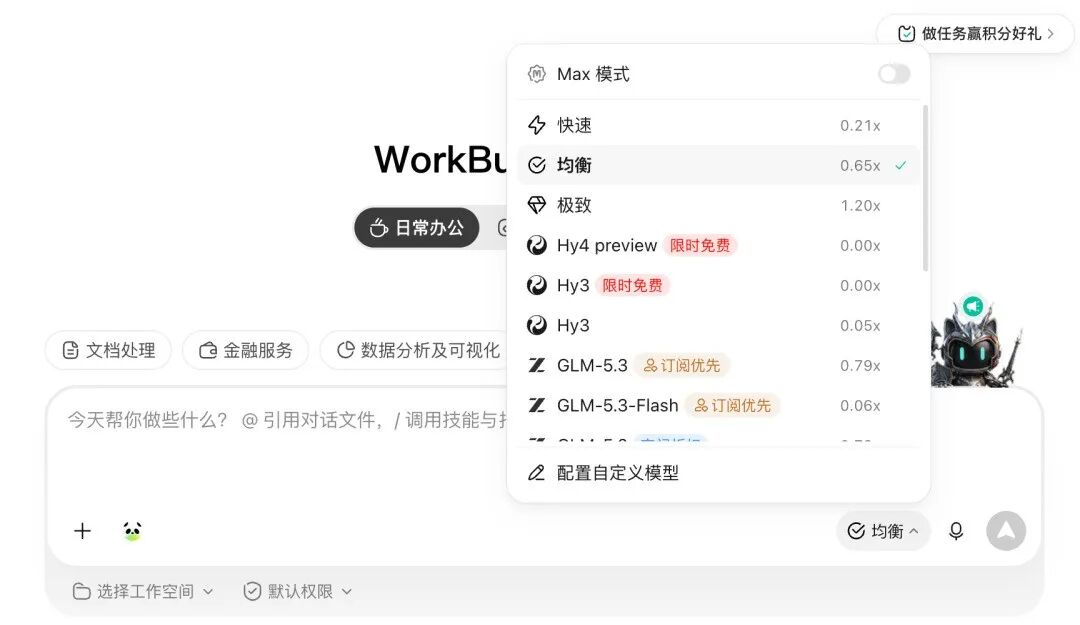
*Screenshot of WorkBuddy interface
There is also an independently displayed material library function on the WorkBuddy interface, which can store documents uploaded by users and files generated by AI. In layman's terms, this function is like equipping AI with a brain, specially used to store materials that "will be used later" to form long-term memory. Moreover, WorkBuddy has also connected Tencent Docs, ima knowledge base and Xiangle knowledge base. Compared with the cloud disks and enterprise knowledge bases of other platforms, WorkBuddy makes the material library an independent Agent infrastructure.
This means that the experience accumulated and knowledge precipitated by users in their daily work can be selectively "inherited" by AI. This function can not only be used for enterprise office, but also allow users to train their own AI avatar according to their personal preferences and directions.
In addition to the "giant camp", Lingxi Professional Edition, as a "professional player of office software", also provides a product route that is more inclined to real office scenarios. Backed by the office capabilities precipitated by Kingsoft Office over the past 38 years, Lingxi Professional Edition does not take connecting enterprise IM as its feature, nor does it have the demand to bind its own large model and realize revenue through Token traffic. Instead, it starts from documents, spreadsheets and PPTs, and focuses on solving real office demands.
Lingxi Professional Edition also supports multiple models. In addition to DeepSeek, GLM, Kimi and MiniMax, users can also use Doubao, Qianwen, Xiaomi MiMo, or add custom models. Lingxi also has a "Favorites" function, which supports users to upload notes, pictures, web pages, files and conversations for quick call later. Combined with its positioning for individual users, Lingxi Professional Edition seems to pay more attention to individual user experience and long-term work asset precipitation.
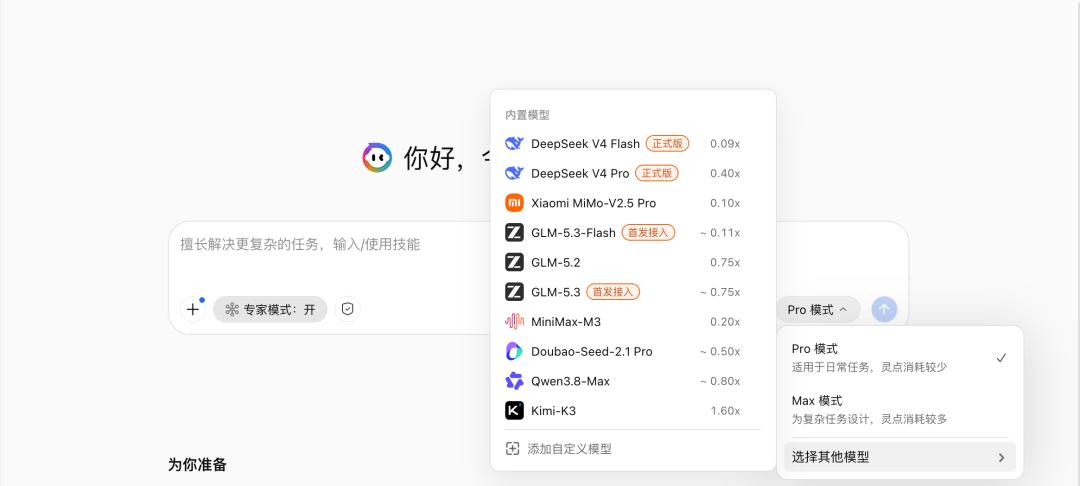
*Screenshot of Lingxi Professional Edition
In general, Baidu Dazi uses its comprehensive technical strength to emphasize the capability of "professional task delivery"; Qianwen embeds AI into the enterprise workflow to extend a set of AI office platform from task initiation to result delivery; Doubao Work turns AI into a "digital colleague" to assist users and help them complete tasks; WorkBuddy allows users to develop exclusive Agents according to their own ideas and real demands by accessing internal products and external resources; while Lingxi Professional Edition is more like a productivity tool, focusing on real office demands and completing result delivery.
Jingzhe Research Institute noticed that the AI office products of various giants not only have different positioning, but also have slightly different pricing. In addition to the free personal version to attract users to experience, the continuous monthly subscription prices of the personal versions of Baidu Dazi, Doubao Work, WorkBuddy and Qianwen Office are 59 yuan, 68 yuan, 70 yuan and 78 yuan respectively, and the pricing of the enterprise standard version charged by seat is 166 yuan per month (Doubao Work), 189 yuan (Baidu Dazi), 198 yuan (Qianwen Office, WorkBuddy).
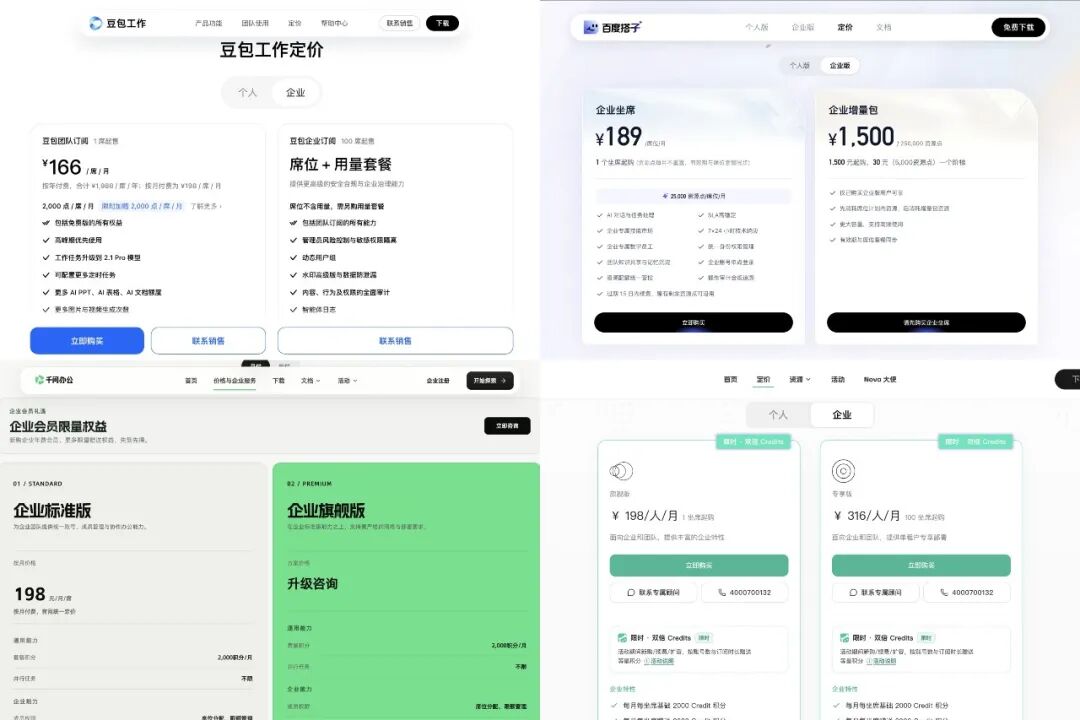
*Enterprise Edition pricing of different platforms
Apart from the price, there is also an obvious industry consensus in the pricing methods of the four products: the enterprise version generally adopts "seat + execution quota" as the pricing basis. Different monthly subscription prices correspond to different points, Credits, resource points and task quotas. This pricing model also reflects that the value of AI office is not a simple AI function, but reflected by the "task completion volume".
Who Can Achieve "Great Success" in AI Office?
When discussing the commercialization capability of AI office products, there is a phenomenon worthy of special attention: many AI office products are first tried by employees, then spread internally, and finally purchased uniformly by the enterprise. There is a very strange commercial contradiction here: people who use AI office are not necessarily the ones who pay for it, and people who pay for AI office do not necessarily really use it.
Behind the contradiction, the essence is the difference in demands between employees and enterprises when using AI office. Employees use AI to "work less and get off work earlier", while enterprises pay for AI in the hope of "higher efficiency and more output". The two demands from the two groups not only affect the final form of AI office products, but also determine their commercialization progress.
According to Jingzhe Research Institute, AI office has obtained value verification among individual users with its capability of "really getting work done", but there is still a certain distance before entering the commercialization stage.
An insider from Baidu disclosed to Jingzhe Research Institute that according to its analysis results of user tasks, 60% of the current tasks have gone through more than three steps such as information search, analysis and judgment, content creation, and format processing, and 86% of the tasks have clear delivery end points such as "reporting, submitting, releasing, and going online". "We see that users' expectations for AI have shifted from 'help me generate a piece of content' to 'help me finish this work'. 95% of users will immediately download, export, share, continue editing or publish after getting the output, which shows that users really care about whether the result can be used directly."
An insider from Kingsoft Office also told Jingzhe Research Institute that the individual side has proved that users are willing to pay for clear productivity improvement, but the entire commercialization of AI office is still in a very early stage. "This is especially true on the enterprise side. Eventually the CEO and CFO will definitely ask: How much did AI cost, where was it spent, what costs were saved, and what value was created."
To put it more plainly, the current AI office market is in the stage of "individual users already have value perception, while enterprises still have doubts about payment". The participation of giants has accelerated user education for AI office products to a certain extent, but it is not yet time to share the cake, and the future market pattern of AI office will not be "giants take all".
An insider from Kingsoft Office mentioned that giants have obvious advantages in dimensions