Wang Xingxing is looking for the next "Wang Xingxing"
A college student built a bipedal robot from scratch with only 200 yuan in his dorm room, and later developed a quadruped robotic dog with 20,000 yuan during his postgraduate studies. This "dog" later won him an 80,000-yuan prize. The young man used this sum of money to start his own business, and eventually built a listed company whose market value once soared to 444.9 billion yuan.
This is the story of Wang Xingxing, the founder of Unitree Robotics.
Nowadays, Wang Xingxing seems to be following his own growth path, looking for the next "Wang Xingxing", or even younger "Wang Xingxing"s.
Recently, Unitree Robotics announced that it will provide free sponsorship for "Genius Youth", targeting young people from high school students to those who have not yet graduated from master's programs, offering 10,000 to 20,000 yuan in start-up funds in stages, with no upper limit for exceptionally outstanding individuals.
There are no restrictions on research directions either. Chip manufacturing, AGI, ultra-micro robots, limb regeneration, superconducting materials... as long as it is sufficiently cutting-edge technology, applications are all welcome.

It is fair to say that the trend of searching for genius youths has finally reached the field of embodied intelligence.
Different from the "genius youths" in the traditional sense, Unitree is not recruiting employees. It is just looking for young people who already have an interest in scientific research at an earlier stage, and providing them with some resources when they need it.
Behind this lies Wang Xingxing's distinct talent cultivation philosophy: he is looking for young people who are truly passionate, willing to learn, and willing to get their hands dirty to practice.
A
The public's perception of "genius youths" mostly started from Huawei.
In 2019, an email from Huawei's President's Office signed by Ren Zhengfei showed that Huawei planned to recruit 20 to 30 "genius youths" from all over the world, for the reason that:
"To win the future technology and business wars in Huawei, the dual-wheel drive of technological innovation and business innovation is the core driving force. Innovation requires top global talents and an organizational soil where top talents can give full play to their wisdom."
Over the years, a large number of high-intelligence talents have joined Huawei with the title of "genius youth". These genius youths usually graduate from top universities with master's or doctoral degrees, and engage in research on cutting-edge technologies such as AI, chips, and algorithms after joining Huawei, with an annual salary starting from one million yuan.

One of the well-known figures is Peng Zhihui. He once participated in research related to Huawei's Ascend AI chips, then left Huawei to start his own business and founded Agibot. Another genius youth Ning Boyu, who recently announced his departure from Huawei, once worked in Huawei's wireless product line.
Elon Musk also has a special preference for genius youths, and is even more radical. In 2023, 14-year-old Kairan Quazi joined the then-unlisted SpaceX as a software engineer. Quazi is undoubtedly a genius youth, who participated in Intel's AI-related research as early as the age of 10.
Of course, this is a very special case.
But the trend is: technology companies are pursuing technical talents at increasingly younger ages. Silicon Valley tech company Palantir once admitted dozens of high school graduates from hundreds of applicants, and some of them even gave up admission offers from Ivy League schools for this opportunity.
This trend has become more obvious after the AI wave. Although it is not carried out under the name of "genius youth", their pursuit of young high-intelligence talents is essentially the same.
According to the report of "Logic Thinking", Google, Meta and OpenAI have cumulatively recruited more than 300 young people who have not completed their university studies from 2024 to 2025, including some who joined directly after graduating from high school.
The same is true in China. Moonshot AI recruited 17-year-old high school student Chen Guangyu; Tencent opened a summer practice program for middle school students aged 13-18 around the world, involving cutting-edge projects such as AI; ByteDance launched the "ByteCamp" training camp and the "Spring Innovation Center" program to recruit researchers for high school students aged 16-18.
In the past, the "genius youths" competed for by technology companies were master's and doctoral students; now some companies have set their sights on high school students.
The reason is simple: the technological iteration brought by AI is getting faster and faster, and truly scarce talents are increasingly difficult to be simply defined by academic qualifications and age. In other words, compared with academic qualifications and working years, practical ability, learning speed and understanding of new technologies are sometimes more worthy of observation in advance.
Now embodied intelligence has also joined this talent competition.
Wang Xingxing has also extended the age range of "genius youths" down to high school students.
However, although it is looking for genius youths, there is no such thing as joining Unitree. It only provides some help at the right time. There is no starting annual salary of one million yuan, but only provides 10,000 to 20,000 yuan of scientific research help in stages, with no upper limit for exceptionally outstanding individuals.
This matter is also more in line with Wang Xingxing's own growth experience.
B
Wang Xingxing may be more aware than many people of what it looks like when a young man has an idea but no money to turn it into reality.
When he was still a freshman, Wang Xingxing started to do some simple scientific research, but his pocket money was limited at that time. Fortunately, he later applied for the Xinmiao Program for college students in Zhejiang Province and obtained 10,000 yuan in project funding.
It was this 10,000 yuan that allowed him to continue his own projects. During his undergraduate years, he completed multiple small projects. These experiences later helped him pursue postgraduate studies and eventually embark on the road of entrepreneurship. That's how the later Wang Xingxing and Unitree came into being.
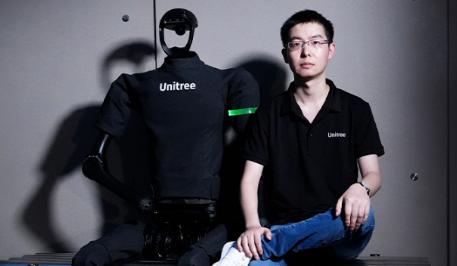
For Wang Xingxing, he experienced a very specific form of talent support very early: young people may not lack ideas, and very often they just lack the first sum of resources to turn ideas into reality.
Therefore, the 10,000 to 20,000 yuan provided by Unitree is more like a very early stage scientific research support.
It can even be said that what Wang Xingxing is doing is something even earlier than traditional angel investors. Before a technology is fully proven and a young person gets financing, he gives him a little resources first to see what he can make out of it.
This is especially suitable for cutting-edge technologies.
Although there have been very young entrepreneurs in the embodied intelligence industry. Letterboard once reported in the article "The First Batch of College Students Starting Robot Businesses Have Raised Hundreds of Millions of Yuan" that a group of very young entrepreneurs have emerged in the robotics industry. They have even founded robotics companies and obtained financing before graduation.
But the projects that can get financing have at least completed part of the market verification. For more unverified technologies, the situation is different. It may be just a very small project, or even just a young person's idea, which may not produce results at the moment.
This kind of exploration is difficult to get the attention of investors in the early stage, and it is precisely these seemingly "useless" attempts that are sometimes the starting point of real innovation.
What Unitree wants to do is to fill this gap, intervene earlier than investors, and give them space to try. It does not matter whether they can produce results in the end. This kind of "result-agnostic" investment is also the meaning of Unitree's "free sponsorship".
Supporting young people's exploration certainly contains Wang Xingxing's idealism, but in the realistic context of Unitree, it is also a very pragmatic judgment: Unitree also needs talents to break through the current bottleneck.
Unitree has gone public, and its market value once soared to 444.9 billion yuan, but its stock price then fell significantly, and now its market value has dropped to 240 billion yuan.
From a startup to a listed company, the problems faced by Unitree have also changed. In the past, the most important task for Unitree was to "build the robot". Now what it needs to continue to solve is: how can robots evolve in the next step?
The way to break through lies in technology, and behind technology are still talents.
Wang Xingxing once said that since its establishment in 2016, Unitree Robotics has grown from a niche field to a popular one step by step, with the core being outstanding talents. No matter in technology or product development, outstanding talents are indispensable.
Just as Huawei needed genius youths to carry out technological innovation back then, Unitree Robotics also needs them. Breakthroughs in cutting-edge technologies often come from unexpected directions, and the people most likely to discover these directions are precisely the young people who have not yet been tamed by industry rules. After all, there are too many possibilities on the road to realizing AGI.
Robotics itself is a highly comprehensive field, involving machinery, motors, control, chips, AI, materials and many other fields. Some of the technical consensus formed in the industry today does not mean that the final solution has been found. Technologies that may truly change the industry in the future may even come from outside the robotics field.
This is why the research directions of Unitree this time have almost no boundaries. Applications are welcome as long as the technology is sufficiently cutting-edge.
Talent itself is a long-term resource for a technology company.
Wang Xingxing has repeatedly stated in public that the company is "extremely short of people" and "all positions are understaffed", and has issued enthusiastic invitations to young people. Especially after AI becomes the core of competition for humanoid robots, this kind of talent anxiety will become more obvious.
Therefore, Unitree's current talent reserve is not just a "genius youth" program. It is also scrambling for talents across universities nationwide and cooperating with universities to cultivate talents.
According to 21st Century Business Herald, since last December, Unitree has launched more than 10 industrial colleges in more than 10 cities including Qingdao, Liuzhou, Zhengzhou, Jiaozuo, Hefei, Xiamen, Suzhou, Ningbo, Guangzhou and Wuhan. These cities all share the common label of being a major manufacturing hub.
This means that Unitree is building a larger talent cultivation system, on the one hand looking for the top talents, and on the other hand cultivating people who can truly enter this industry.
C
In Wang Xingxing's view, for a young person to go far enough, the first thing is to find a direction that he truly loves, the second is to have the ability to keep learning, and to get some necessary support at the right stage.
The so-called "love" means finding a direction that you truly love in your heart and are willing to strive for for a lifetime; the so-called "continuous learning" is the guarantee to avoid being eliminated in the industry with rapid technological iteration. Only by continuous learning can you always stand at the forefront of the times and become a promoter of technology.
Wang Xingxing is the best example. Out of his pure love for robots, he has been "building things from scratch" all the way from university to today.
This kind of "love-driven" entrepreneurship is becoming a new paradigm of Chinese tech entrepreneurship.

Wang Xinyu, a partner of Meituan Dragon Capital, said when talking about investing in Unitree and Moonshot AI that a new entrepreneurial paradigm has emerged, which is love-driven entrepreneurship. This kind of "pure love"-driven entrepreneurship is becoming more and more common, such as Wang Xingxing, Liang Wenfeng and Zhang Xue. They are doing completely different things, but the underlying logic is the same: they have become world-class because of their conviction and love. This is a systematic opportunity, and this entrepreneurial paradigm derived from love will appear in all walks of life in China.
From this perspective, Unitree's free sponsorship for "genius youths" is essentially Wang Xingxing putting his talent cultivation philosophy into practice. What he is looking for are people who have real interest in technology, are willing to keep learning, dare to solve problems with their hands, and have the potential to grow through long-term practice.
Finding talents is only the first step. Wang Xingxing has also thought clearly about how to make these people willing to stay and develop for a long time.
Wang Xingxing is also very generous when it comes to treating technical talents.
When Unitree went public, Wang Xingxing released a large amount of equity to employees. On the first day of listing, not only did Wang Xingxing's net worth soar to more than 100 billion yuan, but a group of core technical backbones also saw a sharp rise in their net worth, even crossing the 100 million yuan threshold.
Specifically, Unitree has set up two employee asset management plans to participate in strategic placement; in addition, Wang Xingxing also contributed all his shares in Shanghai Yuyi to provide equity incentives for future employees, and made it clear that the incentive objects do not include himself.
This means that Wang Xingxing's understanding of talents is not just "recruiting outstanding people". More importantly: let them get rewards as the company grows.
From building a robot with 200 yuan, to getting 10,000 yuan in scientific research funding, to giving young people 10,000 to 20,000 yuan in start-up funds today, Wang Xingxing's view on talents has always had a very clear line:
He himself was once a young man who needed opportunities. So now, what he wants to do is to give more young people a chance.
As for whether these young people will join Unitree in the end, it may not be the most important thing.
What is important is that in today's era of constant changes in robotics, AI and various cutting-edge technologies, discovering people who truly love technology, are willing to keep learning, and dare to turn ideas into reality at an earlier stage is already of great value in itself.
References:
"Unitree Provides Free Sponsorship for 'Genius Youths'", Unitree Robotics
"Unitree Robotics is Scrambling for Talents Across Universities Nationwide", 21st Century Business Herald
"How to Build an Innovative Talent Ecosystem? Wang Xingxing: Discover Passion, Keep Learning, and Provide Necessary Support for Young People", Shangyou News
"Unitree's Wang Xingxing: AI and Robots Are New Things That Can Change the Entire Productivity Structure Like Electricity and Steam Engines", JRJ.com
"From Wang Xingxing to Yang Zhilin, How Does Meituan Dragon Capital Invest in Technology?", LatePost AI
This article is from the WeChat public account <