Mech-Mind officially debuted on the Hong Kong Stock Exchange, becoming the "first listed enterprise in the embodied intelligence sector that integrates vision, brain and hand capabilities".
On September 1, 2026, Mech-Mind (Xiong'an) Robotics Technology Co., Ltd. (hereinafter referred to as "Mech-Mind", stock code: 09615.HK) was officially listed on the Hong Kong Stock Exchange, becoming the "first share of embodied intelligence eye-brain-hand".
Mech-Mind issued 23,140,590 H shares in this IPO at an issue price of HK$101.70 per share, raising a total of about HK$2.353 billion with a market value of over HK$12 billion.
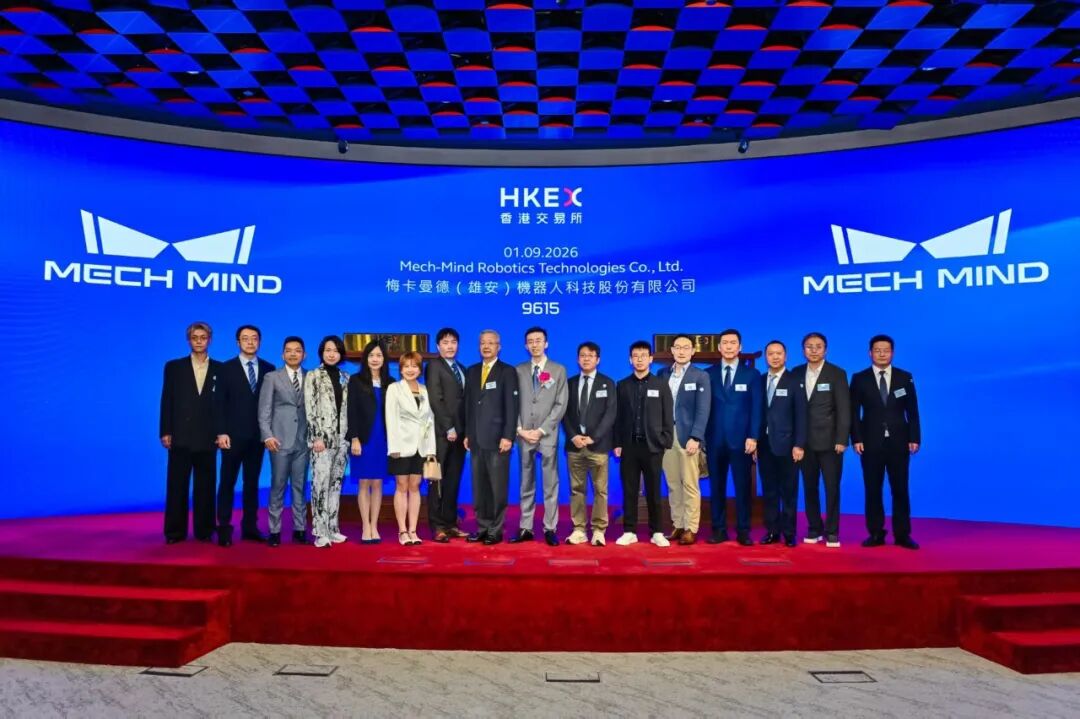
In this offering, Mech-Mind introduced a stellar lineup of cornerstone investors, with 9 institutional investors including the century-old Scottish asset management giant Baillie Gifford, Taikang Life, and Jane Street subscribing for a total of USD 186 million (about HK$1.46 billion). Previously, Mech-Mind has obtained multiple rounds of financing from institutions including Huachuang Capital, HSG, IDG, Meituan, Qiming Venture Partners and others.
Shao Tianlan, Founder and CEO of Mech-Mind, recalled in a previous interview with Huachuang Capital's *Chuang · Wen* that when Mech-Mind received the Pre-A round of investment from Huachuang in 2017, it had only been established for half a year. "At that time, we had no customers and few fully mature products, so Huachuang really recognized us at a very early stage."
Investors from Huachuang Capital said: "Warm congratulations to Mech-Mind on its successful listing on the Hong Kong Stock Exchange! As an early long-term shareholder, Huachuang has witnessed and accompanied Mech-Mind's growth all the way. Looking back at the company's founding at the end of 2016, starting from one office and three core founding members, after ten years of deep cultivation, it has now grown into a globally leading enterprise focused on physical AI and embodied intelligence.
The company's business footprint continues to expand globally, covering China, North America, Europe, Japan and other regions, serving more than 100 Fortune 500 customers worldwide. Its self-developed intelligent robot software and hardware products have been deeply deployed in core industries such as automotive, logistics and consumer electronics, realizing large-scale commercial application and continuously promoting the intelligent upgrading of industries.
Standing at the new starting point of listing on the Hong Kong Stock Exchange, we expect Mech-Mind to rely on the massive data accumulated from real scenarios, continuously polish the core "eye-brain-hand" technology foundation, adhere to the two-wheel drive of technological innovation and industrial implementation, start from real industrial sites, bring physical AI technology to the broader real world, and create greater industrial and social value on the global stage."
The "Eye-Brain-Hand" Closed Loop of "One Brain, Multiple Forms"
Founded in 2016 by a team of Tsinghua returnees, Mech-Mind is a supplier of intelligent robot components that provides advanced and standardized core "eye-brain-hand" intelligent components, enabling robots to perceive, understand and interact with the real world.
The company has formed a product system of "eye, brain, hand", covering the whole chain of robot perception, decision-making and execution:
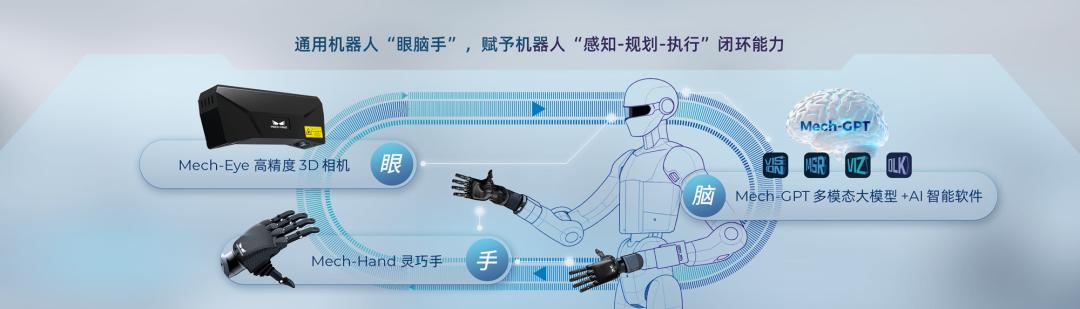
In terms of perception, the "eye" is centered on Mech-Eye industrial 3D cameras and supporting vision software, which overcomes imaging difficulties such as high reflectivity, black light absorption, and complex stacking, and stably outputs high-precision point clouds in harsh environments.
In terms of decision-making, Mech-Mind's self-developed Mech-GPT multimodal embodied large model and Mech-DLK deep learning platform, trained on massive industrial data, enable robots to autonomously identify objects and plan actions under complex working conditions such as random stacking, reflective surfaces, and partial occlusion.
In terms of execution, the dexterous hand Mech-Hand and accumulated operation algorithms fill the gap in fine operation capabilities, realizing the leap from grasping to precise operation.
Mech-Mind's "eye-brain-hand" is not a simple combination of three independent modules, but an integrated and collaborative complete system. The three are deeply coupled to form a full-stack closed loop of "one brain, multiple forms" — a set of intelligent systems drives robots of different forms, degrees of freedom and brands, realizing cross-form and cross-brand plug-and-play.
Product-grade Physical AI Enters Thousands of Industries
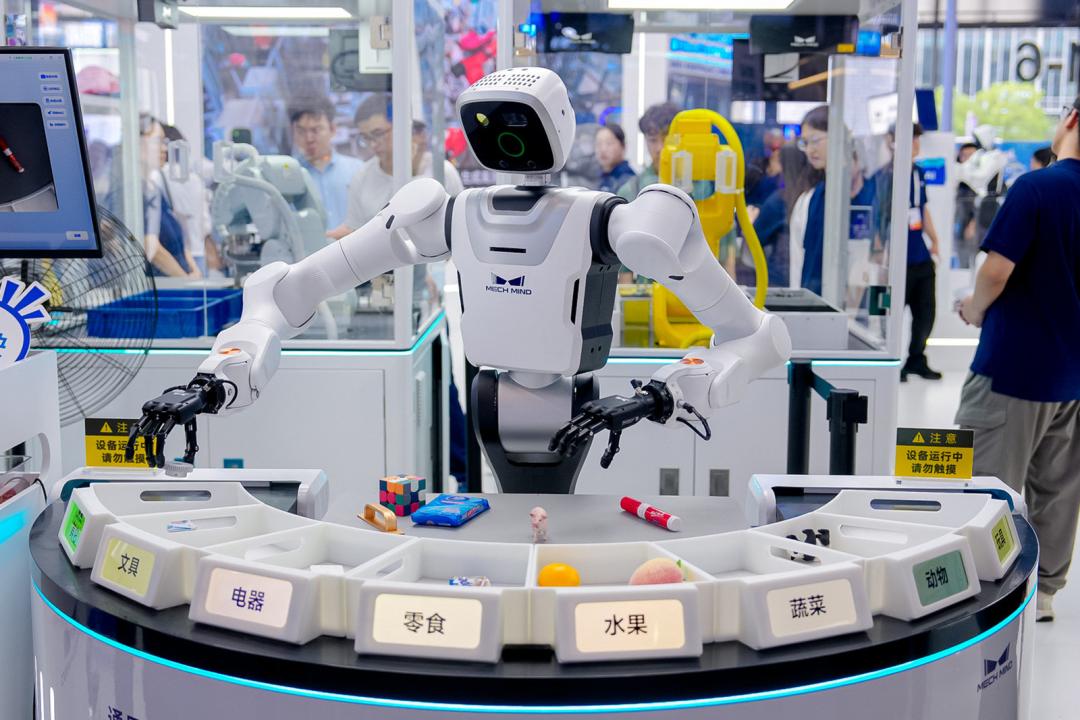
Mech-Mind precipitates the "eye-brain-hand" capabilities into a standardized physical AI product system, uses general physical AI capabilities to cope with complex challenges in real industrial sites, and verifies product-level versatility in four dimensions: object generalization, actuator generalization, task generalization, and ontology generalization.
The company's products are not only compatible with various robot forms such as industrial manipulators, collaborative robots, mobile robots, and humanoid robots, but also widely used in industries including automotive, new energy, logistics, 3C electronics, and heavy industry, and will gradually expand to commercial service industries and even household scenarios in the future.
Up to now, Mech-Mind's products have been deployed more than 29,000 times in total, serving more than 100 Fortune Global 500 enterprises, including CATL, BYD, Foxconn, Midea, etc.
Mech-Mind demonstrates strong customer stickiness: in 2025, 78% of the company's revenue came from existing customers, and the figure reached 86% in the first quarter of 2026.
Financial data shows that from 2023 to 2025, Mech-Mind's revenue increased from RMB 181 million to RMB 389 million, with an annual compound growth rate of 46.6%; during the same period, its gross profit margin continued to rise from 39.1% to 64.6%.
Starting from China, Rooted in Global Industries
Since its establishment, globalization has been a core strategy of Mech-Mind. Previously, Shao Tianlan mentioned in a conversation with Wu Haiyan, Managing Partner of Huachuang Capital, on Huachuang Capital's podcast "Niu Baiding" that Mech-Mind began to deploy overseas business as early as 2019 when it was still in the early startup stage, with the goal of becoming the world's top player in the core hub of the global high-end manufacturing industry.
To build a global service network, Mech-Mind has set up subsidiaries in Munich, Seoul, Chicago, Tokyo and other places, covering multiple links including product, sales, delivery, training and after-sales service.
Up to now, Mech-Mind has achieved large-scale deployment globally, with its business covering nearly 50 countries and regions. Its products have entered the lighthouse factories and production lines of leading enterprises in many countries, and it has ranked first in global market share for four consecutive years.
Globalization has become an important driving force for Mech-Mind's business growth. From 2023 to 2025, the compound growth rate of the company's overseas revenue reached 82.7%. In 2025, overseas revenue accounted for more than half of the company's total revenue for the first time, reaching 50.3%.
According to data from CIC Consulting, calculated by 2025 revenue, Mech-Mind accounts for about 22.1% of the global market for "AI + 3D vision guided non-special purpose intelligent robot components", ranking first; calculated by shipment volume, its global market share exceeds 27%, which is higher than the sum of the next four largest competitors.
Real Scenario Drives the Data Flywheel
For embodied intelligence to achieve large-scale implementation, it not only requires an embodied native general foundation model oriented to the physical world, but also a data flywheel continuously driven by real scenarios. Both of them together form the important support for Mech-Mind to continuously improve its physical AI capabilities.
Precisely because the products have been deployed on a large scale in many industries, these scenario challenges from real factories, such as oil stains, deformation, reflection, random stacking, etc., after desensitization and sorting, are continuously precipitated as important fuel for model training and algorithm iteration.
In the interview with Huachuang Capital's *Chuang · Wen*, Shao Tianlan once said that over the years of entrepreneurship, he and his team have faced countless seemingly trivial details that determine whether the product can be truly implemented. Therefore, half of the company's products rely on cutting-edge technology R&D, and the other half rely on on-site polishing.
In addition, the data flywheel driven by real scenarios has also become an important mechanism for Mech-Mind to continuously improve its physical AI capabilities: the more deployments are made, the more fully exposed problems are, the more diverse data accumulation is, the faster the iteration of models and products is, the stronger the capabilities become, which further promotes more scenario deployments, and finally forms a positive cycle of "application - data - model - capability improvement", providing a foundation for the intelligent upgrading of more industries and more robot forms.
Starting from industrial sites and moving to the broader real world is an important path for physical AI to move towards general intelligence. In Shao Tianlan's view, there is no such thing as "instant success" or genius stories in the robotics industry. Only by taking one step at a time can the intelligence of robots be raised to a higher level.
In the future, Mech-Mind will continue to take real scenarios as the starting point and technological innovation as the driving force, bring physical AI from the laboratory to real industries, from technology exploration to large-scale implementation, and promote the evolution of robots to more general, intelligent and flexible intelligent systems.