Take Salesforce as an example, AI is transforming the "pricing model" of software.
Artificial intelligence is disrupting the subscription charging logic that has dominated the software industry for more than two decades. Enterprise software giants represented by Salesforce are being forced to shift from the model of charging fixed subscription fees per user to billing based on usage volume or even actual business outcomes — a transition that brings both opportunities and full of uncertainties.
According to a report by tech media The Information on August 30, Salesforce CEO Marc Benioff said on the investor conference call last week that the company is allowing enterprise customers to independently choose the payment method for its AI product Agentforce, including signing customized contracts that bill based on the revenue growth brought by AI helping salespeople drive more transactions, or the costs saved through automated customer service.
"Customers want to buy and price in different ways, which is what I have deeply realized recently," Benioff said. This statement reflects the deep-seated uncertainty of software pricing models in the AI era.
This shift has triggered a chain reaction across the industry. According to reports, people familiar with the matter revealed that OpenAI has started offering some large customers the option to pay only after AI completes tasks in recent months; customer management startups Sierra and Fin (Salesforce is acquiring the latter for $3.6 billion) have also adopted the model of charging only after tasks are completed; programming assistant Cognition promises that if it fails to deliver engineering results to enterprise customers worth at least the amount they paid, it will provide a deduction of up to 10 million US dollars.
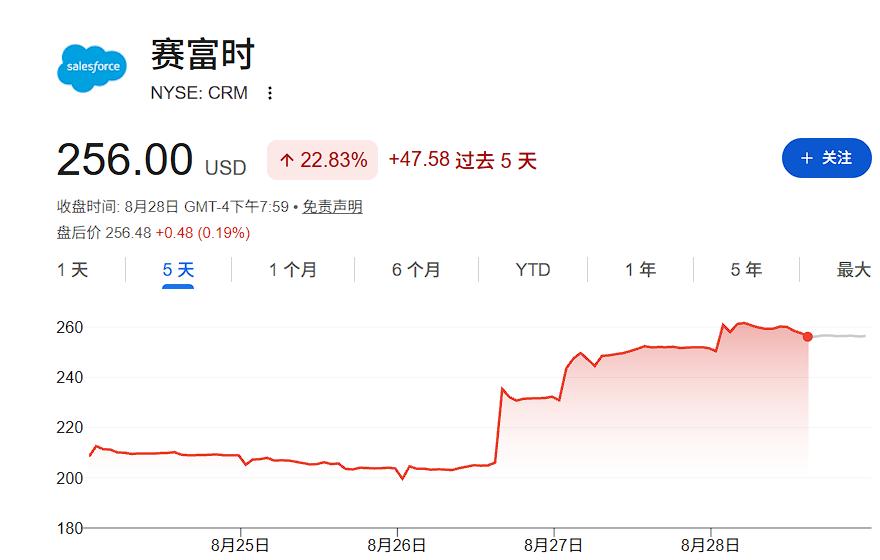
Salesforce's stock price has risen by about 23% cumulatively since the release of its financial report last week.
01 The End of the Subscription Model
This transformation of Salesforce marks that the software-as-a-service (SaaS) business model it created is facing fundamental challenges.
Twenty-five years ago, it was Salesforce that led the historic transformation of the software industry from one-time purchase of licenses to charging subscription fees based on the number of employees. This model reduced the upfront costs of small and medium-sized enterprises, and shifted the burden of software upgrade and maintenance to the supplier side, thus opening the 20-year prosperity cycle of the SaaS industry.
However, the rise of AI is inverting this logic. As enterprises increasingly use advanced AI agents such as Anthropic's Claude to handle complex tasks involving applications like Salesforce, the frequency of employees directly interacting with these applications decreases, and the per-user-seat subscription model loses its foundation accordingly.
Benioff admitted that software pricing is in a period full of uncertainties, and Salesforce is following the pace of startups rather than leading the change.
02 Moving Towards "Outcome-based Pricing"
The new model that Salesforce is currently exploring is highly similar to the long-standing practice of data analytics software company Palantir.
Palantir signs highly customized contracts with enterprise customers, combining fixed fees with charges based on usage volume and business outcomes. Benioff said that this flexible pricing method has helped Salesforce "close very large deals", and pointed out that suppliers can "obtain extremely high pricing" for their products under this model — the substantial revenue growth of Palantir in the past year confirms this judgment.
Benioff further explained his understanding of the hierarchy of "outcome-based pricing":
"We don't just want to say 'we completed so many calls, so we charge $2', we want to be able to say 'we helped you increase your revenue by this much, so we charge $2, because we helped you make $20 or $40'."
This means Salesforce's goal is to deeply bind its own revenue to customers' business outcomes, rather than only staying at the level of metered charging for task completion.
03 Claudeforce: New Layout on the New Battlefield
Facing the pressure from AI-native competitors such as Anthropic, Salesforce launched Claudeforce last week — a service that allows customers to directly use Claude to complete a large number of tasks involving Salesforce applications without operating these applications directly.
According to reports, people familiar with the matter revealed that Salesforce plans to build a revenue mechanism through Claudeforce: Every time a third-party AI calls data within Salesforce applications, Salesforce can benefit from it; customers need to upgrade to a higher subscription tier to enable this feature.
The strategic intention of this layout is that even if users no longer directly use the Salesforce interface, the company can still maintain its core position at the data level in the AI ecosystem, turning the potential risk of user churn into a new monetization entry point.
04 The Attribution Dispute: Potential Hidden Dangers of the New Model
The report states that the outcome-based pricing model is theoretically attractive, but it may trigger complex attribution disputes in the actual implementation stage.
Payment service provider Stripe has issued guidelines on this, clearly pointing out that sales conversion or other business outcomes "may stem from product adjustments, marketing campaigns or seasonal factors" rather than the contribution of the software itself.
"Unless the attribution rules are clear, customers may have disputes over whether the outcomes should be attributed to the software supplier," Stripe said.
This hidden danger is not without precedent. During the period when software monitoring company Splunk transformed from the licensing model to the subscription model, it experienced a phased decline in revenue. Analysts believe that the result of this current pricing model experiment will largely determine whether established enterprise software companies such as Salesforce can complete self-remodeling under the impact of the AI wave.
This article is from the WeChat official account "Hard AI", written by a researcher focused on technology production and R&D, and authorized for release by 36Kr.