The food delivery war has lasted for a year and a half, and all three major relevant players claim that their operating situations are getting better.
The defender is making profitable returns again, and the two attackers are also reporting their respective good news.
On August 28, Meituan released its latest financial report, showing that its core local business returned to profitability with 5.67 billion yuan, and the profit margin rebounded to 7.9%. On August 20, Alibaba's latest financial report revealed that its domestic instant retail revenue increased by 45% year-on-year, and the report stated that the unit economic benefit of Taobao Flash Purchase continued to improve quarter-on-quarter. On August 13, JD's latest financial report showed that the operating loss of its new business segment, which covers the food delivery business, narrowed to 9.85 billion yuan, and Xu Ran stated that a "clear inflection point" has emerged in JD's profit trajectory.
The question then arises: where did the market get three extra wins out of thin air.
18 months ago, the criteria for "winning" were far simpler.
Liu Qiangdong recalled at the time that before the 2025 Spring Festival, he invited Wang Xing, Cheng Wei and Yao Jinbo to dinner, with the main guest being Wang Xing. He said to Wang Xing in person: "Brother, I will officially enter the food delivery sector." Shortly after the dinner, JD began recruiting "high-quality dine-in catering merchants". Subsequently, the "food delivery war" heated up rapidly, with tens of billions of subsidies, a 500 billion yuan investment plan and peak single-day order volumes emerging one after another.
Back then, scale determined who got a seat at the table. Now, Meituan uses profits, JD uses loss reduction, and Alibaba uses per-order economics — the three latest financial reports have adopted three different sets of measurement criteria.
Three "pieces of good news", three new criteria for success
First, let's look at Meituan
It has delivered the most notable improvement in the profit statement sense among the three companies.
The financial report shows that in the second quarter of 2026, Meituan recorded a revenue of 104.64 billion yuan, its core local business revenue reached 71.53 billion yuan, and its operating profit hit 5.67 billion yuan. Just one quarter earlier, this segment still posted a loss of 2.03 billion yuan.
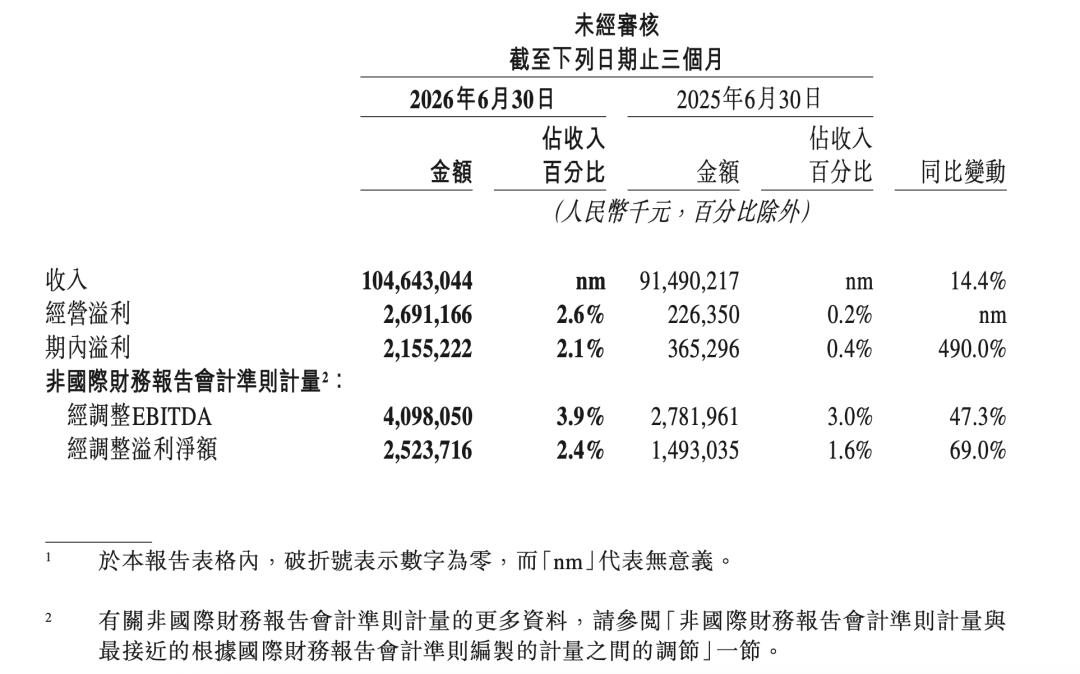
As the defender in this battle, Meituan's profit statement was the first to bear the brunt of the impact.
Multiple past financial reports show that Meituan's core local business fell from a profit of 13.49 billion yuan and a 21.0% profit margin in the first quarter of 2025 to a loss of 14.07 billion yuan in the third quarter. Although it has turned positive again now, the 7.9% profit margin is still less than 40% of the pre-war level. In the first half of 2026, the group's operating loss still stood at 3.78 billion yuan.
Meituan's explanation has also changed accordingly. The latest financial report attributes the profit recovery to the context of "increasingly rational industry competition" and "continuous consolidation of operational efficiency advantages". Scale remains important, but profit recovery and operational efficiency have become new proof points.
JD presents a different "curve"
JD's 2026 second quarter and interim results show that in Q2 2026, the new business segment, which mainly includes JD Delivery, Jingxi, JD Industrial Development and overseas businesses, recorded an operating loss of 9.85 billion yuan, narrowing by 4.92 billion yuan compared with the same period in 2025. Compared with the phased high of 15.74 billion yuan in Q3 2025, the loss has narrowed by about 5.88 billion yuan.
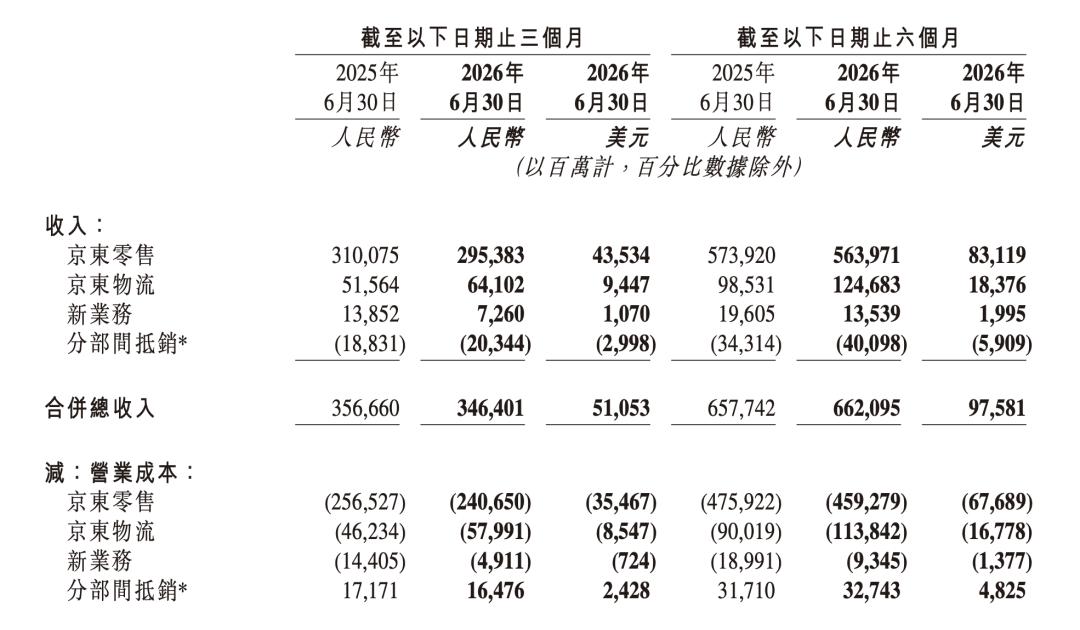
JD cited CEO Xu Ran in its results announcement stating that the group's "profit trajectory has reached a clear inflection point", and attributed part of the improvement to the steady profit performance of JD Retail and the continuous loss reduction of JD's food delivery business.

Differentiation also emerged on the expense side: the group's marketing expenses decreased by 24.8% year-on-year, while fulfillment expenses increased by 10.4% year-on-year. JD attributes the former mainly to the optimization of promotional expenses for new businesses, and the latter to the construction of new business operation infrastructure.
The 9.85 billion yuan is not the separate loss of the food delivery business. The segment data in 2026 is also affected by the transfer of the local instant distribution business to JD Logistics. It is worth noting that the latest financial report no longer discloses the scale of food delivery orders, merchants and riders. The scale figures have disappeared, and "significantly narrowed investment scale year-on-year" has become the new focus.
JD wrote in its English results announcement that the food delivery business has "significantly narrowed its investment scale year-on-year" due to "improved operational efficiency and diversified revenue sources".
Alibaba delivers the third answer
The latest financial report shows that in the quarter ended June 30, 2026, Alibaba's China instant retail revenue reached 53.295 billion yuan, a year-on-year increase of 45%. The financial report attributes this growth to the driving forces of Freshippo and Taobao Flash Purchase.
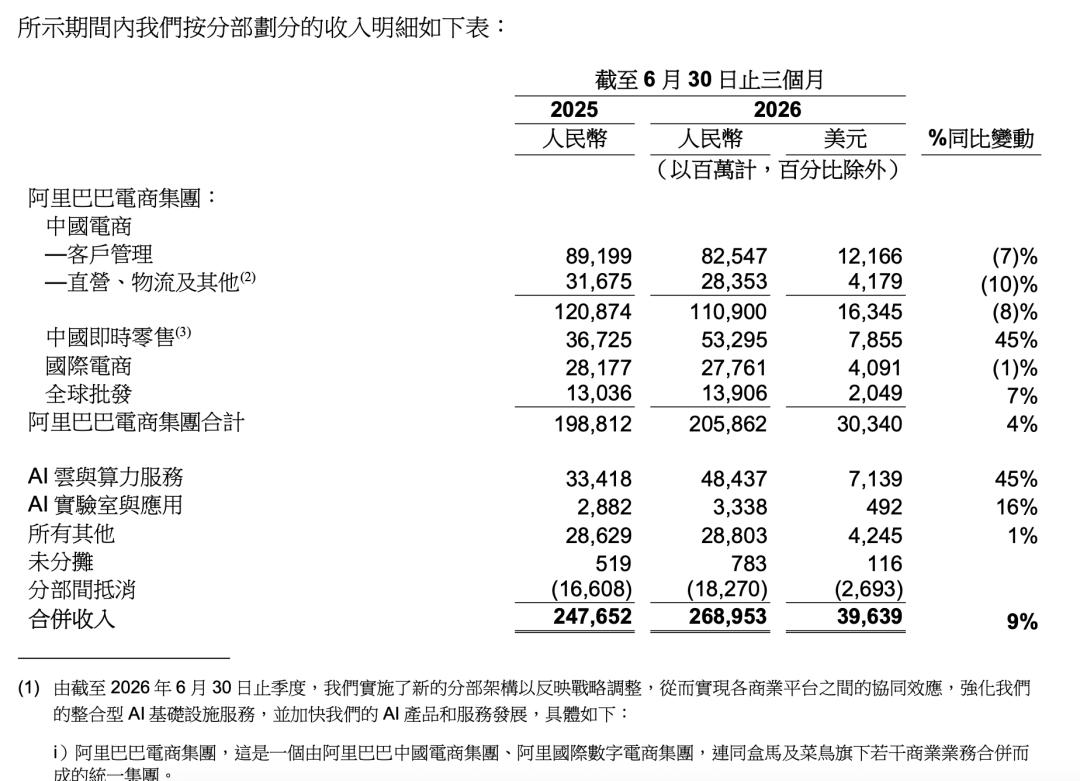
The financial report states: "While maintaining its market share, Taobao Flash Purchase has continued to improve its unit economic benefits quarter-on-quarter, mainly due to the increase in per-order value and fulfillment efficiency." The latest financial report no longer emphasizes peak order volumes, and attributes the improvement to "the increase in per-order value and fulfillment efficiency".
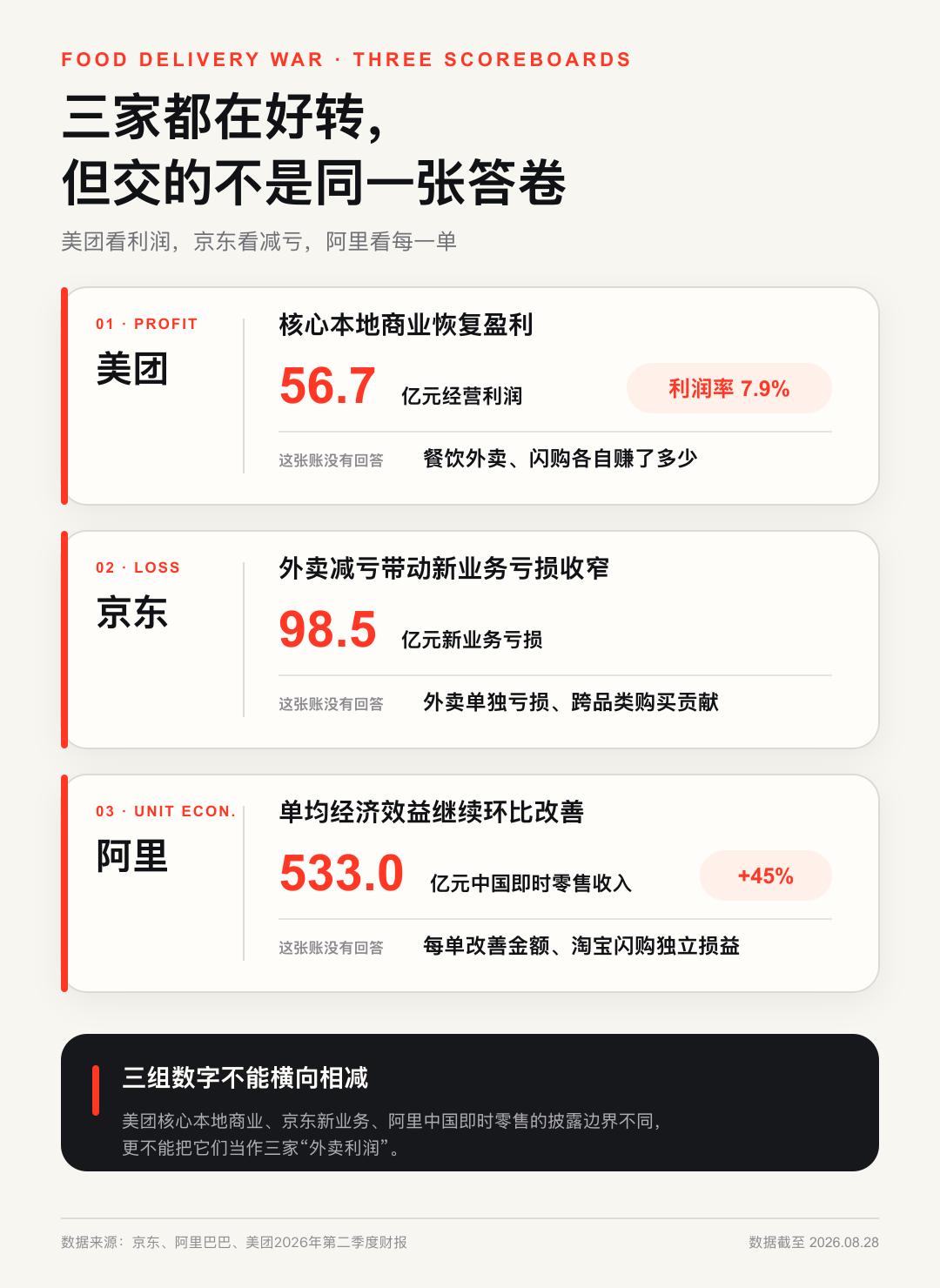
Wang Xing holds a segment profit that has turned positive again, Xu Ran has a loss curve that keeps narrowing, and Alibaba presents the direction of unit economic improvement. The three companies are reporting good news at the same time, but each has changed its scoreboard.
After scale, the three companies re-answer "why do food delivery"
"I can never make money from selling food at the front end, as long as I can make money from the supply chain." On the afternoon of June 17, 2025, at JD's headquarters in Yizhuang, Beijing, Liu Qiangdong broke down the food delivery business logic very straightforwardly.
At that time, JD Food Delivery had just been launched for four months, and the tens of billions of subsidies were being used to drive rapid order growth. This statement from Liu Qiangdong set a yet-to-be-verified business path for JD Food Delivery.
"What everyone sees as the 'food delivery dispute' between us and Xingge (Meituan founder Wang Xing) is a business of ordering meals for ordinary people, but in fact our underlying logic is the fresh food supply chain behind it, which is what I really want." Liu Qiangdong also explained, "(The food delivery business) now has 40% cross-sales to our e-commerce platform, and the money we lose is more cost-effective than buying traffic from Douyin or Tencent."

A year ago, JD presented the figures of orders, merchants and riders in its financial report. But in this quarter, these scale indicators are no longer disclosed, and efficiency, revenue sources and loss reduction have become the focus.
This is not the first time JD has talked about efficiency. 18 months after the food delivery business was launched, it can no longer only answer "whether it can grow large". Liu Qiangdong has set a boundary of low profit or even no profit for the front end, and JD now must prove whether the back-end supply chain can really earn back all the investment.
In the same food delivery war, JD has changed its narrative many times.
JD initially chose the positioning of "quality". "Quality dine-in", zero commission for the whole year and paying "five social insurances and one housing fund" for full-time riders answered the entry question — why users and merchants should trust that JD can also do food delivery well.
Then the narrative shifted to "scale".
On August 14, 2025, JD released its Q2 2025 results. The announcement broke down the progress of food delivery into three sets of figures: daily orders exceeded 25 million during the 618 shopping festival, more than 1.5 million "quality merchants" settled in; as of the end of June, the number of full-time riders exceeded 150,000. Different from the first quarter, which mainly explained "why we entered this sector", the Q2 financial report began to use the scale of orders, merchants and riders to prove that JD had already got a seat at the table.
In the same results announcement, JD CEO Xu Ran stated that the food delivery business has made progress in order growth, merchant expansion, full-time rider recruitment, and synergy with existing businesses such as JD Retail, and claimed that it has "successfully achieved our initial strategic goal" (translated from JD's English announcement). This means that JD not only got the seat at the table, but also began to require the food delivery business to bring incremental value to its original businesses.
The third narrative shift is towards "efficiency and synergy". After the new business loss reached a phased high of 15.74 billion yuan in the third quarter of 2025, it narrowed for three consecutive quarters; the latest financial report no longer announces the scale of food delivery, and starts to emphasize reduced investment, operational efficiency and revenue diversification.
The question to be answered now has become — what exactly has the scale left behind, and when will the supply chain start to generate returns.
Alibaba's shift is more direct.
First, it focused on "consumer mindshare and scale".
On August 29, 2025, Alibaba released its results for the quarter ended June. Wu Yongming said: "We are investing heavily in the instant retail business, quickly achieving phased results and winning consumer mindshare." The financial report also disclosed that in the first three weeks of August, the monthly active consumers of the Taobao App increased by 25% year-on-year.
At this stage, Taobao Flash Purchase first needs to prove that it can bring more consumers and higher-frequency demands back to Taobao.
On November 25, 2025, Alibaba released its results for the quarter ended September, and its narrative was adjusted again.
At this point, Wu Yongming mentioned: "In the consumer sector, the expansion of instant retail scale and the significant improvement of unit economic benefits have driven the monthly active consumers of the Taobao App to achieve rapid growth." The financial report attributed the improvement to three things: improved fulfillment and logistics efficiency, high customer retention rate, and increased customer unit price. As of October 31, about 3,500 Tmall brands have connected their offline stores to the instant retail business.
The scale is still growing, but the measurement method has begun to shift from order volume and activity to the efficiency of each order and the synergy with Tmall's supply.
By August 20, 2026, the statement went a step further. The latest financial report stated that Taobao Flash Purchase "continued to improve unit economic benefits quarter-on-quarter while maintaining market share", which mainly benefited from "the increase in per-order value and fulfillment efficiency". At the same time, it began to emphasize optimizing the order structure and expanding high-per-order-value catering orders and non-food categories.
At this point, what Alibaba needs to prove is no longer just how many people food delivery can bring back to Taobao, but whether these orders can generate higher per-order value, lower fulfillment costs, and further drive Taobao's monthly active users and customer management revenue.
Meituan, on the other hand, shifted from defense to recovery.
Meituan did not simply "defend quality" at first, but fought against vicious competition while declaring war. On the evening of May 26, 2025, at Meituan's Q1 financial report conference call, Wang Xing said he welcomed new players to enter the market, but also said: "Low-quality and low-price 'involution-style' competition is unsustainable in the long run."
What it answered is: Meituan is not only defending orders, but also the quality of merchants, riders and fulfillment networks.
Then it adjusted to "consolidating advantages". On November 28, 2025, Meituan released its Q3 results, and its core local business turned from profit to a loss of 14.1 billion yuan; in the same quarter, it was disclosed that the peak daily order volume of instant retail in July exceeded 150 million, with an average delivery time of 34 minutes.
Wang Xing said at the time that Meituan would "consolidate its core competitiveness and maintain its advantageous position in the industry". After the subsidies were paid out, Meituan needed to prove that the order volume and network density had not been dispersed by the two attackers.
This led to the current state of "exiting low-quality orders and restoring profits".
According to the public transcript of the financial report conference call, Wang Xing said: "Meituan firmly opposes involution. We will actively cooperate with relevant regulatory investigations. At the same time, in the process of striving to consolidate our leading market position, we will also reduce resource investment in low-quality orders."
By August 28, the core local business restored an operating profit of 5.67 billion yuan, and the latest financial report added "increasingly rational industry competition" and "continuous consolidation of operational efficiency advantages" to its explanation. From quality and ecosystem, to market position and network advantages, and then to order structure and profit recovery, Meituan has also adopted three sets of measurement methods.
For the two attackers, the new narrative needs to explain what returns the investment can bring; for the defender, the new narrative needs to explain why profits can still come back after holding the market.
The three new narratives have one thing in common: the value of food delivery is no longer settled only within the food delivery business itself.