Is the strongest El Niño in history approaching? Barclays states that prices of palm oil, rubber and coffee may rise by 30% to 40% within 18 months.
A historically rare super El Niño is taking shape, bringing a new round of supply shocks to the commodity market.
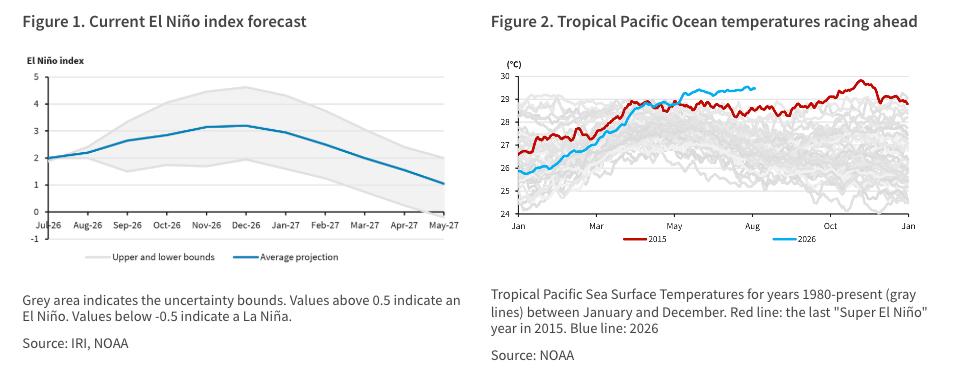
On August 30, Craig Rye, an analyst in sustainable investment research at Barclays, warned in the latest report that the tropical Pacific El Niño index may peak at close to 3.2 degrees Celsius from the end of 2026 to the beginning of 2027, which is about 15% stronger than the 2015-16 super El Niño, and will cause a major impact on the global agriculture, energy and industrial commodity markets.
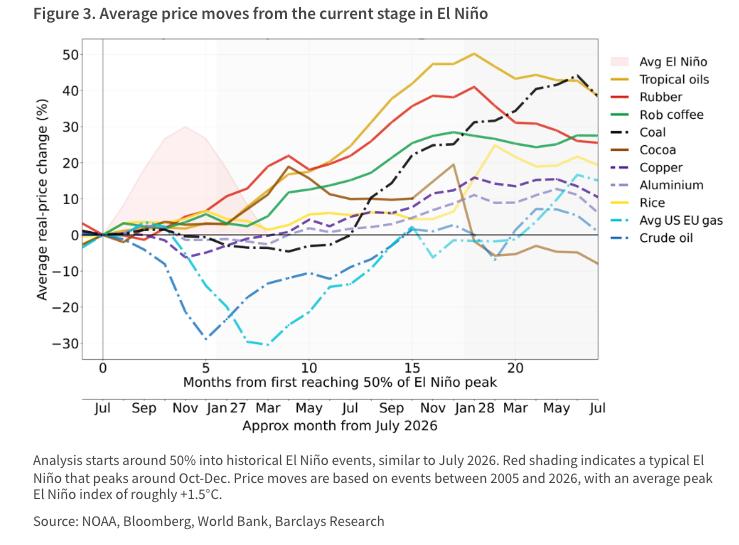
In the agricultural commodity sector, Rye predicts that palm oil, coconut oil and rubber may rise by 30% to 40% in the next 18 months, Robusta coffee may increase by 20% to 30%, and rice prices may rise by 10% to 20%.
The supply shock will then spread to industrial metals, with aluminum and copper potentially rising by up to 20% within 18 months, and thermal coal prices likely to increase by 20% to 40%.
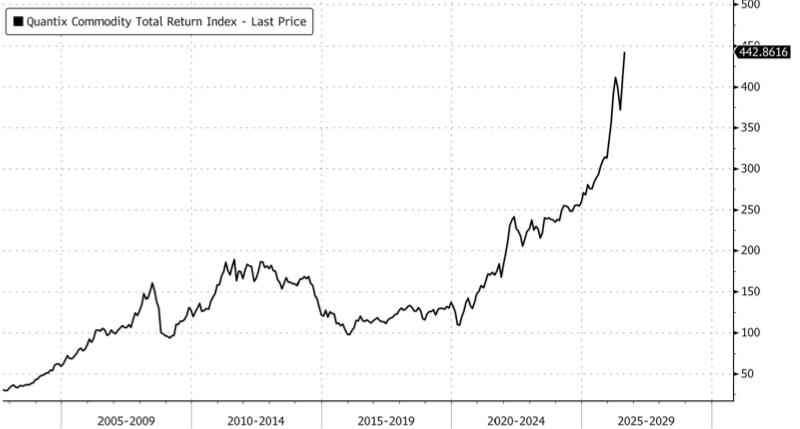
This warning is not an isolated signal. The overall commodity market is tightening — the total return of the Quantix Commodity Index, which tracks 24 U.S. dollar-denominated futures contracts covering energy, agriculture, livestock, industrial metals and precious metals, has surged more than 22.5% since the end of June, hitting an all-time high.
Jeff Curri, a former senior commodity strategist at Goldman Sachs, also said bluntly recently: "The scarcity in the physical world is re-emerging, and the illusion of abundance is most likely a thing of the past."
El Niño intensity may hit a historical record, with agriculture bearing the brunt
Rye cited multi-model forecasts from the International Research Institute for Climate and Society in the report, pointing out that the peak of this round of El Niño index may be close to 3.2 degrees Celsius, with the time window concentrated from the end of 2026 to the beginning of 2027.
If the forecast comes true, its intensity will exceed the strongest 2015-16 super El Niño on record by about 15%, making it the strongest El Niño event ever recorded.
Rye said that as confidence in this historic El Niño rises, the probability of major disruptions to agricultural, energy and industrial commodity markets has increased significantly. Historically, El Niño events are often accompanied by widespread droughts, floods and extreme temperatures, which have a particularly severe impact on major agricultural producing regions such as Southeast Asia and Central America.
Among agricultural commodities, Rye believes that the most concentrated recent risks are for varieties highly sensitive to weather. The main producing areas of palm oil, coconut oil and rubber are concentrated in Southeast Asia, which are extremely vulnerable to the impact of drought and abnormal rainfall, and the price increase is expected to reach 30% to 40% within 18 months. Robusta coffee is mainly produced in Southeast Asian countries such as Vietnam, with an expected increase of 20% to 30%. For rice, drought threatens crops and water supply in parts of Southeast Asia and Central America, and prices may rise by 10% to 20%.
Shocks spread to industrial metals, with copper, aluminum and coal all within the affected range
Rye warned that the supply shock in the agricultural sector will not stop there, and will further transmit to industrial commodities. He predicts that aluminum and copper may rise by up to 20% in the next 18 months, while thermal coal may increase by 20% to 40%.
The transmission path is clear: Drought caused by El Niño will reduce hydropower generation, push up electricity demand and raise electricity prices, thereby increasing the cost of aluminum smelting; at the same time, extreme weather will directly interfere with mine operations and port logistics, reducing the supply of metals such as copper.
Rye pointed out that mine shutdowns, reduced hydropower generation and structural changes in power demand will jointly amplify the impact of drought and extreme weather on the industrial metal market.
This logic has been confirmed in the current market. It is reported that floods in Chile have caused some mines to shut down, and drought in Papua New Guinea has blocked shipping on the Ok Tedi River, affecting copper shipments. LME copper prices have risen for nine consecutive weeks, approaching the historical high range.
Multiple factors are superimposed, and the supply shock is not caused by a single climate event
It is worth noting that this round of tightening in the commodity market is not only driven by El Niño, but the result of the superposition of multiple structural factors.
Rye pointed out in the report that adverse weather, insufficient capital investment over the years, and continuous inventory decline are converging into an emerging supply shock. This is highly consistent with UBS's suggestion to clients this week to "position for the upside cycle of commodities".
From a more macro perspective, the Quantix Commodity Index has risen by more than 22.5% cumulatively since the end of June, hitting an all-time high, covering multiple sectors such as energy, agriculture, livestock, industrial metals and precious metals, indicating that this round of rise is no longer limited to a single category, but presents the characteristics of overall tightening.
Jeff Currie's judgment on this is concise and direct: "The illusion of abundance is most likely a thing of the past."
This article does not constitute personal investment advice, does not represent the position of the platform. The market is risky, and investment needs to be cautious. Please make independent judgments and decisions.
This article is from the WeChat official account "Wall Street CN", author: Dong Jing, published by 36Kr with authorization.