Companies listed on the STAR Market of China's A-share market recorded an aggregate net profit in the first half of the year exceeding the total net profit for the whole of last year. Over 60% of these companies are profitable, with Changxin Technology's net profit skyrocketing by 3427.76% to claim the title of "profit king".
The 2026 semi-annual reporting season has concluded, and the STAR Market has delivered a better-than-expected performance.
According to the Shanghai Stock Exchange, STAR Market-listed companies posted a total operating revenue of 1.01 trillion yuan in the first half of the year, up 38.6% year on year; their net profit reached 1448.87 billion yuan, surging 437.6% year on year. The net profit has exceeded the full-year level of the previous year, further highlighting its core role as the main front for developing new quality productive forces.
Wind statistics show that in the first half of 2026, among the 616 STAR Market-listed companies, 409 made profits, accounting for over 60% of the total; 334 saw their net profit rise year on year, and 133 recorded a net profit growth of more than 100%.
Overall, STAR Market-listed companies present a sound momentum of steady growth in operating revenue and sharp surge in net profit, with their earnings quality significantly improved. The long-term R&D investment of "hard technology" enterprises is accelerating to enter the realization period.
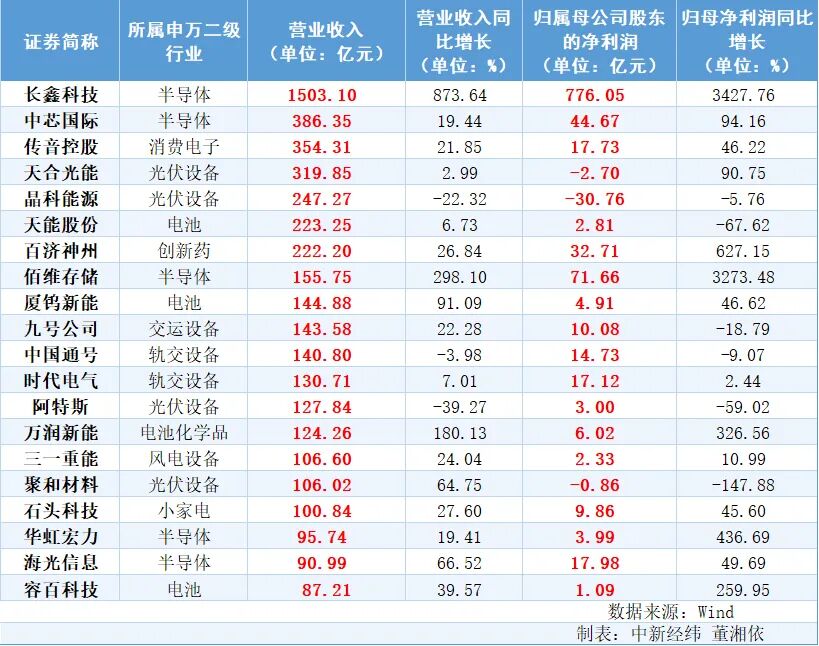
Top 20 STAR Market-listed companies by operating revenue in the first half of 2026.
Semiconductor Leaders Take the Lead
After sorting out by China Newsweek, in the first half of 2026, core tracks such as domestic computing power, innovative drugs, and high-end equipment have achieved all-round growth, with a number of leading enterprises delivering particularly outstanding performance.
The semiconductor sector is the biggest winner. The newly listed Changxin Technology saw both its revenue and net profit surge sharply, with its attributable net profit reaching as high as 77.605 billion yuan in the first half of the year, skyrocketing 3427.76% year on year, making it the "profit champion" overnight, equivalent to earning about 400 million yuan per day.
"The increase in operating revenue, total profit, net profit attributable to shareholders of listed companies, and net profit attributable to shareholders of listed companies after deducting non-recurring gains and losses is mainly due to the rapid growth of global computing power demand and the capacity deployment of major global manufacturers. The global DRAM products are in short supply, and the price shows a sharp upward trend, driving a substantial increase in the gross profit of the company's main DRAM products." Changxin Technology stated in its semi-annual report.
The booming storage industry also drove the performance explosion of Biway Storage. The company achieved an operating revenue of 15.575 billion yuan in the first half of the year, up 298.10% year on year; its attributable net profit reached 7.166 billion yuan, surging 3273.48% year on year.
High-intensity R&D investment has forged the quality of "hard technology". In the first half of the year, Advanced Micro-Fabrication Equipment's R&D investment reached about 2.041 billion yuan, accounting for 30.51% of operating revenue, significantly higher than the sector average. Hygon Information invested 2.652 billion yuan in R&D in the first half of the year, up 55.05% year on year. The substantial growth in R&D investment is accelerating the iteration of its CPU and DCU products and the construction of AI ecosystem.
The two leading foundry enterprises also performed strongly. Hua Hong Hongli achieved a net profit of 399 million yuan, up 436.69% year on year. SMIC realized an operating revenue of 38.635 billion yuan in the first half of the year, up 19.44% year on year; its attributable net profit reached 4.467 billion yuan, up 94.16% year on year. Among them, the revenue from wafer foundry business was 35.858 billion yuan, up 18.1% year on year. SMIC said the performance growth was mainly driven by the increase in wafer sales volume, the rise in average selling price and the change in product mix in the current period.
Innovative drug is one of the tracks with the strongest earnings elasticity in the first half of the year. BeiGene realized an attributable net profit of 3.271 billion yuan in the first half of the year, up 627.1% year on year; RemeGen achieved an attributable net profit of 4.662 billion yuan, up 1137.1% year on year.
According to the data from the National Medical Products Administration, a total of 81 out-licensing deals of Chinese innovative drugs were reached in the first half of the year, with a total transaction value of about 110 billion US dollars, reaching 80% of the total amount for the whole year of 2025. The commercialization and out-licensing of Chinese innovative pharmaceutical enterprises in the global market are accelerating to turn into real monetary gains.
Li Daxiao, former chief economist of a securities firm and member of the Shenzhen Municipal Decision-making Advisory Committee, said in an interview with China Newsweek that the performance of STAR Market-listed companies in the first half of the year presents three major characteristics: first, the earnings quality has improved, and the profit growth rate is faster than the revenue growth rate; second, hard technology tracks such as AI computing power and semiconductors have performed particularly prominently; third, some innovative pharmaceutical enterprises have ushered in their performance realization period.
Structural Differentiation Remains
China Newsweek notes that there is also overall structural differentiation in the performance of the STAR Market, and some tracks are still under pressure.
Wind data shows that 207 of the 616 companies are still in a loss-making state, accounting for more than 30%. Affected by the downward price of the industrial chain, the profitability of industries such as photovoltaics is under pressure. JinkoSolar posted a loss of 3.076 billion yuan in the first half of the year, the largest loss among all STAR Market-listed companies.
On the other side of the high performance growth, there is a clear disparity in prosperity between different industries. Where does this differentiation come from?
"Essentially, it is the result of the combined effect of industrial cycle dislocation and capital allocation logic." Xue Hongyan, a special researcher of Suning Bank, analyzed to China Newsweek that AI computing power, storage, and innovative drugs are in the upward stage where demand explosion and domestic substitution resonate, and the previous R&D investment is entering a concentrated realization period. Tracks such as photovoltaics are mired in the pain of overcapacity and price wars, and the imbalance between supply and demand has not been fundamentally reversed. The continuous migration of capital from traditional sectors to technology tracks has further exacerbated the differentiation.
Xue Hongyan believes that the pattern of performance differentiation is difficult to fundamentally reverse in the short term. However, with the opening of the performance verification window, high-valuation targets that rely purely on theme speculation and have no landed orders will face correction pressure, and the real hard technology leaders with performance realization capabilities are expected to further consolidate their advantages amid differentiation.
Focus on Domestic Substitution Opportunities
Looking ahead, how should ordinary investors grasp the investment logic of the STAR Market?
"As the core position of hard technology, the STAR Market can continue to pay attention to the opportunities brought by domestic substitution in the future. Especially after the sharp decline in July, many leading STAR Market stocks have gradually shown investment value." Yang Delong, chief economist and fund manager of Qianhai Kaiyuan Fund, said that investors can consider deploying some mispriced technology leading stocks or related theme funds on dips to seize opportunities.
Xue Hongyan believes that domestic substitution has moved from policy slogans to the stage of substantive implementation, and main lines such as computing power chips, semiconductor equipment, and storage have long-term allocation value. Ordinary investors can use STAR Market-related index funds to make fixed investment in batches to diversify the risk of individual stocks.
However, Xue Hongyan also reminded that investors should pay attention to the style switching signal, the performance verification of the interim report and the third quarterly report is the core watershed, and remain alert to pure theme targets whose performance cannot match high valuations.
The views in this article are for reference only and do not constitute investment advice. Investment is risky, and caution is advised when entering the market.
This article is from the WeChat official account "China Newsweek" (ID: jwview), written by Dong Xiangyi, edited by Lin Wansi, proofread by Zhang Yihua, Jia Yifu and Chang Tao, and published with authorization from 36Kr.