Is the production volume of flagship smartphones cut in half? The skyrocketing memory prices have driven mobile phone manufacturers to a frenzy: they have finally realized their long-awaited dream of breaking into the high-end market.
Starting every September, major domestic and foreign smartphone manufacturers will successively release new-generation flagship phones, but compared with previous years, manufacturers are generally pessimistic this year.
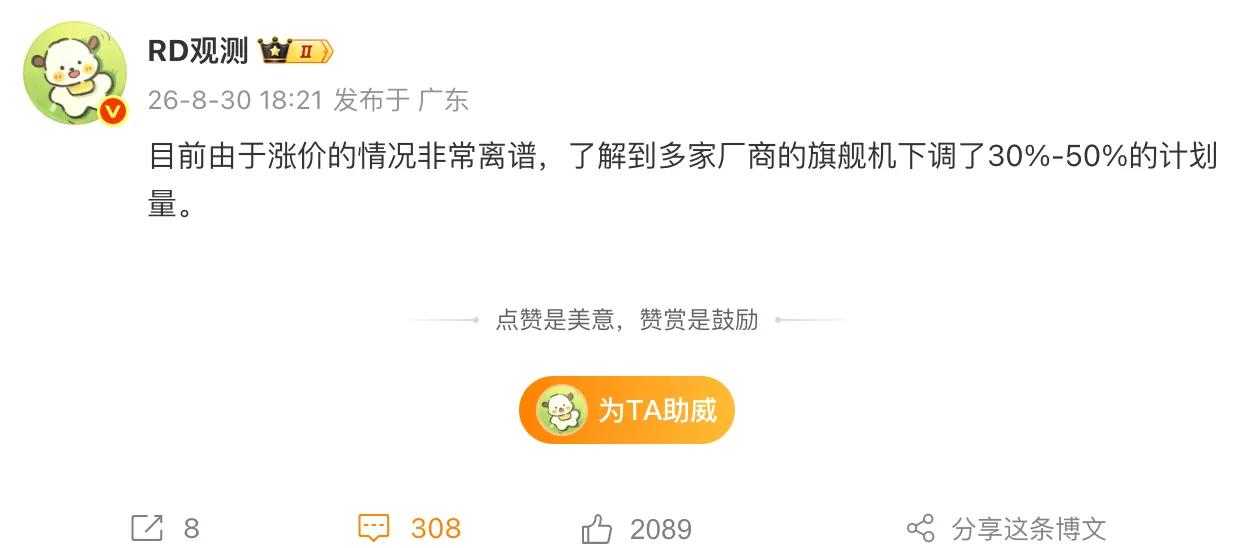
According to digital blogger @RD Observation Leaks, the planned production volume of flagship phones of multiple manufacturers has been cut by 30% to 50%. The main reason for manufacturers to lower their expected sales of flagship phones is the continuously rising costs and overall machine selling prices.
Source: Sina Weibo screenshot
In previous years, the entry price of standard mid-tier flagship phones was around 3999 yuan, while the currently sold models such as Xiaomi 17, OPPO Find X9, and vivo X300 have an initial starting price of over 4300 yuan. The upcoming Xiaomi 18 series, OPPO Find X10 series, vivo X400 series and other models may have a starting price of around 5500 yuan.
Prices rise while configurations are cut, the mobile phone market is becoming more and more abnormal
The demand for memory, flash memory and computing power chips in the AI industry has led to a shortage of production capacity at wafer fabs, and the prices of memory chips have soared all the way.
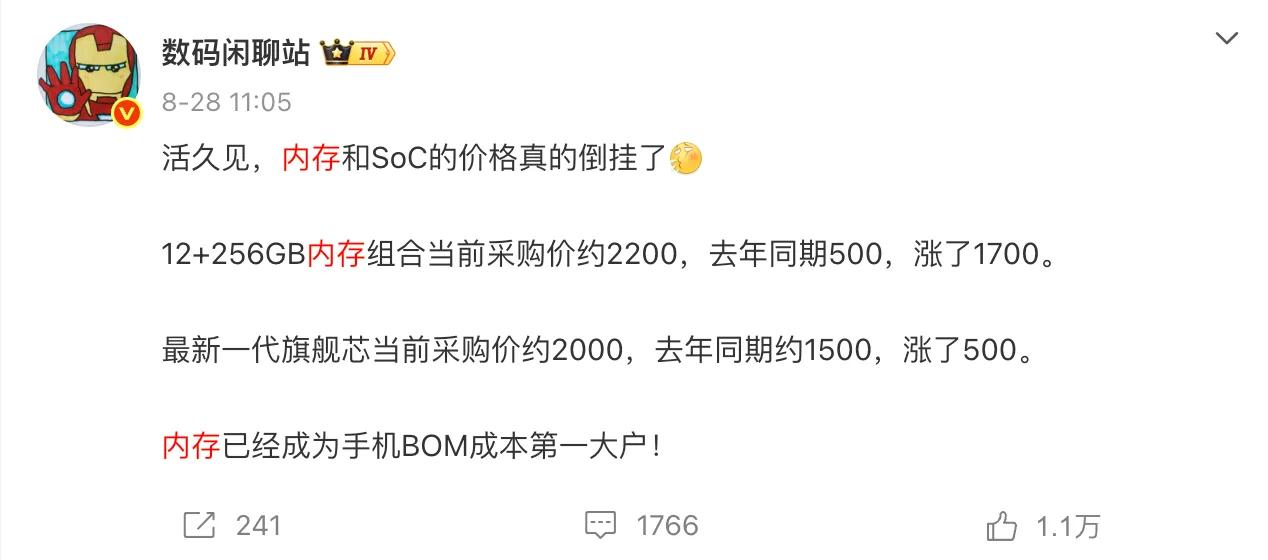
@Digital Chat Station said that the procurement price of 12+256GB memory combination in the same period last year was only 500 yuan, but this year it rose to 2200 yuan, a year-on-year increase of up to 340%. The memory combination has surpassed the SoC and become the most expensive hardware of mobile phones. The blogger also added that a brand's model focusing on camera functions and targeting the offline market has canceled its top-tier variant due to the pressure of memory costs.
Source: Sina Weibo screenshot
@RD Observation revealed that models targeting the low and mid-end markets such as REDMI Note, OPPO A, vivo Y, and Honor X will be priced between 2500 yuan and 3500 yuan, with memory starting at 6GB; mid-to-high-end models such as Xiaomi Digital T, OPPO Reno, and vivo S series will be raised to 4000 yuan to 5000 yuan, with memory starting at 8GB; the starting prices of the standard, mid-tier and top-tier variants of flagship phones will rise to around 5500 yuan, 7000 yuan and 8000 yuan respectively.
As for Apple and Huawei, although their product premium capabilities have always been higher than mainstream Android manufacturers, they cannot avoid the impact of rising memory prices. It is expected that the iPhone 18 series will see a price increase of 1500 yuan to 2000 yuan.
The most outrageous thing is that the new flagships are not only raising prices, but also reducing configurations. In recent years, the entry configuration of mid-tier Android flagships is generally 12GB+256GB, and the top version is equipped with 16GB+1TB memory. The upcoming new standard flagship will not only return to 8GB of memory as the starting configuration, but also the top version will be reduced to 12GB+1TB.
Nowadays, the size of apps is getting more and more bloated. If the memory is insufficient, the problem of mobile phones killing background processes will become prominent. Even though most mobile phones of major manufacturers support virtual memory technology, the read and write speed of flash memory is limited, which is difficult to meet the needs of high-frequency app switching and background retention.
In the past, after a mobile phone was released, its price would only drop instead of rise. But from the beginning of this year to now, mobile phones of brands including OPPO/OnePlus, Xiaomi, vivo/iQOO, Honor, Samsung, and Huawei have raised their prices many times.
Source: Lei Technology
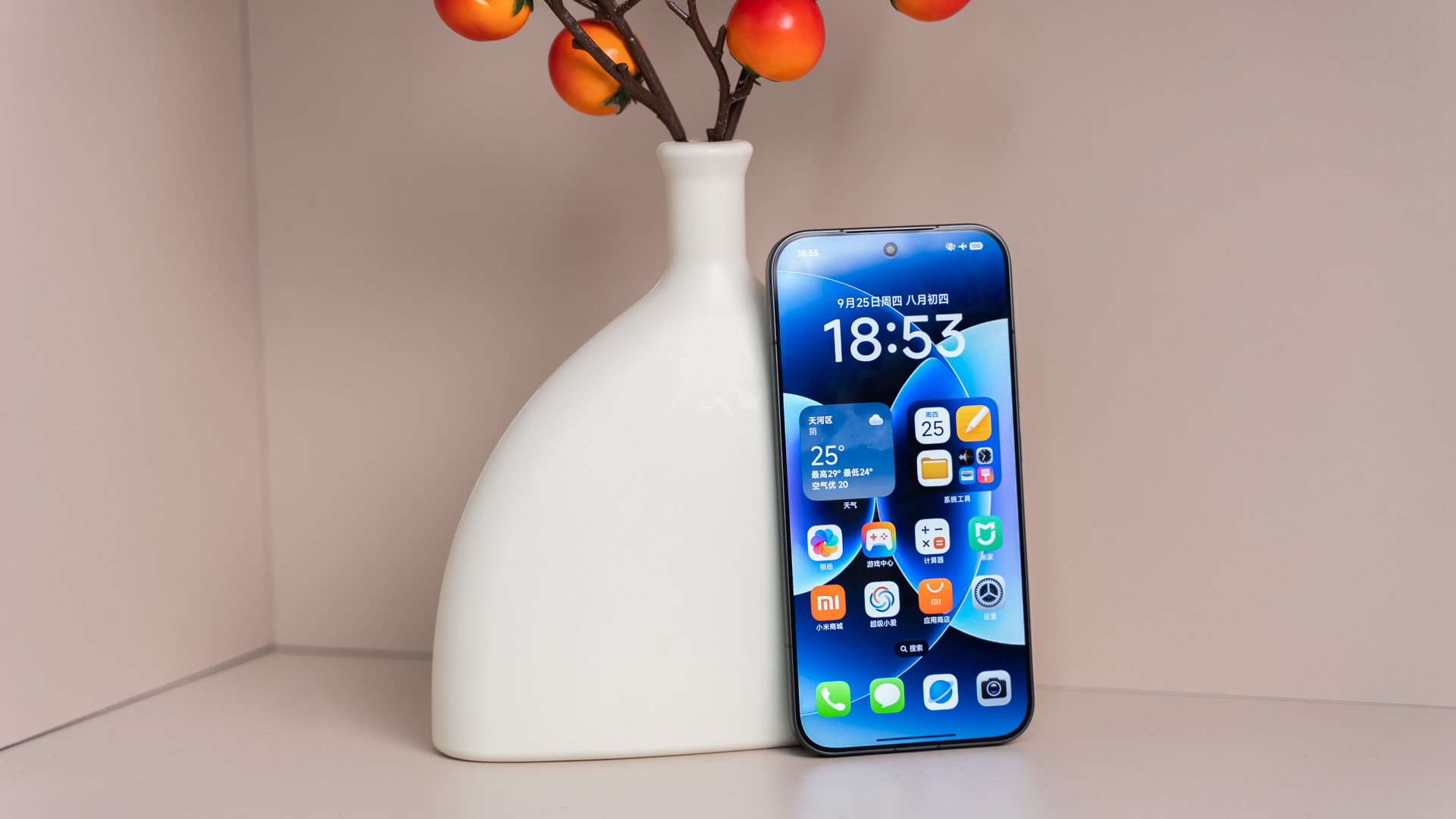
Take the Xiaomi 17 series as an example. This model has experienced multiple price increases. Currently, the official website starting price of the standard Xiaomi 17 is 5099 yuan, which is 600 yuan higher than its initial release price, completely different from the situation where new phones see a sharp price cut half a year after release in previous years.
The price increase of Xiaomi's mobile phones has also led to an inevitable result -- a decline in sales. Xiaomi's financial report shows that the shipment of smartphones in the second quarter of this year was only 31.2 million units, a sharp year-on-year drop of 26.5%.
Other mobile phone manufacturers are also having a hard time. According to statistics from IDC, a data research institution, the shipment of Chinese mobile phone manufacturers in the second quarter was about 66.01 million units, a year-on-year decrease of 4.3%. The sales of OPPO, vivo and Xiaomi are all declining. Only Apple and Huawei, with high product premium capabilities, are less affected by the rising memory prices and still maintain sales growth.
However, Xiaomi, OPPO, vivo and Honor do not need to envy the achievements of Apple and Huawei in the high-end market, because they are being forced to march into the higher-end market.
Xiaomi, Huawei, OPPO, vivo finally successfully "move upmarket", but this time it's forced
Driven by the rising chip prices, mobile products have seen collective price hikes. Low-end phones have risen to the price that originally belonged to mid-to-high-end models, and mid-to-high-end models have directly broken through the mainstream price range of flagship phones. For example, the newly released REDMI K100 Pro Max has a top-tier version priced as high as 5999 yuan, a price point that REDMI could hardly reach in previous years.
Affected by memory price hikes, the 12GB+256GB version of mid-to-low-end models originally priced at around 2000 yuan has increased by 1700 yuan, almost doubling in price. For flagship phones originally priced at around 6000 yuan, the 12GB+256GB version has increased by 1700 yuan, with a price increase of less than one third, which brings completely different feelings to consumers.
Mid-to-low-end models and flagship phones target different groups of audiences. High-end product audiences are less sensitive to prices and usually have stronger anti-risk capabilities.
Source: Lei Technology
Taking Xiaomi as an example again, the average selling price (ASP) of mobile phones in the second quarter reached 1351 yuan, a year-on-year increase of 25.9%. The proportion of models priced at 3000 yuan and above in the Chinese mainland market reached 32.1% for the first time, which is a peak that Xiaomi has never reached. The counter-trend sales growth of Apple and Huawei can also prove that the performance of flagship phones remains stable even when the entire industry is in a downturn.
Under the circumstance that the overall decline in mobile phone sales is a foregone conclusion, manufacturers need to prioritize maintaining profits, which is consistent with the attribute of flagship phones that have large profit margins. From the perspective of Lei Technology, during this "forced upmarket march", mobile phone manufacturers are both worried and excited. They are worried that the narrowing price gap with Apple and Huawei will lead to head-to-head competition that they may not win, while excited that this is an opportunity for them to make further progress in the high-end market.
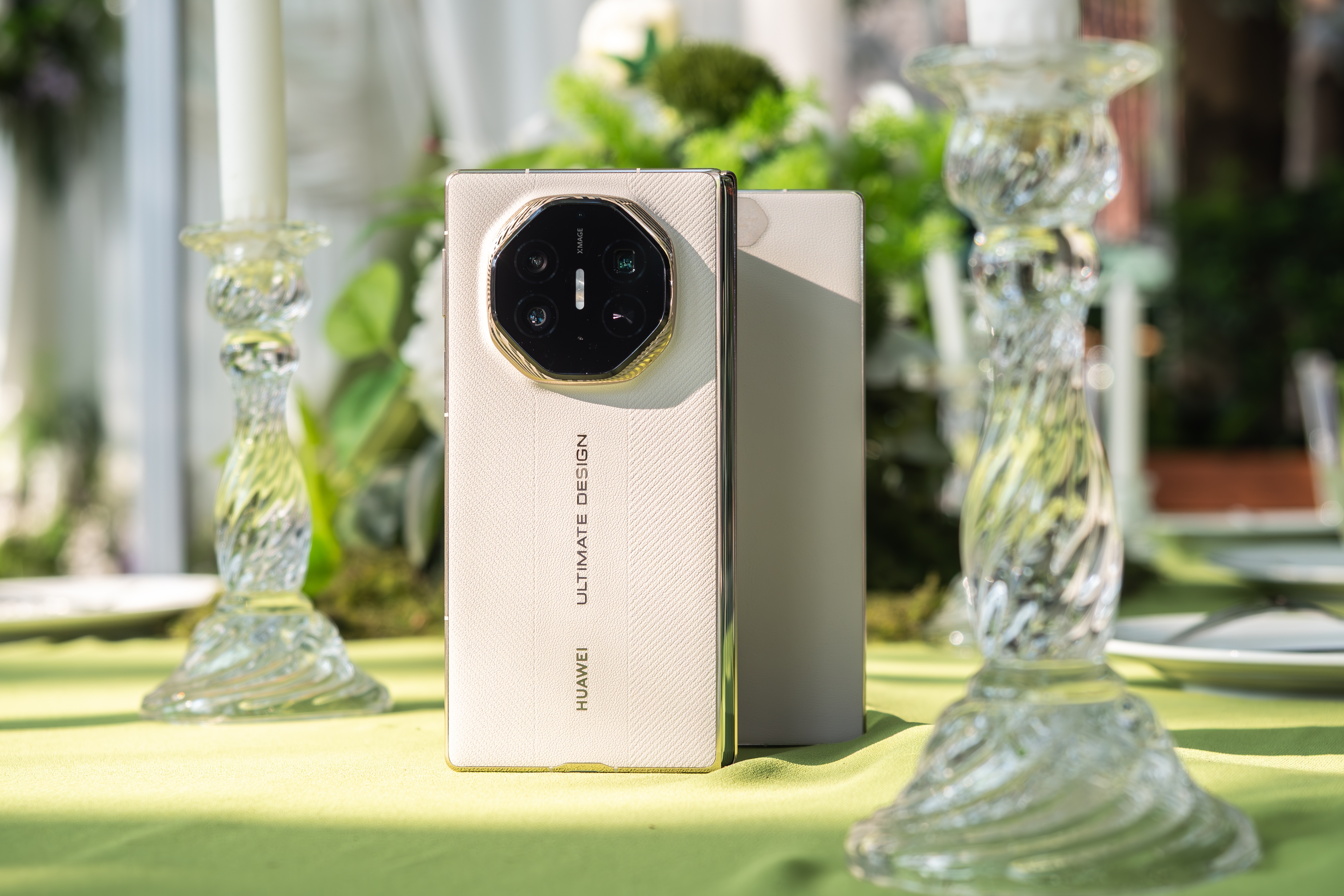
Apple has always been the leader in the global high-end mobile phone market, and only Huawei in China can compete with it. Other domestic mobile phone manufacturers rely on the cost-effective advantages such as low prices and high configurations to occupy a place in the high-end market, and continue to explore upwards through new technologies and new designs.
After the price of flagship phones rises significantly, the price gap between Android flagships and Apple and Huawei flagships will most likely narrow, and this situation will further test the product capabilities of Android manufacturers.
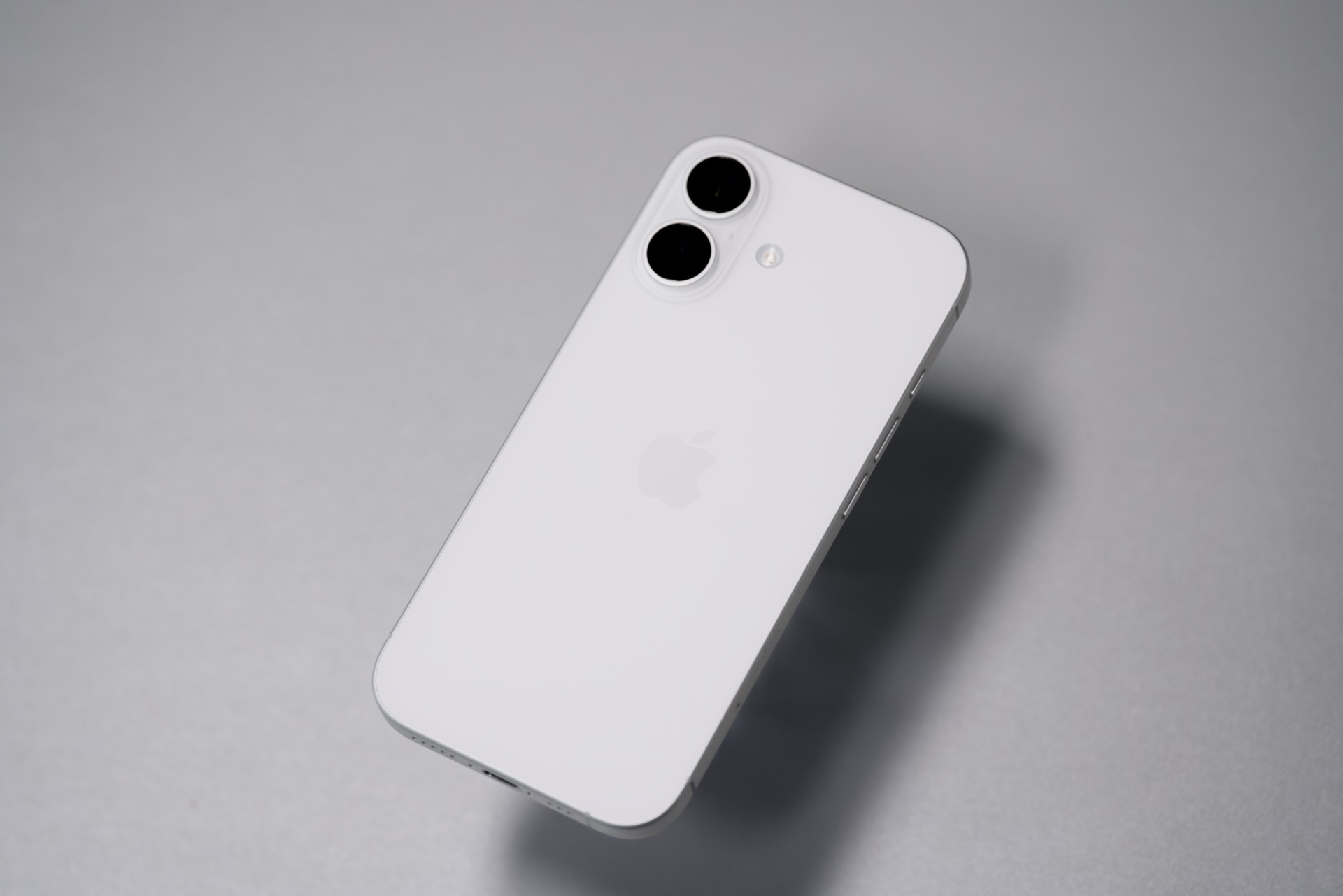
Source: Lei Technology
Perhaps to allocate more chips to the mid and top-tier variants, both Xiaomi and Apple have changed their product release rules this year. In the past, Xiaomi would release the standard and mid-tier models first, and postpone the release of the top-tier variant. This year, it will release the mid-tier model first, and postpone the standard version. Apple is the same: iPhone 18 Pro/Pro Max will be launched this year, while iPhone 18 and iPhone Air 2 will be released early next year.
The new solution can maximize the profit margin in the early stage of release, prioritize launching the higher-spec Pro version to the market, ease the pressure of tight memory supply, and even allow the standard version to be launched after the price surge ends.
How long do users have to wait for mobile phone prices to drop?
In July this year, @Digital Chat Station broke the news that among the top 6 mobile phone manufacturers, many have clearly rejected the memory suppliers' price increase requests for the coming months, and many enterprises in the B-end market are also dissatisfied with the memory prices. According to a report by South Korean media News1, OPPO and vivo have rejected Samsung's proposed differentiated price hike for storage in the third quarter.
Bernstein's July storage price tracking report shows that the contract price of server DRAM in July increased by 8% to 15% month-on-month, and the overall increase in the third quarter is about 13% to 18%; the contract price of mobile DRAM in the third quarter will increase by about 10%. The contract price of NAND wafers remained stable in July, while modular manufacturers focused on destocking, leading to a sharp shrinkage in product delivery volume.
Combining media reports and investment bank research data, it is not difficult to see that all sectors are dissatisfied with the current situation of the memory market. The growth rate of memory price hikes has slowed down significantly, and it is expected to peak at the end of this year and fall back next year.
Of course, the fall in memory prices does not mean that flagship phone prices will also drop. Lei Technology believes that after memory prices fall, flagship phones will not return to the price levels of several years ago, but will take advantage of this memory price hike to consolidate their position in the high-end market. However, mobile phone manufacturers are likely to adopt the method of upgrading configurations to make the price of flagship phones match their configurations when memory prices decline.
As for the price range of 4000 yuan to 5500 yuan, it will be reserved for mid-to-high-end models with upgraded configurations, realizing the collective "upward positioning" of mid-range to flagship phones, and the remaining low-end market will be occupied by new models.