Unitree has slashed its price by half, what makes Agibot justify a higher asking price?
Since mid-August, a new ad has appeared in the building elevators of multiple cities: a bipedal robot less than one meter tall greets children, saying "The first robot friend for your kid".
This is "Xiaobumi" from Songyan Dynamics, priced at 9998 yuan, and it is advertised through Focus Media. A company founded three years ago and supported by Series B financing is selling robots in the same way that learning machines are sold.
In the embodied intelligence industry in the same August, the more high-profile event was Unitree Robotics, the "first stock of humanoid robots" listed on August 19. Its market value evaporated by more than 2000 billion yuan in 9 trading days. It closed at 564.90 yuan on August 31, a 48.6% retracement from the opening price on the first day. After its share price nearly halved, its static P/E ratio still stood at around 800 times.
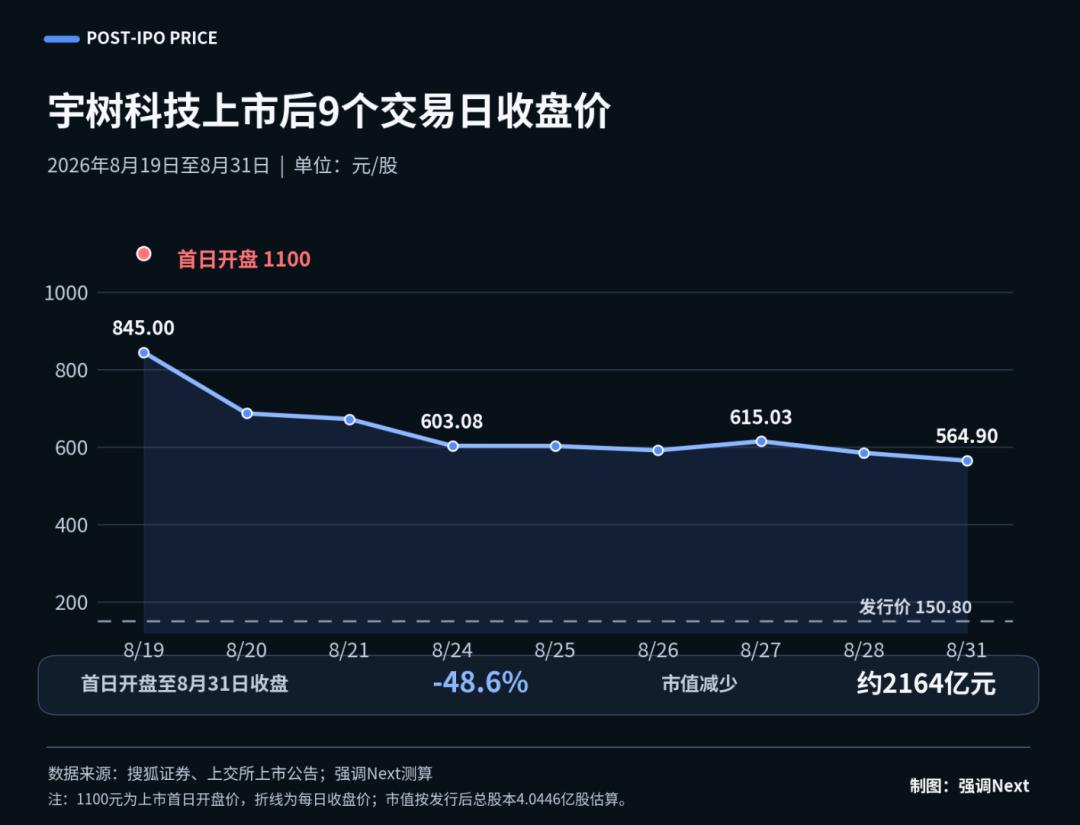
The primary market is so hot that robot ads are placed in elevators, while the secondary market is so cold that the "first stock" saw its share price halved in nine days. These are two sides of the same coin: the source of capital in this industry is starting to be questioned.
Wang Xingxing took the initiative to cool down the market, and Unitree lost its pricing power
On August 20, the second day after Unitree's listing, Wang Xingxing attended the World Robot Conference and gave a speech. He did not mention the listing, share price or the 4449 billion yuan market value throughout the speech. The most impressive point of view in the whole speech was that the "ChatGPT moment" of embodied intelligence has not yet arrived, "it will take 2 to 3 years at the fastest, or 5 to 10 years at the slowest."
The acceptance criteria he gave is: throw a robot into an unfamiliar home or office, and only give voice commands. If it can complete 80% of daily tasks, it can be regarded as reaching the critical point.
On that day, Unitree's share price fell by 18.70%.
This speech is more worth reading carefully than short-selling reports. At the peak of market value, the founder personally marked the industrial realization cycle as "at least two years later", while the market pricing was based on the assumption of "immediate explosion". The subsequent nine trading days in the secondary market are essentially just aligning these two timetables.
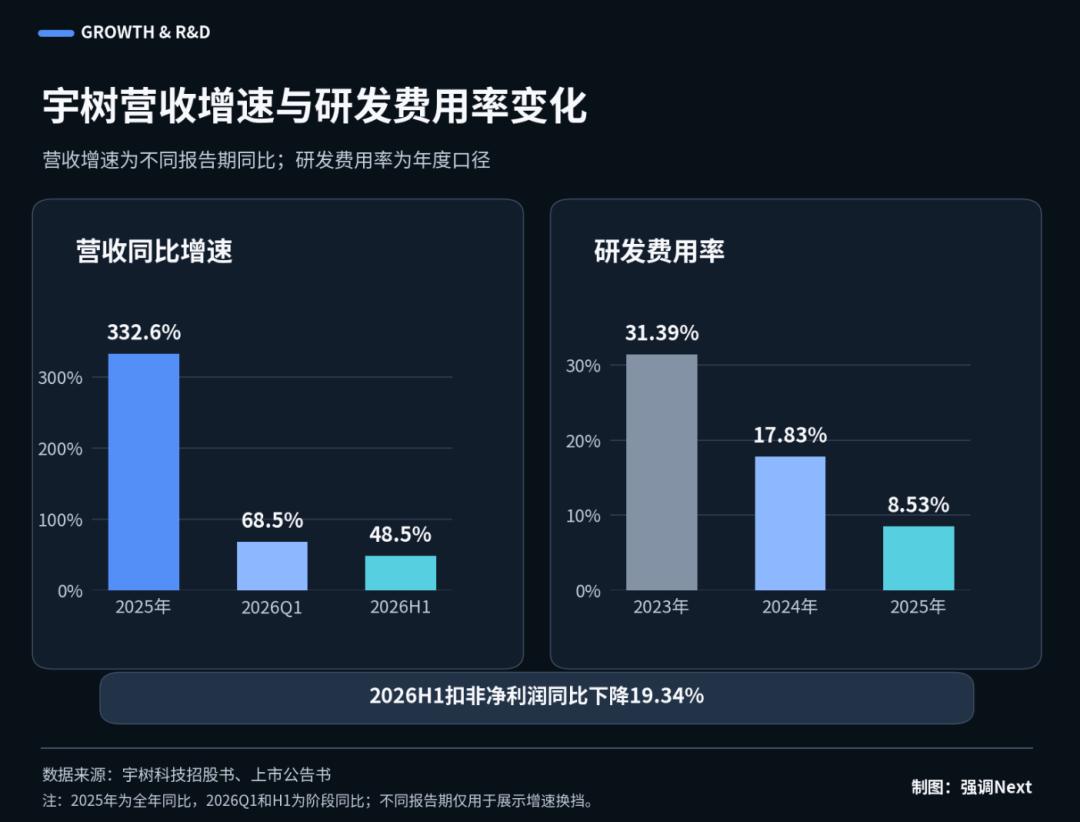
After alignment, we can see that the revenue growth rate dropped from 332% in 2025 to 68.49% in the first quarter and 48.54% in the first half of the year; the non-recurring profit and loss deducted net profit in the first half of the year was 244 million yuan, down 19.34% year on year; in the first three quarters of 2025, 73.6% of humanoid robot revenue came from scientific research and education scenarios, and the industrial penetration rate was about 9%; the R&D expense ratio shrank from 31.39% in 2023 to 8.53%.
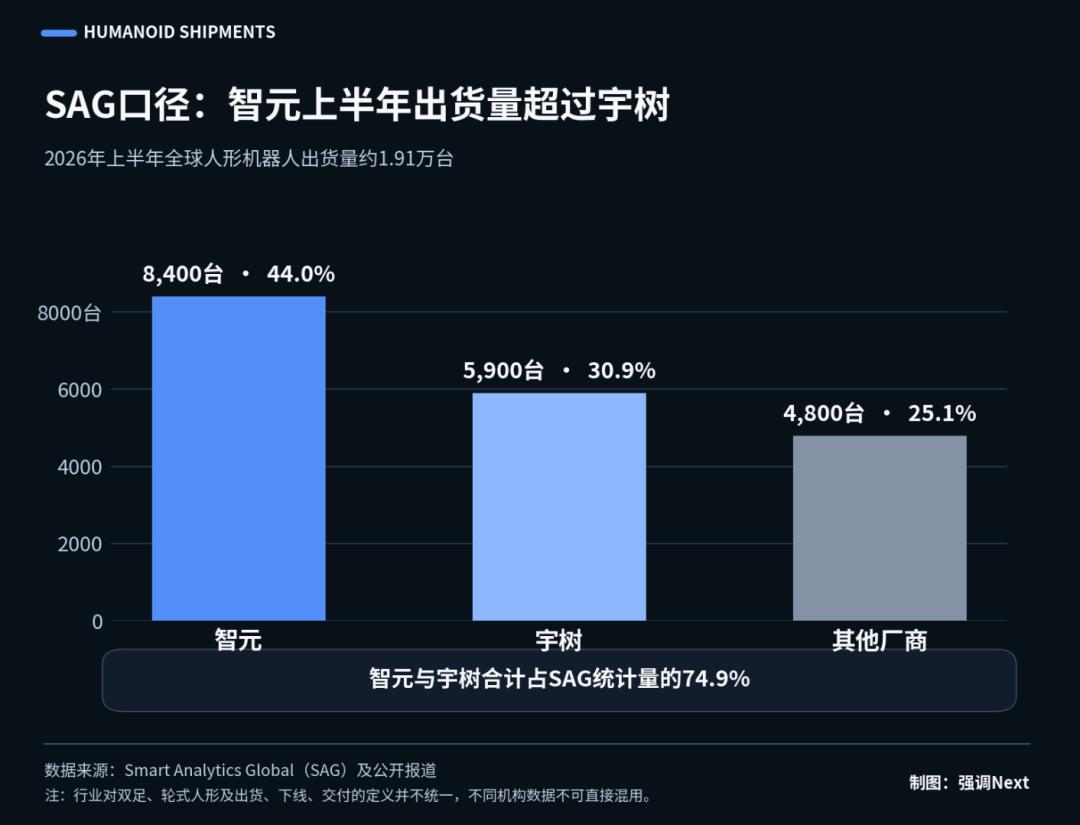
More critically, the industry's market leadership has changed hands. According to statistics from research institution SAG, in the first half of 2026, Agibot ranked first globally with 8400 units sold, accounting for 44% of the market share, while Unitree dropped to second place with 5900 units. That means, according to SAG's statistical caliber, Unitree's "global first" position had already changed hands half a month before its listing.
Unitree is still in an awkward position after its share price halved. The lead underwriter CITIC Securities gave a reasonable valuation range of 50.6 billion to 55.9 billion yuan, while its current market value of 228.5 billion yuan is still 4 times the upper limit of the range.
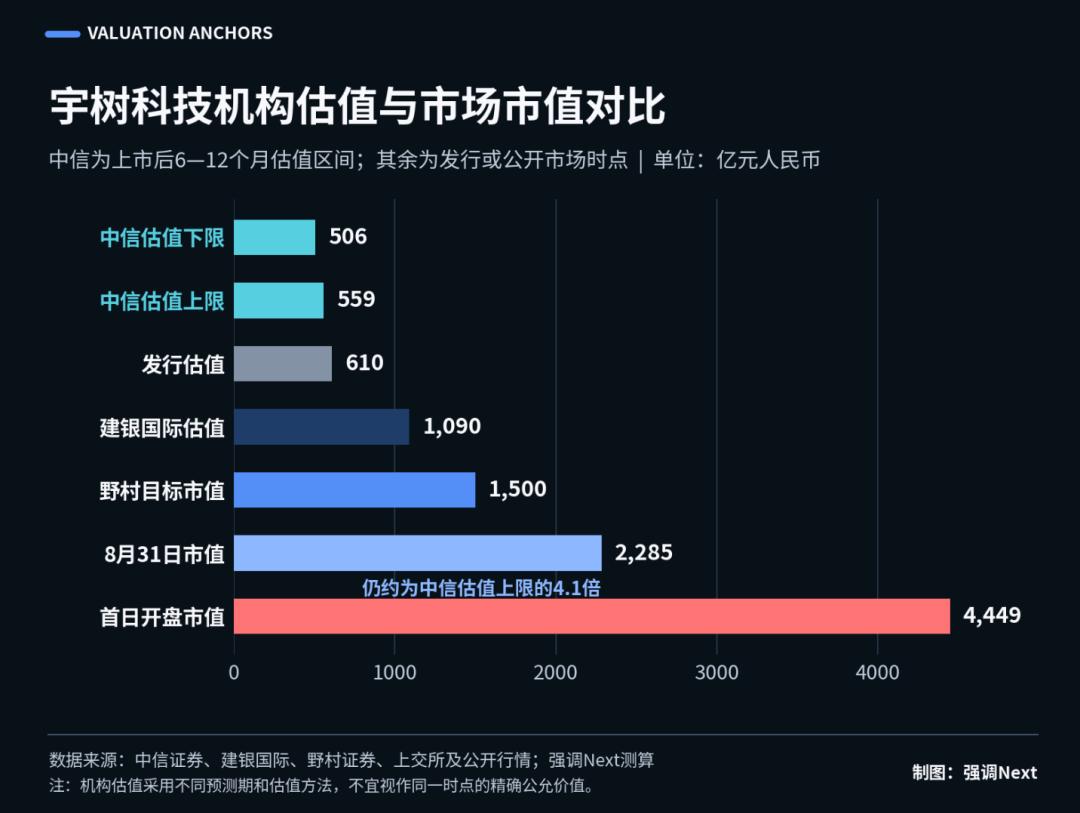
After the share price fell by half, the market still has not found a basis for pricing. This is not the end of negative news, but a symptom of the loss of pricing standards.
Therefore, this round of decline of Unitree has deprived it of the qualification for "scarcity pricing". In the future, if any company wants to obtain a high valuation multiple, labels like "first", "only" and "fastest" may no longer be sufficient.
Agibot: Higher valuation multiple and the accounts that must be made public
The first to take over the baton is Agibot. On July 24, Agibot confirmed that it had initiated the Hong Kong stock listing process. The target valuation given by cornerstone investors is HK$40 billion to HK$50 billion, corresponding to its 2025 revenue of 1.05 billion yuan, which is a price-to-sales ratio of 33 to 41 times, precisely covering the approximately 36 times price-to-sales ratio of Unitree at the time of issuance, higher than the estimated 24 times of Unitree before listing, and much higher than the approximately 19 times of Ubtech on the Hong Kong stock market.
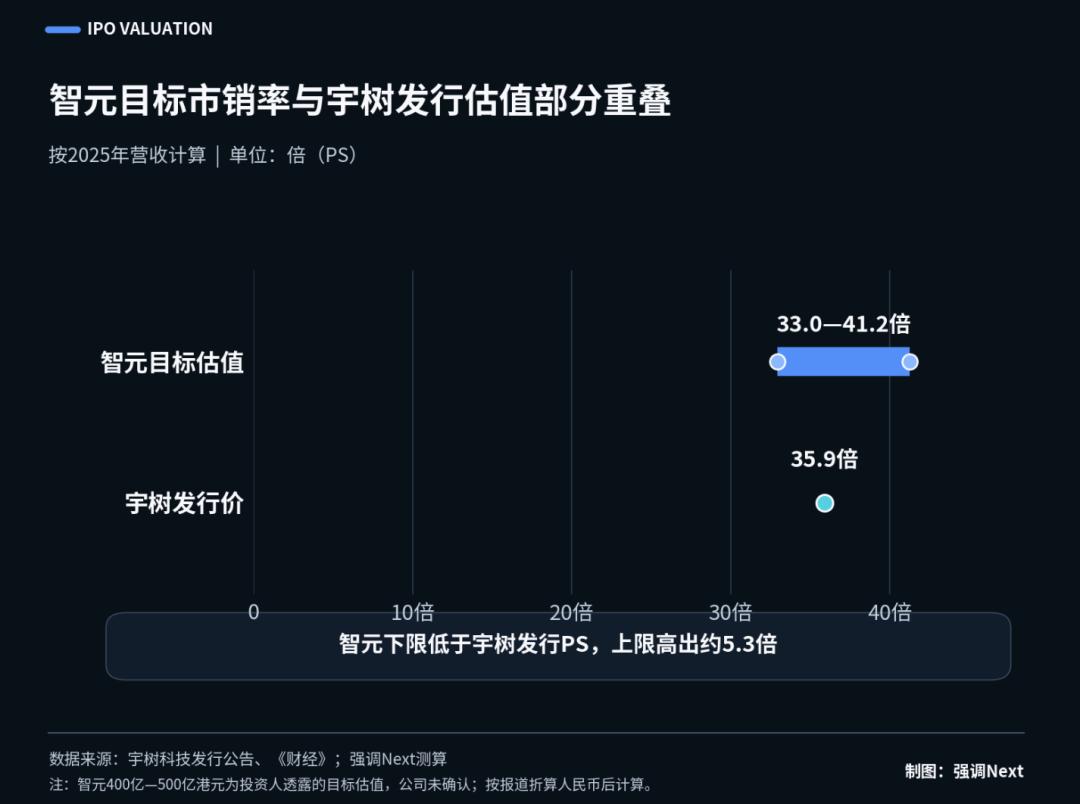
The upper limit that Agibot pursues is a higher pricing than that of the "first stock", and its confidence comes from the top shipment volume it has seized and a more aggressive growth rate. According to reports, Agibot's revenue in the first quarter of 2026 has exceeded 1 billion yuan, catching up with the total revenue of last year.
But there is a key footnote to this report card.
According to the investigation by *Caijing*, behind Agibot's high growth is an ecological model of "trading robots for cooperation opportunities": some investors and ecological partners purchase robots in exchange for cooperation opportunities or orders, and the main payers are entities with government and state-owned capital backgrounds.
Agibot has won more than ten state-owned capital projects directly or indirectly, and the maximum amount of a single "partner procurement" exceeds 100 million yuan; Zhuhai Zhihui Yuanqi, in which it holds a 30% stake, won a 12.736 million yuan procurement project for the local embodied intelligence innovation center, and the state-owned capital controlling shareholder of this joint venture is also a shareholder of Agibot.
This is not a unique practice of Agibot. According to the report of *Caijing*: selling to "partners" is a common phenomenon in the whole industry, and "the essential reason is that the commercialization implementation capability is not mature enough".
When the facts are put together, the problem comes to the surface. A considerable part of the revenue of leading companies in the embodied intelligence industry circulates between their own shareholders and local governments. The transactions are real, but the price and necessity still need to be tested by independent buyers.
This cycle can operate for many years in the primary market. In the secondary market, it will be fully disclosed for the first time in the prospectus.
According to reports, Agibot has accumulated a total loss of about 280 million yuan in three years, and it is expected to achieve overall profitability in 2028. Then at what price does it recognize revenue for the robots sold to shareholders? After excluding related party procurement and government orders, what is the proportion of revenue from independent third parties? Where does the incremental revenue come from to achieve the promised 10 billion yuan revenue in 2027 from the current 1.05 billion yuan?
Agibot's answer will determine how companies like Deep Robotics, Leju Robotics and Pudu Robotics will be audited in the future. Because this is not a risk unique to Agibot, but the compliance cost of the whole industry.
The teams are still sprinting according to the old syllabus
At the same time when Unitree's share price halved, the listing queue did not slow down: the listing applications of Deep Robotics and Leju Robotics have been accepted, Dobot has passed the hearing, Pudu Robotics has submitted its listing application confidentially, and RoBoTech has landed on the Hong Kong Stock Exchange in July. More than 20 embodied intelligence enterprises have listing plans in 2026.
The primary market has sufficient ammunition. In the first half of the year, there were 137 equity financing events in the track, with the total amount exceeding 900 billion yuan, a year-on-year increase of 215%; Galaxy Universal has a post-investment valuation of about 26 billion yuan with an annual revenue of only several hundred million yuan, and the number of 10-billion-yuan unicorns has expanded to more than a dozen. Songyan Dynamics' elevator ad is exactly a footnote: there is so much financing that it spills over to the mass communication side (part of the reason is that it needs to prove its revenue faster).
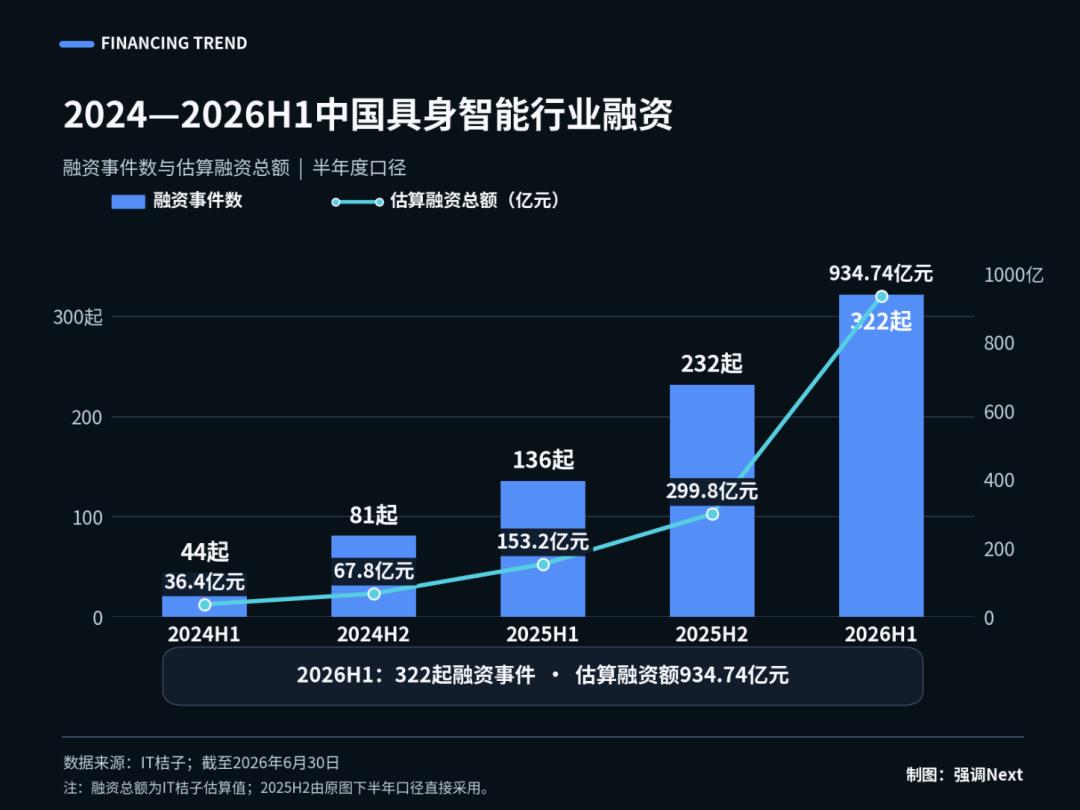
Why is the primary market still accelerating? Because the primary market does not price the company's value, but the listing seat.
The pre-review mechanism of the Sci-Tech Innovation Board compressed Unitree's IPO to 104 days. The 18C rules of the Hong Kong Stock Exchange and the fourth set of standards of the Growth Enterprise Market allow unprofitable enterprises to go public, and the system has improved the probability of listing. As long as the channel is still open, the logic of "I will not take the last baton" holds. Unitree's pre-listing valuation was about 46 billion yuan, and its market value after halving is still more than 200 billion yuan, giving early investors several times of returns.
The weakness of this system is also obvious: it is extremely sensitive to regulatory trends, but not necessarily sensitive to technological progress. After the A-share market tightened IPOs in stages in the second half of 2023, a large number of unprofitable enterprises withdrew their applications, and Pre-IPO valuations were generally revised down within several months. For companies in the listing queue, the real time bomb is not the next technical debate, but the subtle changes in the audit rhythm.
What is the real foundation, and how much time is left
In the first half of this year, the global shipment volume of humanoid robots reached 19,100 units, a year-on-year increase of 3 times. Chinese manufacturers accounted for 97% of the total, and the proportion of industrial and commercial scenarios rose from about 50% to more than 70%.
The order volume of components also increased significantly. The revenue of Green Harmonic's humanoid reducer in the first half of the year increased by 38.64% year on year, and the revenue of MOONS' Electric's humanoid motor increased by 380%. These orders directly derived from the volume growth of complete machines are data that are much harder to falsify.
But on top of the real foundation, the price is collapsing along a curve: Unitree G1 is priced from 99,000 yuan, R1 is reduced to 29,900 yuan, and Xiaobumi is directly priced at 9998 yuan. The price of complete machines has rushed to the 10,000-yuan level in more than two years, while the BOM disassembly of Optimus by GF Securities is about 316,000 yuan.
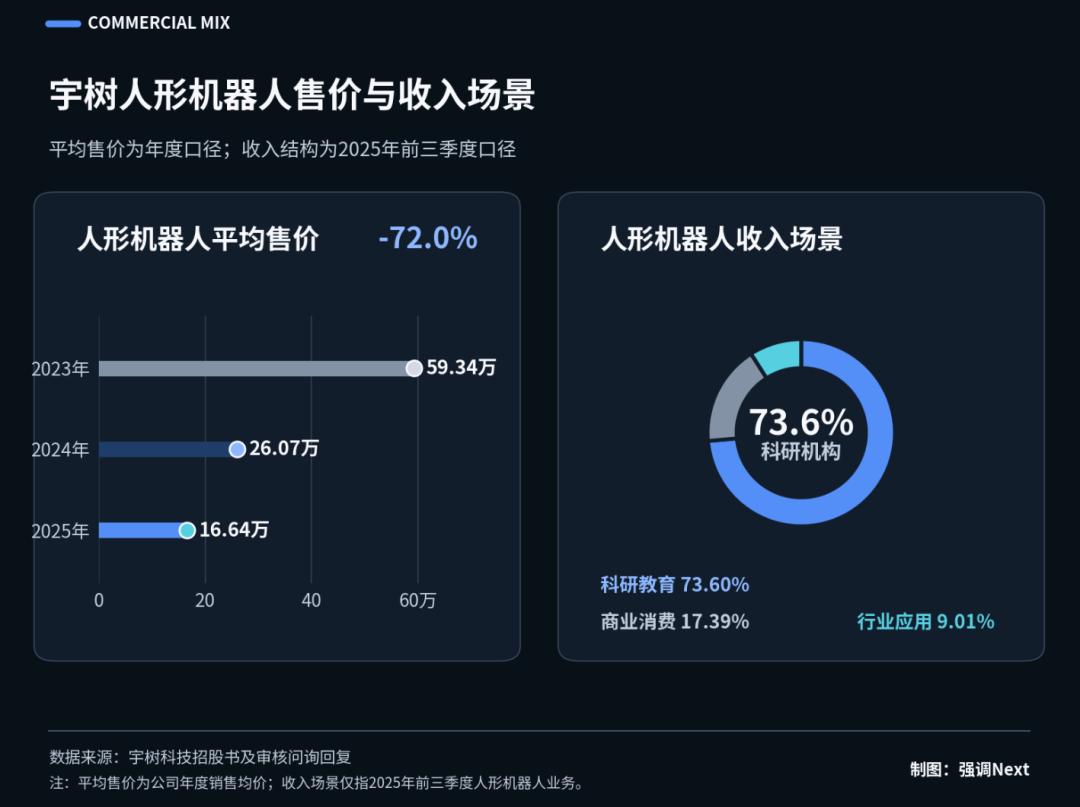
The gap in between can only be reduced by scale effect, or subsidized by shareholders. The lithium battery industry chain has demonstrated the outcome: at the initial stage of mass production, the component links reaped all the dividends. Once the price war starts, profits will quickly flow back to the complete machine manufacturers, and then be eaten by involution. The more full the component orders are today, the faster the price war will break out tomorrow.
The industry reshuffle sequence will strictly follow the quality of revenue, and component companies whose revenue all comes from independent customers are the safest. Among complete machine manufacturers, those whose revenue can pass the test of "excluding related parties" can survive this round.
Those whose valuations are based on partner procurement and government orders will be exposed one after another at the two nodes of listing pricing and share unlocking. The quality of revenue is the only hard currency in this industry in the next 18 months.
Wang Xingxing finished the timetable on the second day after listing: 2 to 3 years at the fastest, 5 to 10 years at the slowest. The market caught up with half of this judgment in nine trading days, and the remaining half will continue to be fulfilled on the day when Agibot opens its accounts.
Note: The data in this article comes from public reports and materials, and does not constitute investment advice.
This article is from the WeChat Official Account "Emphasize Next" (ID: leo89203898), written by Hua Wen, edited by Xiao Bai, and officially released by 36Kr with authorization.