The tax exemption dividend is gone. Are electric vehicles about to increase in price?
Today marks the first day of the battery consumption tax levy, which seems small at only 2%. However, this is a historic day.
From today onwards, the era of "tax exemption dividends" enjoyed by the new energy industry has come to an end. China's new energy industry has grown up and it is time to take corresponding responsibilities.
And the "equal rights for gasoline and electric vehicles" has finally ushered in the dawn of hope after long-awaited calls. This also echoes the prelude to the evolution of the 4:4:2 multi-route path in the "Energy Saving and New Energy Vehicle Technology Roadmap 3.0".
So how much impact will the battery consumption tax have? Personally, in the short term, automakers will bear the cost and are fully capable of doing so, leading to little tangible impact. But in the medium and long term, this is a "butterfly effect": the butterfly has just flapped its wings now, and a storm sweeping the entire industry is expected to break out later.
The wool comes from the sheep?
This battery consumption tax refers to the Announcement No. 20 "Announcement on Adjusting Some Battery Consumption Tax Policies" jointly issued by the Ministry of Finance, the General Administration of Customs, and the State Taxation Administration on July 16.
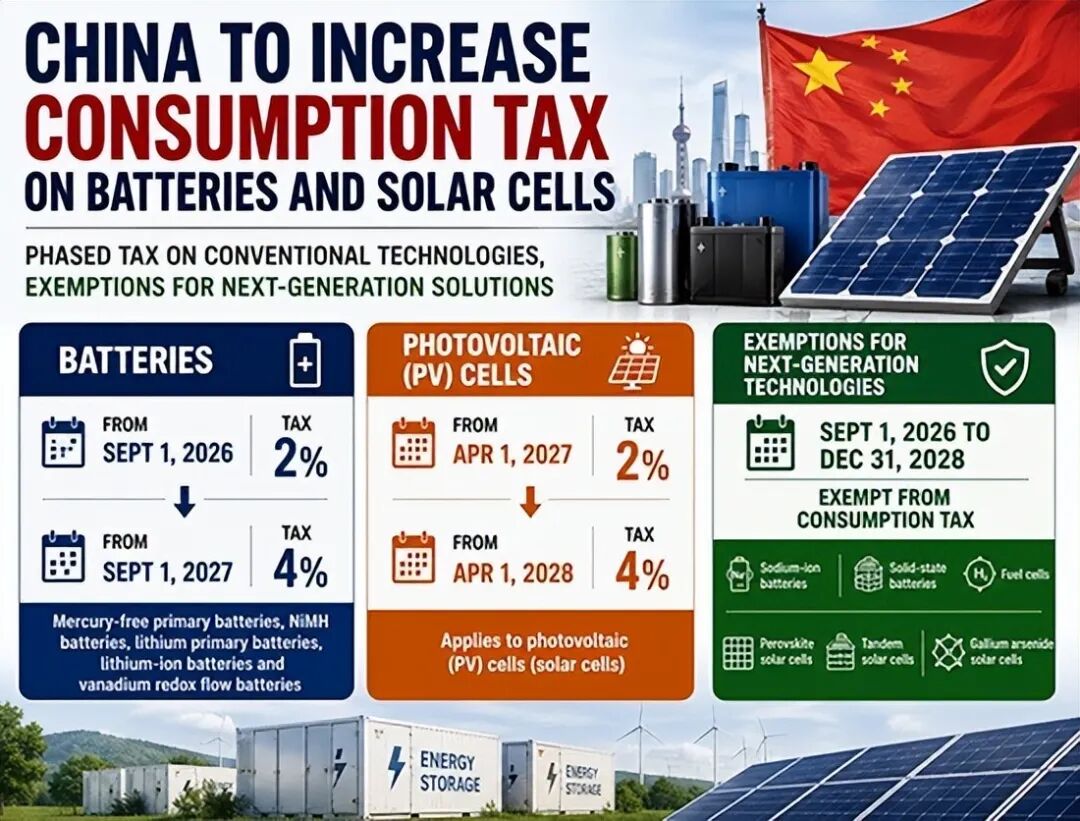
The announcement clearly states that starting from September 1, 2026, a 2% consumption tax will be levied on mercury-free primary batteries, metal hydride nickel storage batteries, lithium primary batteries, lithium-ion storage batteries, and all-vanadium flow batteries. In addition, the tax rate will be raised to 4% starting from September 1, 2027.
The implementation of the new policy puts an end to the 11-year tax-free history of categories such as lithium-ion batteries specified in the announcement on adjusting some battery consumption tax policies.
In fact, for the country, the battery industry system, which has grown to be the largest in the world, can no longer rely on low costs to gain market share, and it is necessary to support new technologies and new products. This requires giving full play to the regulatory and guiding role of consumption tax, promoting the structural upgrading of the battery industry system, and reserving development space and opportunity windows for sodium-ion batteries, solid-state batteries, fuel cells and other new battery technologies.
According to the current average price of 0.36~0.4 yuan/Wh for lithium iron phosphate cells, the battery cost of a pure electric vehicle equipped with a 60kWh battery pack is about 22,000~24,000 yuan (the price of CATL's products is 5~20% higher). The 2% tax amounts to 440~480 yuan. However, even though it is only a few hundred yuan, under the current fierce competition situation, both automakers and battery enterprises are facing considerable pressure that is hard to bear.
After all, at first glance, this sum of money accounts for less than 1% of the total vehicle price according to calculations. But if we take a broader view, the average profit margin of China's complete automobile manufacturing industry from January to May 2026 is only 1.5%, so this 2% tax is quite a heavy burden. Many enterprises only make a profit of several thousand yuan per vehicle, and some even have a profit as low as only tens of yuan per vehicle.
Therefore, although this price increase seems not large, automakers, caught in fierce price wars and cutthroat internal competition, will have to consider whether to grit their teeth and bear the cost themselves if they can.
At the terminal market, for entry-level electric vehicles priced below 100,000 yuan, an extra cost of several hundred to one thousand yuan accounts for nearly 1% of the total price, and consumers are extremely sensitive to such changes. Price increases will definitely affect sales, so no brand will raise prices if they can avoid it. For high-end electric vehicles priced above 300,000 yuan, this extra cost is almost negligible. The real pain point falls on the models priced between 100,000 and 300,000 yuan. Whether to raise prices or not has become a difficult choice just like "To be or not to be".
However, even if automakers can avoid raising prices in the short term, in the medium and long term, this part of the cost will definitely return to the vehicle price or configuration in the form of a boomerang, and eventually, the consumers will still pay for all the extra cost.
Of course, there is also a process of negotiation and game between automakers, battery suppliers and even upstream material suppliers.
According to the conventional practice of the industry, after the consumption tax policy was released on July 16, major automakers and battery enterprises have already launched intensive consultations on who will bear the new consumption tax for batteries delivered after September 1.
There is a detail here: the time when the tax obligation occurs is the time when the batteries are shipped out of the factory and invoices are issued, not the time when the contract is signed. In other words, even the 3~5 year long-term cooperative orders signed before will not be exempted, and the tax still needs to be paid for batteries shipped after September 1.
According to the information currently available, the result of the negotiation is roughly as follows: for the existing long-term cooperative orders finalized in the first half of the year, which are scheduled to be delivered gradually from the third quarter to the end of the year, the new consumption tax cost can only be digested by the automakers themselves. This is understandable, as no one expected such a policy change before.
For the fourth quarter procurement orders newly negotiated after the policy was released in July, the two parties will generally split the cost 50/50, each bearing half. But for second-tier battery suppliers, due to their weaker strength, most of the negotiations will end up with automakers bearing 60% and the suppliers bearing 40%.
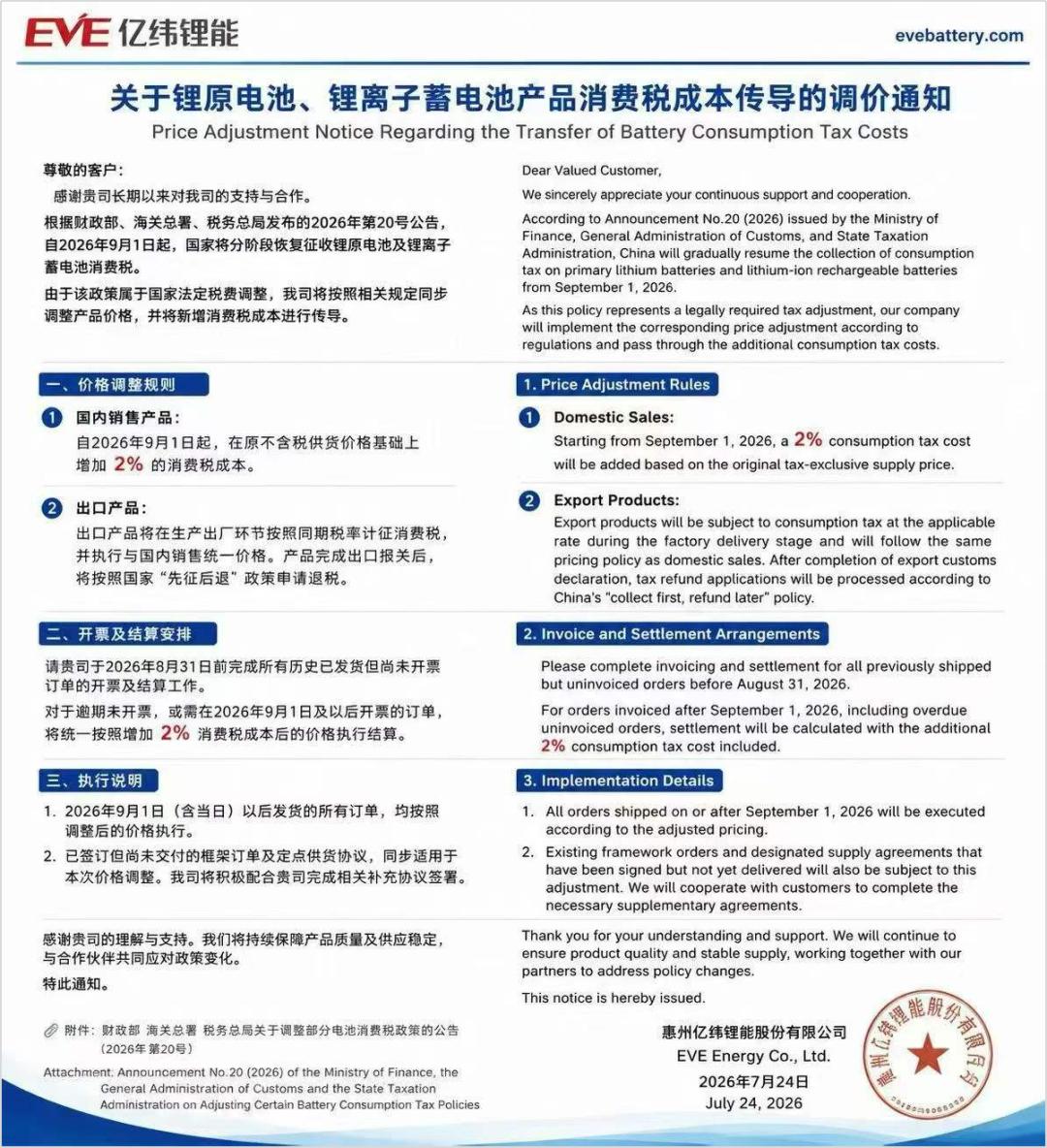
No matter how the negotiation goes, the price will definitely rise. As the tax levy is approaching, many domestic battery manufacturers have announced price increases. For example, on July 27, EVE issued a "Price Adjustment Letter for Passing on Consumption Tax Costs", making it clear that starting from September 1, a 2% consumption tax will be added to the original tax-exclusive supply price of domestically sold battery products.
On August 18, Lishen Battery (Suzhou) issued a customer contact letter, stating that a 2% consumption tax and additional taxes and fees will be added starting from September 1.
CATL is no exception. It announced that starting from August 1, the quotation for 314Ah cells was raised from 0.414 yuan/Wh to 0.423 yuan/Wh, an increase of about 2.17%. Some other small and medium-sized manufacturers also followed up with price increases.
Of course, for automakers, it is rather difficult that they can neither easily raise the selling price of terminal models nor fully digest the new consumption tax cost.
What is the best solution? Automakers develop and produce batteries by themselves.
For leading enterprises with complete self-owned battery production capabilities such as BYD, Chery, and Geely, according to the current policy, taxpayers do not need to pay consumption tax if they use self-produced taxable battery products for continuous production of other taxable battery products.
Taking Rhino Battery under Chery and FinDreams Battery under BYD as examples, the link where their produced cells are continuously processed into PACK within their own system meets the tax exemption conditions for self-produced and self-used products for continuous production, which can reduce the occupation of tax funds in intermediate links. This kind of capability is definitely far better than that of automakers who purchase all cells from external suppliers. This also reflects that competition ultimately depends on technical strength.
As the saying goes, a single move affects the whole body. The transmission chain brought by this consumption tax is passing the cost from automakers to battery enterprises, and then from battery enterprises to material suppliers. Each link has to digest part of the cost, and in the end, the small and medium-sized cell factories and material suppliers with no bargaining power are likely to bear the largest share of the cost.
The Curtain of "Equal Rights for Gasoline and Electric Vehicles" Is Raised
From another perspective, for consumers, the price difference between placing an order before September 1 and after September 1 is only several hundred to one thousand yuan even if there is a price increase. No matter what, the actual experience will not be very different. On the contrary, the cost of choosing the wrong model is far greater than the money saved on the tax.
In fact, what is really worth paying attention to is the medium and long-term trend. For ordinary consumers, this tax levy means two things:
First, the expectation that electric vehicles will "always be cheap" has been broken. Second, consumers need to calculate the total cost of car purchase, including purchase tax, battery tax, vehicle and vessel tax, and residual value of second-hand cars. The era of "10 cents per kilometer" is over. This is also the reason why a number of joint-venture gasoline vehicles have become surprisingly cost-effective this year.
This also leads to a question: the first half of 2026 was the highlight moment for pure electric vehicles to achieve counterattack. Will the arrival of consumption tax make the industry "apply the brakes gently" again?
In the first half of the year, with the Strait of Hormuz blocked, pure electric vehicles ushered in an unprecedented boom. Subsequently, automakers responded quickly: Li Auto shifted its focus to pure electric vehicles, Leapmotor downplayed extended-range electric vehicles, and with NIO ES9, NIO ES8, Li Auto i6, and Xiaomi YU7 gaining great popularity, the 250,000~450,000 yuan pure electric SUV market saw explosive growth. At the Beijing Auto Show, the number of pure electric models exceeded the sum of fuel vehicles and plug-in hybrid vehicles for the first time...
After the new energy penetration rate has stayed above 60% for three consecutive months, pure electric vehicles have become the largest pillar of sales. However, this consumption tax is very likely to make the galloping pure electric vehicle market "apply the brakes gently".
Of course, this is not the first time the battery consumption tax has slowed down the industry, there have been two previous times.
The first one was the purchase tax policy changing from "full exemption" to "half reduction" at the beginning of the year. Starting from January 1, the new energy vehicle purchase tax was changed from full exemption to half levy, with a maximum tax reduction of 15,000 yuan per vehicle (it was fully exempted with a maximum of 30,000 yuan per vehicle in 2024~2025). For a 200,000-yuan electric vehicle, consumers need to pay about 10,000 yuan more since 2026.
The effect of this half reduction of purchase tax is very direct: the market temperature dropped sharply, and the industry faced a very tough situation in the first two months. If the conflict between the US and Iran had not broken out, the situation would not have improved so quickly.
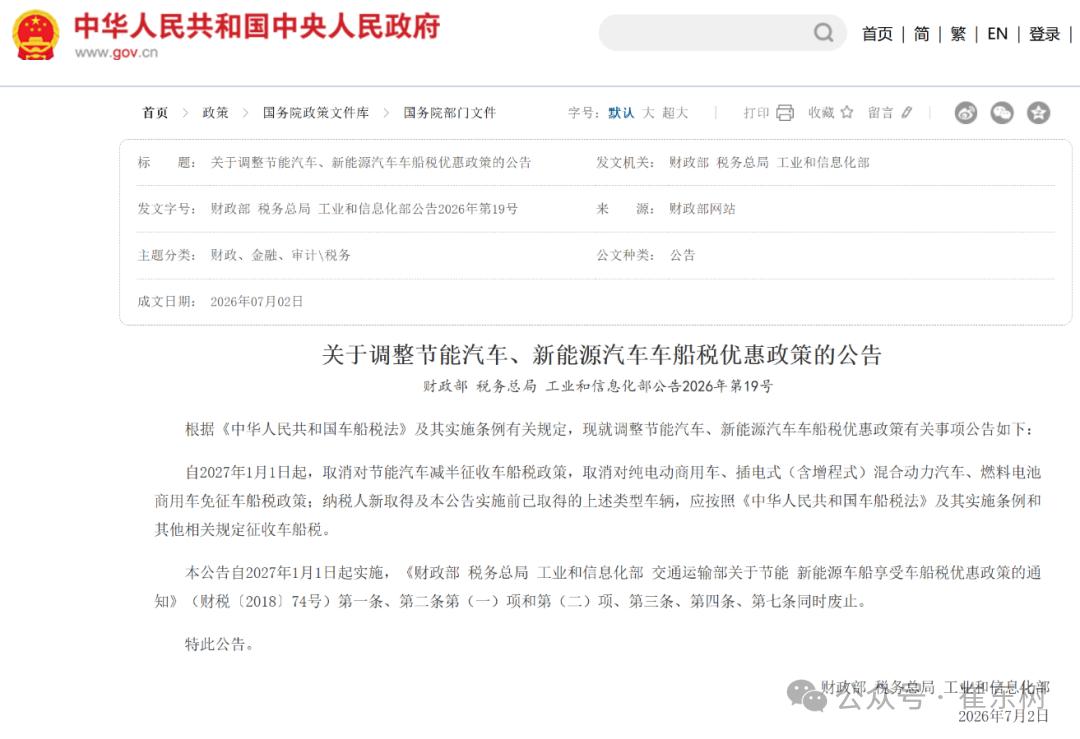
The second gentle brake was the withdrawal of the vehicle and vessel tax preference. On July 3, the three government departments jointly issued an announcement, stating that the preferential policy of exempting pure electric commercial vehicles, plug-in hybrid vehicles and other models from vehicle and vessel tax will be canceled starting from January 1, 2027. This policy that has been implemented for nearly 15 years has officially entered the exit channel.
This is exactly what China National Radio and Television Online stated, "The tax preferential system covering the whole chain of car purchase, car use and production is being withdrawn in an orderly manner in stages."
So what will the situation be like after the battery consumption tax is levied this time?
Cui Dongshu, Secretary General of the China Passenger Car Association, believes that "the adjustment of energy-saving and new energy vehicle and vessel tax policies this time is a landmark step for the implementation of the 'equal rights for gasoline and electric vehicles' reform in China's automobile industry, and it is also a key tax system optimization for the new energy industry to fully move from the policy support period to a mature market-oriented stage."
In other words, the curtain of "equal rights for gasoline and electric vehicles" has been officially raised. After new energy vehicles grew from scratch to a mainstream category with a penetration rate of 65.8%, the "cultivation period" or "policy support period" is finally coming to an end. In the future, the competition will focus on product strength rather than policy dividends.
This is certainly a good thing for fuel vehicles. In the past, fuel vehicles were "the side suppressed by policies", but now electric vehicles are also subject to taxation, so as long as fuel vehicles have strong product strength (fuel-efficient, reliable, high residual value), they can compete with electric vehicles in a relatively fair environment in the future.
Cui Dongshu put it very aptly: equal rights for gasoline and electric vehicles does not mean one-size-fits-all equalization. It is to establish an automobile tax system with matching rights and responsibilities and fair tax burden based on technical attributes, emission characteristics and usage scenarios, forcing the industry to shift from competing for policy dividends to competing for product strength.
From the half reduction of purchase tax, to the levy of vehicle and vessel tax, and then to the introduction of battery consumption tax, the arrival of "equal rights for gasoline and electric vehicles" also means that the era of new energy vehicles competing with policy subsidies is coming to an end, and the next stage will be a stage of real strength competition. Consumers also need to keep their eyes open to see the situation clearly.
This article is from the WeChat official account "Auto Community" (ID: iAUTO2010), written by Wang Xiaoxi, and authorized for release by 36Kr.