Raised 100 million yuan in financing, a group of post-1990s entrepreneurs in Shenzhen developed an AI assistant that has received orders from 12,000 people.
Before OpenClaw took the world by storm, a post-90s startup team based in Shenzhen had already begun experimenting to pack similar Agent capabilities into a palm-sized hardware device.
This product is Violoop.
It is equipped with an independent chip and edge-side computing power, connects to existing computers via HDMI and USB, sees the screen, uses the keyboard and mouse like a human, and completes real work across applications. Even if the user leaves the computer, it can continue to perform authorized tasks.
Violoop aims to make a plug-and-play AI assistant accessible to ordinary consumers.
At present, Violoop has completed angel round and Pre-A round financing of over 100 million yuan. Lenovo Capital and Incubator Group, CICC Porsche, BlueRun Ventures, YuanSheng Capital, Qifu Capital and Zero2IPO Ventures co-invested, with Sunward Capital acting as the long-term exclusive financial advisor.
He Jialin, the founder of Violoop, is a post-90s generation, born in Shenyang, and moved to Zimbabwe with his parents when he was a teenager, where he spent his entire high school years. In 2012, he enrolled in the University of California, San Diego to study software engineering.
Before founding Violoop, He Jialin and his team deployed local AI models for a Fortune 500 consumer goods giant, and used AI to reconstruct the enterprise's original knowledge base. The project generated considerable revenue, but it was complex to deliver and difficult to scale.
This experience also led him to raise two questions:
Can the exclusive AI that only enterprises can afford be compressed into a desktop product that ordinary consumers can buy? After people leave the computer, can AI continue to help them finish their work?
These two questions eventually became the starting point of Violoop.
Up to now, about 12,000 overseas users of Violoop have paid deposits, and the product is scheduled to be officially launched in September.
Recently, Pencil News conducted an exclusive interview with He Jialin. He believes that as AI evolves from answering questions to performing work, a new type of personal computing device may emerge accordingly —
It will not replace computers, but connect to them, gradually becoming an AI that knows how to use computers, understands personal work styles and keeps growing.
- 01 - Why Do You Need a Piece of Hardware for AI to Do Work?
"AI is clearly getting more and more powerful, so why are humans still the ones doing the actual work?"
"Why can AI only answer questions in the dialog box, instead of entering the computer, using existing software, and helping people complete the real work that happens every day?"
In the process of deploying internal models for Fortune 500 companies, He Jialin's team hoped that AI could "grow hands and feet" to take on complete work tasks.
Around August or September last year, the team officially finalized the product direction of Violoop.
Violoop chose the hardware form not simply to put a shell on the software.
Because the hardware allows AI to be present continuously. It determines how the system connects to the computer, how it obtains context, which calculations can be completed locally, and how the permission boundary between AI and humans is established.
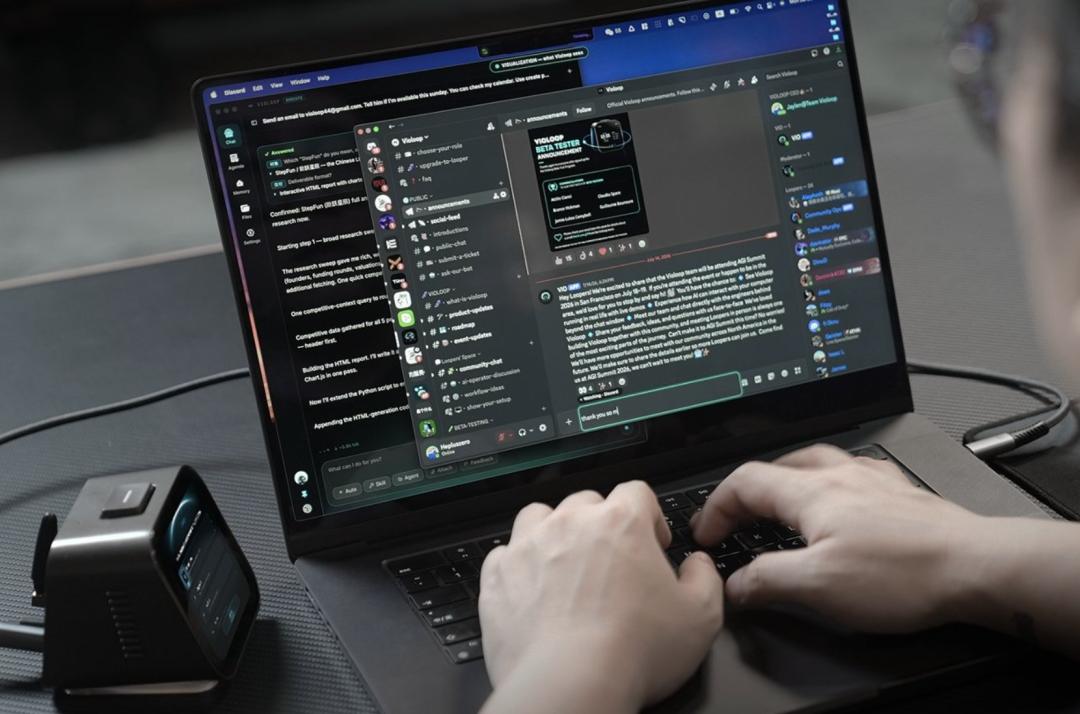
Violoop Product Photo
What the software determines is what it can understand and complete after entering the work scenario, and whether it can continue to grow in long-term use.
Violoop has long-term memory, with a memory system that gradually evolves around the individual's real work.
Secondly, Violoop's "hands and feet" (Agent Harness) is very well-measured. In the process of working, it will not only generate its own ideas (understand tasks, call tools), but also recognize boundaries (stop and wait for human confirmation when necessary).
Apart from these, Violoop has two other differences from ordinary AI products.
First, continuous presence and global context understanding.
Over the past year, many voice recording rings, voice recording necklaces and voice recording cards have appeared on the market. They are trying to solve the same problem: how to obtain more user context to build long-term memory for AI?
Most of these products start from wearable devices and voice recording, while Violoop chooses the computer desktop as its entry point.
He Jialin told Pencil News that the information density of computer screens is far higher than several meetings in a day. A large number of a person's projects, files, emails, communications, judgments and work results are generated on the computer screen.
If AI cannot enter this environment, the information it obtains is often only partial information that users actively copy, organize and submit to it.
With user authorization, Violoop can continuously obtain high-density screen context, and complete perception, filtering and long-term memory construction locally as much as possible; for really complex reasoning tasks, it will hand them over to the cloud large model through model routing.
"The foundational model is enabling AI to learn the world, and we hope to make Violoop learn every individual," He Jialin said.
The second difference is computer use, which means that AI can use computers just like humans.
Pure software Agent is usually restricted by operating system permissions, application compatibility and API coverage. Many software do not open interfaces for AI, and some web page logins, system permissions and local applications are also difficult to be uniformly connected.
Violoop chooses the interaction method that humans have used for decades: understand what is happening through the screen, and then complete operations through the keyboard and mouse.
This path does not require all software to be modified for AI one by one, nor is it limited to a small number of applications that have opened standard APIs. Theoretically, all the work that humans can complete through the screen, keyboard and mouse can be covered by its capabilities.
At the same time, completing screen image processing and part of model analysis locally also helps reduce cloud computing costs and avoid unnecessary leakage of sensitive data.
- 02 - Software Gross Margin, Long-term Target of 70%
Around early January this year, He Jialin noticed OpenClaw for the first time. At that time, it had already gained high popularity on GitHub.

He Jialin, Founder of Violoop
His first reaction was: Finally, someone has the same idea as Violoop.
At the same time, he had a thought that is hard for entrepreneurs to avoid: Why weren't we the first to be noticed?
The reason is not complicated.
Violoop had hardly done any external promotion before, nor did it open its code repository. The team chose a slower hardware path, hoping to finally deliver a complete and stable consumer product to users, rather than an open-source framework that is mainly for engineers and requires users to configure and maintain by themselves.
The popularity of OpenClaw has also made more people see the practical problems in the implementation of Agent, including privacy and permission boundaries, security risks, and high and uncontrollable Token consumption.
Compared with the pure open-source framework, Violoop's business model mainly consists of two parts.
The first part is hardware sales; the second part is continuous software and model services.
However, Violoop will not force users to purchase model packages. If users already have APIs for Kimi, GLM, DeepSeek or other models, they can directly connect to the device for use.
If users choose the model package provided by Violoop, they can call a variety of mainstream models in a unified manner. The system will balance effect, speed and cost through the model scheduling layer: call models with stronger capabilities for complex tasks, and assign simple tasks to models with faster speed and lower cost.
At the same time, Violoop is training and testing its own models, which are currently mainly divided into two directions: one focuses on task understanding and task decomposition, and the other focuses on specific execution.
As the self-developed models gradually mature, some suitable tasks can be assigned to the self-owned models for processing, so as to reduce the cost of calling external models.
At present, the gross profit margin of Violoop's software package is about 30%. He Jialin predicts that as the proportion of tasks undertaken by self-developed models increases in the future, the long-term gross profit margin of the software business will gradually move towards 70%.
The 70% here refers to the long-term target of the software business, not the current comprehensive gross profit margin of the hardware and software businesses.
Up to now, about 12,000 overseas users of Violoop have paid deposits.
Judging from the existing user portraits, more than 30% are geek users, but more than 55% of users are not traditional tech enthusiasts, but entrepreneurs, heads of small teams and operators of small and medium-sized enterprises.
This group of people has one common feature: efficiency improvement can be directly converted into economic benefits.
They buy Violoop not just because AI hardware is novel enough, but because they hope one person can complete the work that used to require more people and longer time to finish.
This is somewhat similar to the core buyers in the early days of personal computers. The first batch of personal computer users bought not just a new device, but a re-amplification of personal productivity.
- 03 - Eliminate Prompts, Let AI Work More Proactively
In the process of testing the product together with users around the world, the Violoop team also found another more common problem —
What prevents AI and Agent from entering real production work is often not only the model capability, but the prompt itself.
In order to make AI complete a complex task, users usually need to stop their ongoing work first, reorganize the background, find materials, explain the goals, break down the steps, and then compress the context originally scattered in the screen, files, historical records and personal experience into a clear, structured and machine-understandable prompt.
For a small number of skilled users, this is a skill; but for most ordinary users, it adds extra work instead.
This led Violoop to form another judgment: The direction of the next generation of human-computer interaction is not to make everyone a prompt engineer, but to make AI no longer rely on a complete prompt to start understanding and working.
Violoop hopes to "kill the prompt".
What is to be eliminated here is not human intention, nor the communication between humans and AI, but the prompt as a necessary prerequisite for AI to start working.
People no longer need to write a complete "work instruction" for each task, but only need to express the goal, calibrate the direction, and retain the final decision-making power.
Prompts will not disappear completely overnight, but they will gradually retreat from the necessary starting point of every work to a tool used for supplement and correction when necessary.
Violoop calls this capability Artificial Intuition.
Human intuition is not some mysterious talent, but a quick judgment formed after a large amount of experience is compressed.
The same is true for Agent. Only when it continuously participates in real work, accumulates sufficient task experience, understands a person's preferences, habits and boundaries, and constantly obtains result feedback and correction, can it complete the correct preparation in advance at the right time.
But being proactive does not mean making all decisions for people.
According to Violoop's product design, the system can understand in advance, organize information and complete reversible operations; when the task involves irreversible behaviors, it must stop and wait for the user to confirm through the physical button.
AI can always be present, but the power will not be transferred as a result.
What Violoop hopes to establish is a new personal computing relationship: understanding occurs before instructions, actions are always subject to human authorization, and personal intelligence continues to grow in long-term collaboration.
This article does not constitute any investment advice.
This article is from the WeChat Official Account "Pencil News" (ID: pencilnews), author: Huang Xiaogui, editor: Zou Wei, published with authorization from 36Kr.