Major upheaval is sweeping the dairy industry: some players are advancing light-footed, while others are surging ahead at full speed.
In late August, the semi-annual reports of dairy enterprises are released intensively. The two leading giants Yili and Mengniu disclosed their performance on the same day, Junlebao updated its IPO application materials, and brands including Milkland, New Dairy, and Tianrun Dairy have all released their performance reports.
Some say the dairy industry is still going through tough times, while others claim the inflection point has arrived. What is the truth exactly?
On one hand, consumers find milk is getting cheaper and promotions in supermarkets are becoming more frequent; on the other hand, enterprises including Yili, Mengniu, New Dairy, and Milkland have seen their revenue resume growth, and some upstream animal husbandry companies have also turned losses into profits. The industry is clearly no longer in the era where growth could be achieved simply by expanding distribution and raising prices, but it is far from losing opportunities. It is going through a long-term rebalancing of supply and demand.
The most notable point in this round of semi-annual reports is not that any single company has earned several hundred million yuan more, but that the profit model of dairy enterprises has changed. Scale is still important, while product structure, channel efficiency, milk source management and segmented scenarios have already determined whether an enterprise can truly convert revenue into profits.
The dairy business is far from simple
Before talking about performance, let's first introduce the landscape of the dairy industry.
This is a typical industry featured with long industrial chain and heavy assets. Every link from raising cows on pastures to cold chain transportation, from sterilization and filling to end shelves, requires massive capital investment.
Even a slight fluctuation in raw milk prices will bring hardship to upstream pastures while benefiting downstream dairy enterprises, and vice versa. Over the past four years, raw milk prices have dropped by about 30% cumulatively from the peak, with the adjustment duration and range exceeding the previous two cycles.
Many small and medium-sized pastures cannot withstand the pressure, and the number of dairy cows on hand has decreased by 550,000 head from the peak. The upstream de-capacity leaves downstream enterprises with room for bargaining, which is the underlying logic of the dairy industry cycle.
Another feature is high-frequency rigid demand with slowing growth. China's per capita dairy consumption still lags behind that of developed countries, but the industry has bid farewell to the high-growth era of extensive expansion.
From 2019 to 2025, the average annual compound growth rate of China's dairy market retail sales is only 1.8%. In the era of stock competition, enterprises with better product structure and higher brand premium will perform better.
The latest hot topic in the industry is inseparable from the "inflection point of the raw milk cycle". Since mid-July, milk prices have turned positive year-on-year earlier than the market expectation of a recovery in the second half of the year.
Data from the National Bureau of Statistics of China also confirms this point: from January to June, the domestic dairy output reached 15.184 million tons, a year-on-year increase of 5.8%, and the operating rate at the processing end has rebounded.
The capacity clearance is nearing the end, the demand side starts to recover, and the most difficult period for the industry may really have passed.
Dairy industry is essentially a "slow business"
There are many hot topics in the dairy industry recently. Raw milk prices remain at a low level, and de-capacity of pastures continues; the infant formula industry is facing changes in the birth population; new products of fresh low-temperature milk, functional yogurt and cheese snacks keep emerging; Junlebao updated its Hong Kong stock listing materials, which also makes the capital market re-examine the value of regional leading enterprises.
These seemingly scattered topics all point to the same thing in essence: the old growth formula is failing.
The dairy industry has three distinct characteristics.
First, the industrial chain is very long. From forage, dairy cows, raw milk to processing, cold chain and terminal sales, imbalance in any link will be transmitted to the profit statement.
Second, the shelf life of products varies greatly. Normal temperature milk can be distributed nationwide, low-temperature milk puts high requirements on urban density and cold chain efficiency, while formula milk powder and cheese follow completely different consumption logics.
Third, it has both people's livelihood attributes and consumer attributes. Basic plain milk is price-sensitive, while functional nutritional products pay more attention to brands, formulas and usage scenarios.
Therefore, cheaper raw milk does not necessarily mean that dairy enterprises will earn more profits. If demand is insufficient, low-cost milk sources will be accompanied by pressure from milk powder spraying, inventory and promotions; only if enterprises do well in product upgrading and channel turnover, can they retain the cost dividend in their profit statements.
Data from the National Bureau of Statistics of China shows that in 2024, the dairy output of enterprises above designated size nationwide was 29.62 million tons, a year-on-year decrease of 1.9%, marking the first negative growth in five years.
Public data from Nielsen IQ shows that in May and June 2026, the total omni-channel sales of dairy products decreased by 9.7% and 8.6% year-on-year respectively, with a larger decline in offline channels. The overall market is still under pressure, which is the background for understanding this year's semi-annual reports, and also makes the revenue recovery more valuable.
Three changes reflected in the industry's semi-annual reports
As of August 30, the semi-annual reports of representative dairy enterprises show three positive changes.
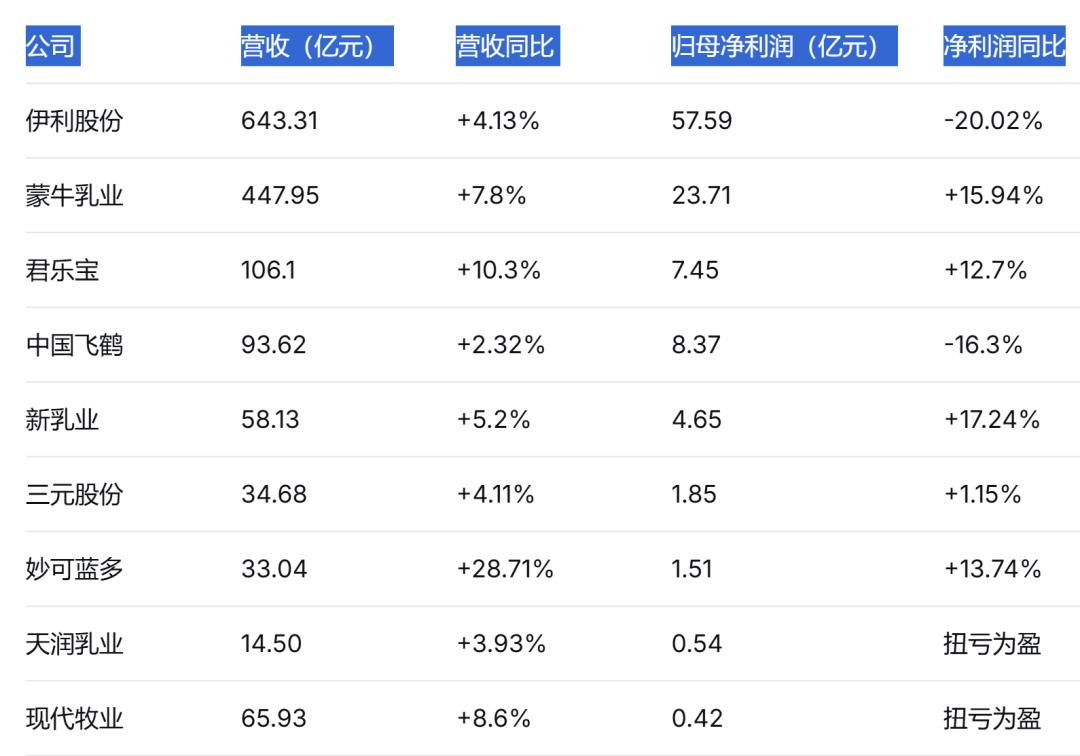
First of all, the revenue of leading enterprises has recovered. Yili's revenue in the first half of the year reached 64.331 billion yuan, a year-on-year increase of 4.13%; Mengniu's revenue reached 44.795 billion yuan, a year-on-year increase of 7.8%, and profit attributable to shareholders reached 2.37 billion yuan, a year-on-year increase of 15.9%.
Against the background that the retail end of the industry is still contracting, the growth of the two national leading enterprises shows that their channels, brands and multi-category portfolios still have strong defensive capabilities.
Yili's net profit attributable to shareholders decreased by 20.02% year-on-year, but we cannot only focus on this number. The company disclosed that the goodwill impairment is a one-time impact that does not involve cash outflow; after excluding this impact, the core operating profit reached 8.38 billion yuan, a year-on-year increase of 10%, and the core operating profit margin rose to 13%. After the exclusion, the financial statements are of higher quality.
Meanwhile, the net cash flow from operating activities reached 9.759 billion yuan, a year-on-year increase of 229.23%. The coexistence of pressure on book profit and improvement of core operations is the complete picture of the financial statements.
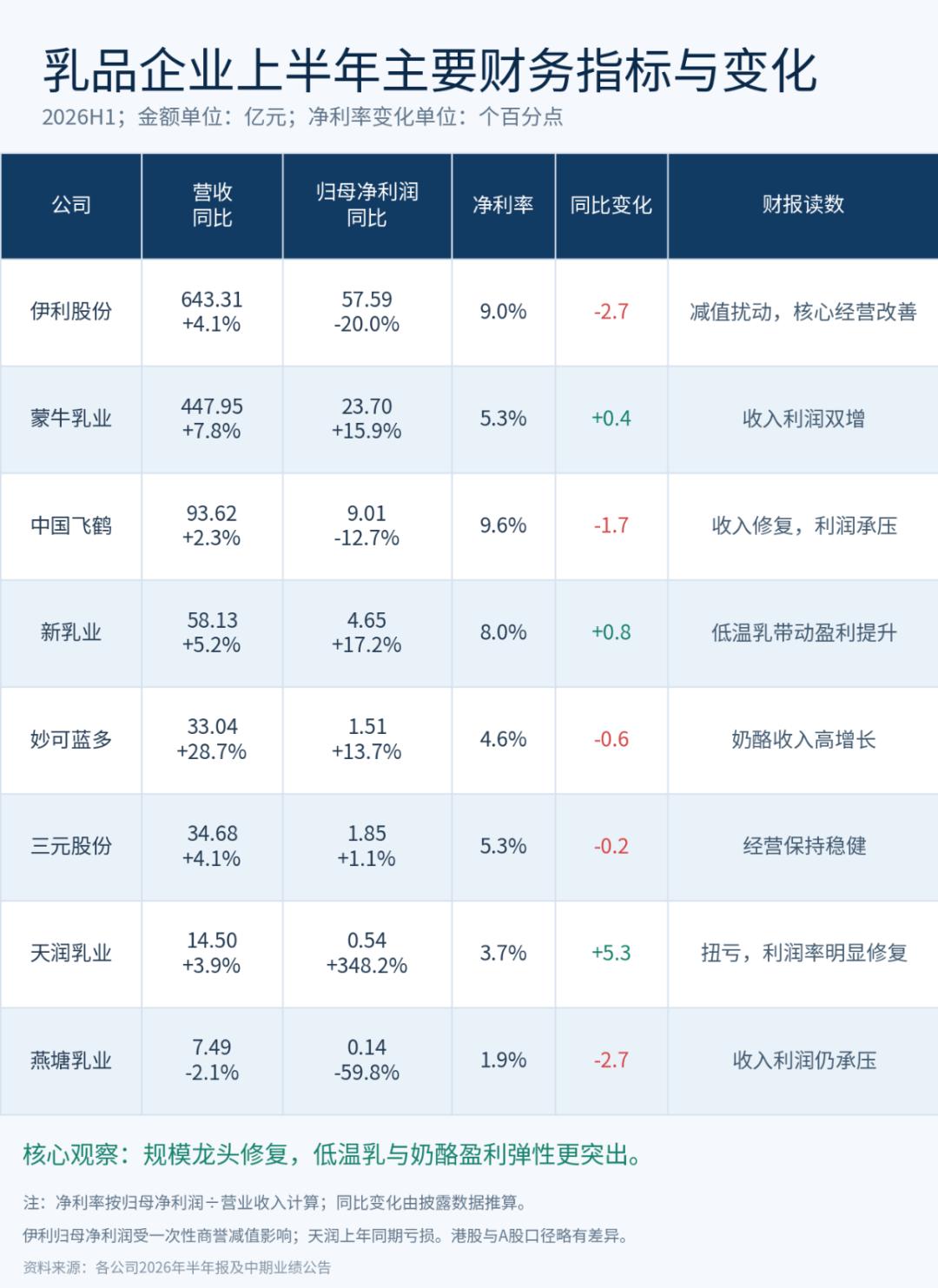
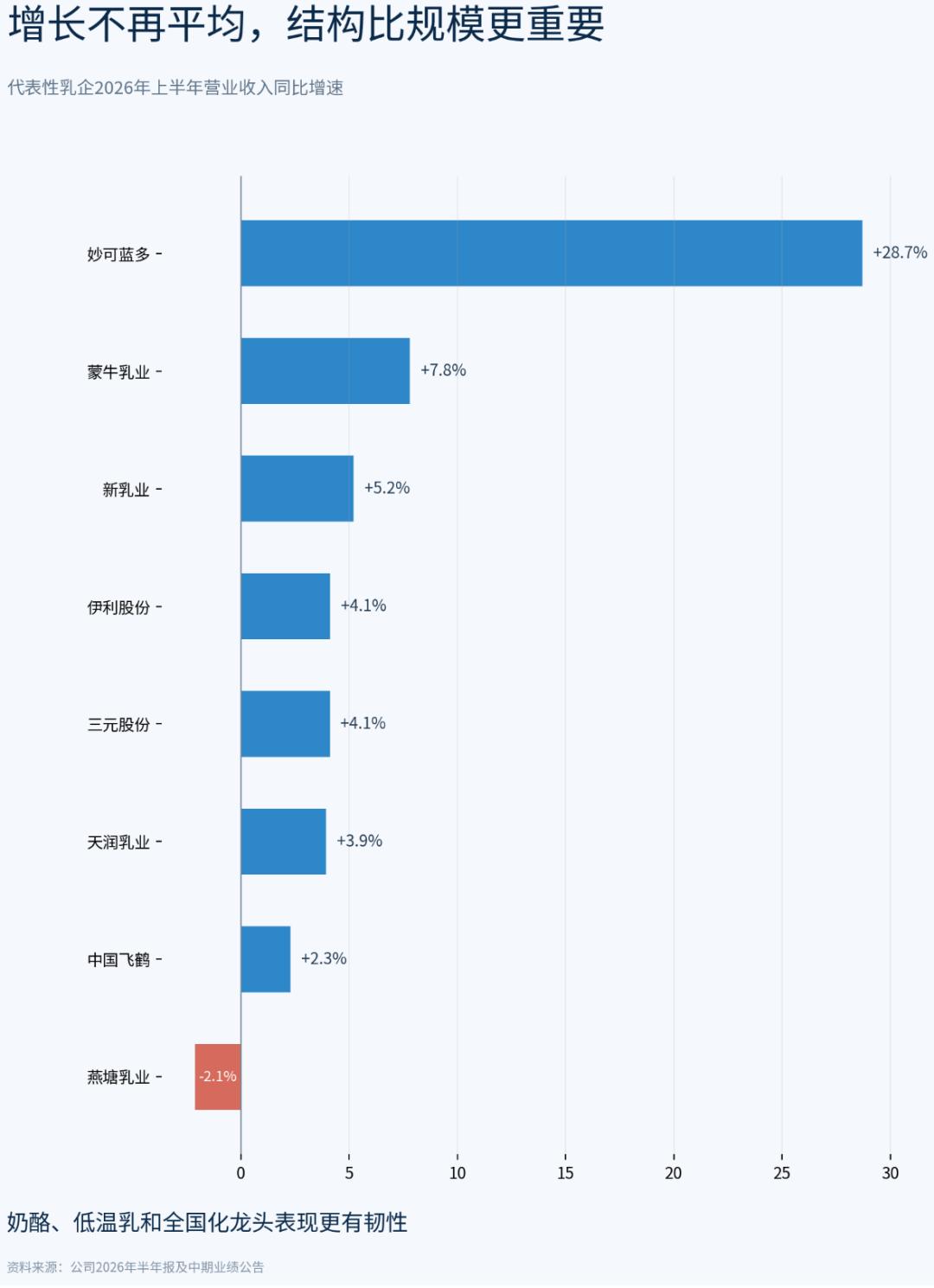
Secondly, segmented categories have achieved faster growth. Milkland's revenue increased by 28.71%, of which the cheese business revenue reached 2.887 billion yuan, a year-on-year increase of 28.95%; New Dairy's revenue increased by 5.20%, and its net profit attributable to shareholders increased by 17.24%.
Cheese has expanded into scenarios of snacks, baking and home meals, while low-temperature dairy products have built differentiation with freshness and high-frequency consumption. They jointly prove that there is no lack of demand for dairy products, but the demand for basic categories is shifting to more specific scenarios.
Thirdly, the most severe period of the upstream sector has shown signs of easing. Youran Dairy's revenue in the first half of the year reached 10.627 billion yuan, a year-on-year increase of 3.3%, and its net profit attributable to shareholders reached 806 million yuan, turning from a loss of 297 million yuan in the same period of last year to profit.
Tianrun Dairy also turned losses into profits. It should be noted that upstream profits are greatly affected by the fair value of biological assets, cow elimination and raw milk prices, and cannot be simply extrapolated, but the reduction of losses and the improvement of cash flow are still important signals of supply-demand rebalancing.
Of course, the recovery is not evenly distributed. Feihe's profit decreased by 12.7% year-on-year, and Yantang Dairy's profit decreased by 59.84%, indicating that the infant formula sector and some regional dairy enterprises are still under pressure from demand, cost and channel adjustment.
The answer given by the semi-annual reports is not "a full industry reversal", but "leading enterprises with competitive advantages are the first to get out of the trough".
The next round of competition will not only focus on normal temperature plain milk
There is still room for growth in China's dairy consumption, but this room can no longer be realized simply by the per capita consumption gap with developed countries. In the past, the industry focused on penetration rate, while in the future, more attention will be paid to consumption frequency, nutritional value and scenario density.
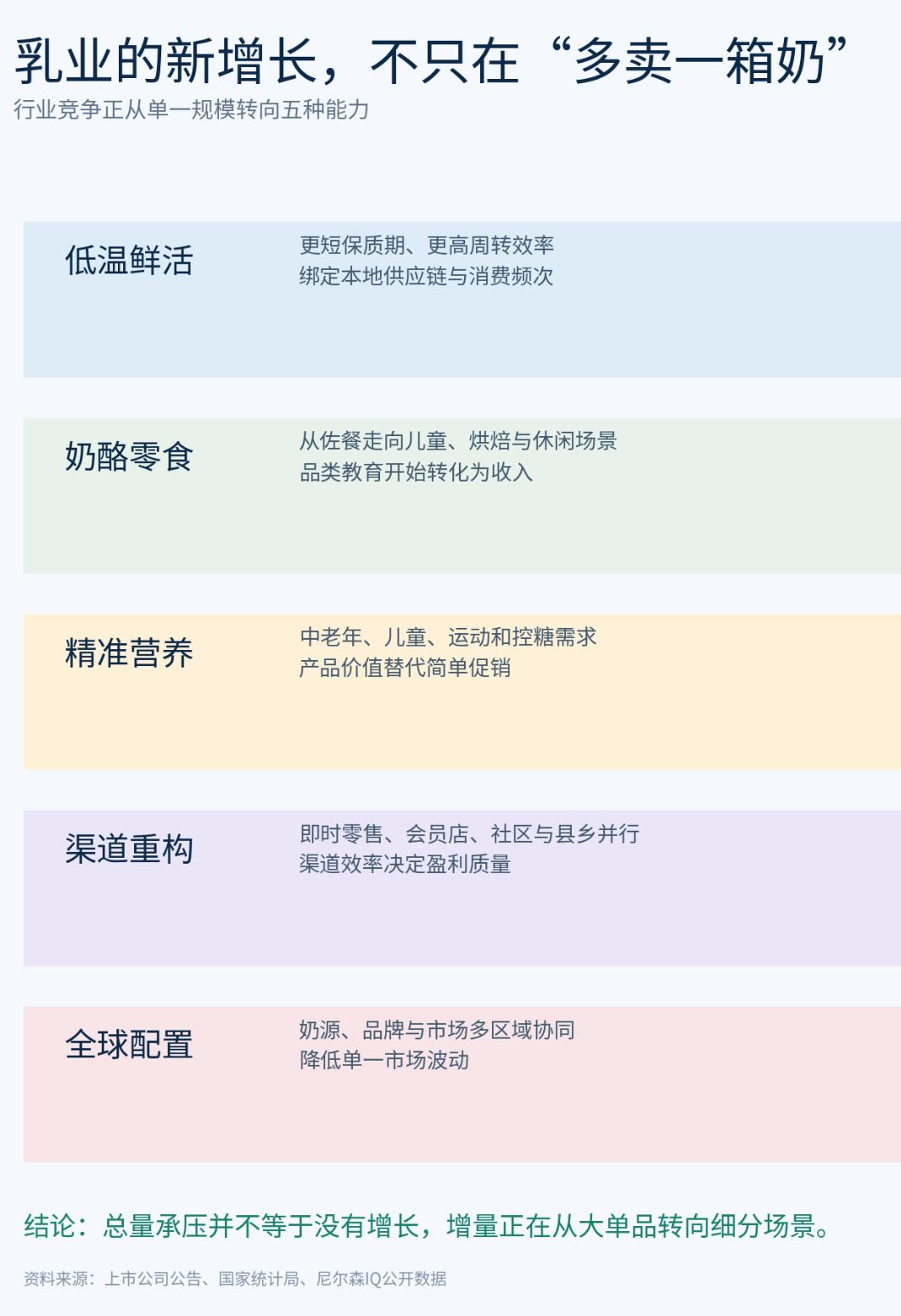
The first growth track is low-temperature fresh dairy products. Low-temperature milk puts high requirements on the supply chain, which in turn forms regional barriers. The enterprise that can make pastures, factories, warehousing and distribution, and stores closer to consumers can obtain more stable repurchase with fresher products.
The second growth track is precise nutrition. Demands for children's growth, middle-aged and elderly bone health, sports supplementation, low sugar and high protein are easier to generate consumers' willingness to pay than the general concept of "one cup of milk a day". The competition in the future is not just adding a new concept, but the combination of formula, scientific research evidence and taste.
The third growth track is cheese and snack-typed dairy products. Cheese is no longer limited to family breakfast, and is entering the fields of baking, catering, children's snacks and instant consumption. The growth of Milkland shows that once the category education crosses the critical point, the revenue elasticity will be significantly higher than that of traditional plain milk.
The fourth growth track comes from channel restructuring. Offline hypermarkets are under pressure, while warehouse clubs, instant retail, community stores and county and rural markets provide new touchpoints. What dairy enterprises really need to do is not to put the same box of milk on more platforms, but to design different specifications, price ranges and consumption reasons for different channels.
Market competition has also evolved from direct confrontation between national brands to multi-level competition.
National leading enterprises rely on normal temperature channels, brand budgets and full-category layout to maintain their scale; regional leading enterprises rely on low-temperature supply chain and urban density to increase profit margins; segmented enterprises enter the market with cheese, functional nutrition and characteristic dairy products; upstream animal husbandry determines its operating quality through per unit yield, feed cost and elimination efficiency.
Price competition will still exist, but low price alone will not be the final outcome. The production, cold chain and distribution of dairy products all have hard costs, and long-term price war will only weaken investment in innovation and milk source quality. A healthier competition pattern is that basic products provide stable cost performance, while high-value products obtain premium with real functions and better experience.
Summary
The dairy industry once believed that as long as the population grew and channels expanded to lower-tier markets, a box of milk could be sold to farther places. Today, this path has become narrower. Consumers have not abandoned dairy products, but they no longer pay easily for similar packaging, vague concepts and repeated promotions.
This is a good thing in turn. It forces enterprises to return to products, to efficiency, and to the most simple value of a glass of milk: safe, nutritious, tasty, and suitable for real life.
The positive significance of this year's semi-annual reports is not that all figures have turned positive, but that growth has begun to have new sources. Leading enterprises restore their operations with scale and global resource allocation, regional dairy enterprises build barriers with low-temperature and local supply chains, cheese and functional nutrition segments make consumption scenarios more detailed, and the upstream sector is also going through the painful but necessary capacity rebalancing.
The dairy industry will not replicate the high-growth era of the past, but it may enter a more solid stage. After the tide recedes, what is really valuable is not just the milk in the pastures, but the ability to differentiate a glass of milk, deliver it to consumers, and make consumers willing to buy it again.
This article is from WeChat Official Account "Investment Banking Circle", written by Senior Sister from Investment Banking, and authorized for release by 36Kr.