Token replaces the trolley case, and credit cards are given an AI makeover.
Faced with the dilemma of credit card business, a quiet AI revolution has swept across the banking industry.
From China Merchants Bank taking the lead in incorporating large model Tokens into new user benefits, to Agricultural Bank of China partnering with Kimi to launch a co-branded credit card, followed by Ping An Bank, SPD Bank, Bank of Communications and many other institutions entering the track one after another, more than 15 banks have released AI-themed credit card products by late August.
Behind this change, is it the helplessness of the credit card industry mired in stock game, or a real subversion of the old model? Can AI credit cards win back users' favor?
01 The AI Credit Card Boom Is Coming
Tokens are replacing suitcases, becoming a new leverage for banks to drive credit card business growth.
On June 12, 2026, China Merchants Bank took the lead in launching the American Express Engineer Credit Card, incorporating large model Tokens into the first swiping gift for new users, making it the first credit card in China equipped with Token benefits. New users who meet the consumption requirements can get the MiniMax computing power benefit package, with a maximum monthly usage of 1.8 billion Tokens for the M3 model.
Shortly afterwards, a number of banks joined this "AI benefit war" through different paths:
One-time Token gifting route: For the engineer group, China Merchants Bank offers three optional AI benefit packages for qualified new users.
Consumption for computing power route: Agricultural Bank of China cooperates with Kimi, allowing cardholders to directly redeem Kimi membership and computing power quota with their daily consumption points; Ping An Bank AI Intelligent Computing Card realizes "computing power accumulation through card use", the more you consume, the more computing power points you get.
Reducing AI usage cost route: SPD Bank "Elite Tech Credit Card" provides Alibaba Cloud product coupons and a maximum of 3 billion Qwen large model Token computing power subsidies.
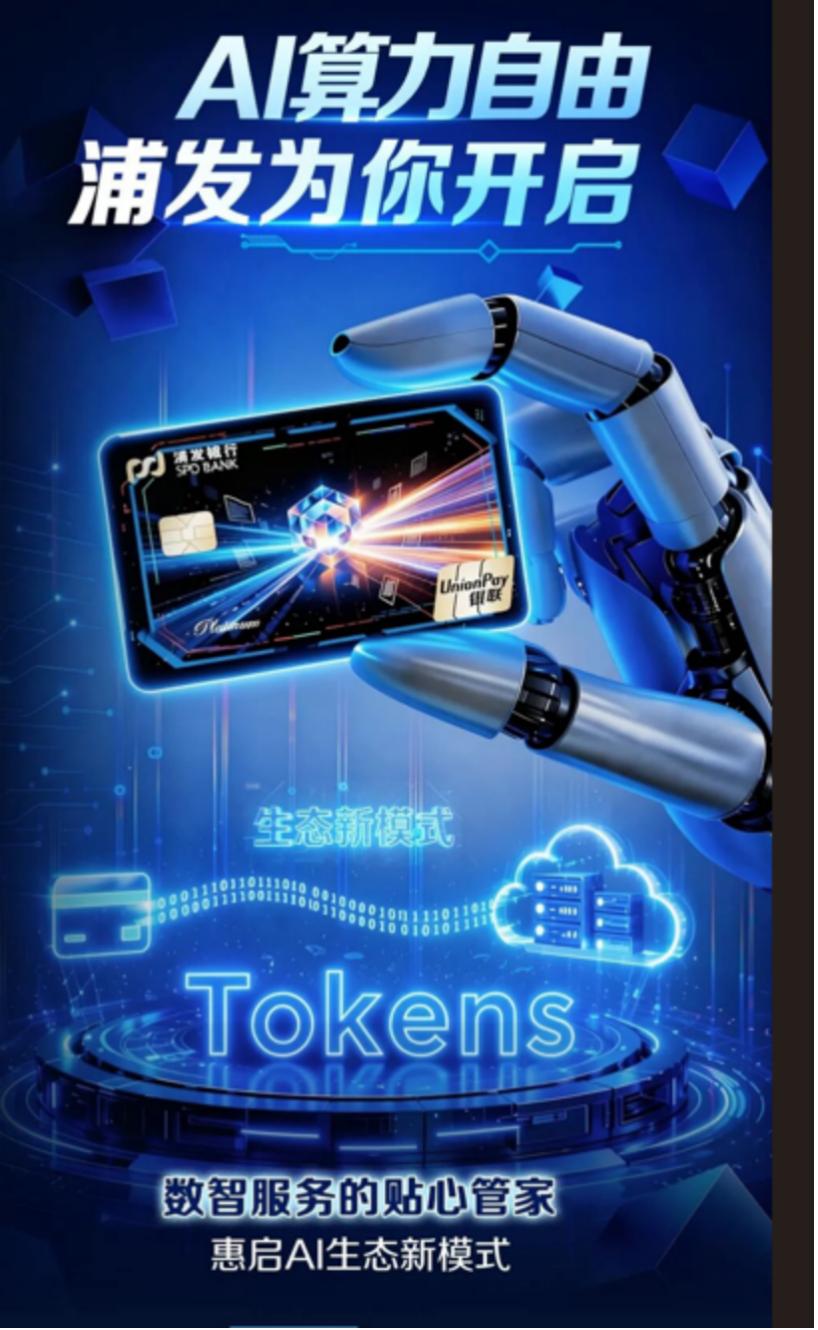
On July 24, China UnionPay joined hands with Ping An Bank, Bank of Communications, SPD Bank and other institutions to hold a grand intelligent agent bank card issuance ceremony and Token benefit cooperation signing. All major state-owned banks and leading joint-stock banks including Industrial and Commercial Bank of China, Agricultural Bank of China, Bank of China, China Construction Bank, Bank of Communications, Postal Savings Bank of China and China Merchants Bank participated in the event.
The booming development of AI credit cards is forced by the situation under the three-year continuous contraction cycle of the industry.
Data from the People's Bank of China shows that by the end of the first quarter of 2026, the number of active credit cards and integrated loan cards nationwide has reached 687 million, a decrease of more than 120 million from the historical peak of 807 million in the third quarter of 2022, and the overall scale has fallen back to the level of 2018.
"Banks are now facing deep involution under the stock game. Traditional benefits are severely homogenized, and it is difficult to impress young people by 'giving suitcases' anymore," a credit card industry practitioner said bluntly.
At the same time, Tianyancha disclosed that the net interest margin of commercial banks has dropped to a historical low of 1.4%.
Against this background, the traditional extensive development idea of credit cards is no longer sustainable. In 2025, many banks closed more than 60 credit card branches, and some banks abandoned the assessment of card issuance volume and turned to quality indicators such as customer structure and transaction activity.
However, it cannot be ignored that AI credit cards, which are precisely targeted at "new tech elites", are by no means inclusive products available to everyone.
By checking the card application regulations of various banks, most AI benefits are set with pre-conditions such as education background, income and age.
Taking Agricultural Bank of China Zunran Platinum Card (Smart AI Edition) as an example, relevant reports show that card applicants need to meet the requirement of social security base of more than 8,000 yuan or annual income of 200,000 to 300,000 yuan. Within two natural months after the card is approved, the accumulated consumption must reach 6 transactions and 5,888 yuan to receive the opening gift.
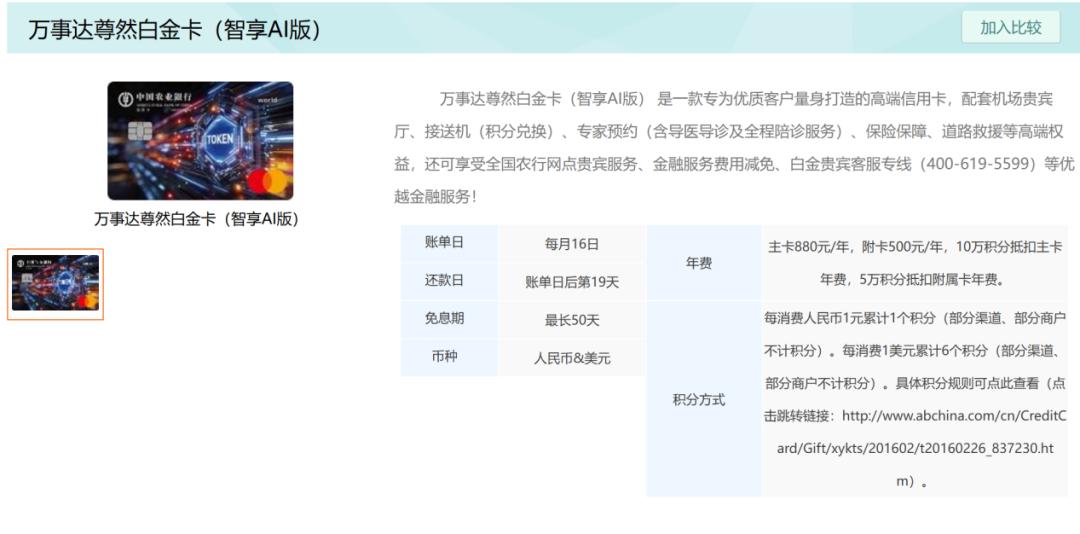
The "high threshold" reflects the issuer's intention of targeted customer screening and selecting the best from the mass — groups that frequently use large models such as AI developers, scientific researchers and content creators are exactly the "new tech elites" that banks are eager to acquire.
"Such users are not only high-income groups, but also represent high-quality assets under the digital economy, and their demand for productivity tools provides scenarios for banks to deeply bind with them," said Dong Ximiao, chief economist of China Merchants Union Consumer Finance.
02 Gimmick or Real Innovation?
Although banks have made high-profile layouts collectively, AI credit cards are "lukewarm" at terminal outlets.
After visiting a number of bank outlets in Beijing as a customer, Qicaijing found that "many customers still prefer physical gifts such as suitcases, rice cookers and bicycles when choosing gifts". A lobby manager of a joint-stock bank branch admitted that few customers take the initiative to consult about AI credit cards, and even fewer people apply for them.
Some banks set AI benefits as "only available for new users", so existing old users cannot enjoy them.
In other words, AI credit cards are no different from the old ones in essence, and their benefits are essentially "one-time customer acquisition subsidies", which is the common customer acquisition routine used by banks.
In fact, when banks cooperate with AI manufacturers, they usually "only need API docking to complete the benefit distribution". The "light asset, easy to replicate" gameplay has led to a flood of participants in the industry, making credit cards easily return to the old path of "competing on subsidies and rolling out benefits".
In addition, the practicality of AI credit card computing power benefits has obvious circle limitations for ordinary public users. A post-90s white-collar worker in Haidian, Beijing told Qicaijing, "I am not in a technical R&D position. The large model can meet my daily office needs, and I basically don't use Tokens in my daily life."
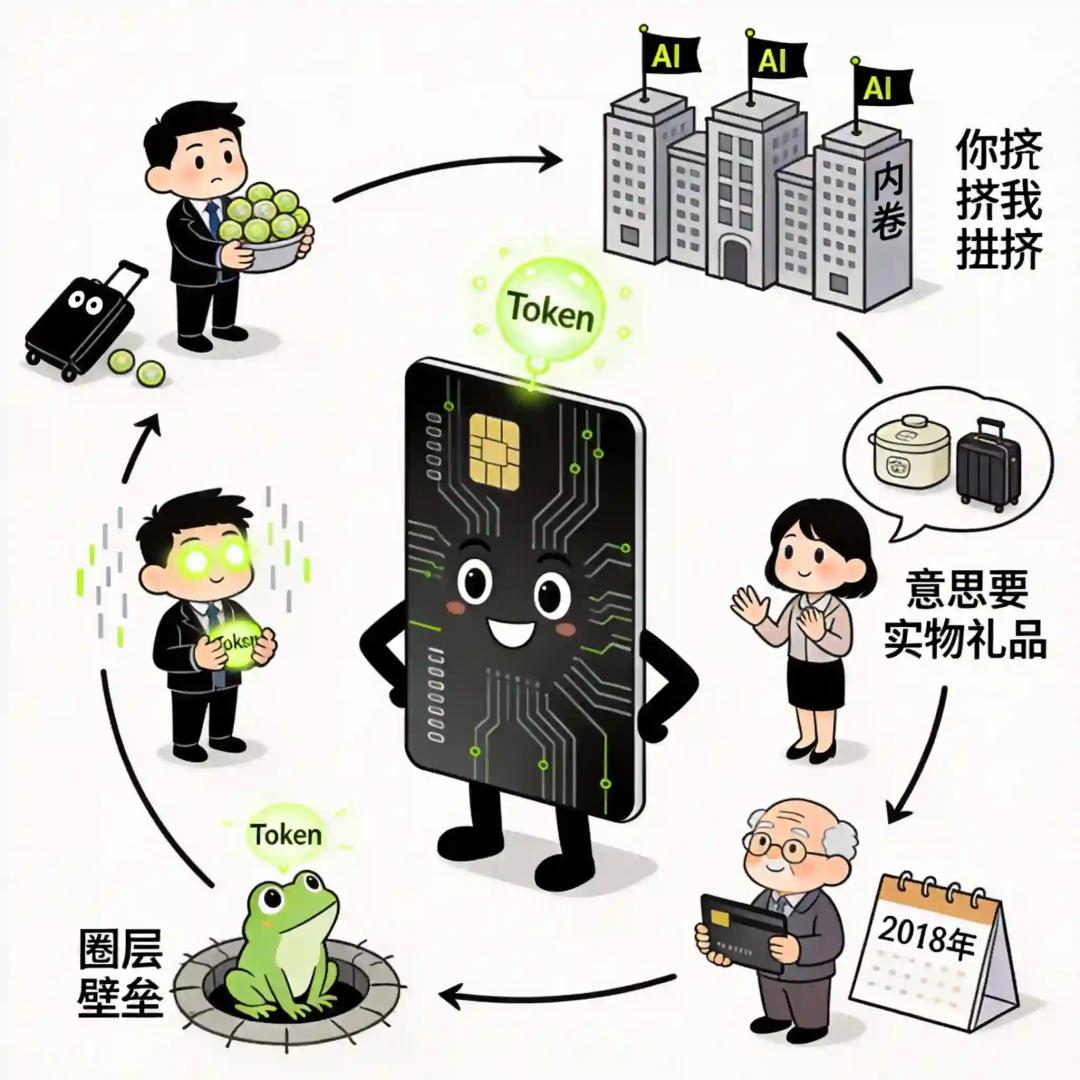
▲ Image source / AI-generated image
However, there is no consistent view in the industry on whether AI credit cards are innovation or gimmick at present.
Optimists believe that this is the correct direction for credit cards to upgrade from "life consumption type" to "productivity empowerment type". Just as Tian Lihui, dean of the Financial Development Research Institute of Nankai University, compares Tokens to "electricity bills or fuel bills in the AI era", "what you get from swiping cards for consumption is not consumer goods, but means of production that you really need, which can help you write code, design, analyze data and generate content."
Xue Hongyan, special researcher of Suning Bank, pointed out that people with high-frequency demand for AI computing power are mostly concentrated in high value-added industries, with rising income expectations and in the period of career growth. "Their dependence on computing power has a certain rigidity, which means that the activity of such credit card accounts may get more stable underlying support."
The cautious side believes that current AI credit cards have not jumped out of the traditional customer acquisition logic. Wang Pengbo, senior analyst of the financial industry at Bocom Consulting, said, "Such benefit cards are not pure gimmicks, and they do meet the AI usage needs of some young groups, but the underlying logic is still customer acquisition and activity improvement through benefits, which is no different from cashback on consumption."
He further pointed out that the replication threshold of Token benefits is low, it is difficult to form user stickiness, and it cannot fundamentally alleviate the problem of young customer churn.
On the whole, AI credit cards are still in the initial stage of following the trend and trying new things, and it is too early to reverse the industry's downward trend by relying on this.
03 Conclusion
In the view of Qicaijing, the real subversive imagination space for AI credit cards to stand on the "trend" does not lie in "giving Tokens by swiping cards", but in AI changing the underlying logic of payment and financial services. This requires banks to integrate AI into core business processes such as credit approval, intelligent risk control and user operation, rather than just taking Tokens as a customer acquisition prop.
But in any case, the concentrated launch of AI credit cards at least shows one thing: banks have realized that they can no longer impress young people by "giving suitcases". From "consumption rebate" to "productivity empowerment", the courage to seek change itself is worthy of recognition.
But Tokens are just an appetizer after all. The real "winning move" is whether banks can complete the leap from marketing innovation to service capability reconstruction with the help of AI.
If Tokens are only regarded as a new type of coupon, this AI credit card boom will probably repeat the old story of co-branded cards "issued in batches, left unused in batches" in the past.
This article is from the WeChat official account "Qicaijing", written by Wu Yi, and released with authorization from 36Kr.